Bite-sized Insights about
 
Providing you with data-based insights about things happening around you.
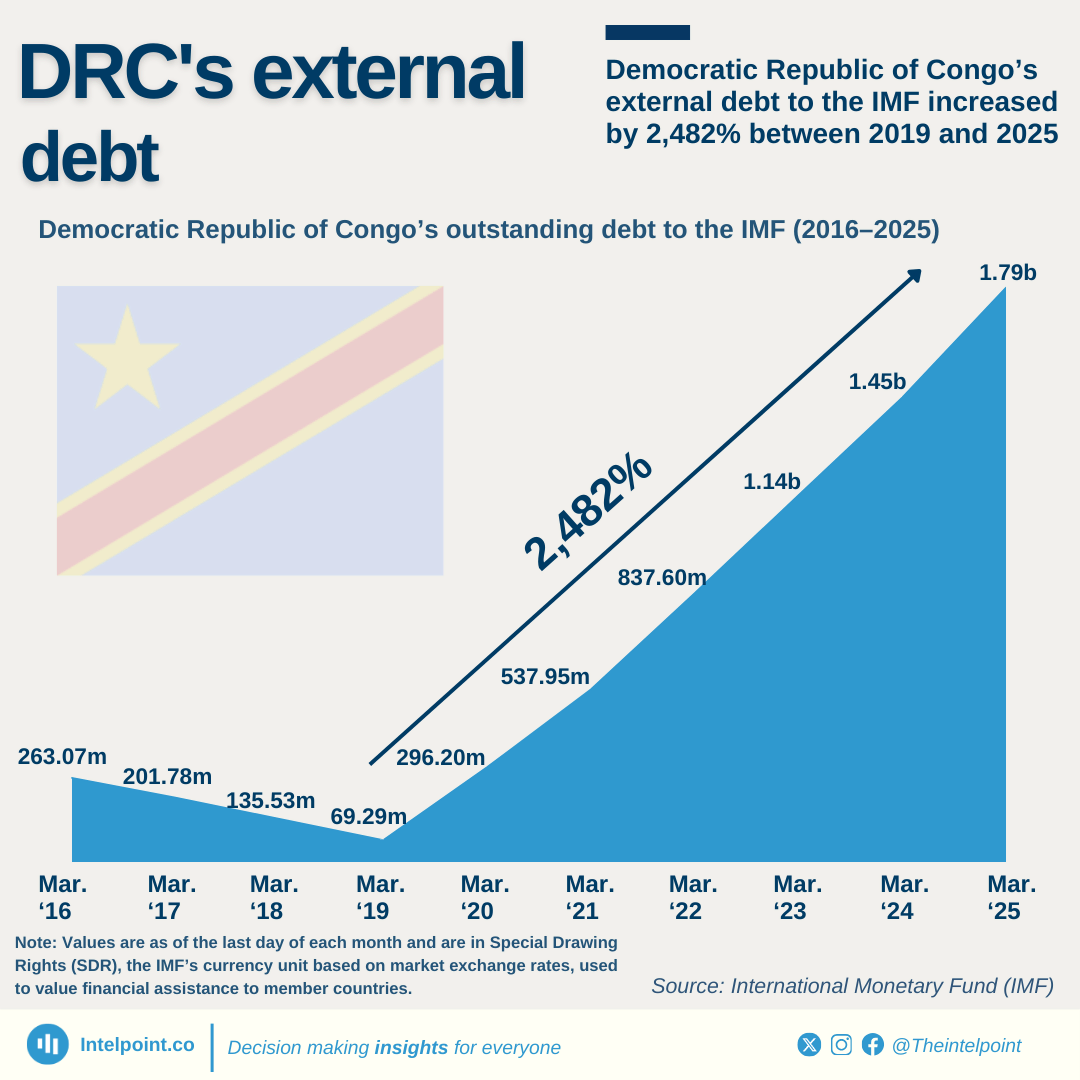
Democratic Republic of Congo’s external debt to the IMF increased by 2,482% between 2019 and 2025
Key Takeaways:
  • The Democratic Republic of Congo (DRC) reduced its external debt significantly from SDR 263 million in 2016 to SDR 69.3 million by 2019.
  • A sharp reversal occurred in 2020, with debt surging by 327% within a single year, from SDR 69.3 million in 2019 to SDR 296.2 million.
  • Over the decade from 2016 to 2025, the country’s debt increased by 580%, reaching SDR 1.79 billion by March 2025.
  • From 2020 to 2025, the DRC has accumulated over SDR 1.49 billion in new debt.

Naira launched with 5 notes in 1973, evolving through various shifts to 3 high-security designs by 2022
  • Nigeria’s currency has undergone 10 key shifts; from note introductions to redesigns and a digital launch.
  • Between 1999 and 2005, four new notes; ₦100 to ₦1,000, were introduced in response to inflation.
  • The ₦200, ₦500 & ₦1,000 notes, which dominate in circulation by value, were revamped with high-security features.
  • In 2021, Nigeria launched the eNaira, making it the first African country with a Central Bank Digital Currency.

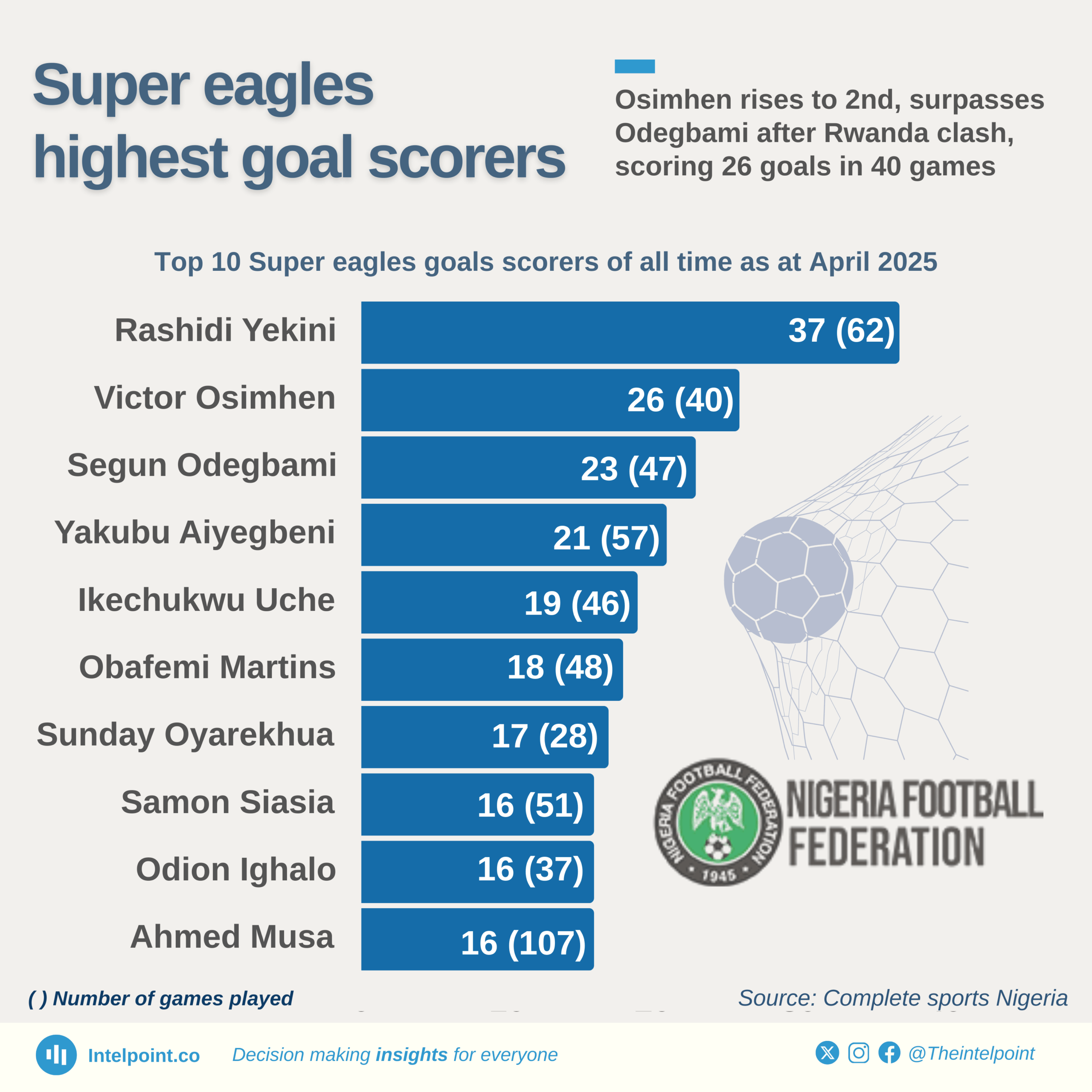
Osimhen rises to 2nd, surpasses Odegbami after Rwanda clash, scoring 26 goals in 40 games
  • Rashidi Yekini remains Nigeria’s all-time top scorer with 40 goals in 58 appearances — a record that has stood for over two decades.
  • Victor Osimhen now ranks 2nd, overtaking Segun Odegbami by scoring 26 goals in just 40 matches.
  • Segun Odegbami, now 3rd, recorded 23 goals in 46 appearances during his time with the national team.
  • Among the top scorers, Osimhen has the best goals-per-game ratio, scoring 0.65 goals per game, compared to Yekini’s 0.69 and Odegbami’s 0.50.

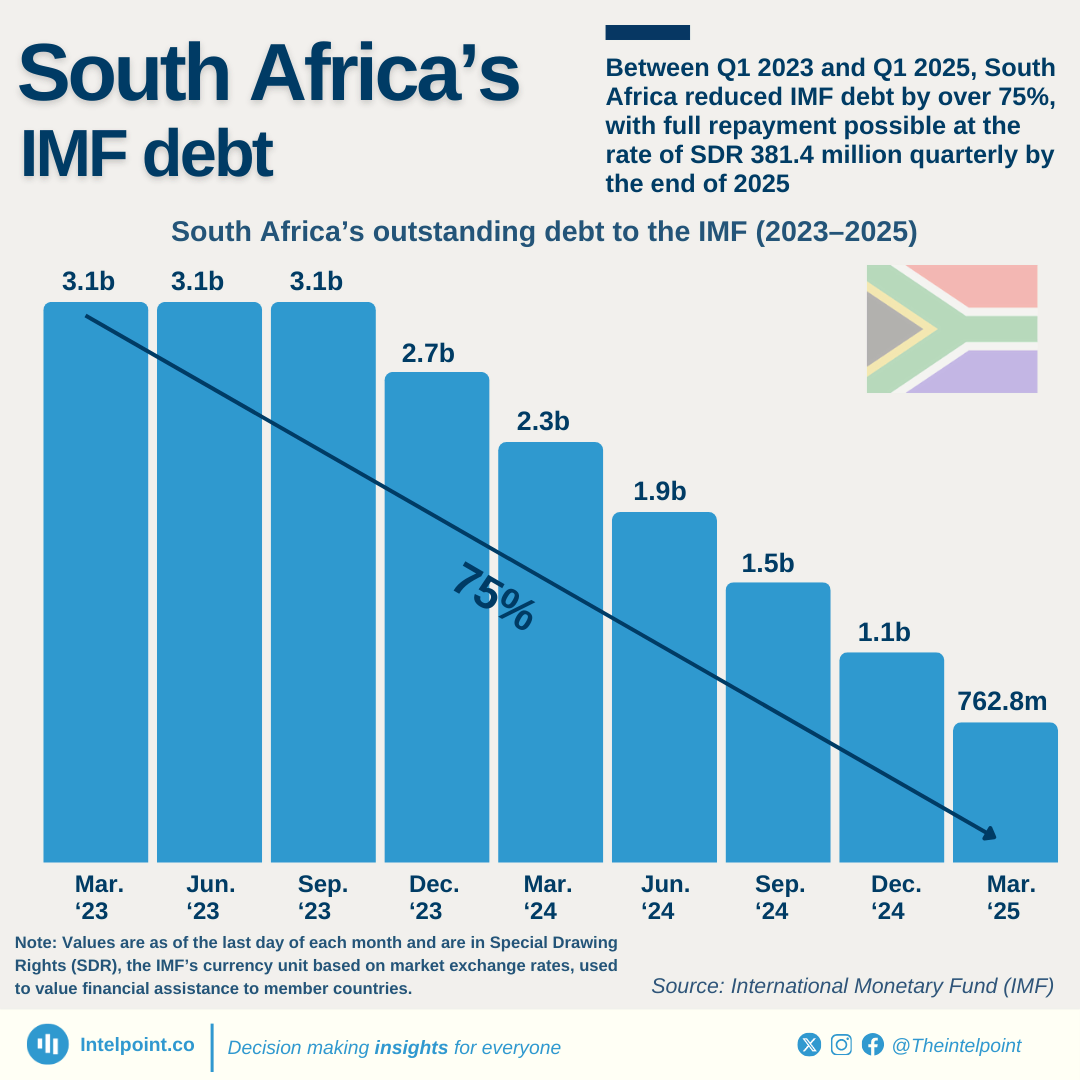
Between Q1 2023 and Q1 2025, South Africa reduced IMF debt by over 75%, with full repayment possible at the rate of SDR 381.4 million quarterly by the end of 2025
Key Takeaways:
  • South Africa’s outstanding debt to the International Monetary Fund (IMF) decreased from SDR 3.05 billion in March 2023 to SDR 762.8 million by March 2025.
  • The debt level remained unchanged at SDR 3.05 billion through the first three quarters of 2023.
  • Starting in December 2023, South Africa began making consistent quarterly repayments of SDR 381.4 million.
  • This trend demonstrates steady progress in debt reduction and a strengthened commitment to fiscal discipline.
  • The country is potentially on track for full repayment of its debt by the end of 2025.

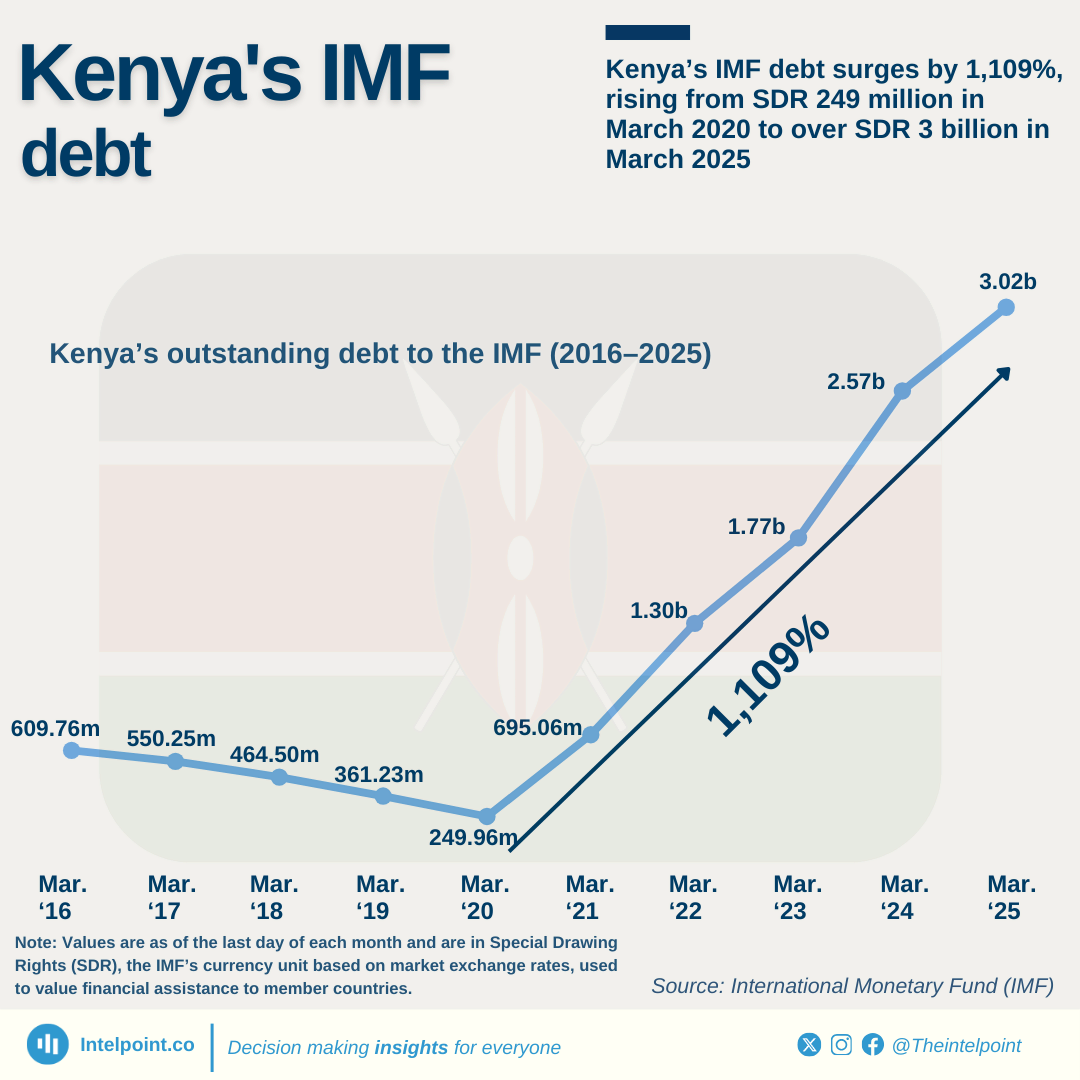
Kenya’s IMF debt surges by 1,109%, rising from SDR 249 million in March 2020 to over SDR 3 billion in March 2025
Key Takeaways:
  • Between 2016 and 2020, Kenya's debt to the International Monetary Fund (IMF) declined steadily by 59%, from SDR 609.8 million to SDR 249.9 million.
  • This downward trend reversed dramatically after 2020, with public debt rising to SDR 3.02 billion by March 2025.
  • The most significant annual increase occurred between 2020 and 2021, when debt jumped by 178%.
  • The lowest recorded debt level during the study period was in 2020, at the height of the COVID-19 pandemic, when it fell to approximately SDR 250 million.
  • Kenya’s IMF debt grew more than elevenfold (1,109%) from its 2020 low to its 2025 peak.

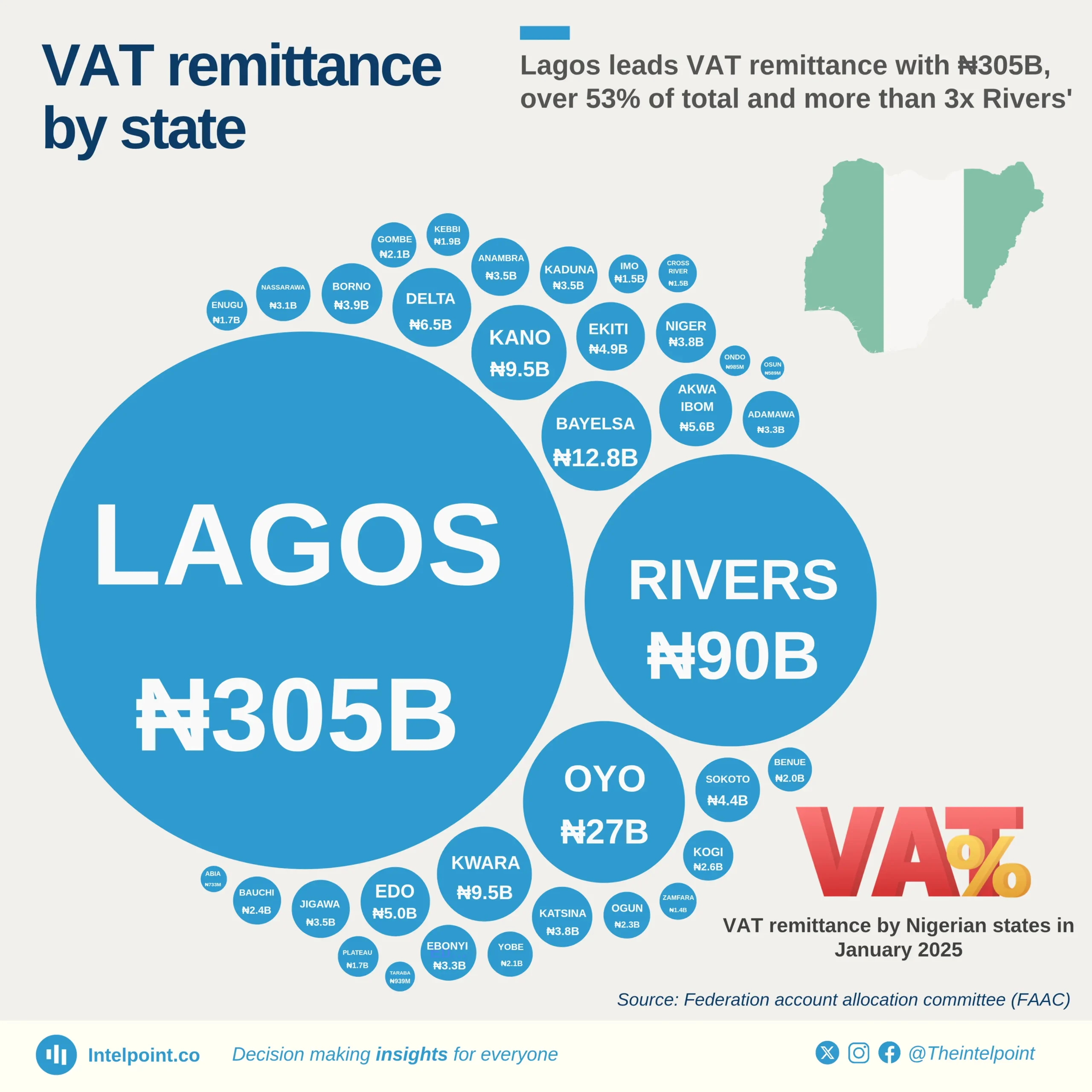
Lagos leads VAT remittance with ₦305B, over 53% of total and more than 3x Rivers'
  • Lagos State contributed ₦305B in VAT, making up over 53% of the national total and more than three times that of any other state.
  • Rivers (₦90B) and Oyo (₦27B) followed Lagos as the second and third highest contributors, highlighting a steep drop after the top state.
  • Only a few states, including Bayelsa, Kano, Kwara, and Edo, remitted above ₦5B, showing a highly uneven distribution of VAT contributions.
  • Over 8 states, such as Kebbi, Osun, Imo, and Zamfara, contributed less than ₦2B each, indicating minimal VAT activity in many parts of the country.

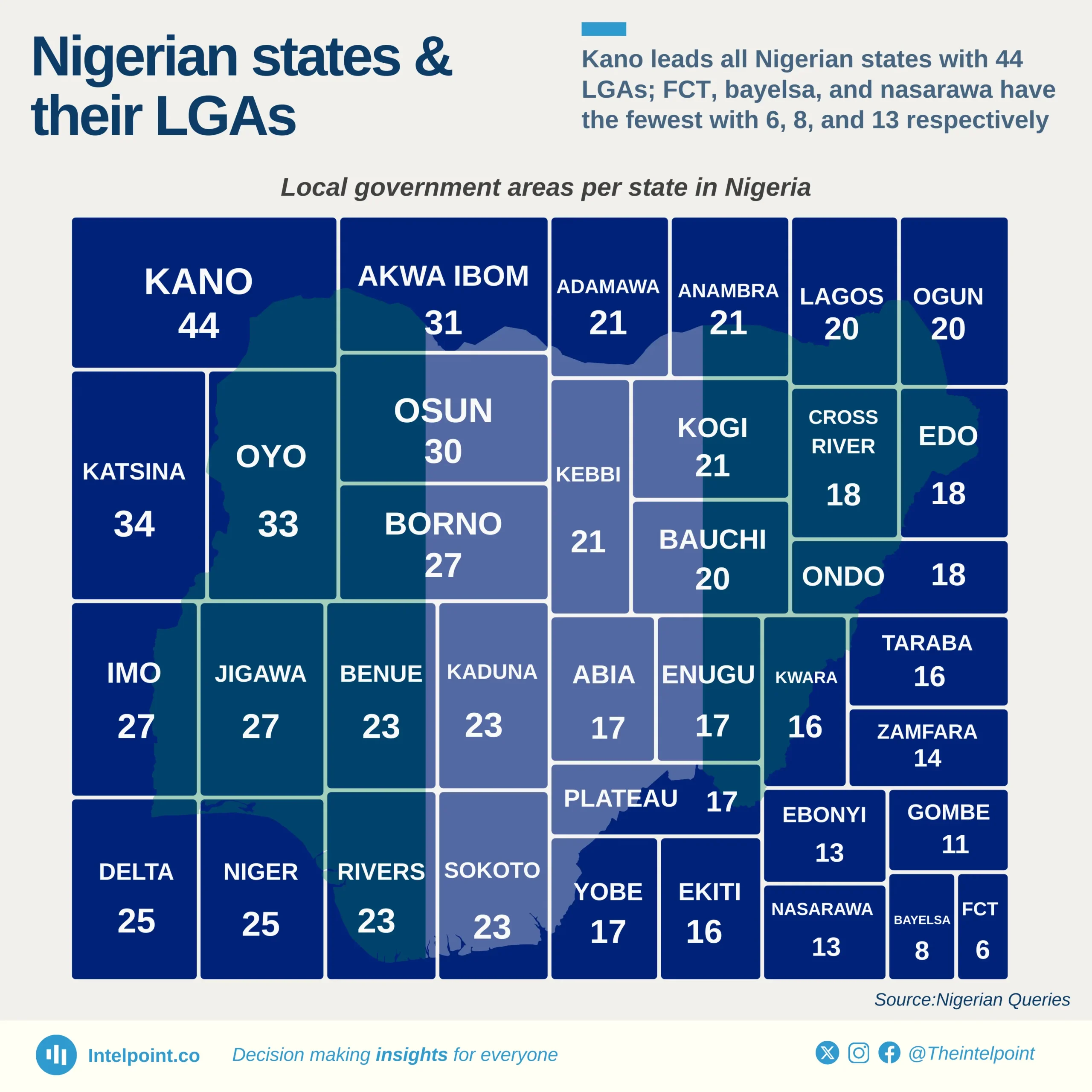
Kano leads all Nigerian states with 44 LGAs; FCT, Bayelsa, and Nasarawa have the fewest with 6, 8, and 13 respectively
  • Kano State has the highest number of LGAs in Nigeria, with 44, far exceeding the national average of 21 LGAs per state.
  • Bayelsa, Nasarawa, and the FCT have the fewest LGAs, recording 8, 13, and 6 respectively, despite varying population sizes and landmass.
  • Northern states dominate the upper tier of the LGA count, with Katsina (34), Oyo (33), and Jigawa (27) all ranking among the top.
  • Southern states tend to have fewer LGAs, with Lagos and Ogun, two highly urbanised states, having just 20 LGAs each, hinting at a denser governance structure per area.

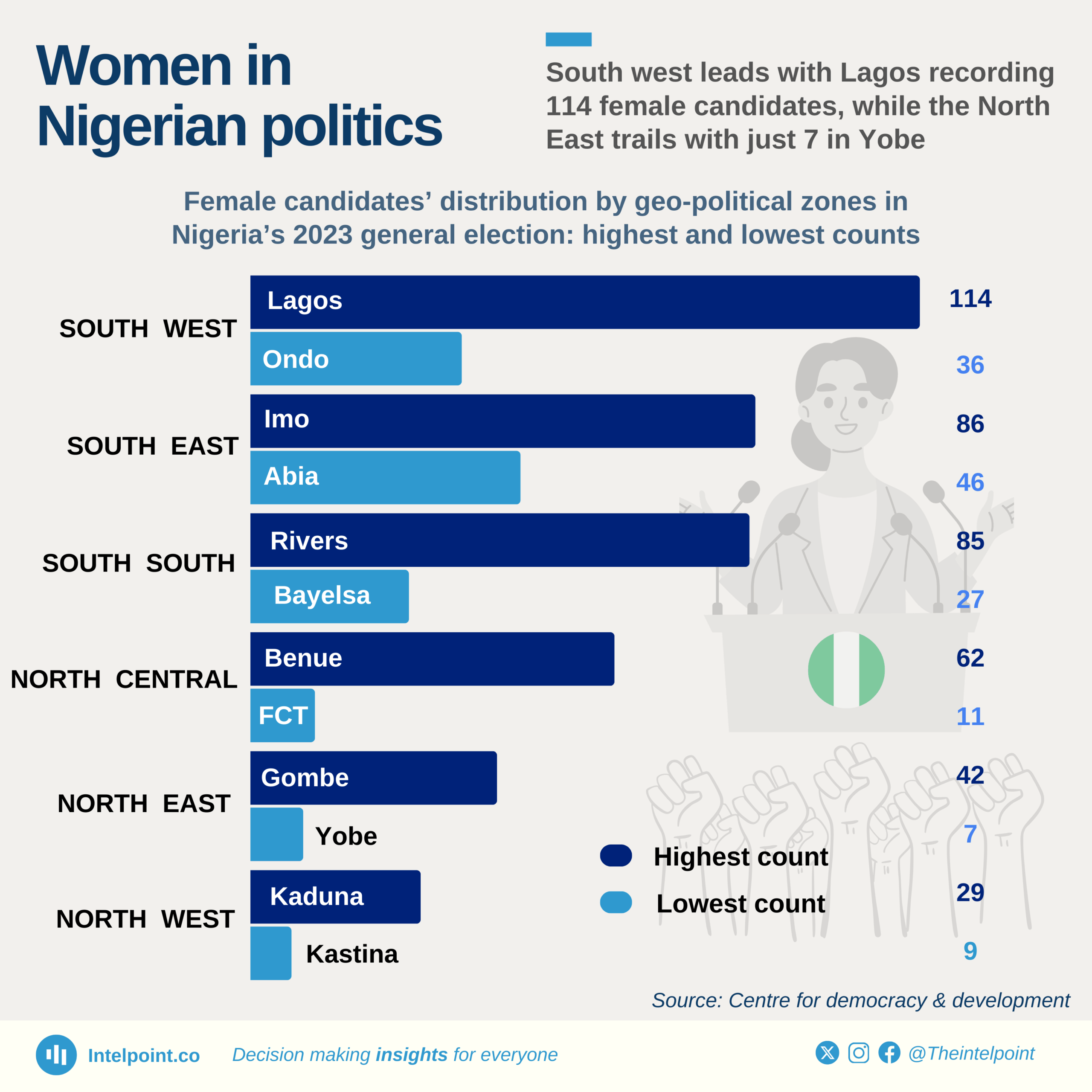
South west leads with Lagos recording 114 female candidates, while the North East trails with just 7 in Yobe
  • Lagos had the highest female representation in Nigeria’s 2023 elections, with 114 female candidates, more than any other state.
  • Yobe recorded the lowest, with just 7 female candidates, highlighting a wide disparity in representation across regions.
  • The South East and South South zones recorded some of the strongest numbers overall, with Imo (86) and Rivers (85) nearly matching Lagos.
  • The South West led overall in female candidate numbers, while the North East trailed, with its highest (Gombe – 42) still lower than other zones’ peaks.
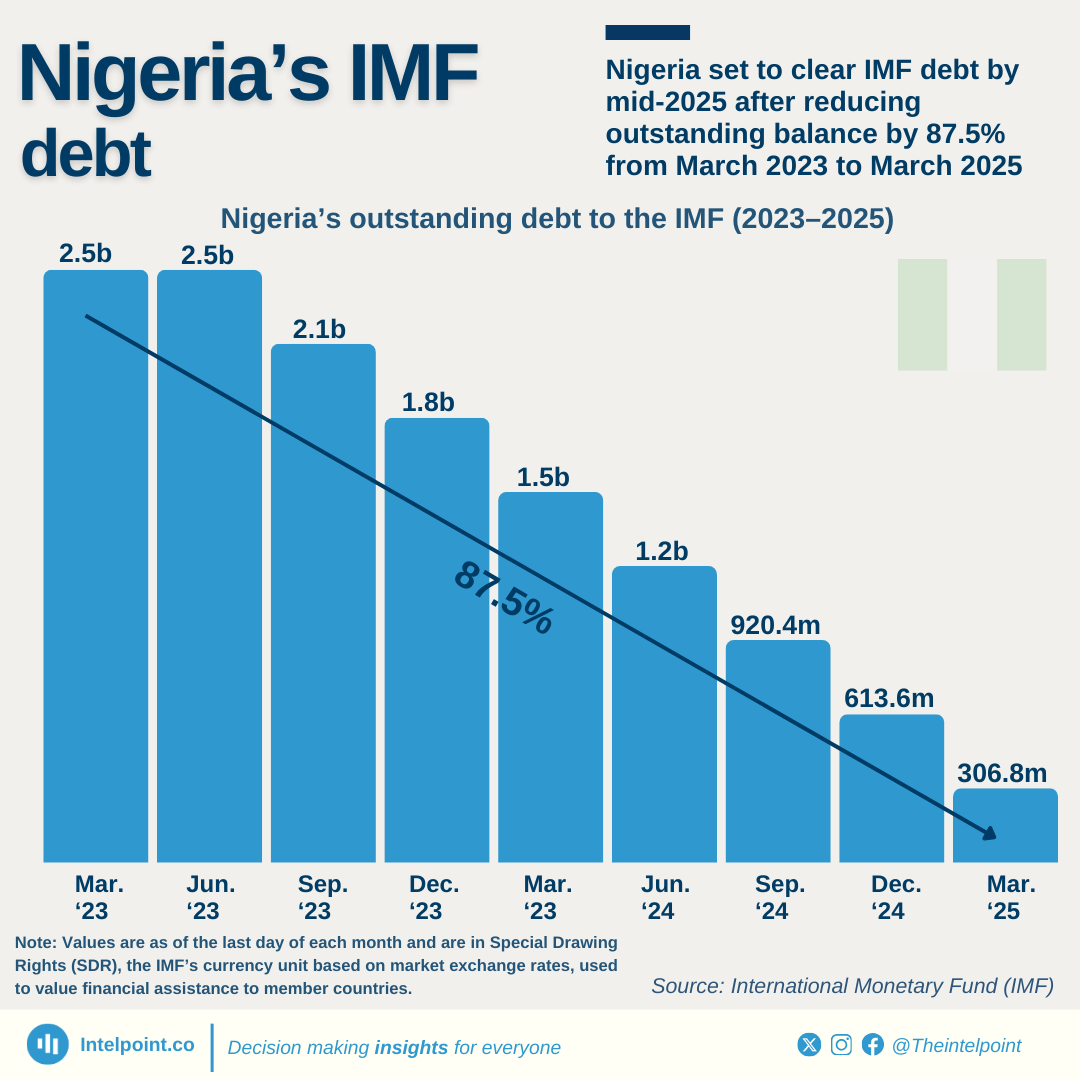
Nigeria set to clear IMF debt by mid-2025 after reducing outstanding balance by 87.5% from March 2023 to March 2025
Key Takeaways:
  • Nigeria’s outstanding debt to the IMF has reduced from SDR 2.45 billion in March 2023 to SDR 306.81 million by March 2025.
  • The country has maintained a consistent quarterly repayment pattern, averaging SDR 306.8 million.
  • This steady repayment trend reflects Nigeria’s commitment to managing its external obligations.
  • At the current repayment rate, Nigeria is positioned to fully clear its IMF obligations by mid-2025.

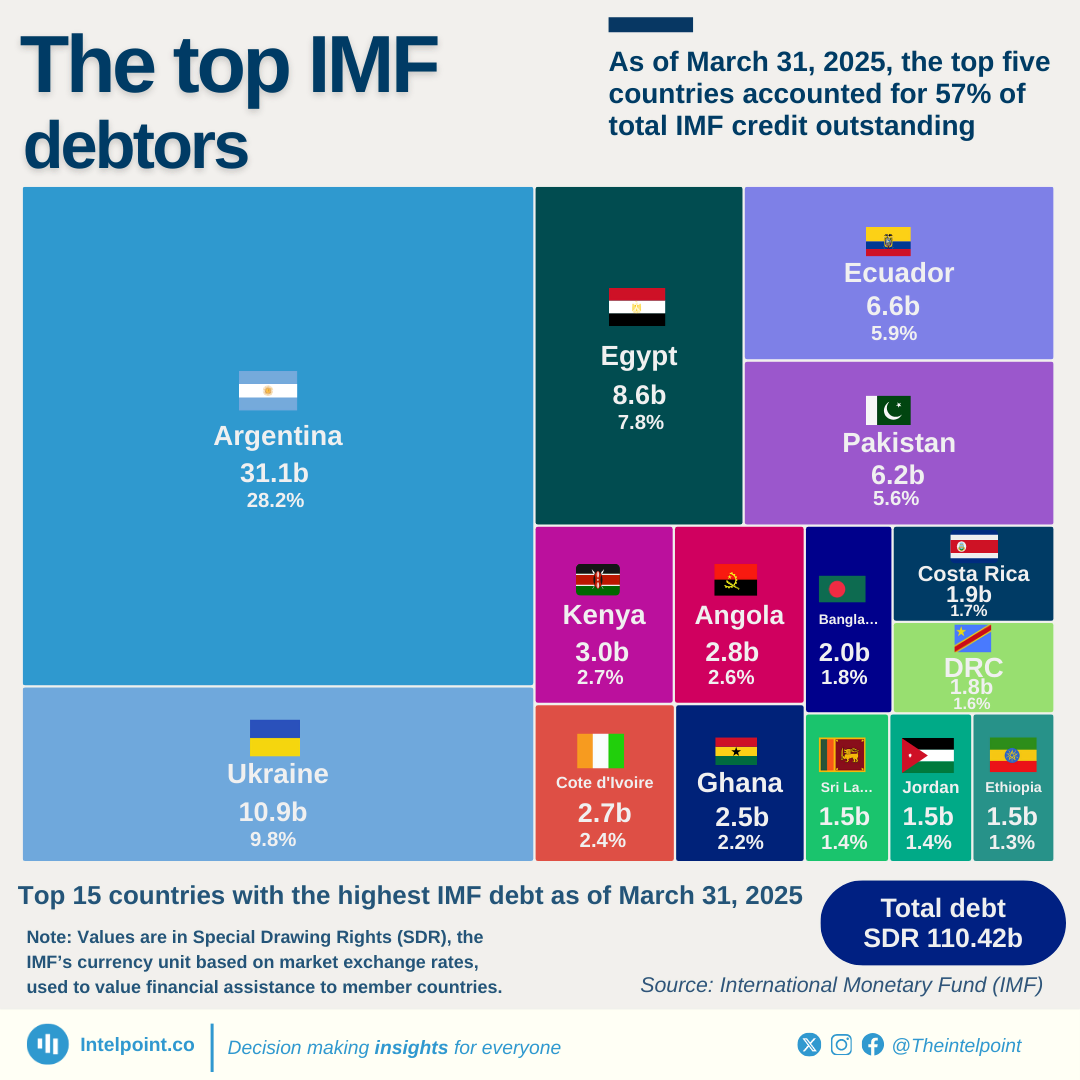
As of March 31, 2025, the top five countries accounted for 57% of total IMF credit outstanding
Key Takeaways:  
  • Argentina tops the list with SDR 31.1 billion in outstanding IMF credit.
  • The top three borrowers, Argentina, Ukraine, and Egypt, together hold over 45% of total IMF credit.
  • All 15 countries on the list have outstanding credit of at least SDR 1.4 billion.
  • African nations such as Kenya, Angola, Ghana, and Ethiopia rank among the top 15 IMF debtors.
  • The top 10 countries alone account for more than two-thirds of the IMF’s total outstanding credit.

1 … 10 11 12 13 14 … 17

Can’t find what you’re looking for? Please fill the form below
Contact Form Demo
SIGN UP TO OUR NEWSLETTER
Get periodic updates about the African startup space, access to our reports, among others.
Subscribe Here
Subscription Form

A product of Techpoint Africa. All rights reserved