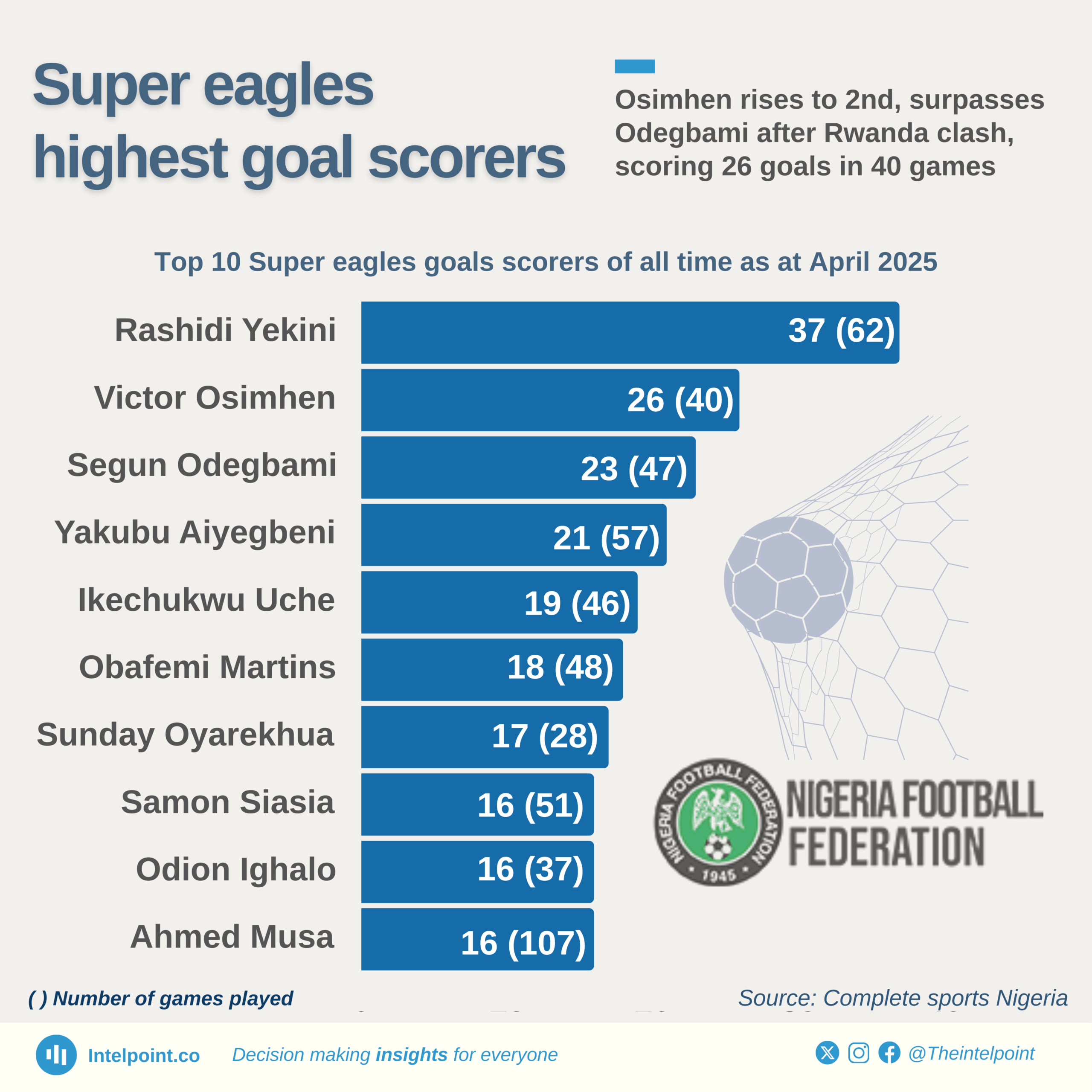
Osimhen rises to 2nd, surpasses Odegbami after Rwanda clash, scoring 26 goals in 40 games

Key Takeaways

  • Rashidi Yekini remains Nigeria’s all-time top scorer with 40 goals in 58 appearances — a record that has stood for over two decades.
  • Victor Osimhen now ranks 2nd, overtaking Segun Odegbami by scoring 26 goals in just 40 matches.
  • Segun Odegbami, now 3rd, recorded 23 goals in 46 appearances during his time with the national team.
  • Among the top scorers, Osimhen has the best goals-per-game ratio, scoring 0.65 goals per game, compared to Yekini’s 0.69 and Odegbami’s 0.50.

Nigeria’s top scorer chart has a new look after the 2026 World Cup qualifier against Rwanda. Rashidi Yekini still leads the all-time list with 40 goals in 58 games, a legendary feat untouched since the 1990s. But Victor Osimhen is closing in fast. With his latest goal, Osimhen now has 26 goals in 40 appearances, moving past Segun Odegbami, who scored 23 in 46.

What sets Osimhen apart is his efficiency: his 0.65 goals-per-game ratio places him just behind Yekini’s 0.69, making him the most clinical finisher Nigeria has seen in recent years. The race for Nigeria’s all-time top scorer is heating up and history could be rewritten soon.
Source:

Complete sports Nigeria

Period:

2025
HTML code to embed chart
Want a bespoke report?
Reach out
Tags
Related Insights

Nigeria has produced 7 African Player of the Year winners in 33 years
  • Nigerian players have won the award seven times from 1992 to 2025.
  • Ivorian players follow with six wins, driven by their strong presence in the 2000s and 2010s.
  • Only four countries have produced four or more individual winners: Nigeria, Côte d’Ivoire, Cameroon, and Senegal.
  • Just 12 African nations account for all winners across the 33 years, showing how concentrated elite talent production has been.

Nigeria has qualified for 6 World Cups since its first appearance in 1994
  • Nigeria has qualified for six World Cups since its first appearance in 1994.
  • Three second-round finishes in 1994, 1998, and 2014 represent the country's best performances at the tournament.
  • Nigeria ended three of its World Cup appearances at the group stage (2002, 2010, and 2018).
  • Nigeria failed to qualify for the 2006, 2022, and 2026 tournaments.
  • Nigeria did not qualify for any World Cup before 1994, making its debut year a significant milestone.
  • Qualification challenges are increasing, as shown by more failures in recent cycles.

Nigeria’s power grid is 69.9% powered by thermal plants
  • Thermal energy dominates Nigeria’s grid, supplying 69.9% of total power.
  • Hydro plants contribute 30.1%, making them the country’s second major source.
  • The heavy reliance on thermal generation shows Nigeria’s grid is still largely fossil-fuel driven.
  • Hydro remains a crucial but secondary source, supporting overall supply stability.

Nigeria's DisCos recorded ₦360bn revenue gap after collecting ₦1.12tn from ₦1.49tn billed in H1 2025
  • DisCos billed approximately ₦1.49 trillion but collected only ₦1.12 trillion in H1 2025.
  • Ikeja and Eko DisCos generated the highest revenues, collecting ₦206.22 billion and ₦210.59 billion, respectively.
  • Revenue collection gaps remain significant, with Jos, Kaduna, and Yola posting the weakest collection performances.
  • The wide gap between billings and actual collections suggests persistent challenges in customer payment compliance, metering, and distribution efficiency.

Nigeria has installed 3.65 million electricity metres since 2019; Ikeja DisCo leads with 823,000, and Aba Power at the bottom with 56,000
  • Approximately 3.65 million metres have been installed nationwide across all frameworks since 2019.
  • Ikeja DisCo leads by a wide margin with 823,000 installations, over twice the volume of most other DisCos.
  • Kaduna, Yola, and Aba Power recorded the lowest metre installations, each below 100,000.
  • The disparities in installation totals reveal uneven progress in achieving nationwide metering coverage.

More than 8 in 10 electricity customers of Ikeja and Eko DisCos are now metered
  • Ikeja (84.6%) and Eko (83.3%) lead Nigeria’s metering performance, keeping unmetered customers below 17%.
  • Eight out of the twelve DisCos have metering rates below 60%, showing a wide sector imbalance.
  • The worst-performing DisCos — Yola, Jos, Kaduna, and Kano — have over 65% unmetered customers.
  • Regional disparities are sharp: Lagos and Abuja outperform northern and south-eastern DisCos by large margins.

POPULAR TOPICS
SIGN UP TO OUR NEWSLETTER
Get periodic updates about the African startup space, access to our reports, among others.
Subscribe Here
Subscription Form

A product of Techpoint Africa. All rights reserved