Bite-sized Insights about
 
Providing you with data-based insights about things happening around you.
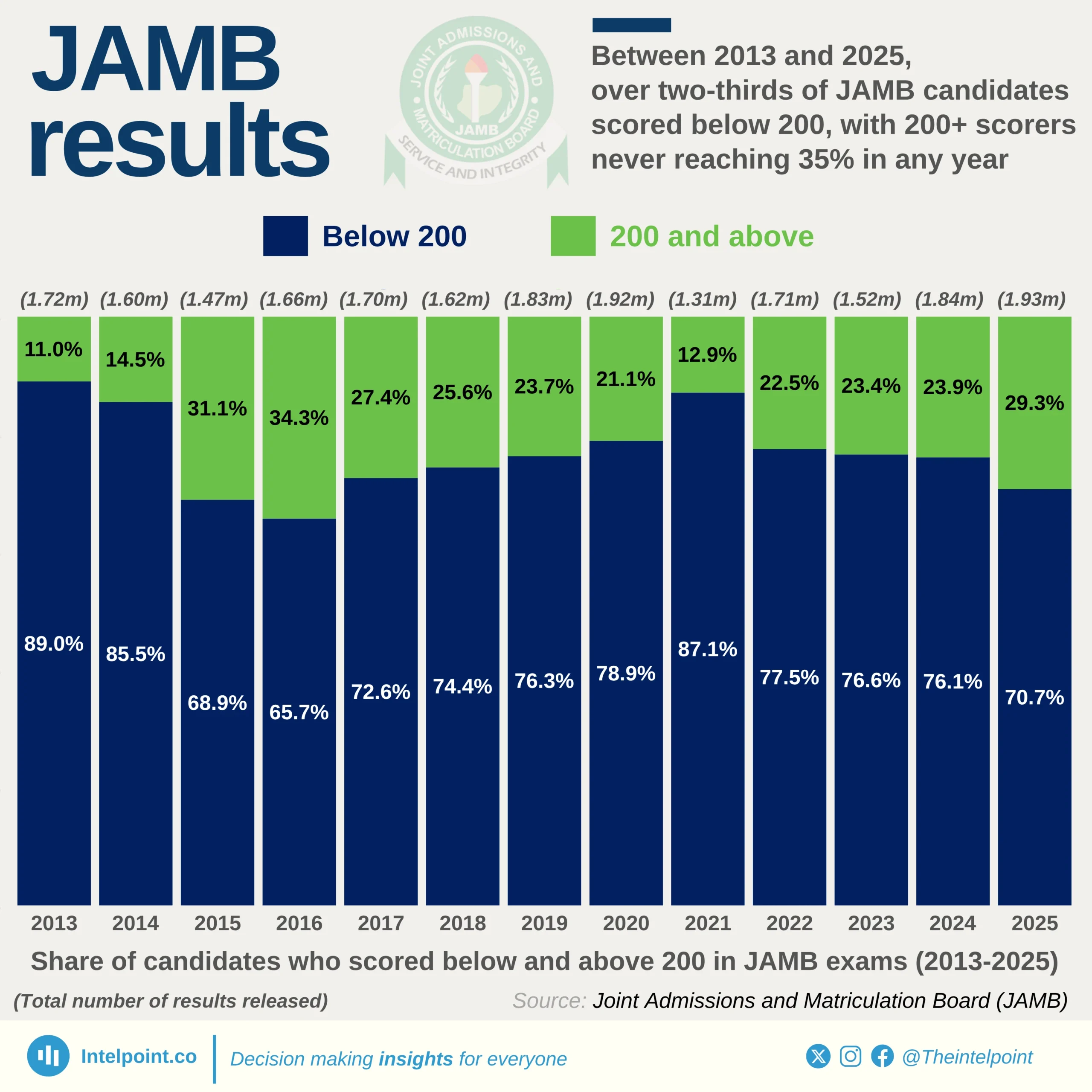
Between 2013 and 2025, over two-thirds of JAMB candidates scored below 200, with 200+ scorers never reaching 35% in any year
  • In every year from 2013 to 2025, over 65% of JAMB candidates scored below 200.
  • The highest share of candidates scoring 200 and above was 34.3% in 2016.
  • The years 2015 and 2016 marked the most significant shifts in performance, with over 30% scoring 200+.
  • The year 2021 recorded the lowest share of high scorers (12.9%) after 2013 and 2014.

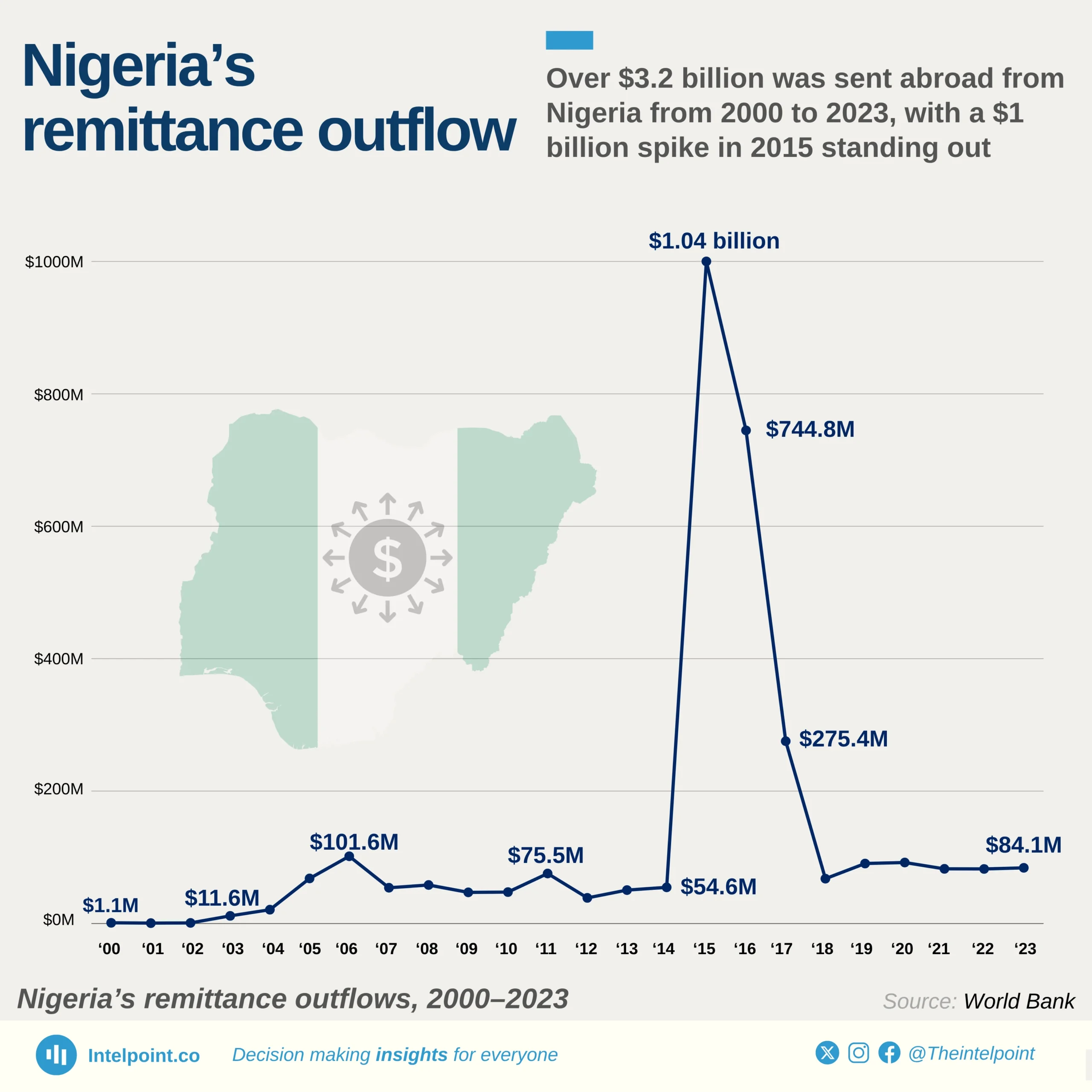
Over $3.2 billion was sent abroad from Nigeria from 2000 to 2023, with a $1 billion spike in 2015 standing out
  • Migrants living in Nigeria sent out over $3.2 billion in personal remittances between 2000 and 2023.
  • The year 2015 recorded a sharp and unusual outflow of $1.04 billion, the highest by far in the entire 24-year span.
  • After 2015, remittance outflows sharply declined, stabilising below $100 million from 2018 onward.
  • Prior to 2015, outflows were consistently under $110 million annually, indicating a major anomaly in that spike year.

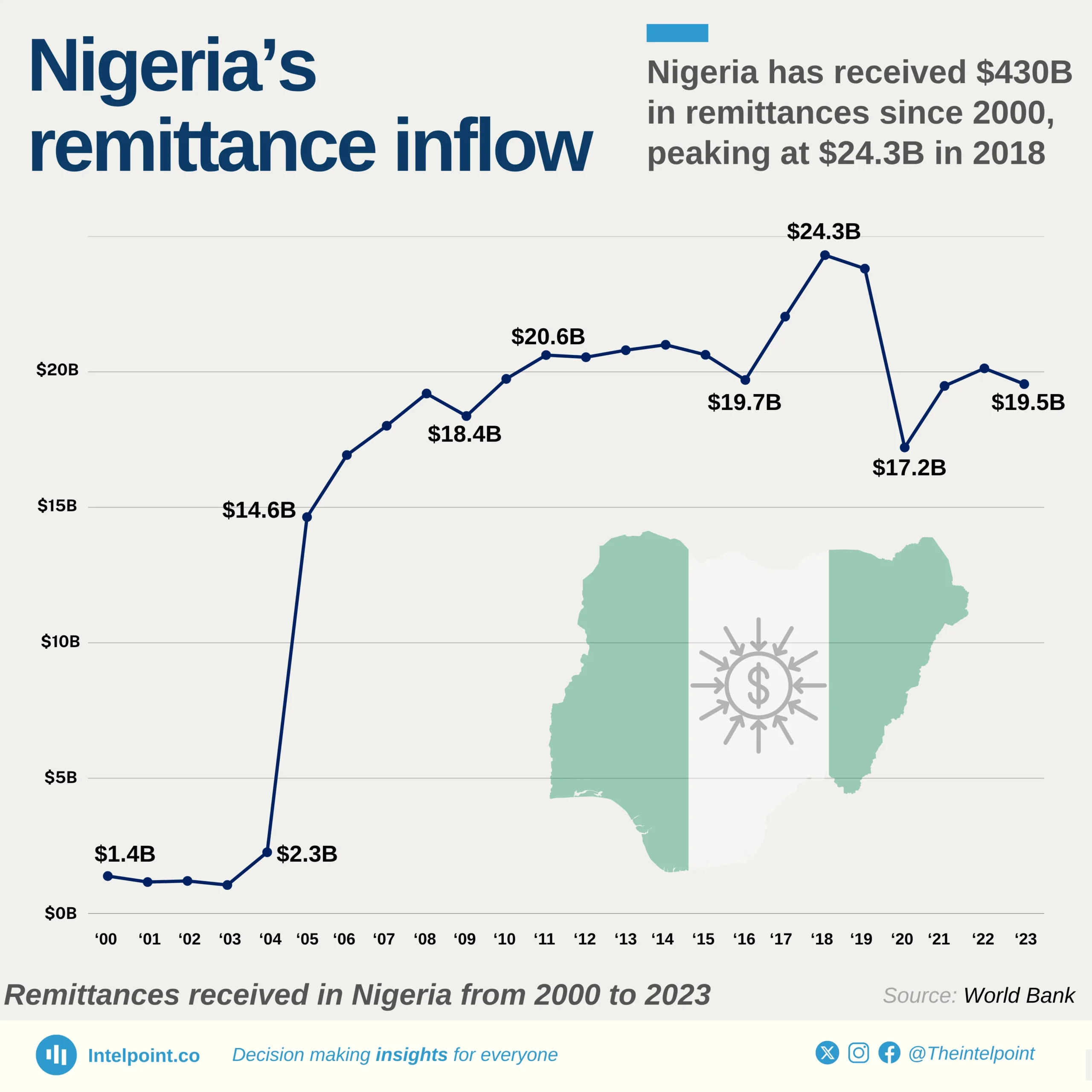
Nigeria has received $430B in remittances since 2000, peaking at $24.3B in 2018
  • Nigeria received a total of approximately $430 billion in remittances between 2000 and 2023.
  • The highest amount recorded was in 2018, when remittances peaked at $24.31 billion.
  • In 2020, inflows dropped significantly to $17.21 billion due to the global COVID-19 crisis.
  • Between 2021 and 2023, remittances remained stable, averaging around $19.7 billion per year.

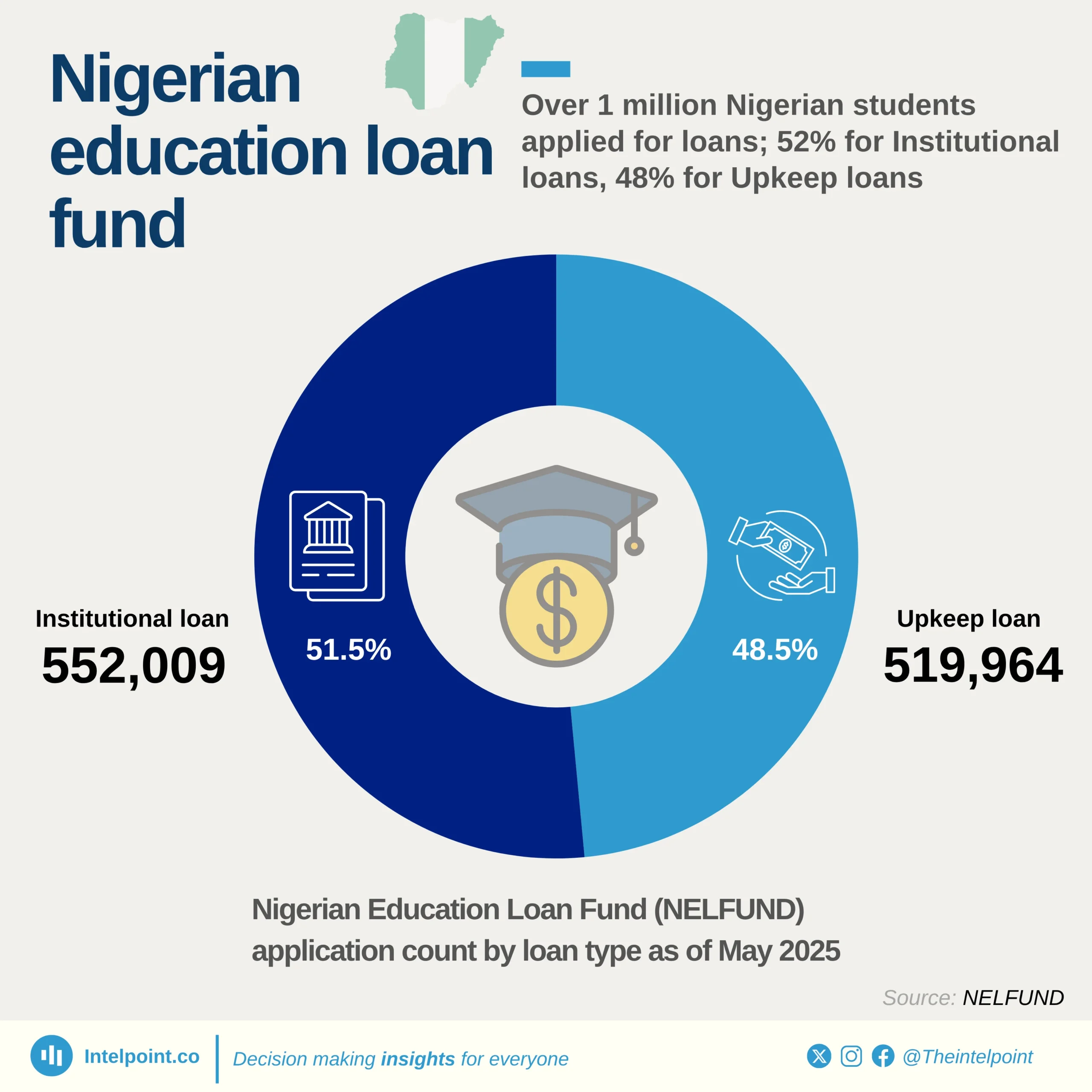
Over 1 million Nigerian students applied for loans; 52% for Institutional loans, 48% for Upkeep loans
  • Institutional loans lead slightly, with 552,009 applications, showing a strong need for tuition and direct school-related expenses.
  • Upkeep loans are not far behind, at 519,964 applications, highlighting the importance of financial support beyond school fees.
  • Combined, over 1 million applications reveal a large and growing demand for structured educational funding in Nigeria.
  • The close margin suggests dual pressure: students aren’t just struggling to pay fees, but also to survive the cost of schooling.

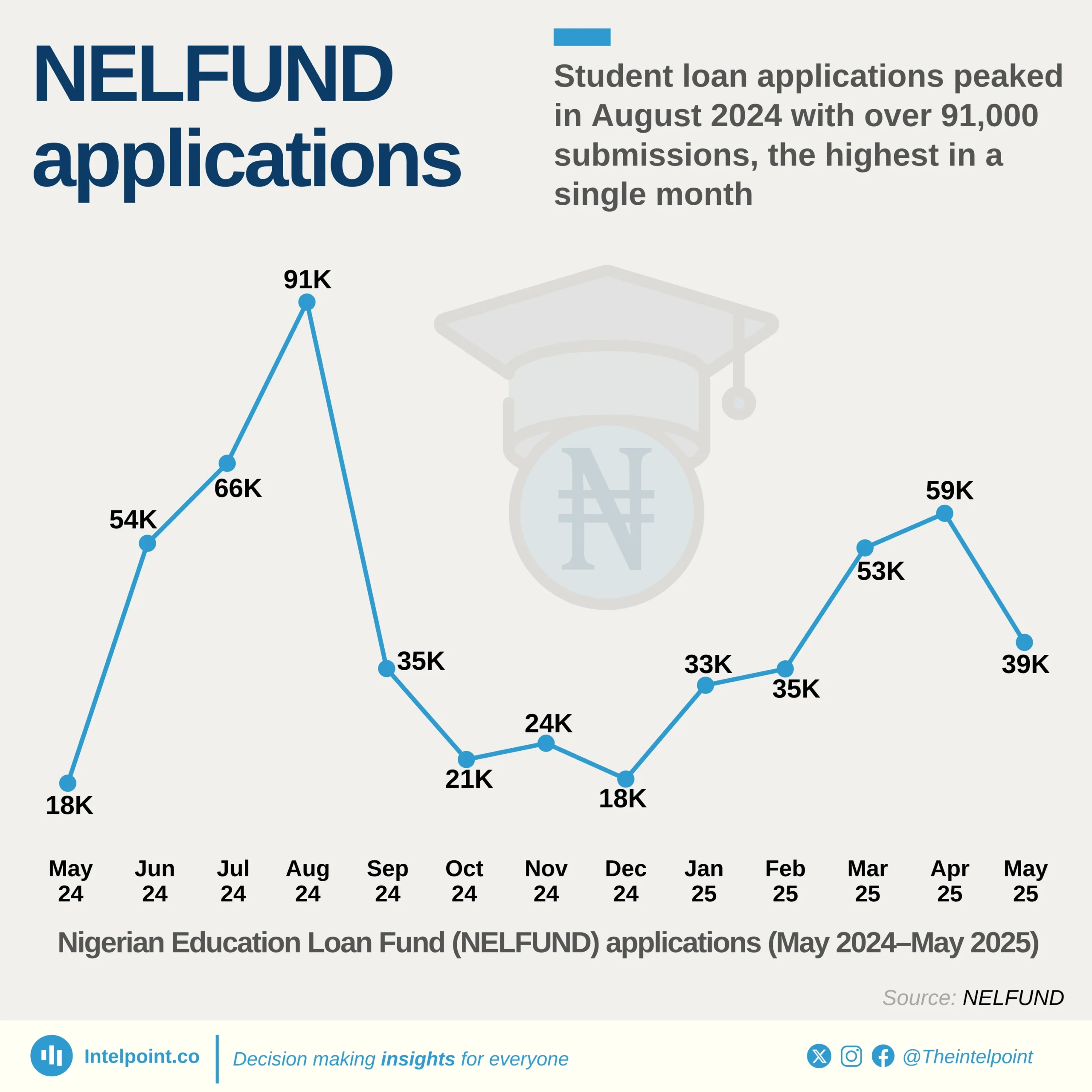
Student loan applications peaked in August 2024 with over 91,000 submissions, the highest in a single month
  • Student loan applications peaked sharply in August 2024 with 91K submissions, marking the highest monthly volume within the 13-month period.
  • After August’s spike, applications declined steeply, hitting a low of 18K in December 2024.
  • A resurgence began in January 2025, leading to a second wave of activity that reached 59K applications in April 2025, the second-highest month.
  • Monthly application volumes remained volatile, reflecting fluctuating demand and possible cycles tied to academic calendars or policy updates.

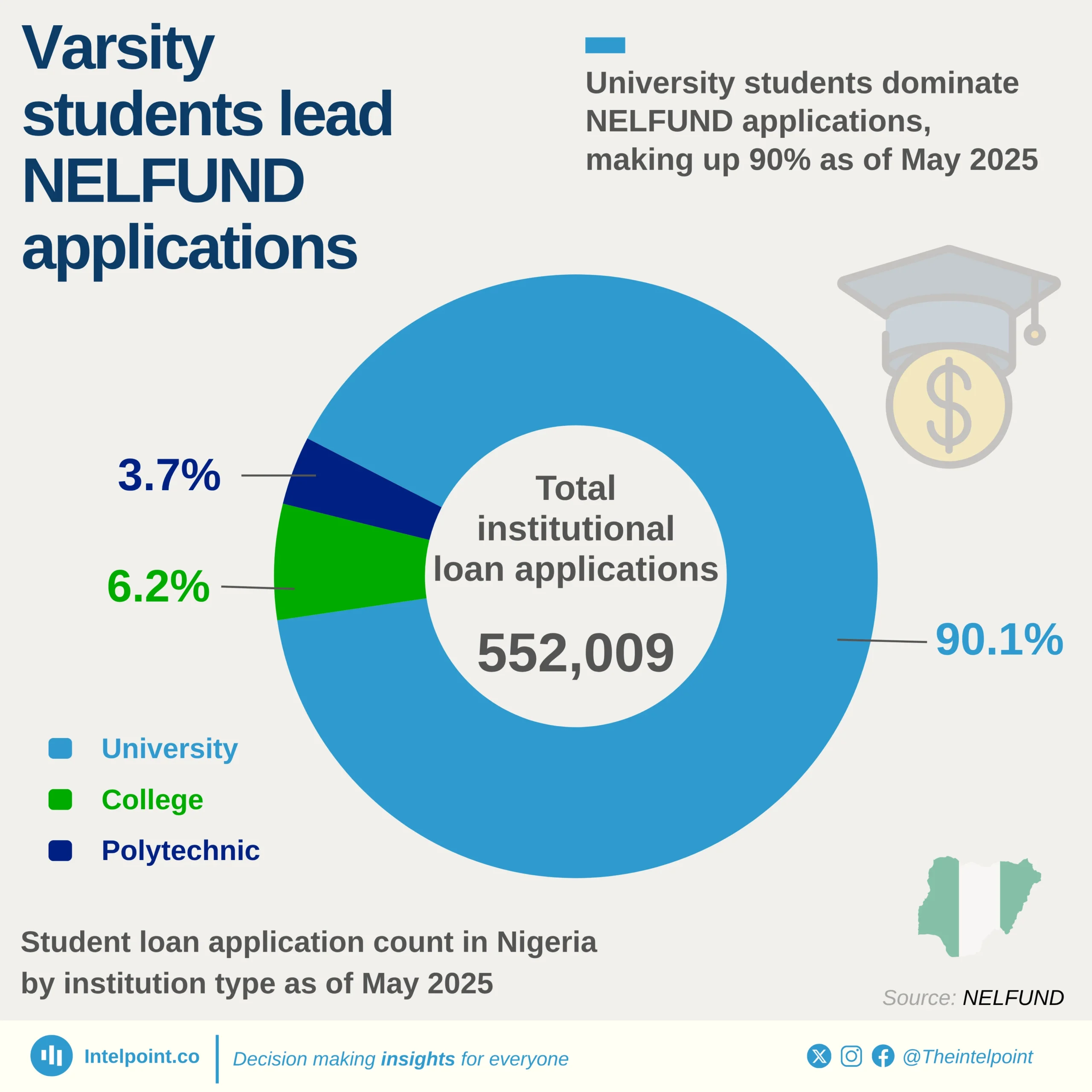
University students dominate NELFUND applications, making up 90% as of May 2025
  • University students filed 497,000 loan applications, accounting for a staggering 90.1% of all institutional submissions.
  • College of education students submitted just 34,000 applications, making up only 6.2% of the total pool.
  • Polytechnics trailed with 21,000 applications, contributing 3.7% to the national tally.
  • Out of every 10 students applying for a loan, 9 are university students, underscoring their dominance in demand.

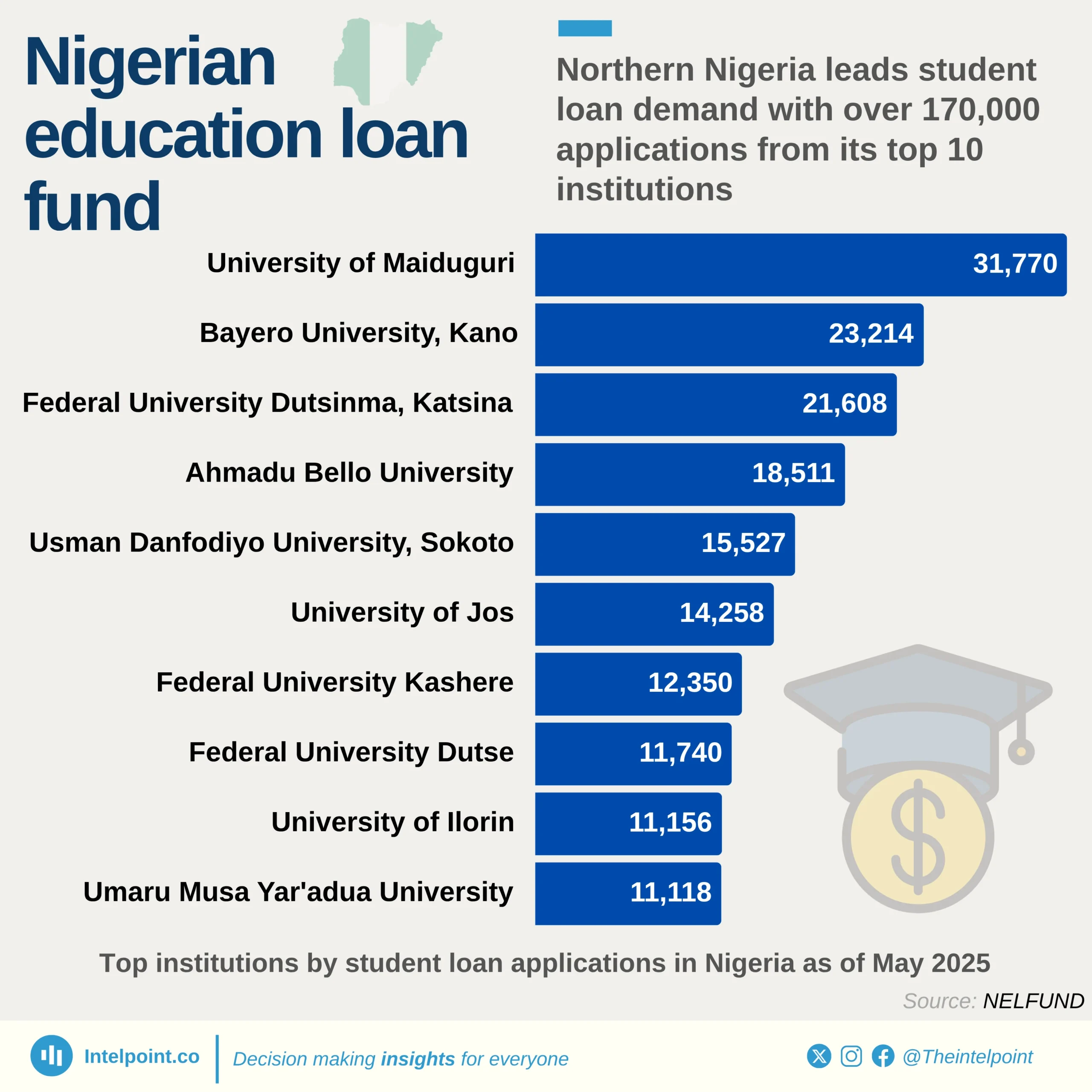
Northern Nigeria leads student loan demand with over 170,000 applications from its top 10 institutions
  • University of Maiduguri leads with 31,770 applications, indicating a significant demand for student loans in the North East.
  • North West institutions dominate the list, with five universities (Bayero University Kano, Federal University Dutsinma Katsina, Ahmadu Bello University, Usman Danfodiyo University, Sokoto, and Umaru Musa Yar'adua University) collectively accounting for a substantial portion of applications.
  • North Central is represented by University of Jos and University of Ilorin, highlighting the region's active participation in the student loan programme.
  • Federal University, Kashere's presence underscores the North East's engagement, with two institutions in the top 10.
  • All listed universities received over 11,000 applications, reflecting widespread awareness and utilization of the student loan initiative across these regions.

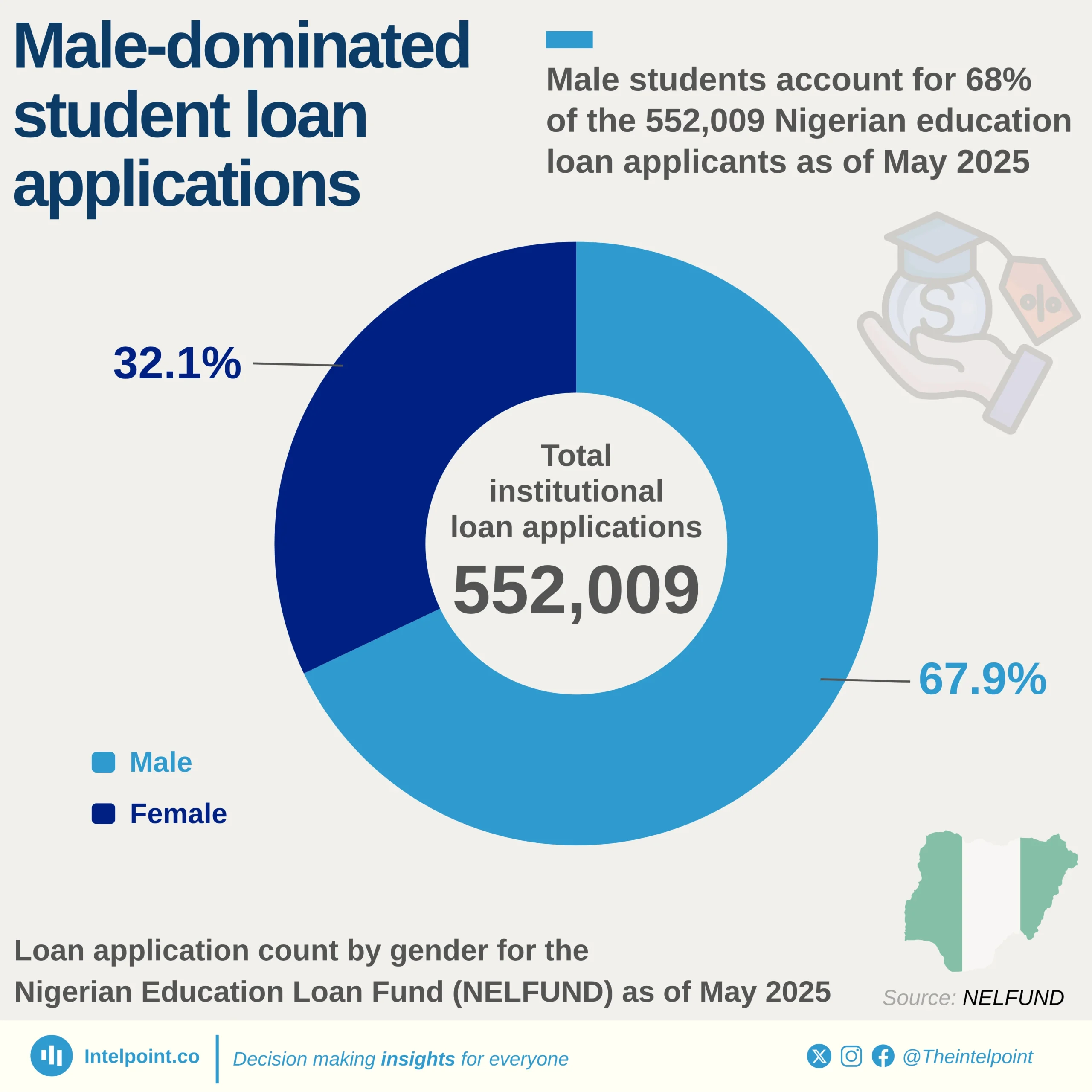
Male students account for 68% of the 552,009 Nigerian education loan applicants as of May 2025
  • Male applicants dominate the Nigerian student loan landscape with 374,946 accounts, representing 68% of total applications.
  • Female applicants trail behind at 177,063, contributing just 32% to the total loan accounts.
  • For every 10 students who applied, approximately 7 are male and 3 are female.
  • The gender gap in student loan uptake is 197,883, with males nearly double the number of female applicants.

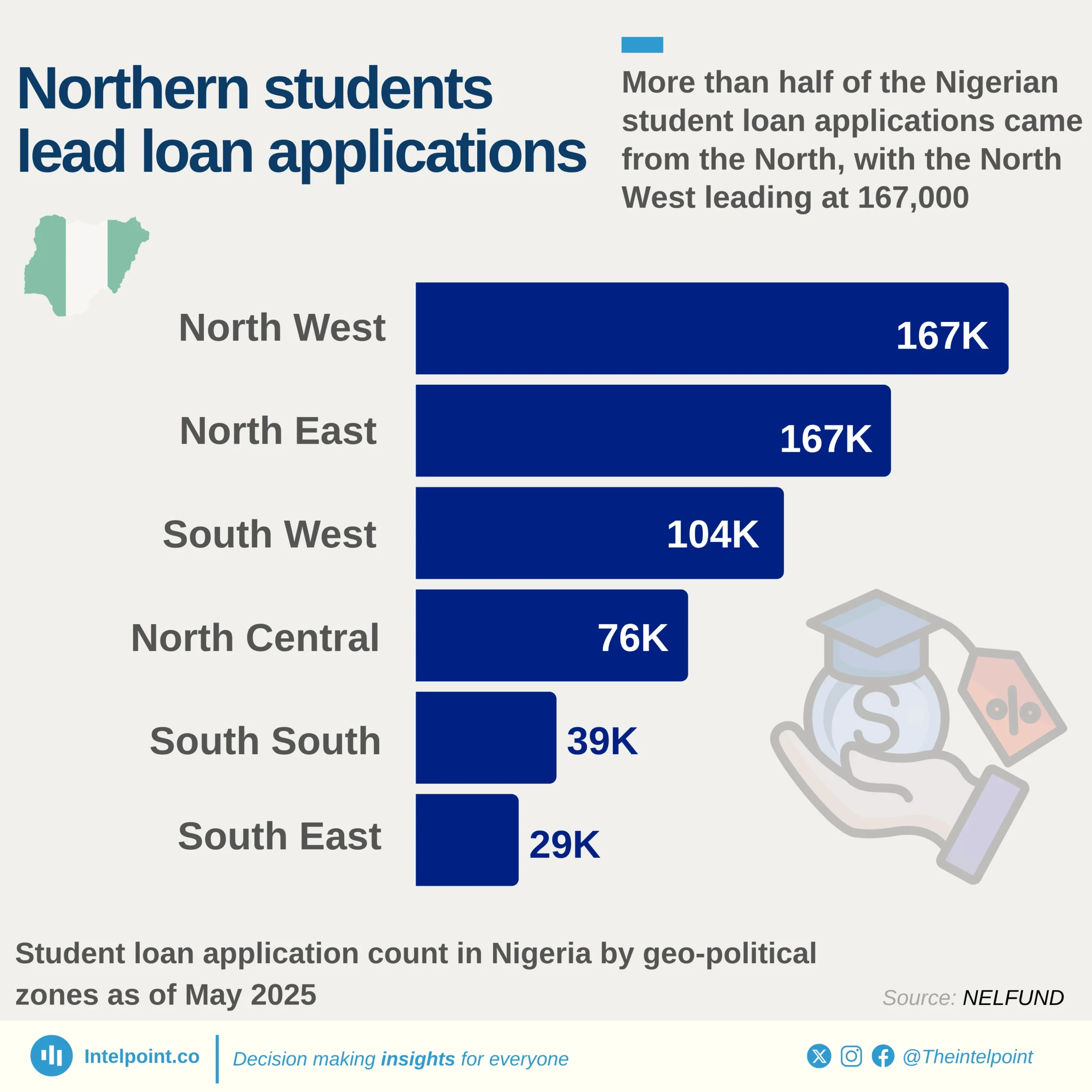
More than half of the Nigerian student loan applications came from the North, with the North West leading at 167,000
  • With 167,639 applications, the North West zone accounts for the highest number of student loan submissions, representing a significant concentration of demand in that region.
  • The North East follows with 134,359 applications, bringing the northern region's combined total to over 300,000, more than half of all zonal submissions.
  • The South West stands as the highest-contributing southern zone with 104,079 applications, showing a strong but comparatively lower demand than the North.
  • The South East recorded just 29,097 applications, the lowest across all six geopolitical zones.
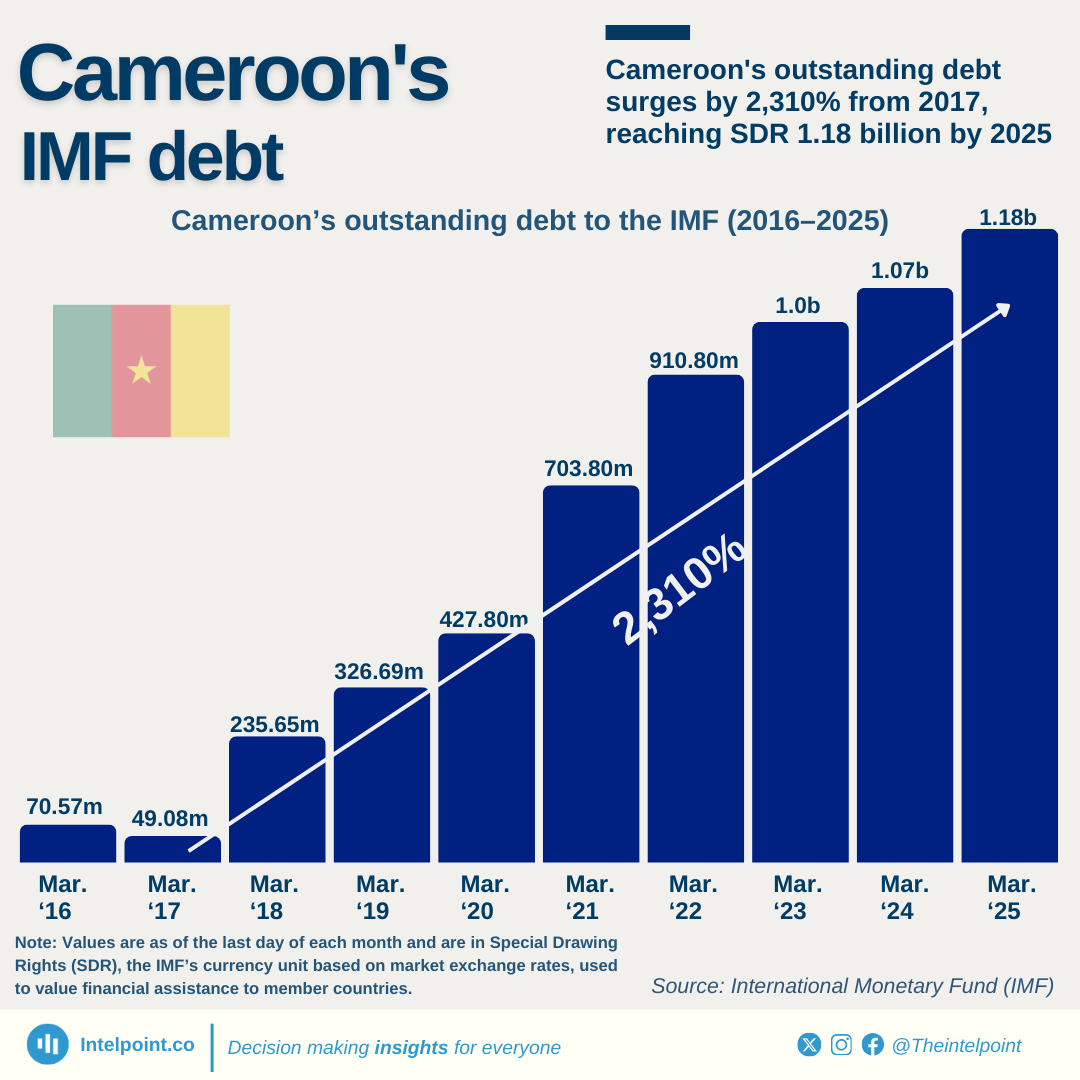
Cameroon's outstanding debt surges by 2,310% from 2017, reaching SDR 1.18 billion by 2025
Key Takeaways:
  • Cameroon’s IMF debt decreased from SDR 70.6 million in 2016 to SDR 49.1 million in 2017—a 30% reduction.
  • From 2018 onwards, the country experienced steady increases in outstanding debt.
  • After an initial 30% reduction from 2016 to 2017, debt skyrocketed by 380% in just one year (2017-2018).
  • By March 2025, Cameroon’s outstanding debt had reached SDR 1.18 billion, representing a staggering SDR 1.13 billion increase from its 2017 level.
  • Although the pace of accumulation has moderated in recent years, the overall debt trend remains upward.

1 9 10 11 12 13 17

Can’t find what you’re looking for? Please fill the form below
Contact Form Demo
SIGN UP TO OUR NEWSLETTER
Get periodic updates about the African startup space, access to our reports, among others.
Subscribe Here
Subscription Form

A product of Techpoint Africa. All rights reserved