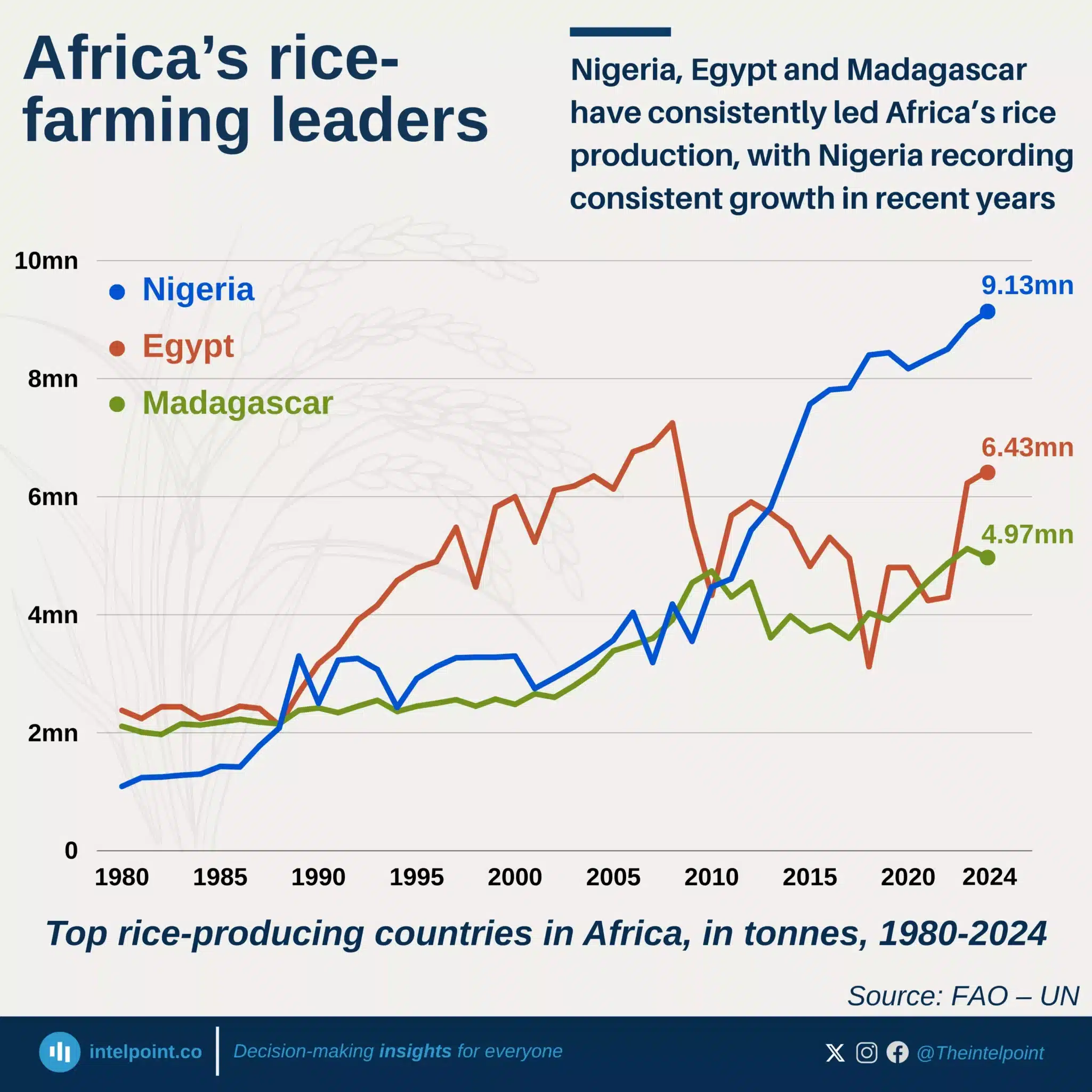
Nigeria, Egypt and Madagascar have consistently led Africa’s rice production, with Nigeria recording consistent growth in recent years

Key Takeaways

  • Nigeria's rice production hit 9.13 million tonnes in 2024, its highest level since 2021.
  • Egypt and Madagascar produced 6.43 and 4.97 million tonnes, respectively, in 2024.
  • Egypt and Madagascar combined produced 11.4 million tonnes, exceeding Nigeria's output.
  • Africa's rice production reached a record 44.8 million tonnes in 2024, up 421% since 1980.

Since 2021, Nigeria's rice production has increased every year, reaching a record 9.13 million tonnes in 2024. Egypt and Madagascar, the other two leading rice producers in Africa, have followed different trends.

Egypt's production was much higher in the 2000s, but declined sharply to 3.12 million tonnes in 2018. It has since recovered steadily, reaching 6.43 million tonnes in 2024.

Madagascar has also seen fluctuations over the years, although its overall increase has been more gradual. Production reached 4.97 million tonnes in 2024.

Together, Egypt and Madagascar produced 11.4 million tonnes of rice in 2024, more than Nigeria's 9.13 million tonnes.

Africa's rice production increased by 421% between 1980 and 2024, reaching a record 44.8 million tonnes. The three countries accounted for roughly 46% of all rice produced in Africa in 2024.
Source:

Food and Agriculture organization of the UN

Period:

1980-2024
HTML code to embed chart
Want a bespoke report?
Reach out
Tags
Related Insights

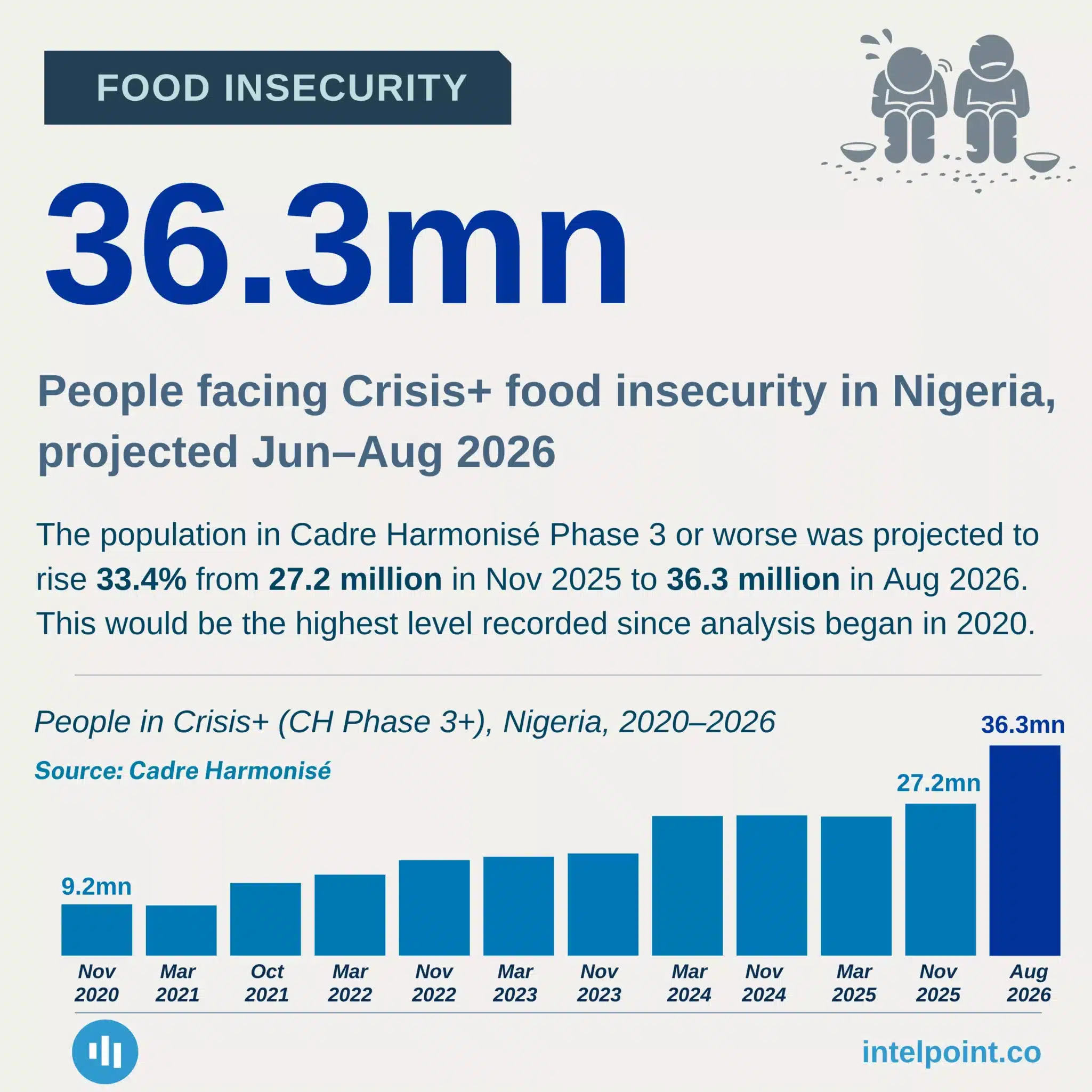
People facing Crisis+ food insecurity in Nigeria, projected Jun–Aug 2026
  • 36.3 million people face Crisis-level food insecurity in August 2026, up 33% from November 2025.
  • Nearly 8 in 10 households in the northeast have less than a week's food supply.
  • 58% of people in the northeast have insufficient food consumption.
  • Conflict, displacement and market disruption are deepening the crisis.

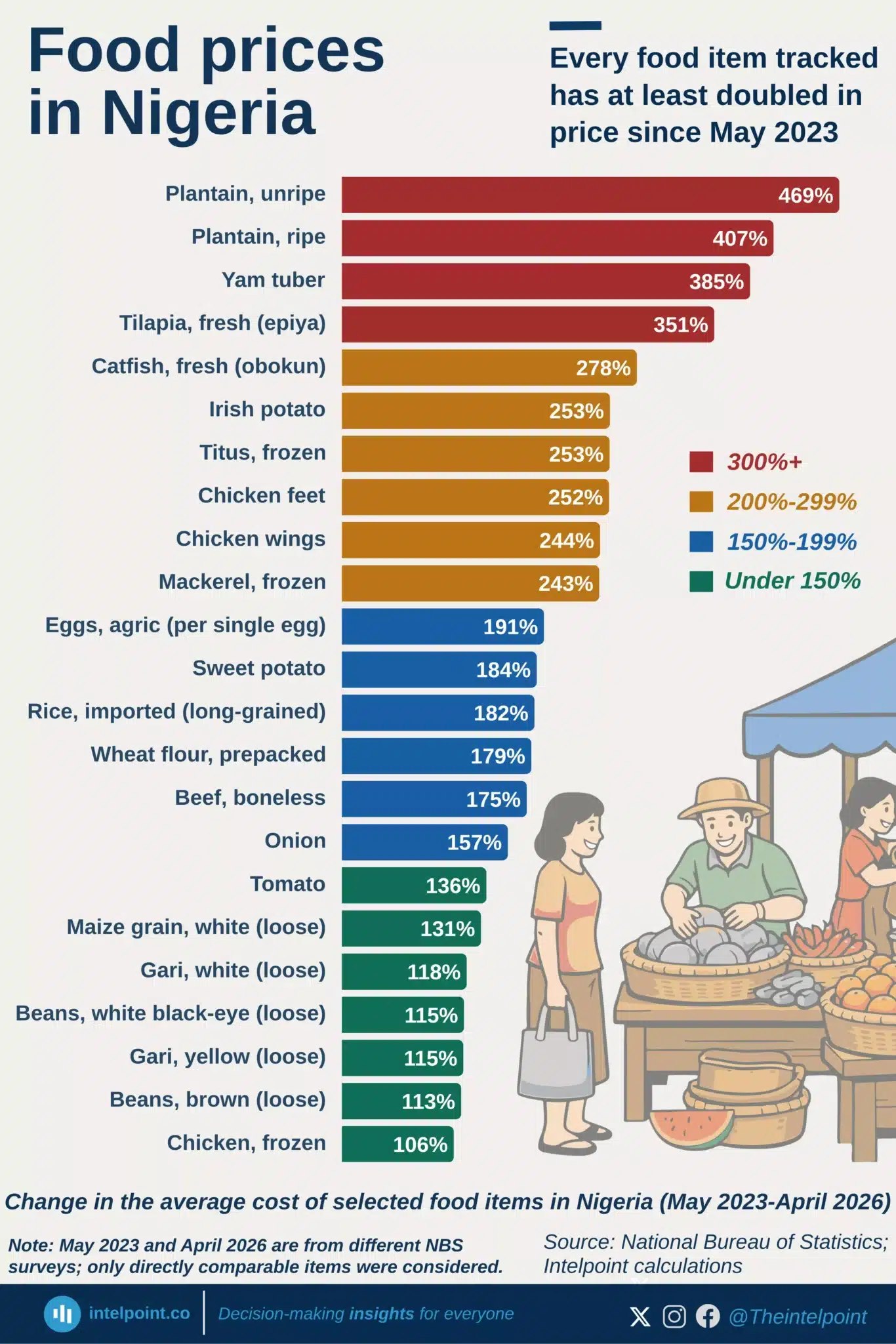
Every food item tracked has at least doubled in price since May 2023
  • Every comparable food item tracked is now at least twice as expensive as it was in May 2023.
  • Nearly half of the selected food items have more than tripled in price since the month before fuel subsidy removal.
  • Unripe plantain recorded the steepest increase, rising by 469% between May 2023 and April 2026.
  • Ripe plantain, yam tuber, and fresh tilapia also saw extreme increases of more than 300%.
  • Even the slowest-rising staples, including frozen chicken, beans, gari, and maize, still more than doubled in price.

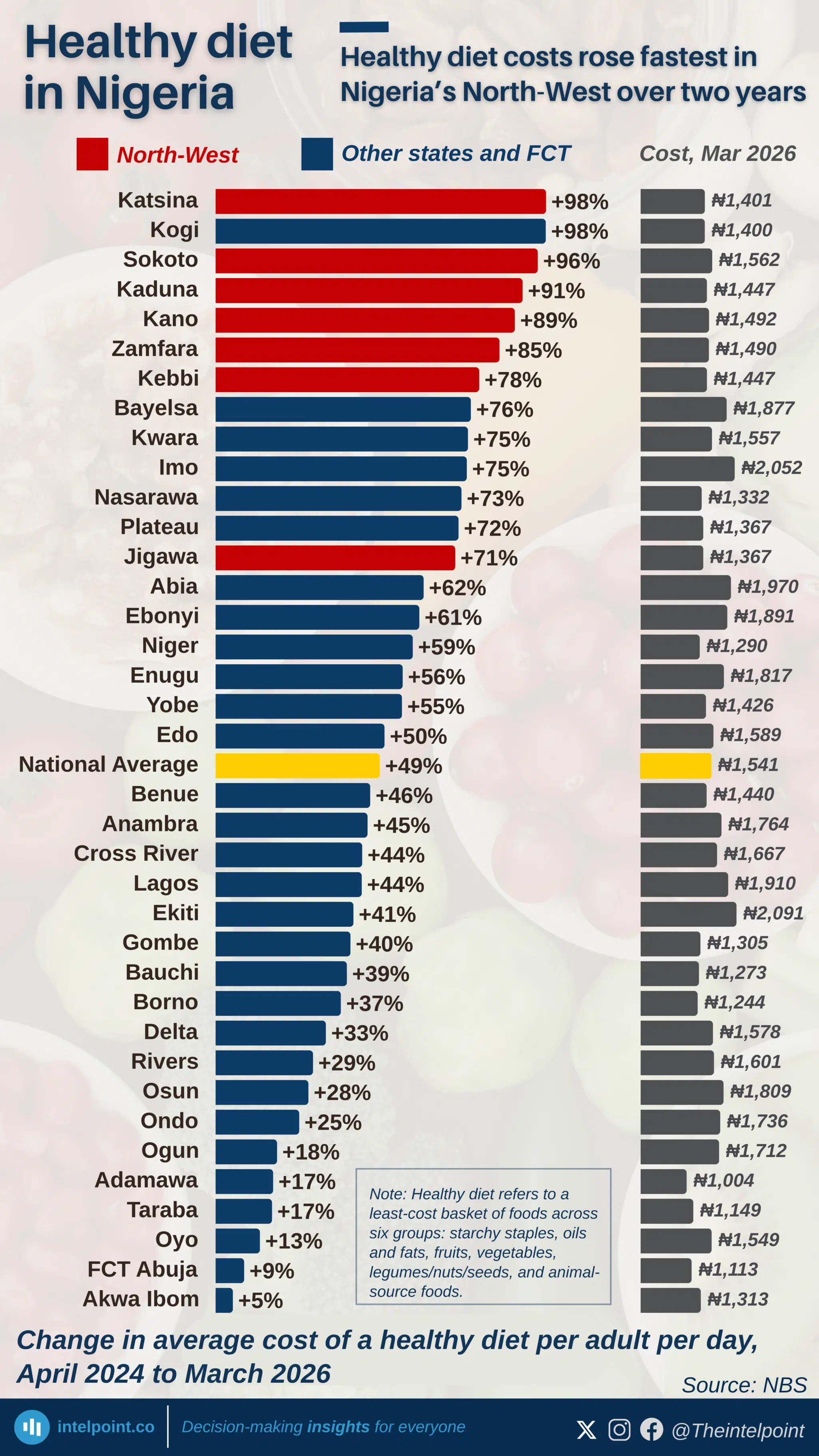
Healthy diet costs rose fastest in Nigeria’s North-West over two years
  • Healthy diet costs rose 49% nationally in two years.
  • North-West states recorded the fastest increases.
  • All seven North-West states rose above the national average.
  • Katsina and Kogi recorded the steepest increases, at 98%.
  • Akwa Ibom had the lowest increase, at 5%.

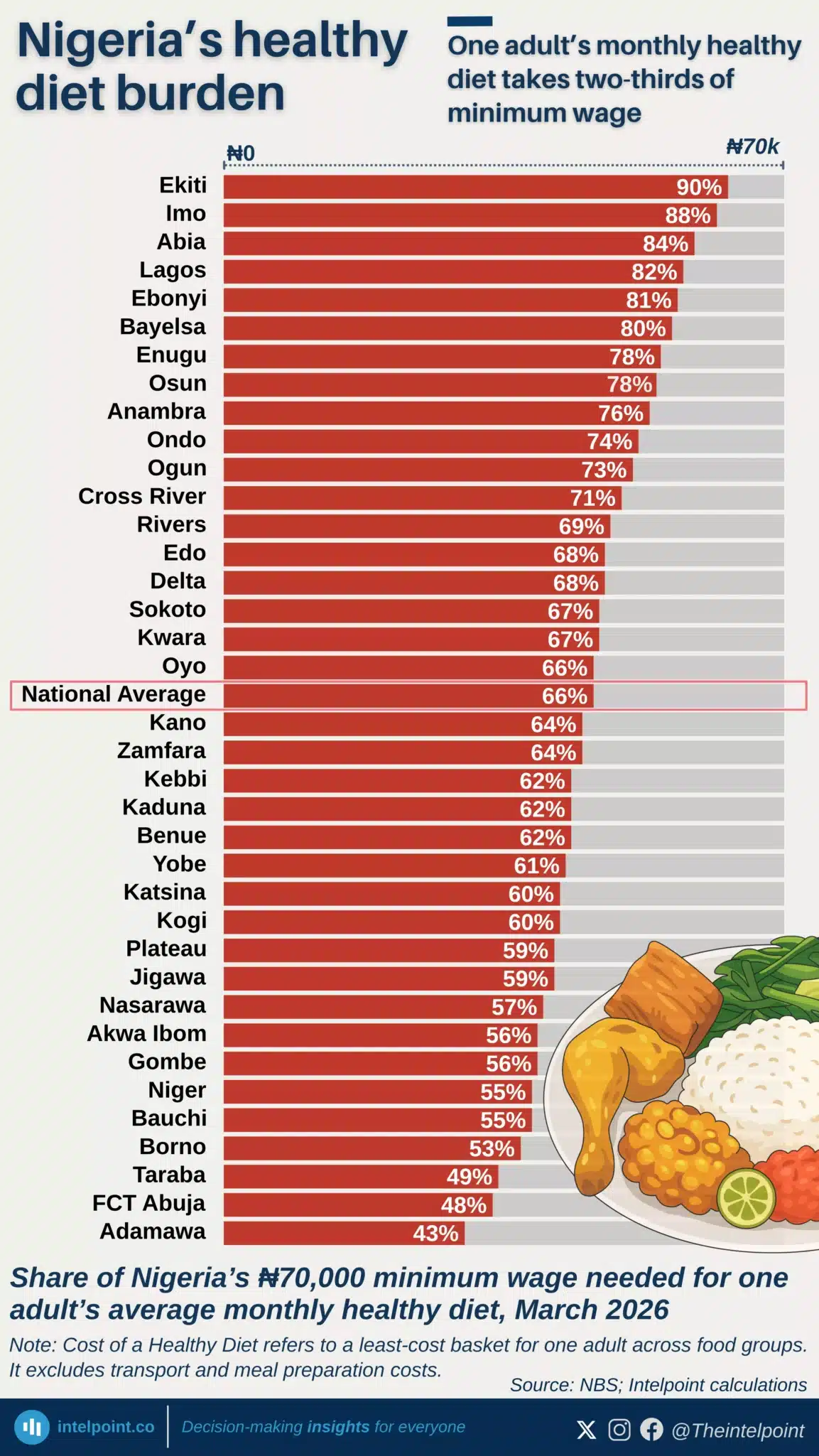
One adult’s monthly healthy diet takes two-thirds of minimum wage
  • One adult’s healthy diet takes 66% of Nigeria’s minimum wage.
  • The national average monthly cost is about ₦46,230 per adult.
  • Ekiti has the highest burden, at 90% of minimum wage.
  • Six states require over 80% of minimum wage for one adult’s healthy diet.
  • Adamawa has the lowest burden, at 43%.

From 45% to 2%: How Nigeria lost its global palm oil production share to Asia
  • Indonesia dominated with 46.8M tonnes in 2022, up from 145.7 ktonnes in 1961
  • Malaysia was the second-largest producer in 2022 with 18.5M tonnes
  • Global production has increased from under 2M tonnes (1961) to over 75M tonnes (2022)
  • Thailand, Colombia, and Guatemala have emerged as major producers in recent decades
  • Nigeria was historically significant, but has been overtaken by Asian producers

Over one-fourth of Asia’s forests were in legally established protected areas as of 2024
  • Asia leads globally with 26% of its forests in legally protected areas.
  • The global average stands at 20%, meaning that one-fifth of all forests are under some form of legal protection.
  • Africa and Europe are tied at 23%, both above the global average.
  • South America has only 17% of its forests protected, despite being home to the Amazon rainforest.

POPULAR TOPICS
SIGN UP TO OUR NEWSLETTER
Get periodic updates about the African startup space, access to our reports, among others.
Subscribe Here
Subscription Form

A product of Techpoint Africa. All rights reserved