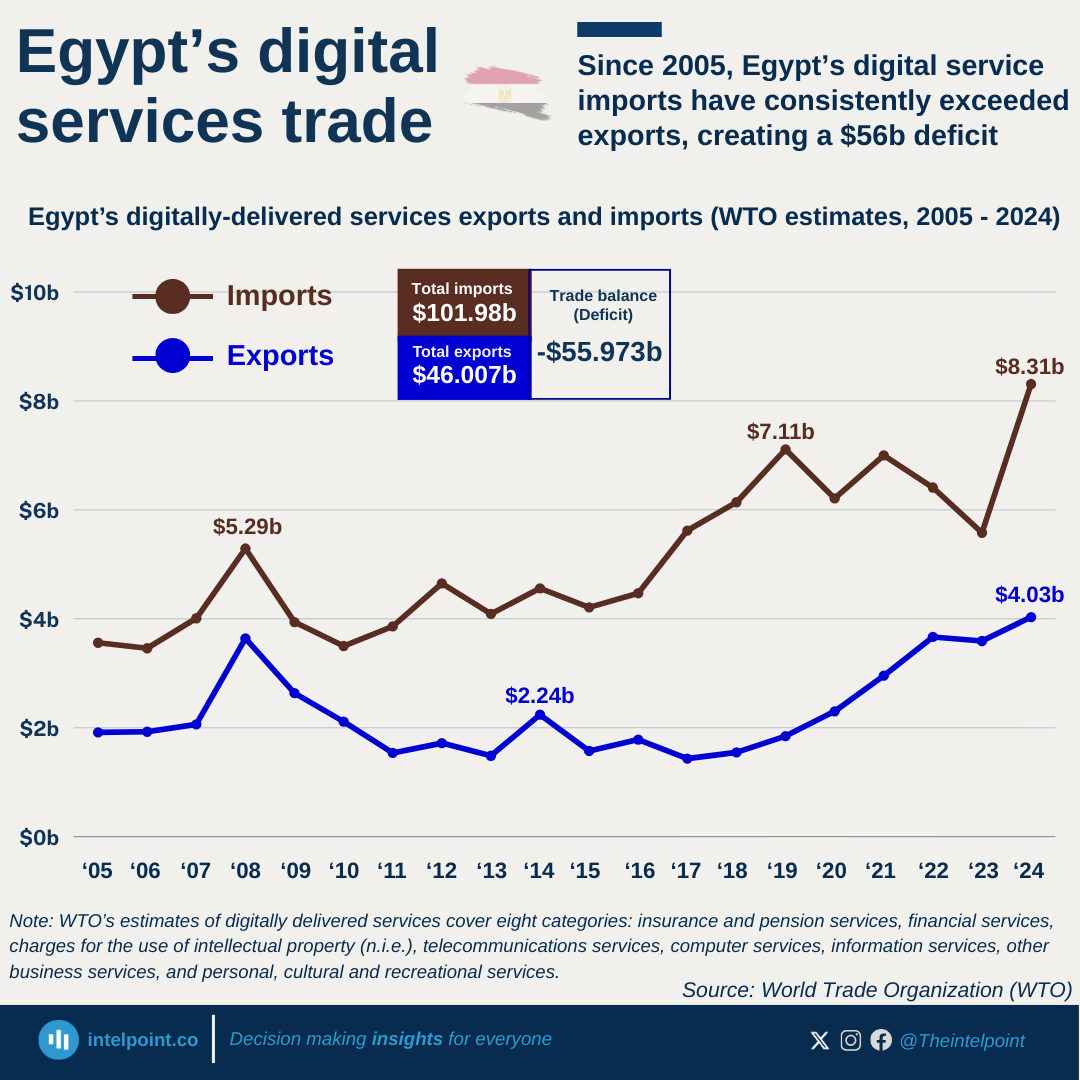
Since 2005, Egypt’s digital service imports have consistently exceeded exports, creating a $56b deficit

key takeaways:

  • Egypt spends twice as much on digital services imports than it earns from exports, with $8.31b on imports and $4.03b from exports recorded in 2024.
  • Egypt exported $46.007 billion in digital services between 2005 and 2024.
  • Imports during the same period reached $101.98 billion.
  • The result was a trade deficit of $55.973 billion in over 20 years.
  • Export earnings rose from just $1.91 billion in 2005 to $4.03 billion in 2024.

From 2005-2024, Egypt exported a total of $46.007 billion in digital services. During the same period, imports were much higher, amounting to $101.98 billion, resulting in a substantial trade deficit of $55.973 billion. In 2005, Egypt’s exports in digital services stood at just $1.91 billion. By 2024, exports had more than doubled to $4.03 billion, reflecting upward momentum. However, imports in 2024 alone was $8.31 billion, more than twice the export value. This ratio illustrates Egypt’s heavy reliance on foreign digital solutions and platforms.

The rising demand for imports reflects the strength of Egypt’s domestic digital consumption. Yet, the slower pace of export growth highlights structural weaknesses in the competitiveness of local providers. The trade deficit of $55.973 billion represents a significant outflow of value over two decades. This imbalance raises concerns about Egypt’s ability to capture value in the global digital economy.
Source:

World Trade Organization

Period:

2005-2024
HTML code to embed chart
Want a bespoke report?
Reach out
Tags
Related Insights

9 of Nigeria’s 26 publicly listed trillion-naira companies are in financial services
  • 26 companies on NGX are valued above ₦1 trillion.
  • MTN Nigeria leads at ₦16.38 trillion, making it the most valuable listed company.
  • The top three firms (MTN Nigeria, BUA Foods, and Dangote Cement) are far ahead of the rest, each exceeding ₦13 trillion.
  • 9 of the 26 companies are in the financial services sector.
  • Telecoms and manufacturing dominate the upper tier, highlighting infrastructure and essential services as market anchors.
  • Energy companies are firmly positioned, reflecting their central role in the economy.
  • Market concentration is high, as a few giants carry disproportionate weight relative to the 122 sub-₦1 trillion firms.
  • Sector diversity exists within the top 26, but most belong to industries tied to basic economic activity rather than emerging tech or high-growth startups.

Local companies have consistently contributed most of Nigeria’s Company Income Tax payments since 2016
  • Local companies dominated CIT contributions in most years, accounting for over 50% of payments in 9 of 11 periods between 2015 and 2025 (Q1–Q3).
  • Foreign companies briefly closed the gap in 2023, contributing 49%, the closest they have come to matching local firms.p
  • Local companies recorded their strongest share in 2021 at 65%, marking the widest gap between local and foreign contributors.
  • “Other payments” peaked during the pandemic, rising to 17% in 2020 before dropping to 0% from 2022 onward.

Nigeria is Africa’s fastest country to attain $100bn GDP, reaching the mark in a record 34 years
  • Nigeria is the fastest to reach $100B — 34 years, achieving the milestone in 1994.
  • Ethiopia took the longest — 81 years, reaching the mark in 2022 after decades of gradual expansion.
  • Resource-driven economies reached the threshold faster, including Angola (36 years) and Algeria (43 years).
  • North African economies crossed earlier, with Egypt (1989) and Morocco (2008) benefiting from diversified economic bases.
  • South Africa reached $100B as early as 1988, reflecting its long-standing industrial and financial depth.
  • Ghana is among the slowest climbers (68 years), but its recent 2025 milestone shows the impact of sustained reforms and growth.
  • Speed varies widely (34 to 81 years), showing that growth paths across Africa are shaped by very different economic realities.

After three years of decline, China-Nigeria export trade hit a new peak of $24.9bn in 2025
  • Export value more than doubled from $9.72 billion in 2016 to $24.91 billion in 2025.
  • Trade rose steadily between 2016 and 2019, then surged sharply in 2021.
  • Exports declined for three consecutive years (2022–2024) after the 2021 peak.
  • 2025 marks the highest export value in the ten-year period.

Lagos and Rivers stand as Nigeria’s most self-financing states
  • Rivers, Lagos, and Ogun lead the ranking, covering most operating costs from their own revenue.
  • Jigawa, Bayelsa, and Yobe are the most dependent on federal allocations, with internal revenue covering only a fraction of expenses.
  • Higher-ranked states demonstrate stronger economic resilience and better domestic revenue mobilisation.
  • Lower-ranked states need to grow internal revenue or reduce operating expenses to improve financial self-sufficiency.

China's top 10 African export destinations take about 66% of its exports to the continent in 2025
  • Nigeria leads by a clear margin, receiving the highest export value at $24.91bn.
  • Large, diversified economies dominate the top tier, with South Africa and Egypt ranking among the biggest destinations.
  • Resource-linked trade remains significant, with countries like Liberia and Algeria absorbing substantial export value.
  • Trade reach is geographically diverse, spanning West, East, and North Africa, including GhanaTanzaniaKenyaMorocco, and Guinea.

POPULAR TOPICS
SIGN UP TO OUR NEWSLETTER
Get periodic updates about the African startup space, access to our reports, among others.
Subscribe Here
Subscription Form

A product of Techpoint Africa. All rights reserved