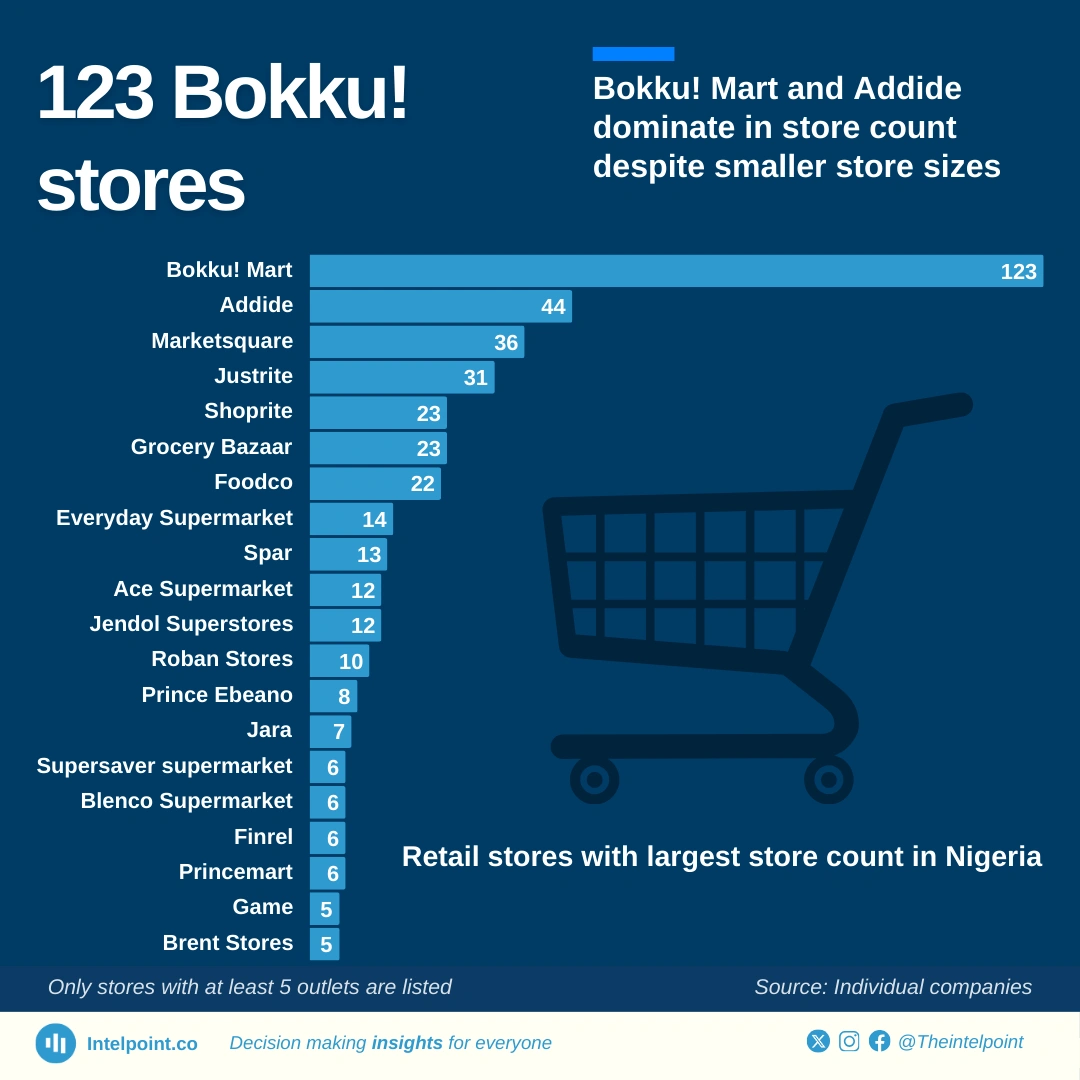
Bokku! Mart and Addide dominate in store count despite smaller store sizes

Key takeaways

  • Bokku! Mart dominates the retail landscape with 123 locations, nearly three times the count of the second-largest chain, Addide, which has 44 stores
  • Marketsquare, Justrite, and Shoprite round out the top five with 36, 31, and 23 stores, respectively, indicating a competitive yet fragmented retail sector
  • Most retail chains have fewer than 25 stores, with 13 out of the 18 listed having fewer than 15 stores
  • Traditional supermarket names like Shoprite and Game face competition from local brands

Nigeria’s retail sector is highly fragmented, with some players having extensive footprints. Bokku! Mart leads with 123 stores, far ahead of the second-largest chain, Addide, which has 44 stores. Other notable brands like Marketsquare, Justrite, and Shoprite have between 23 and 36 stores.
Despite Shoprite’s international reputation, it lags behind indigenous brands in terms of store count. The majority of retail chains have fewer than 15 outlets, reflecting the sector's challenges in achieving large-scale expansion. While some brands focus on widespread presence, others prioritise fewer but larger stores.
Source:

Individual companies

Period:

2025
HTML code to embed chart
Want a bespoke report?
Reach out
Tags
Related Insights

85 cents of every dollar in capital imported into Nigeria in 2025 went to portfolio investments
  • Nigeria's total capital imports surged to $23.2bn in 2025, the highest level recorded in the entire 2014 to 2025 period.
  • Foreign Portfolio Investment dominated in 2025, claiming 85 cents of every dollar imported, up sharply from 68% in 2024.
  • Foreign Direct Investment has remained consistently weak, never exceeding 20% across all eleven years, and falling to just 4% in 2025.
  • The "Others" category, which peaked at 61% in 2023, has collapsed to just 11% in 2025, reflecting a dramatic shift toward portfolio-driven capital flows

Nigeria's foreign capital inflows nearly reached the 2019 record, but 87% went to banks and financiers
  • Inflows surged from $3.9B in 2023 to $23.2B in 2025, near the all-time record.
  • Banking and financing captured 87% of all inflows.
  • Agriculture got $167M, oil and gas $18M, and construction $6M, .
  • The recovery is real, but it is not yet reaching ordinary Nigerians.

Private sector pension contributions hit ₦744bn in the first nine months of 2025, exceeding the whole of 2024
  • Over 85x growth in 20 years; total pension contributions grew from ₦15.6 billion in 2004 to ₦1.37 trillion in 2024.
  • In Q1–Q3 2025, private-sector contributions (₦744 billion) surpassed those of the public sector (₦574 billion).
  • Contributions declined in 2015 and 2016 as crashing oil revenues choked government remittances, and again in 2021 amid COVID-19 disruptions.
  • Each time, the system recovered within a year, proving its foundations hold even under severe macro pressure

Nigeria’s four billionaires have a combined $4.5bn more than South Africa’s seven
  • South Africa leads in headcount, with seven billionaires, more than other African countries.
  • Nigeria leads in wealth, with four billionaires worth $47.5 billion, $4.5 billion more than the combined $43 billion of South Africa's seven billionaires.
  • Nigeria's billionaires are richer individually, with an average net worth of $11.9 billion, compared with South Africa's $6.1 billion.
  • North Africa punches below its weight: Egypt, Morocco, and Algeria have ten billionaires combined but just $31.4 billion in total wealth.
  • East Africa barely registers: Tanzania and Zimbabwe each have just one billionaire, both worth $2.1 billion.
 

African markets posted strong growth in 2025, with JSE leading in size and GSE in momentum
  • Seven of nine exchanges posted positive growth, signalling broad-based expansion across African equity markets in 2025.
  • Ghana Stock Exchange led all exchanges in growth rate, rising 133.86% across the year — the sharpest single-year gain in this dataset.
  • The Johannesburg Stock Exchange closed Q4 at $1.3 trillion, making it by far the largest exchange on the continent by market capitalisation.
  • The Stock Exchange of Mauritius and MERJ Exchange (Seychelles) were the only two exchanges to contract, declining 2.61% and 8.02% respectively.

Local companies have consistently contributed most of Nigeria’s Company Income Tax payments since 2016
  • Local companies dominated CIT contributions in most years, accounting for over 50% of payments in 9 of 11 periods between 2015 and 2025 (Q1–Q3).
  • Foreign companies briefly closed the gap in 2023, contributing 49%, the closest they have come to matching local firms.
  • Local companies recorded their strongest share in 2021 at 65%, marking the widest gap between local and foreign contributors.
  • “Other payments” peaked during the pandemic, rising to 17% in 2020 before dropping to 0% from 2022 onward.

POPULAR TOPICS
SIGN UP TO OUR NEWSLETTER
Get periodic updates about the African startup space, access to our reports, among others.
Subscribe Here
Subscription Form

A product of Techpoint Africa. All rights reserved