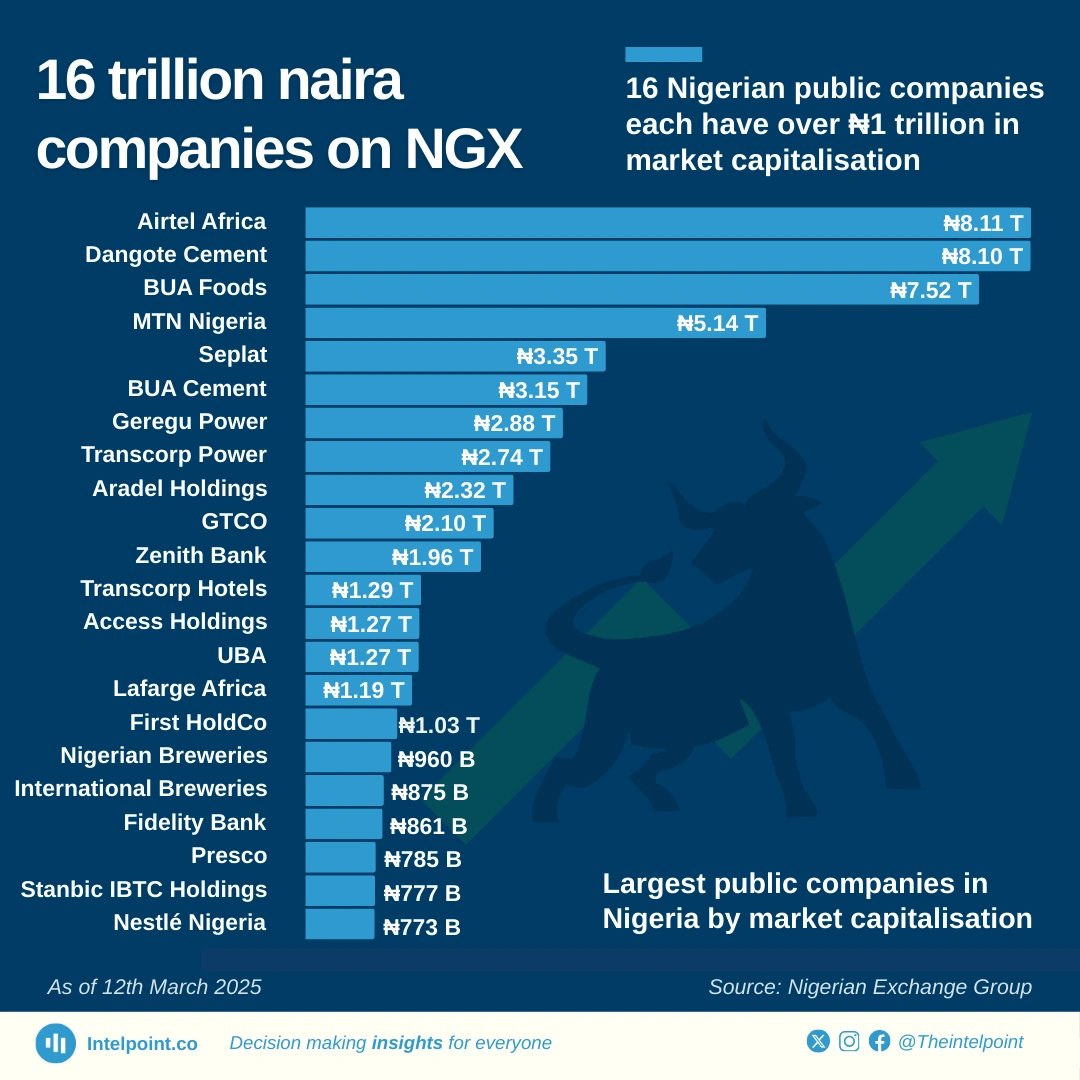
16 Nigerian public companies each have over ₦1 trillion in market capitalisation

Key takeaways

  • Airtel Africa leads the Nigerian stock market with a market cap of ₦8.11 trillion naira, followed by Dangote Cement at ₦8.10 trillion and BUA Foods at ₦7.52 trillion.
  • The largest public companies in Nigeria are mostly in financial services, industrial goods and consumer goods.
  • A total of 16 Nigerian public companies have surpassed the ₦1 trillion market cap threshold.
  • The lowest-ranked trillion-naira company, First HolCo, has a ₦1 trillion naira market cap.

Airtel Africa holds the highest market capitalisation among Nigerian public companies, standing at ₦8.11 trillion, with Dangote Cement and BUA Foods following closely behind, reflecting strong dominance in the industrial and consumer goods sectors. MTN Nigeria leads ICT stocks after Airtel, as the only two companies in the sector to make the list. In total, 16 companies have crossed the ₦1 trillion mark, spanning industries like ICT, industrial goods, oil and gas, utilities, banking, and consumer goods, underscoring the influence of key sectors driving Nigeria’s economy.
Source:

Nigerian Exchange Group

Period:

March 12, 2025
HTML code to embed chart
Want a bespoke report?
Reach out
Tags
Related Insights

Local companies have consistently contributed most of Nigeria’s Company Income Tax payments since 2016
  • Local companies dominated CIT contributions in most years, accounting for over 50% of payments in 9 of 11 periods between 2015 and 2025 (Q1–Q3).
  • Foreign companies briefly closed the gap in 2023, contributing 49%, the closest they have come to matching local firms.
  • Local companies recorded their strongest share in 2021 at 65%, marking the widest gap between local and foreign contributors.
  • “Other payments” peaked during the pandemic, rising to 17% in 2020 before dropping to 0% from 2022 onward.

9 of Nigeria’s 26 publicly listed trillion-naira companies are in financial services
  • 26 companies on NGX are valued above ₦1 trillion.
  • MTN Nigeria leads at ₦16.38 trillion, making it the most valuable listed company.
  • The top three firms (MTN Nigeria, BUA Foods, and Dangote Cement) are far ahead of the rest, each exceeding ₦13 trillion.
  • 9 of the 26 companies are in the financial services sector.
  • Telecoms and manufacturing dominate the upper tier, highlighting infrastructure and essential services as market anchors.
  • Energy companies are firmly positioned, reflecting their central role in the economy.
  • Market concentration is high, as a few giants carry disproportionate weight relative to the 122 sub-₦1 trillion firms.
  • Sector diversity exists within the top 26, but most belong to industries tied to basic economic activity rather than emerging tech or high-growth startups.

Local companies have consistently contributed most of Nigeria’s Company Income Tax payments since 2016
  • Local companies dominated CIT contributions in most years, accounting for over 50% of payments in 9 of 11 periods between 2015 and 2025 (Q1–Q3).
  • Foreign companies briefly closed the gap in 2023, contributing 49%, the closest they have come to matching local firms.p
  • Local companies recorded their strongest share in 2021 at 65%, marking the widest gap between local and foreign contributors.
  • “Other payments” peaked during the pandemic, rising to 17% in 2020 before dropping to 0% from 2022 onward.

Nigeria is Africa’s fastest country to attain $100bn GDP, reaching the mark in a record 34 years
  • Nigeria is the fastest to reach $100B — 34 years, achieving the milestone in 1994.
  • Ethiopia took the longest — 81 years, reaching the mark in 2022 after decades of gradual expansion.
  • Resource-driven economies reached the threshold faster, including Angola (36 years) and Algeria (43 years).
  • North African economies crossed earlier, with Egypt (1989) and Morocco (2008) benefiting from diversified economic bases.
  • South Africa reached $100B as early as 1988, reflecting its long-standing industrial and financial depth.
  • Ghana is among the slowest climbers (68 years), but its recent 2025 milestone shows the impact of sustained reforms and growth.
  • Speed varies widely (34 to 81 years), showing that growth paths across Africa are shaped by very different economic realities.

Lagos and Rivers stand as Nigeria’s most self-financing states
  • Rivers, Lagos, and Ogun lead the ranking, covering most operating costs from their own revenue.
  • Jigawa, Bayelsa, and Yobe are the most dependent on federal allocations, with internal revenue covering only a fraction of expenses.
  • Higher-ranked states demonstrate stronger economic resilience and better domestic revenue mobilisation.
  • Lower-ranked states need to grow internal revenue or reduce operating expenses to improve financial self-sufficiency.

The Nigerian Army commands over half of Nigeria’s proposed 2026 defence budget, more than every other force combined
  • The Army has been allocated ₦1.50tn, more than half of the top-ten defence allocations, making it the backbone of Nigeria’s security spending.
  • The Navy (₦443.9bn) and Air Force (₦407.2bn) come next, but together they are far behind the Army.
  • Institutions like the Defence Intelligence Agency, Training and Doctrine Command, and Defence Missions receive meaningful but much smaller funding, reinforcing their support-role status.
  • The Defence Space Administration (₦37.3bn) is on the table, but its small size shows Nigeria is only cautiously stepping into cyber- and space-based security.

POPULAR TOPICS
SIGN UP TO OUR NEWSLETTER
Get periodic updates about the African startup space, access to our reports, among others.
Subscribe Here
Subscription Form

A product of Techpoint Africa. All rights reserved