Home
Reports
Blog
Insights
About Us
Subscribe
Home
Reports
Blog
Insights
About Us
Export
Top African countries by chocolate export value in 2020
On 2020's World Chocolate Day
, an annual celebration of chocolate, we look at the top 12 African countries with the highest chocolate export value in 2020 -- a combined $421.43m.
Source:
<div style="text-align: center;"><a href="https://intelpoint.co/insights/top-african-countries-by-chocolate-export-value-in-2020/" title="Top African countries by chocolate export value in 2020"><img src="https://intelpoint.co/wp-content/uploads/2024/02/Top-African-countries-by-chocolate-export-value-in-2020.webp" style="width: 80%; height: auto; max-width:960px;-ms-interpolation-mode: bicubic; margin: 0 auto; display: block;" alt="Chart: Top African countries by chocolate export value in 2020"/></a><br><span>Find more insights at <a href="https://intelpoint.co/insights?utm_source=Insight%20Embed&utm_medium=HTML&utm_campaign=Top+African+countries+by+chocolate+export+value+in+2020" target="_blank" style="color: #4f9acc; text-decoration: none;">Intelpoint</a>.</span></div>
Copied to clipboard!
Period:
2020
HTML code to embed chart
Want a bespoke report?
Reach out
Click to copy HTML embed code
<div style="text-align: center;"><a href="https://intelpoint.co/insights/top-african-countries-by-chocolate-export-value-in-2020/" title="Top African countries by chocolate export value in 2020"><img src="https://intelpoint.co/wp-content/uploads/2024/02/Top-African-countries-by-chocolate-export-value-in-2020.webp" style="width: 80%; height: auto; max-width:960px;-ms-interpolation-mode: bicubic; margin: 0 auto; display: block;" alt="Chart: Top African countries by chocolate export value in 2020"/></a><br><span>Find more insights at <a href="https://intelpoint.co/insights?utm_source=Insight%20Embed&utm_medium=HTML&utm_campaign=Top+African+countries+by+chocolate+export+value+in+2020" target="_blank" style="color: #4f9acc; text-decoration: none;">Intelpoint</a>.</span></div>
Copied to clipboard!
Tags
Algeria
Chocolate export
Côte d'Ivoire
Egypt
Eswatini
Ghana
Madagascar
Morocco
Nigeria
Senegal
South Africa
Tunisia
Zambia
Related Insights
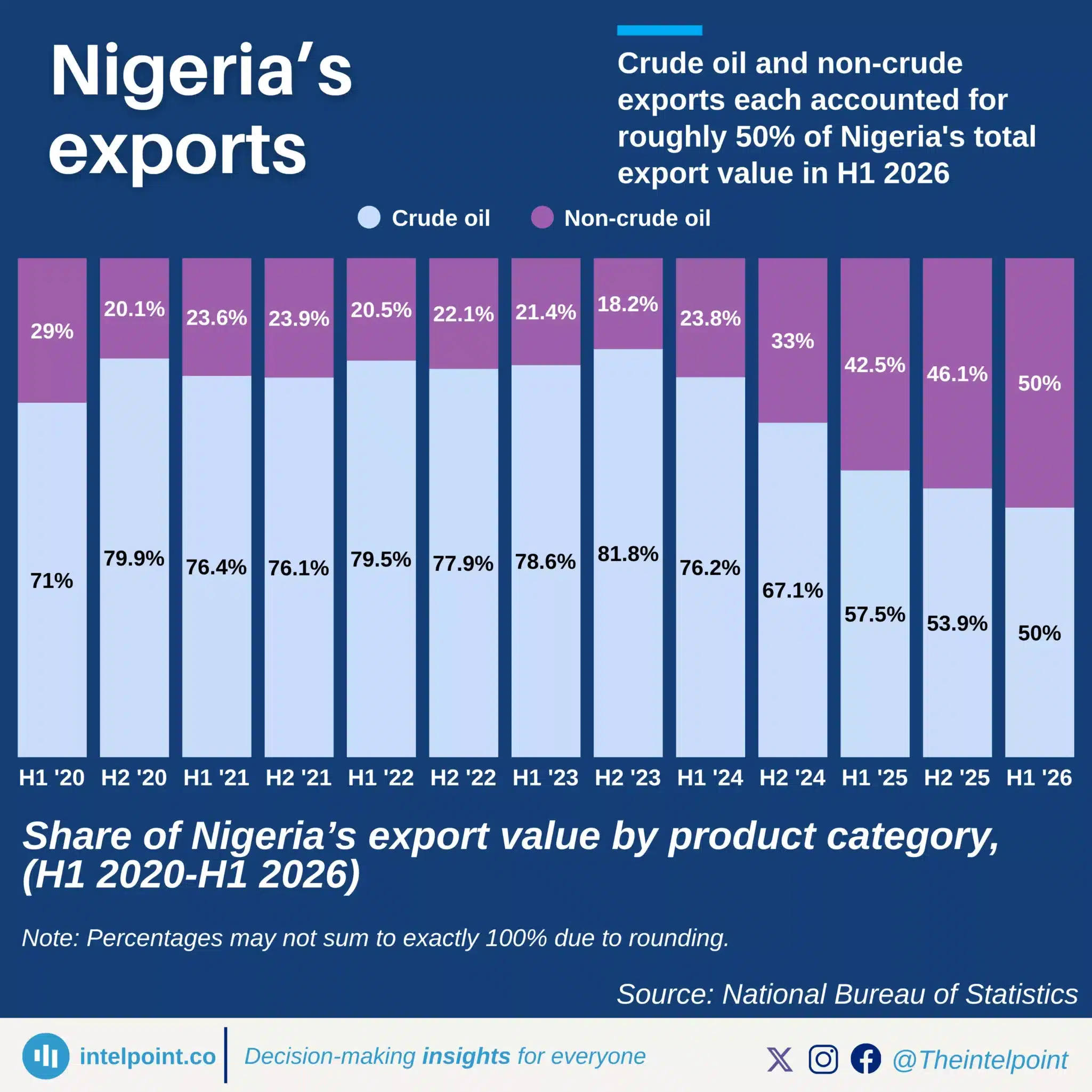
Crude oil and non-crude exports each accounted for roughly 50% of Nigeria's total export value in H1 2026
Nigeria’s crude and non-crude exports were nearly equal in H1 2026, at ₦24.1tn and ₦24tn, respectively.
Non-crude exports overtook crude in Q2 for the first time in at least six years, reaching ₦14.11tn.
Petroleum products and natural gas dominate non-crude exports, while non-oil exports accounted for just 13.8% of Q2 exports.
Nigeria’s export mix is shifting, but remains heavily dependent on hydrocarbons.
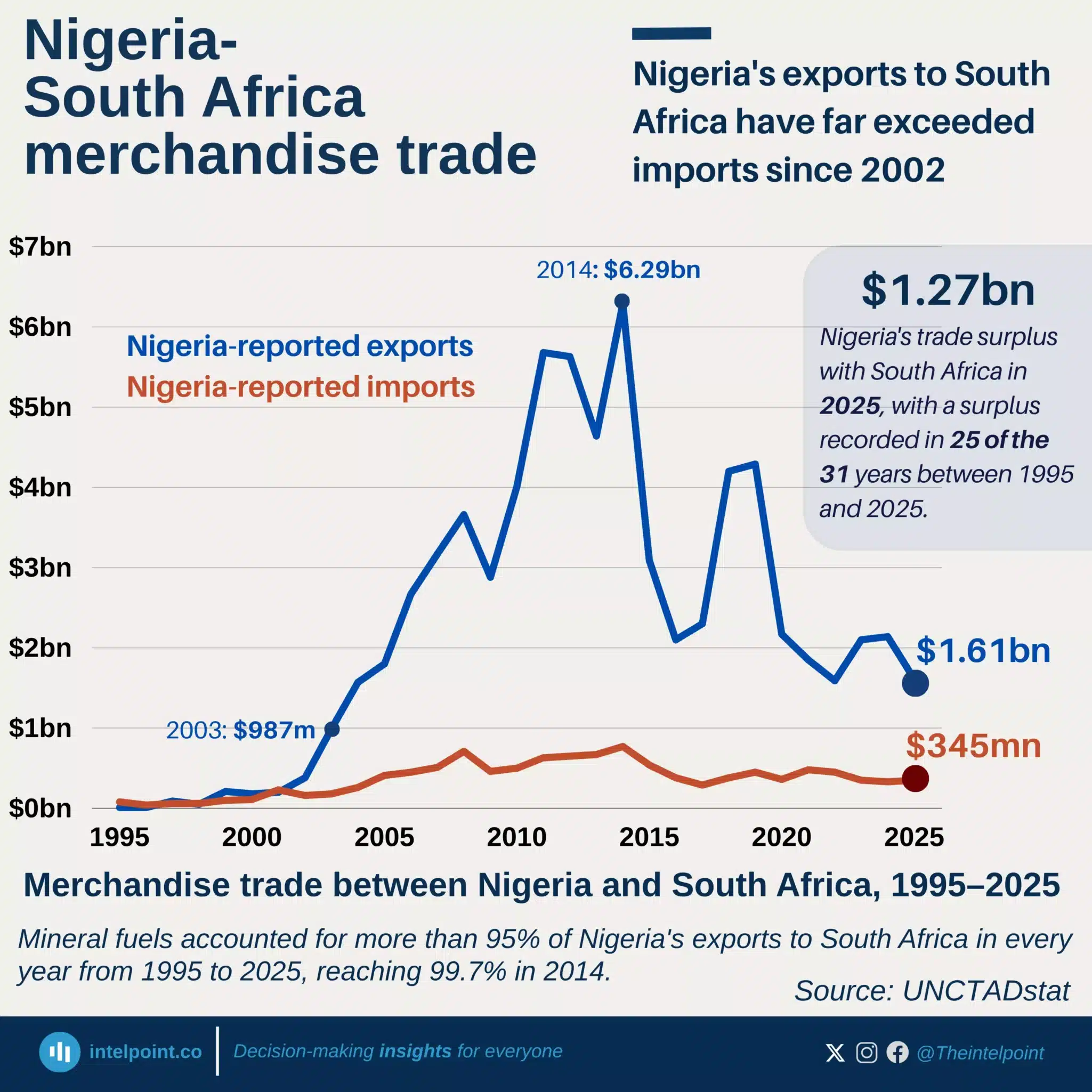
Nigeria's exports to South Africa have far exceeded imports since 2002
Nigeria has exported more to South Africa than it has imported every year since 2002.
Exports peaked at $6.29 billion in 2014, driven almost entirely by mineral fuels.
Imports from South Africa have remained below $1 billion annually.
Nigeria recorded a $1.27 billion trade surplus with South Africa in 2025.
Mineral fuels made up over 95% of Nigeria's exports throughout 1995-2025.
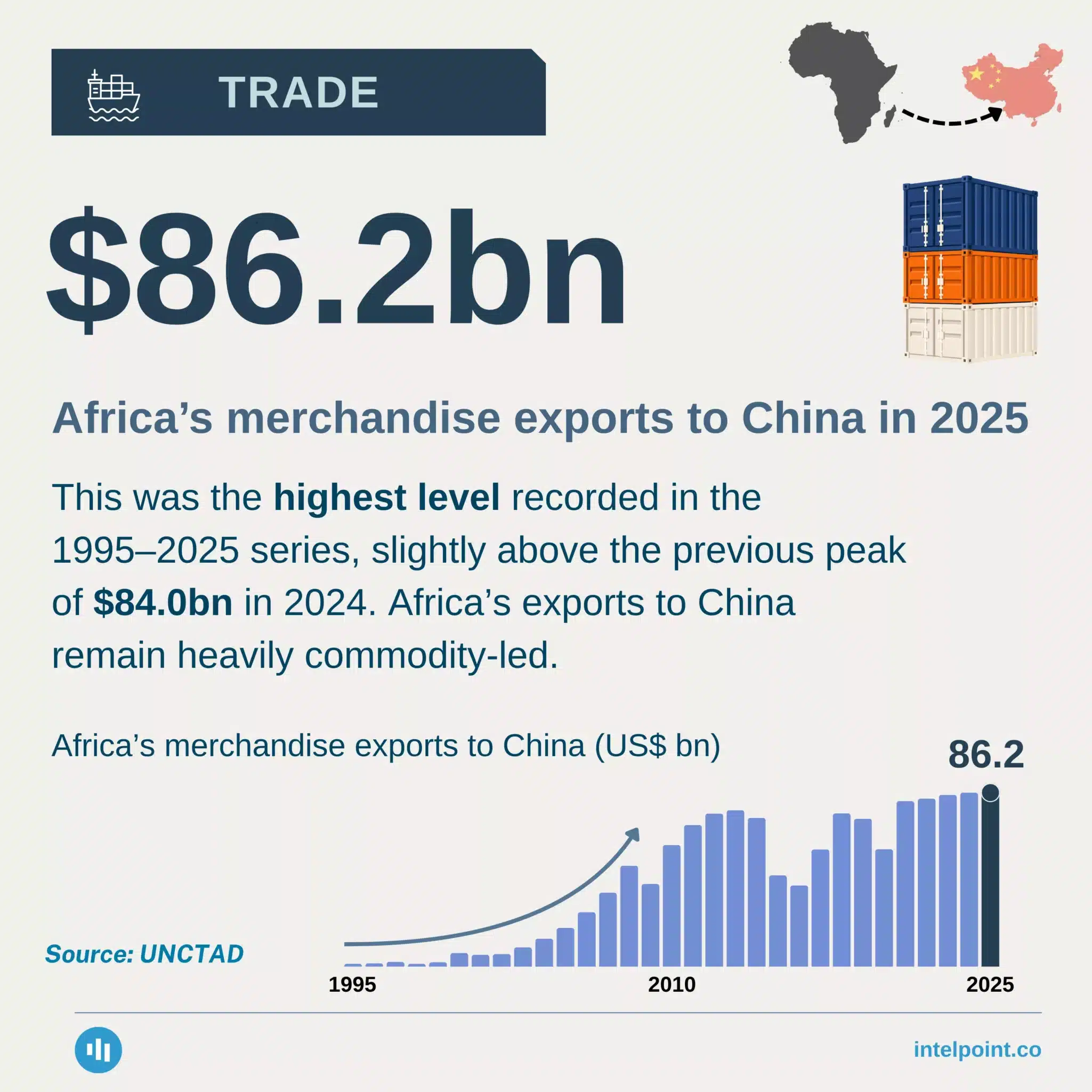
Africa’s merchandise exports to China in 2025
Africa exported a record $86.2bn worth of goods to China in 2025.
China received about 12.5% of Africa’s total merchandise exports.
Annual exports remained below $10bn until 2004, before accelerating sharply.
Export values have remained relatively high since 2021 despite earlier downturns.
The trade relationship remains heavily commodity-led, with limited manufactured exports.
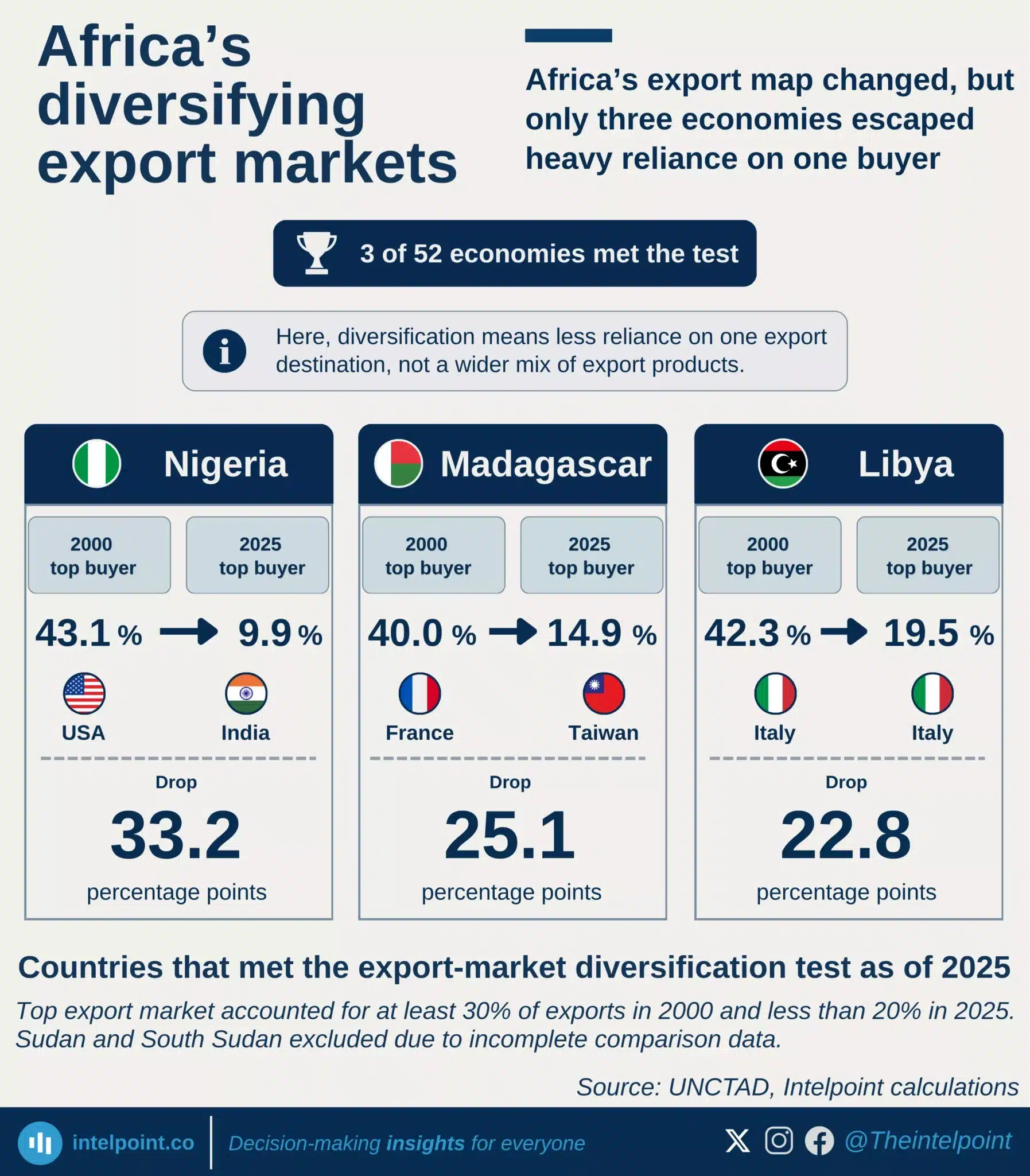
Africa’s export map changed, but only three economies escaped heavy reliance on one buyer
Only 3 of 52 African economies met the export-market diversification test in 2025.
Nigeria recorded the largest and most sustained shift, with its top-buyer share falling from 43.1% to 9.9%.
Madagascar’s top-market share dropped from 40.0% to 14.9% and has remained below 20% since 2021.
Libya narrowly qualified at 19.5%, after remaining above the threshold in 2024.
The test measures reduced dependence on one export destination, not greater product diversification.
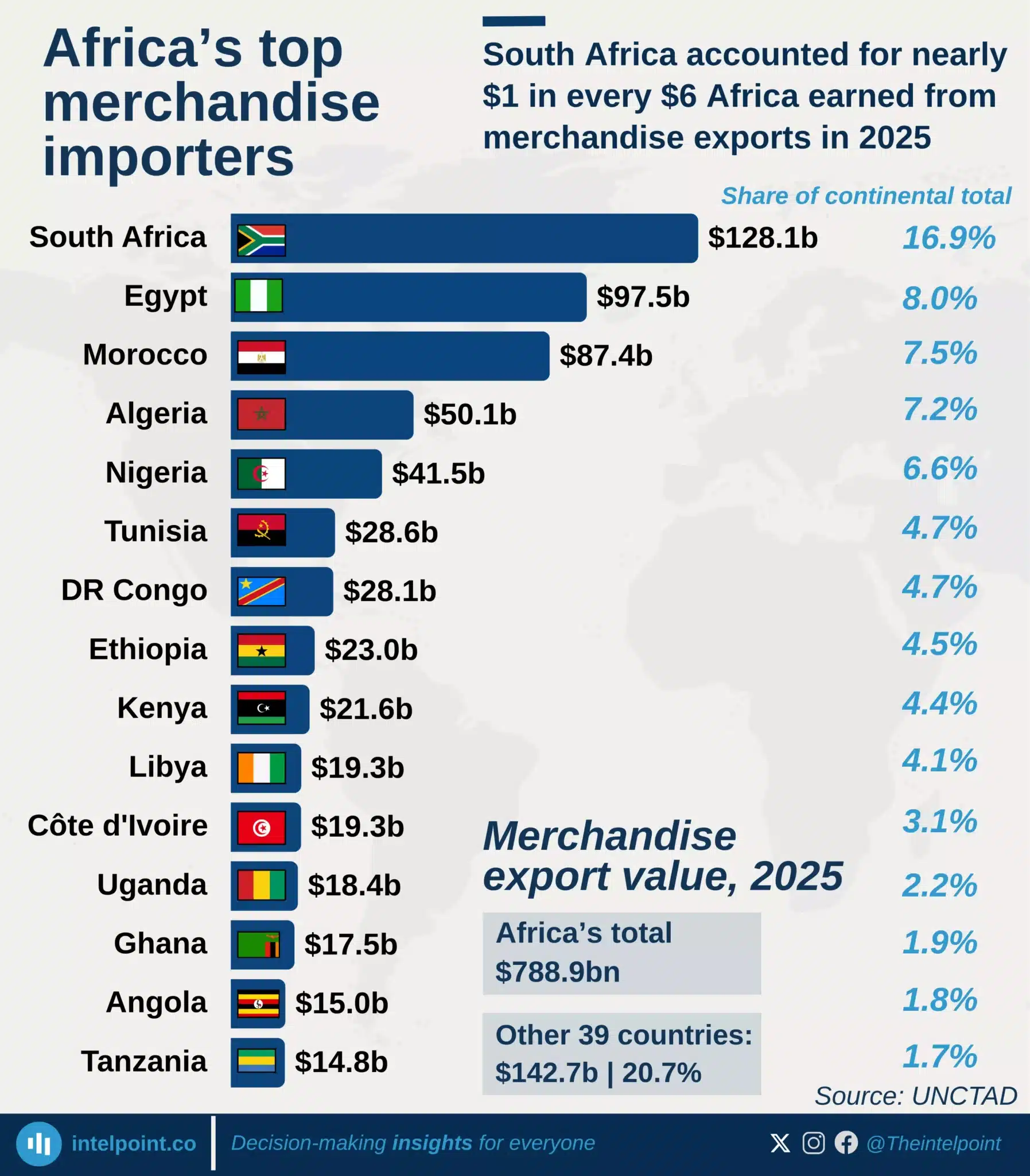
South Africa accounted for nearly $1 in every $6 Africa earned from merchandise exports in 2025
Africa’s merchandise exports reached $689.2 billion in 2025.
Exports grew by 9.7%, the fastest rate outside Asia.
Africa accounted for just 2.6% of global merchandise exports.
South Africa led with $116.4 billion, followed by Nigeria and Egypt.
The top 15 economies generated 79.3% of Africa’s exports.
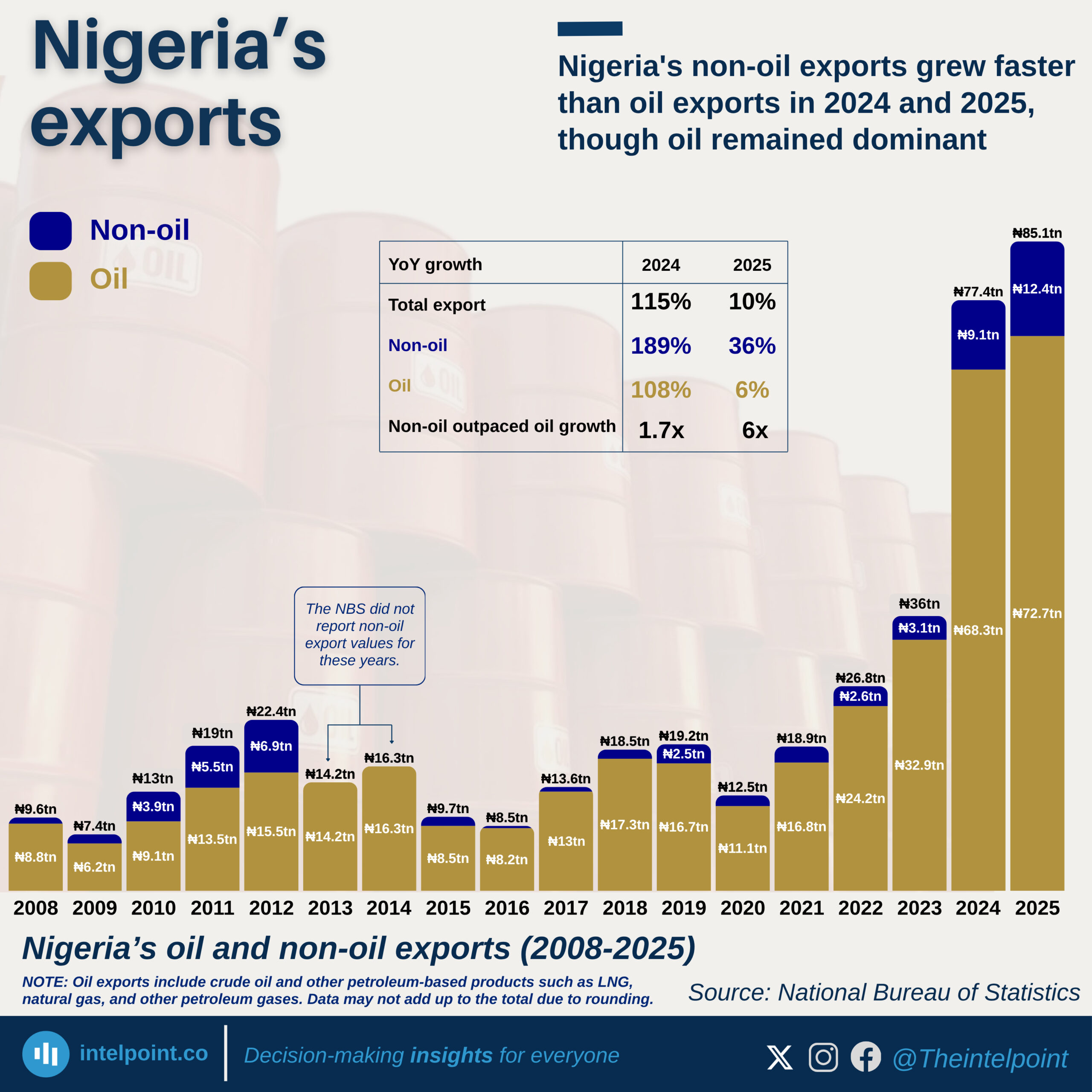
Nigeria's non-oil exports grew faster than oil exports in 2024 and 2025, though oil remained dominant
In 2025, non-oil export growth (36%) was 6x higher than oil (6%).
In 2024, non-oil exports grew by 189% vs oil’s 108%.
Total exports still heavily depend on oil.
Export value rose from ₦36 trillion in 2023 to ₦85.1 trillion in 2025.
POPULAR TOPICS
Nigeria
Trade
Debt
Economy
GDP
GET IN TOUCH
+234 813 204 738
hello@intelpoint.co
FIND US ON
SIGN UP TO OUR NEWSLETTER
Get periodic updates about the African startup space, access to our reports, among others.
Subscribe Here
Subscription Form
Notify
Sign Up
A product of Techpoint Africa. All rights reserved
Subscribe to our newsletter
Subscription Form
Newsletter
Sign Up
download
twitter-square
facebook-square
code
instagram