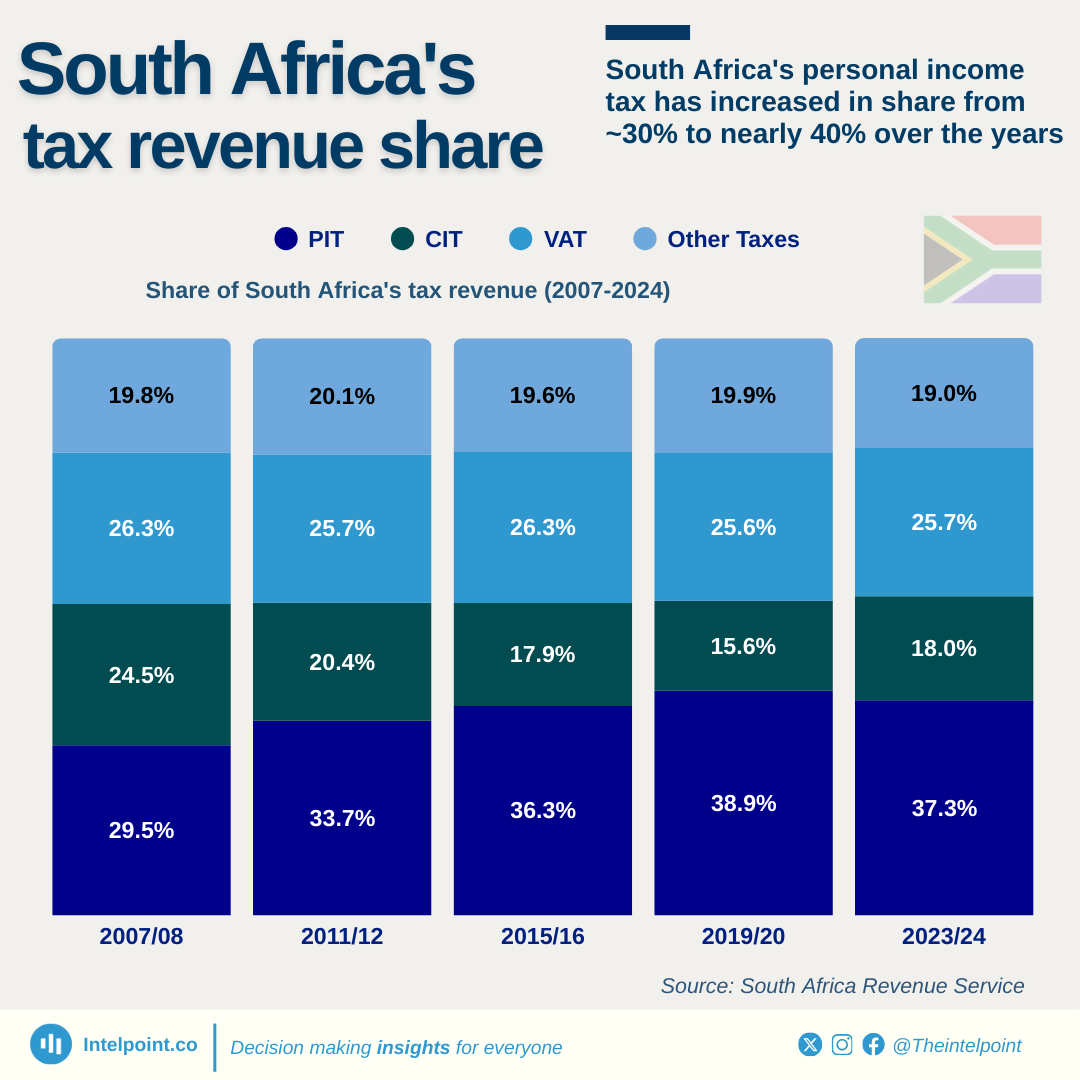
South Africa's personal income tax has increased in share from ~30% to nearly 40% over the years

Key Takeaways:

  • In 2007/08, personal income tax (PIT) contributed 29.46% of total tax revenue, while corporate income tax (CIT) added a substantial 24.46%.
  • The share of personal income tax in tax revenue rose by 27% from 2007/08 to 2023/24.
  • Corporate income tax contribution declined by 26% from 2007/08 to 2023/24.
  • In 2019/20, personal income tax made the largest contribution to tax revenue (38.9%), a 32% rise from the 2007/08 contribution.
  • Other taxes showed minor variations, averaging around 19% of total tax revenue.
  • Personal income tax reached its peak contribution at 38.92% in 2019/20 before dropping by 4% in 2023/24.

In the fiscal years spanning 2007/08 to 2023/24, the composition of South Africa's tax revenue has experienced notable shifts, mirroring broader economic transitions. Personal income tax (PIT) has established itself as the primary source of revenue, climbing from 29.46% in 2007/08 to 37.28% by 2023/24 and peaking at 38.92% in 2019/20. This trend reflects an increasing dependence on individual taxpayers.

In contrast, the Corporate Income Tax (CIT) witnessed a decrease from 24.46% in 2007/08 to 17.99% in 2023/24, including a significant reduction to 15.60% in 2019/20. This pattern aligns with analyses indicating a reduction in CIT contributions linked to factors like a contracting tax base and difficulties faced by key industries.

Meanwhile, VAT contributions remained relatively consistent throughout the examined years, oscillating between 25.58% and 26.27%. Other taxes displayed slight variances, averaging around 19% of the overall tax revenue.

In conclusion, the increasing significance of personal income tax points to a growing burden on individual taxpayers, while the gradual decline in CIT may suggest attempts to foster a more favourable business climate or reflect wider economic challenges.
Source:

South Africa Revenue Service

Period:

2007-2024
HTML code to embed chart
Want a bespoke report?
Reach out
Tags
Related Insights

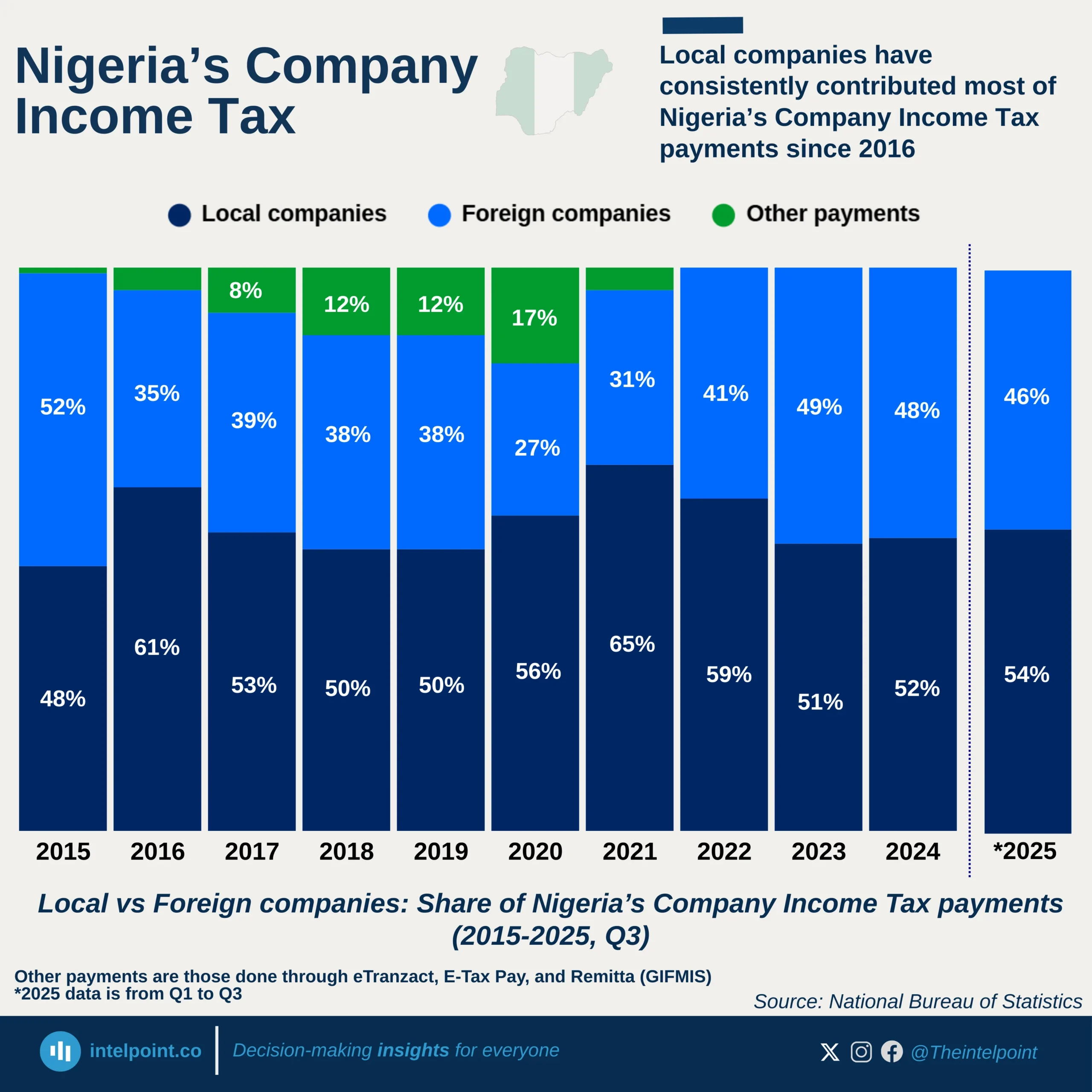
Local companies have consistently contributed most of Nigeria’s Company Income Tax payments since 2016
  • Local companies dominated CIT contributions in most years, accounting for over 50% of payments in 9 of 11 periods between 2015 and 2025 (Q1–Q3).
  • Foreign companies briefly closed the gap in 2023, contributing 49%, the closest they have come to matching local firms.
  • Local companies recorded their strongest share in 2021 at 65%, marking the widest gap between local and foreign contributors.
  • “Other payments” peaked during the pandemic, rising to 17% in 2020 before dropping to 0% from 2022 onward.

Local companies have consistently contributed most of Nigeria’s Company Income Tax payments since 2016
  • Local companies dominated CIT contributions in most years, accounting for over 50% of payments in 9 of 11 periods between 2015 and 2025 (Q1–Q3).
  • Foreign companies briefly closed the gap in 2023, contributing 49%, the closest they have come to matching local firms.p
  • Local companies recorded their strongest share in 2021 at 65%, marking the widest gap between local and foreign contributors.
  • “Other payments” peaked during the pandemic, rising to 17% in 2020 before dropping to 0% from 2022 onward.

97% of businesses in Kogi are aware of Nigeria's 2025 tax reform, while 99% in Abia are not
  • Kogi entrepreneurs have the highest tax policy awareness in Nigeria (96.8%) in 2025.
  • Abia has the lowest awareness nationwide at just 1.4%.
  • Fewer than one-third of Nigerian states have awareness levels above 60%.
  • Major economic hubs like Lagos and Rivers have awareness below 50%.
  • Northern states dominate the top awareness rankings more than southern states.
  • Several states cluster around the 40–50% range, indicating partial reach.
  • States with low awareness risk lower compliance and higher friction during enforcement.
  • The gap between the highest and lowest states exceeds 95 percentage points, showing extreme disparity.

Nigeria's non-oil tax revenue solidified its dominance over oil in FIRS collections, reaching a record of ₦15.9t in 2024, more than 2.7x the ₦5.8t from oil
  • FIRS recorded ₦15.9 trillion of non-oil tax, almost three times the ₦5.8 trillion recorded for oil tax.
  • Non-oil tax revenue made up 73.3% of the total revenue collected in 2023.
  • From 2012 down to 2024, non-oil tax revenue surpassed oil tax revenue most of the time.
  • Oil taxes are petroleum profit tax and company income (oil & gas) tax while non-profit tax includes company income (non-oil) tax, gas tax, capital gains, stamp duty, NCS import VAT, and non-import VAT.

Nigeria's FIRS surpassed 2024 target as revenue soared 76% to a record ₦21.7 trillion
  • The FIRS collected ₦21.7 trillion, outpacing the target of ₦19.4 trillion set by the government.
  • FIRS grossed its highest revenue of all time since 2012 in 2024.
  • Comparing the values of 2021, 2022, 2023 and 2024 reveals a significant shift.
  • The tax revenue collected in 2024 surpassed the amount collected in 2023 by an outstanding 75.6%.

Non-oil company income tax and two other sources accounted for over 70% of Nigeria's tax revenue in 2024
  • Company Income Tax (Non-Oil) emerged as the largest contributor, accounting for over 30% of total tax revenue.
  • NCS-Import VAT followed closely, contributing 23.63%, emphasising the significance of import-related taxes to Nigeria's revenue.
  • Traditional oil-based taxes such as Petroleum Profit Tax/Hydrocarbon Tax and CIT (Oil & Gas) jointly contributed over 26%, showing that oil remains a vital but declining pillar.
  • Newer tax streams like the Electronic Money Transfer Levy and NASENI (National Agency for Science and Engineering Infrastructure) funding have emerged, but still make up less than 2% of total revenue.
  • Minor tax categories like Capital Gains Tax, NITDEF (National Information Technology Development Fund), and NPTFL (Nigeria Police Trust Fund) had negligible impact, each contributing less than 0.5%

POPULAR TOPICS
SIGN UP TO OUR NEWSLETTER
Get periodic updates about the African startup space, access to our reports, among others.
Subscribe Here
Subscription Form

A product of Techpoint Africa. All rights reserved