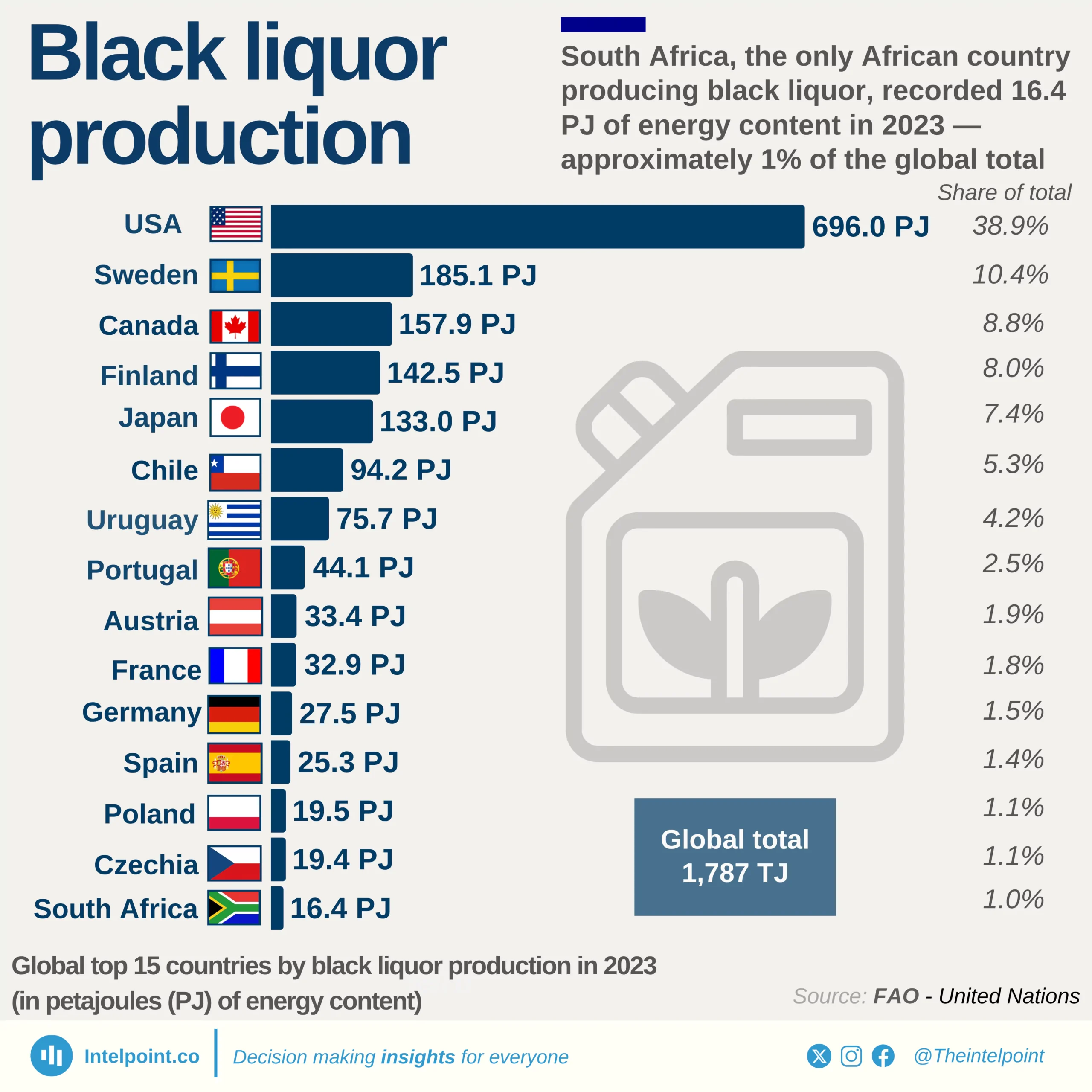
South Africa, the only African country producing black liquor produced only 16.4PJ in 2023, approximately 1% of the global total

  • The United States of America led the production of black liquor with 696.0PJ produced, making up 38.9% of the global total produced in 2023.
  • South Africa is the only African country producing black liquor with 16.4PJ produced, making up 1% of the global total.
  • The total amount of black liquor produced globally in 2023 was 1,787PJ.
  • Sweden, Canada, Finland and Japan produced 185.1PJ (10.4%), 157.9PJ (8.8%), 142.5PJ (8.0%), and 133.0PJ (7.4%), respectively.

Black liquor is a by-product of the kraft process used to convert wood into paper pulp. It is a biofuel derived from organic, renewable biomass sources and represents a significant form of industrial energy.

In 2023, the United States led in black liquor energy content with 696.0 PJ, representing 38.9% of the global total. Sweden, Canada, Finland, and Japan followed with 185.1 PJ (10.4%), 157.9 PJ (8.8%), 142.5 PJ (8.0%), and 133.0 PJ (7.4%), respectively.

South Africa was the only African country with reported black liquor production in 2023, totaling 16.4 PJ (1% of the global share). The relatively low share highlights a significant gap in energy recovery from industrial by-products in Africa, especially in relation to the growing pulp and paper industry across the continent.
Source:

Food and Agriculture organization of the UN

Period:

2023
HTML code to embed chart
Want a bespoke report?
Reach out
Tags
Related Insights

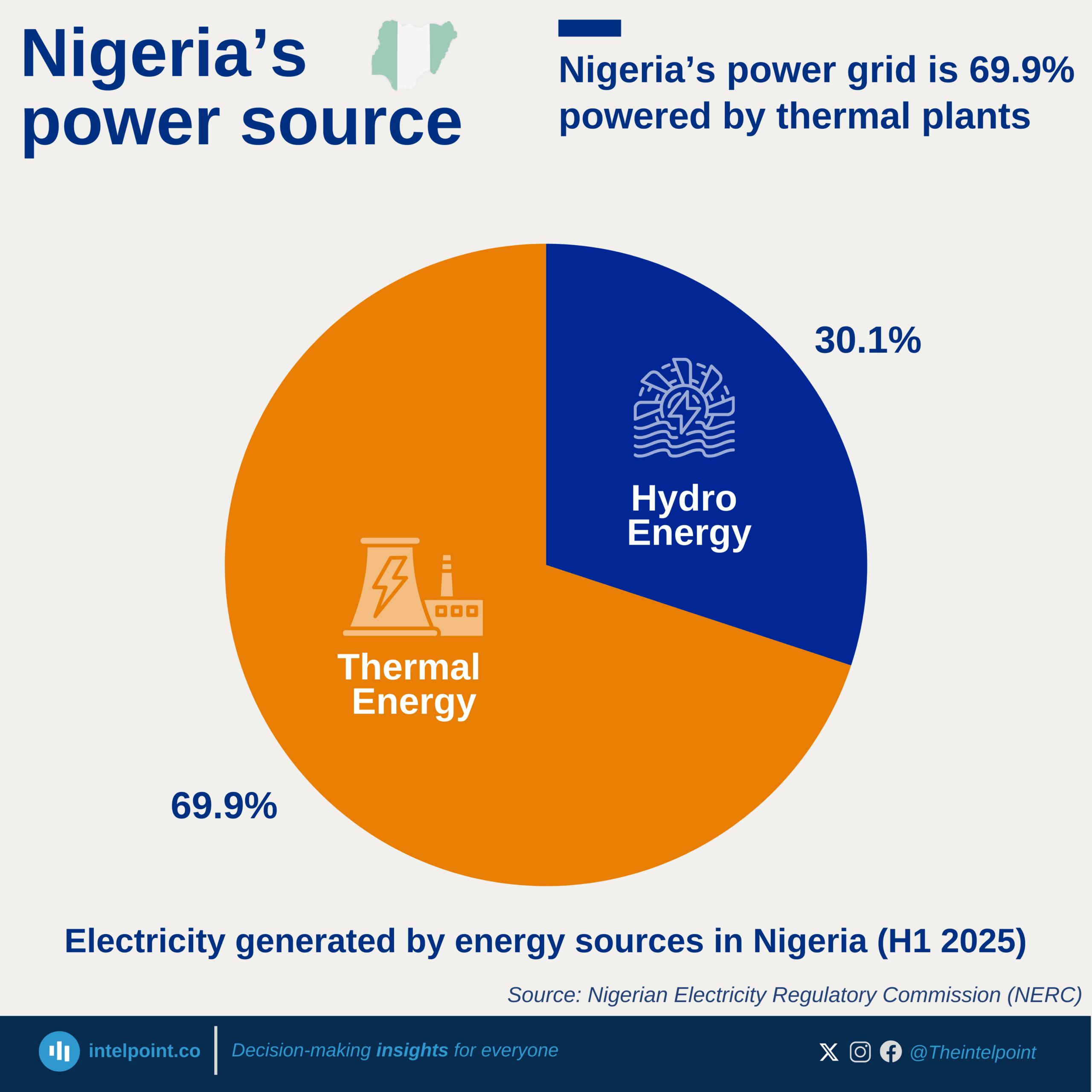
Nigeria’s power grid is 69.9% powered by thermal plants
  • Thermal energy dominates Nigeria’s grid, supplying 69.9% of total power.
  • Hydro plants contribute 30.1%, making them the country’s second major source.
  • The heavy reliance on thermal generation shows Nigeria’s grid is still largely fossil-fuel driven.
  • Hydro remains a crucial but secondary source, supporting overall supply stability.

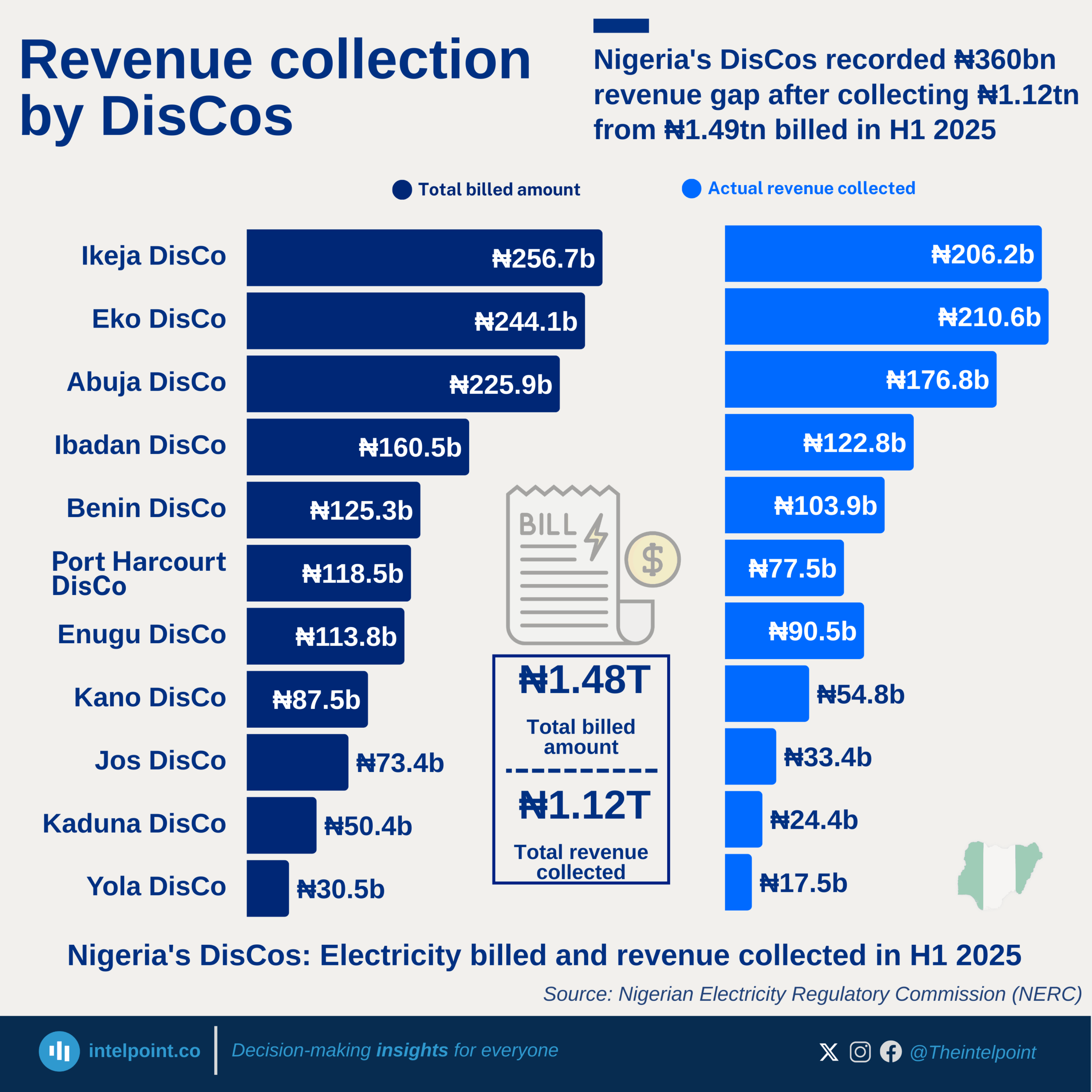
Nigeria's DisCos recorded ₦360bn revenue gap after collecting ₦1.12tn from ₦1.49tn billed in H1 2025
  • DisCos billed approximately ₦1.49 trillion but collected only ₦1.12 trillion in H1 2025.
  • Ikeja and Eko DisCos generated the highest revenues, collecting ₦206.22 billion and ₦210.59 billion, respectively.
  • Revenue collection gaps remain significant, with Jos, Kaduna, and Yola posting the weakest collection performances.
  • The wide gap between billings and actual collections suggests persistent challenges in customer payment compliance, metering, and distribution efficiency.

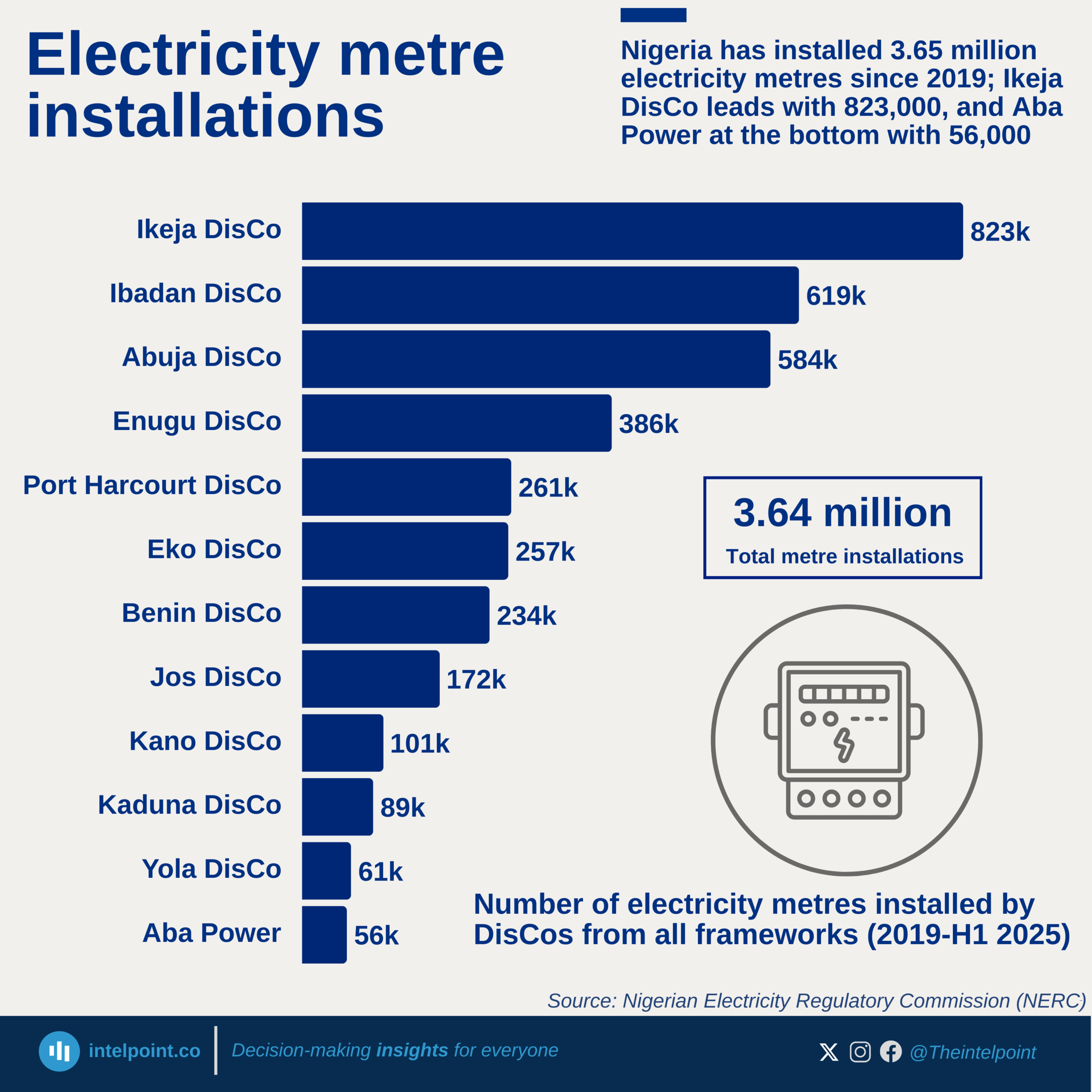
Nigeria has installed 3.65 million electricity metres since 2019; Ikeja DisCo leads with 823,000, and Aba Power at the bottom with 56,000
  • Approximately 3.65 million metres have been installed nationwide across all frameworks since 2019.
  • Ikeja DisCo leads by a wide margin with 823,000 installations, over twice the volume of most other DisCos.
  • Kaduna, Yola, and Aba Power recorded the lowest metre installations, each below 100,000.
  • The disparities in installation totals reveal uneven progress in achieving nationwide metering coverage.

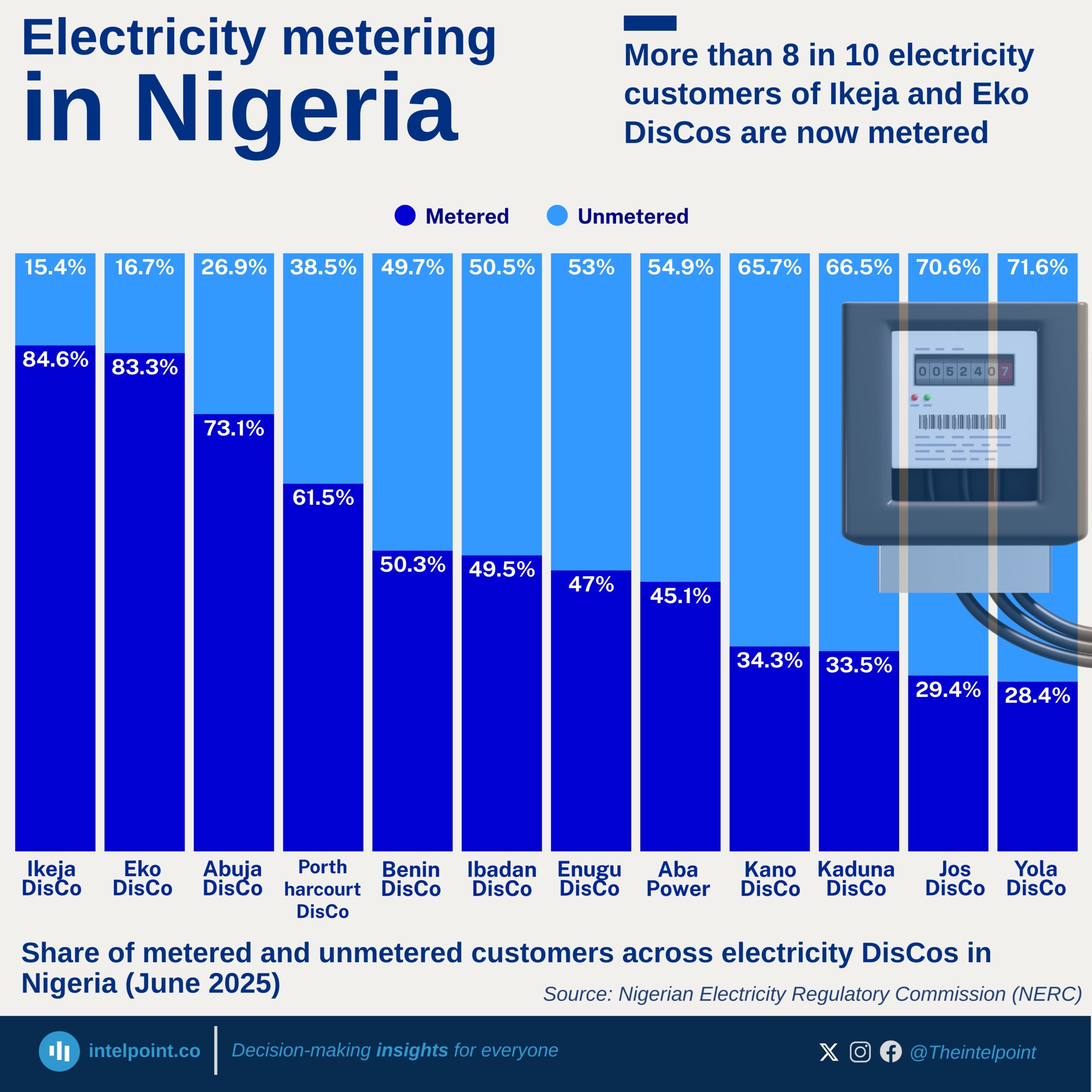
More than 8 in 10 electricity customers of Ikeja and Eko DisCos are now metered
  • Ikeja (84.6%) and Eko (83.3%) lead Nigeria’s metering performance, keeping unmetered customers below 17%.
  • Eight out of the twelve DisCos have metering rates below 60%, showing a wide sector imbalance.
  • The worst-performing DisCos — Yola, Jos, Kaduna, and Kano — have over 65% unmetered customers.
  • Regional disparities are sharp: Lagos and Abuja outperform northern and south-eastern DisCos by large margins.

South Africa dominates Africa's battery energy storage pipeline, with over three times the capacity of Egypt, the next largest market
  • South Africa dominates with 30 battery storage systems, the largest by far.
  • Egypt is the second-largest market with 7 projects, while Morocco has 4.
  • Nigeria and Senegal have five projects each (operational + pipeline).
  • Several countries, including Ghana, Togo, Angola, Botswana, DR Congo, and Mauritius, each have just one or two projects, indicating an uneven spread across the continent.
  • South Africa also leads in systems under construction (7).
  • Operational projects are still limited continent-wide, with most systems either under construction or in the planning pipeline.

Nigeria’s urban electrification has stalled below 90% for over three decades
  • Urban electricity access has remained between 80% and 89% since 1990, never crossing to 90%.
  • The inability to achieve universal access suggests that infrastructure expansion has struggled to keep pace with rapid urbanisation and population growth.
  • Periodic dips in access, such as in 2010 and 2015, point to challenges in maintaining consistent electricity supply rather than just extending connections.
  • Insufficient generation, outdated grids, and policy inefficiencies have constrained Nigeria’s ability to deliver reliable and universal electricity access even in its urban centres.

POPULAR TOPICS
SIGN UP TO OUR NEWSLETTER
Get periodic updates about the African startup space, access to our reports, among others.
Subscribe Here
Subscription Form

A product of Techpoint Africa. All rights reserved