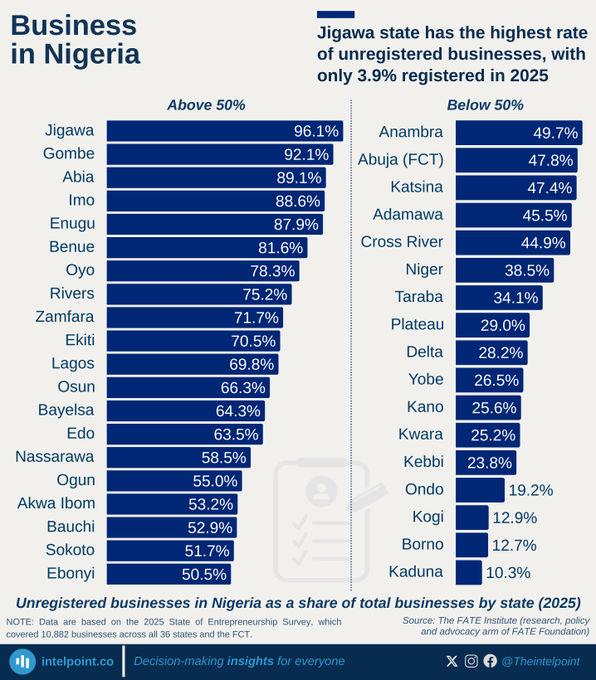
Jigawa state has the highest rate of unregistered businesses, with only 3.9% registered in 2025

  • Jigawa has the highest share of unregistered businesses in Nigeria (96.1%) in 2025.
  • Over half (20) of Nigerian states have more than 50% of businesses operating informally.
  • Informality is not limited to poorer states; Lagos and Rivers both exceed 65%.
  • Southern and northern states alike show high informality, indicating a nationwide challenge.
  • Only a small group (10) of states have informality rates below 30%.
  • Kaduna records the lowest share of unregistered businesses (10.3%)

Nigeria’s informal economy remains deeply entrenched. In 2025, most Nigerian states still have a majority of businesses operating without formal registration, with Jigawa standing out sharply: 96.1% of businesses are unregistered, meaning only 3.9% are formally registered. This positions Jigawa as the state with the highest level of informality in the country and highlights how far parts of Nigeria remain from a formalised business environment.

What is striking is how widespread informality is across the country, cutting across regions and economic profiles. Several states, including Gombe, Abia, Imo, Enugu, and Benue, record unregistered business rates above 80%, while even commercial hubs like Lagos (69.8%) and Rivers (75.2%) show that informality dominates over formal enterprise. This suggests that business registration in Nigeria is not just a rural or low-income issue, but a systemic feature of entrepreneurship nationwide.
Source:

The FATE Institute (research, policy and advocacy arm of FATE Foundation)

Period:

2025
HTML code to embed chart
Want a bespoke report?
Reach out
Tags
Related Insights

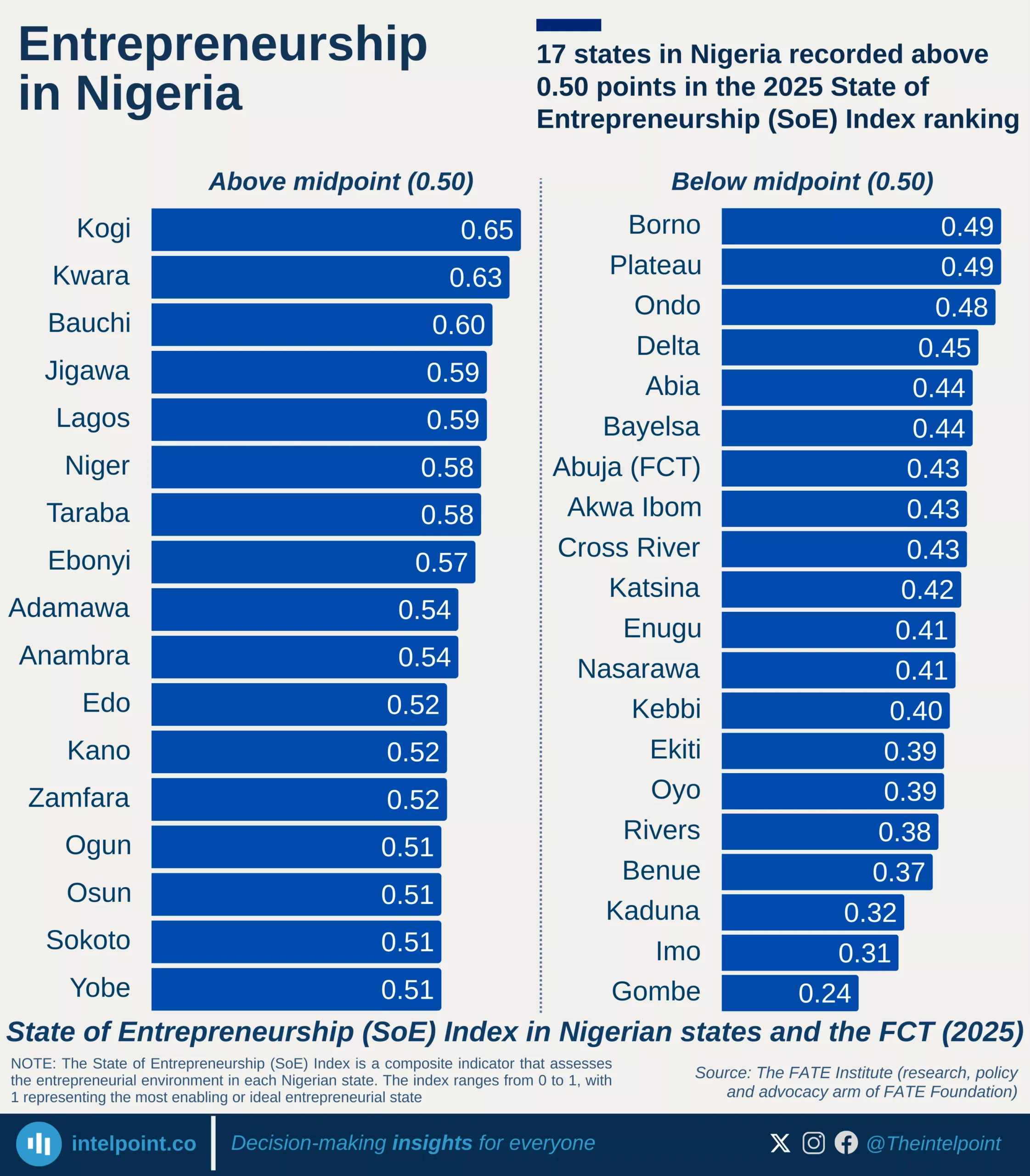
17 states in Nigeria recorded above 0.50 points in the 2025 State of Entrepreneurship (SoE) Index ranking
  • Only 17 of 37 states and the FCT recorded above-midpoint entrepreneurship scores in 2025.
  • Kogi State leads nationally, outperforming all others on the SoE Index.
  • Strong entrepreneurship performance is not limited to Lagos or major commercial centres.
  • Several northern and middle-belt states rank high.
  • Urban and resource-rich states do not automatically guarantee strong entrepreneurial outcomes.
  • Local governance and operating conditions appear more influential than state size or wealth.

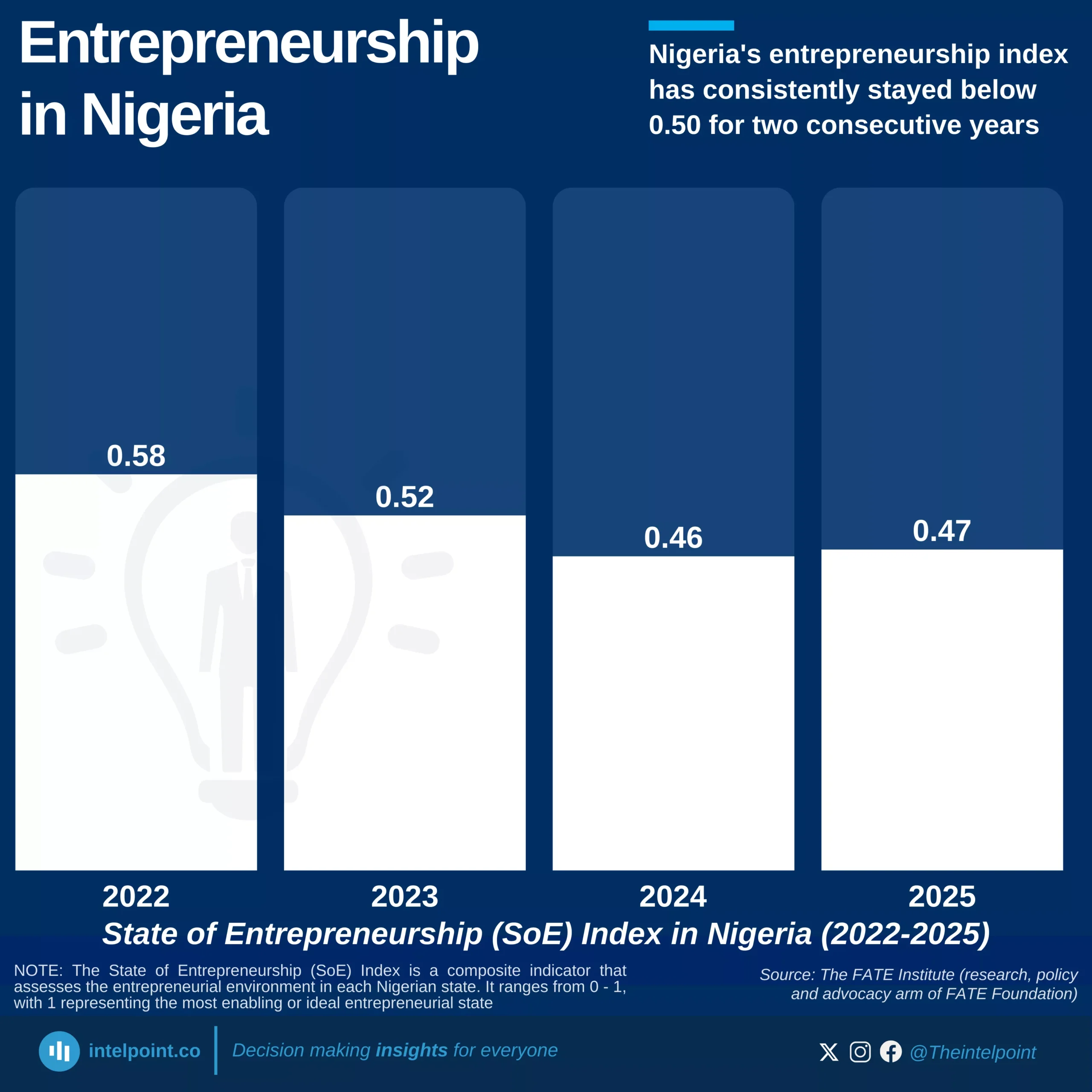
Nigeria's entrepreneurship index has consistently stayed below 0.50 for two consecutive years
  • Nigeria’s entrepreneurship index increased in 2025 for the first time since 2022.
  • The 2025 score (0.47) represents a reversal of a two-year downward trend.
  • The ecosystem remains weaker than in 2022, when the index peaked at 0.58.
  • The sharpest decline occurred between 2022 and 2023.
  • The improvement from 2024 to 2025 is incremental, not transformative.
  • The index suggests stabilisation rather than full recovery in the entrepreneurial environment.

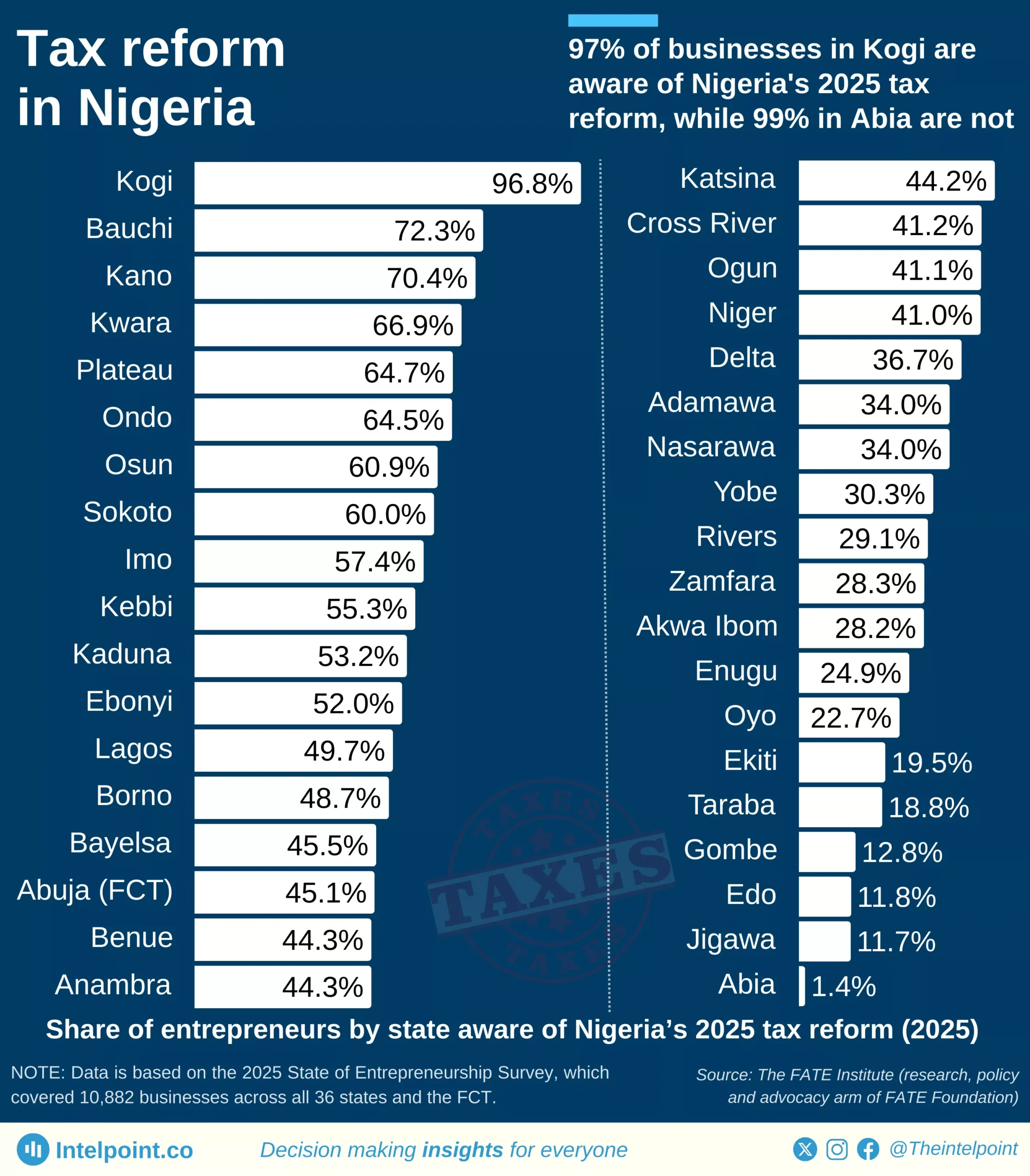
97% of businesses in Kogi are aware of Nigeria's 2025 tax reform, while 99% in Abia are not
  • Kogi entrepreneurs have the highest tax policy awareness in Nigeria (96.8%) in 2025.
  • Abia has the lowest awareness nationwide at just 1.4%.
  • Fewer than one-third of Nigerian states have awareness levels above 60%.
  • Major economic hubs like Lagos and Rivers have awareness below 50%.
  • Northern states dominate the top awareness rankings more than southern states.
  • Several states cluster around the 40–50% range, indicating partial reach.
  • States with low awareness risk lower compliance and higher friction during enforcement.
  • The gap between the highest and lowest states exceeds 95 percentage points, showing extreme disparity.

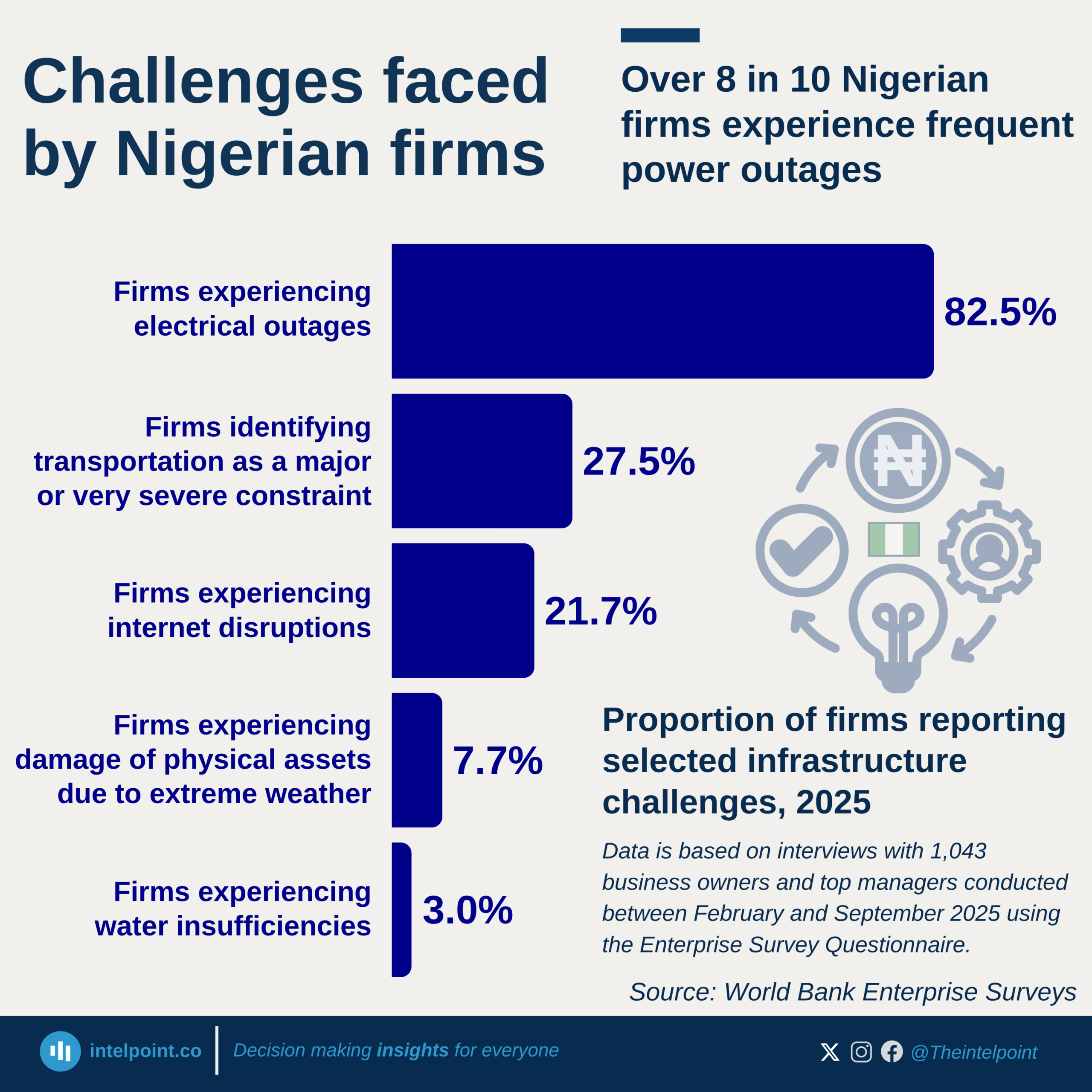
Over 8 in 10 Nigerian firms experience frequent power outages
  • Power supply remains the biggest challenge affecting Nigerian businesses, affecting 82.5% of firms nationwide.
  • Poor transport infrastructure limits operations for over a quarter of businesses.
  • Internet disruptions affect more than one in five firms, highlighting connectivity gaps.
  • Climate and water issues are emerging risks, with some firms reporting weather damage and supply shortages.
  • The survey covered 1,043 firms across Nigeria and reflects responses from business owners and top managers.

POPULAR TOPICS
SIGN UP TO OUR NEWSLETTER
Get periodic updates about the African startup space, access to our reports, among others.
Subscribe Here
Subscription Form

A product of Techpoint Africa. All rights reserved