Iceland ranks first in the world for gender equality, with a parity score of 0.935, reflecting a strong balance between men and women.

Key takeaways:

  • With a score of 0.935, Iceland continues to set the benchmark for gender equality.
  • Namibia (0.805) and Nicaragua (0.811) are redefining expectations, proving that gender equality is not just a goal for wealthier nations but a global priority.
  • Germany (0.810), Ireland (0.802), and Lithuania (0.793) highlight Europe’s dominant role in advancing gender parity, setting examples for other regions.
  • Namibia (0.805) and South Africa (0.785) represent two of Africa’s most gender-equal societies.
  • Nigeria has a score of 0.65, making it the 125th country worldwide

Iceland has presented itself as the global leader in gender equality for 2024, with a near-perfect parity score of 0.935. This remarkable achievement reflects a strong balance between men and women across key metrics such as economic participation, political empowerment, education, and health. Finland and Norway follow closely, both achieving scores of 0.875.
Source:

World Economic Forum

Period:

2024
HTML code to embed chart
Want a bespoke report?
Reach out
Tags
Related Insights

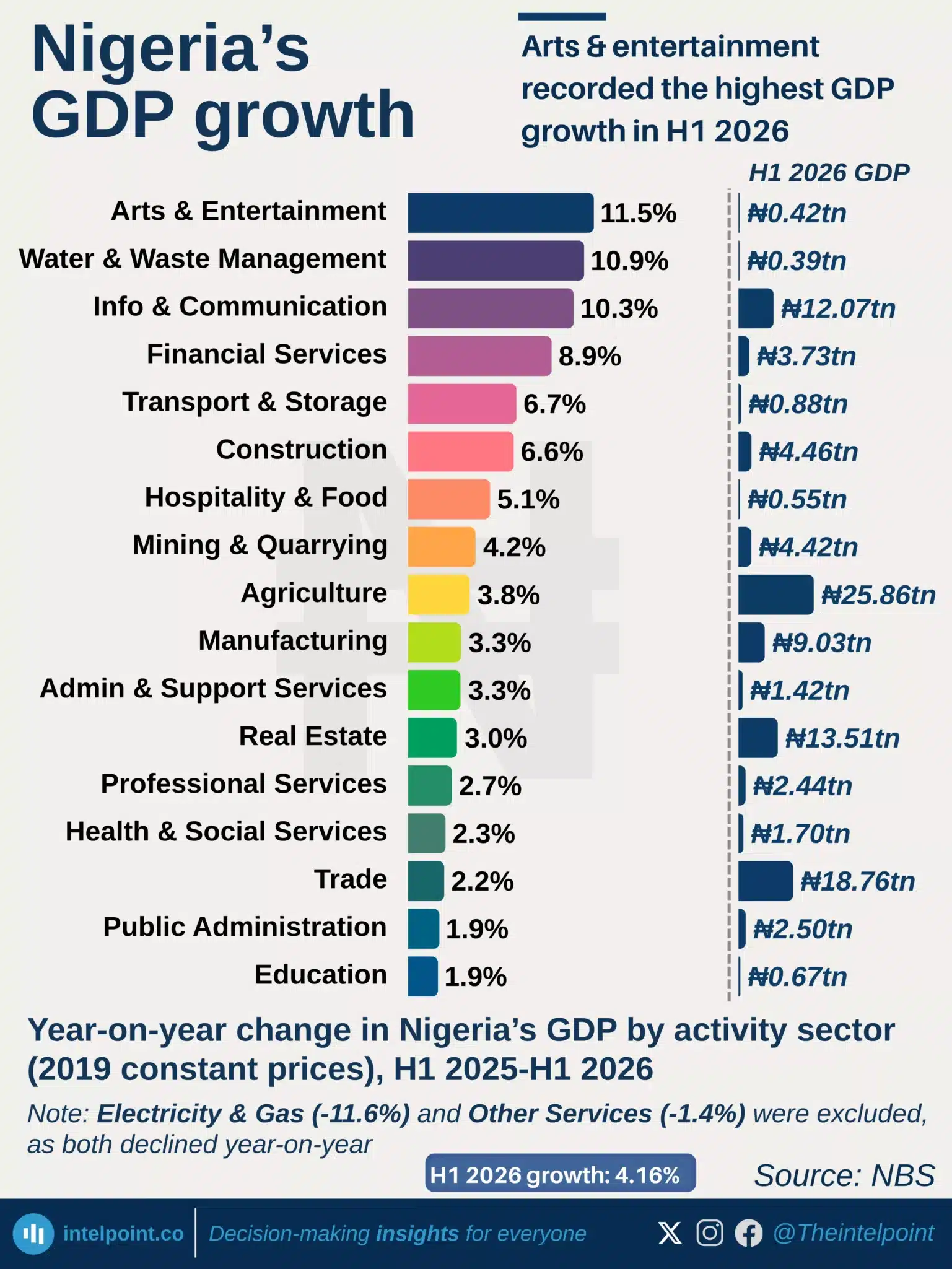
Arts & entertainment recorded the highest GDP growth in H1 2026
  • Nigeria’s economy grew 4.16% in H1 2026, but growth was uneven across sectors.
  • Arts and entertainment grew fastest at 11.5%, followed by water and waste management (10.9%) and information and communication (10.3%).
  • Agriculture, which accounts for about a quarter of GDP, grew 3.8%, below the headline rate.
  • Trade and real estate also lagged, growing 2.2% and 3.0%, respectively.
  • Electricity and gas was the biggest drag, contracting 11.6%, while Other Services fell 1.4%.

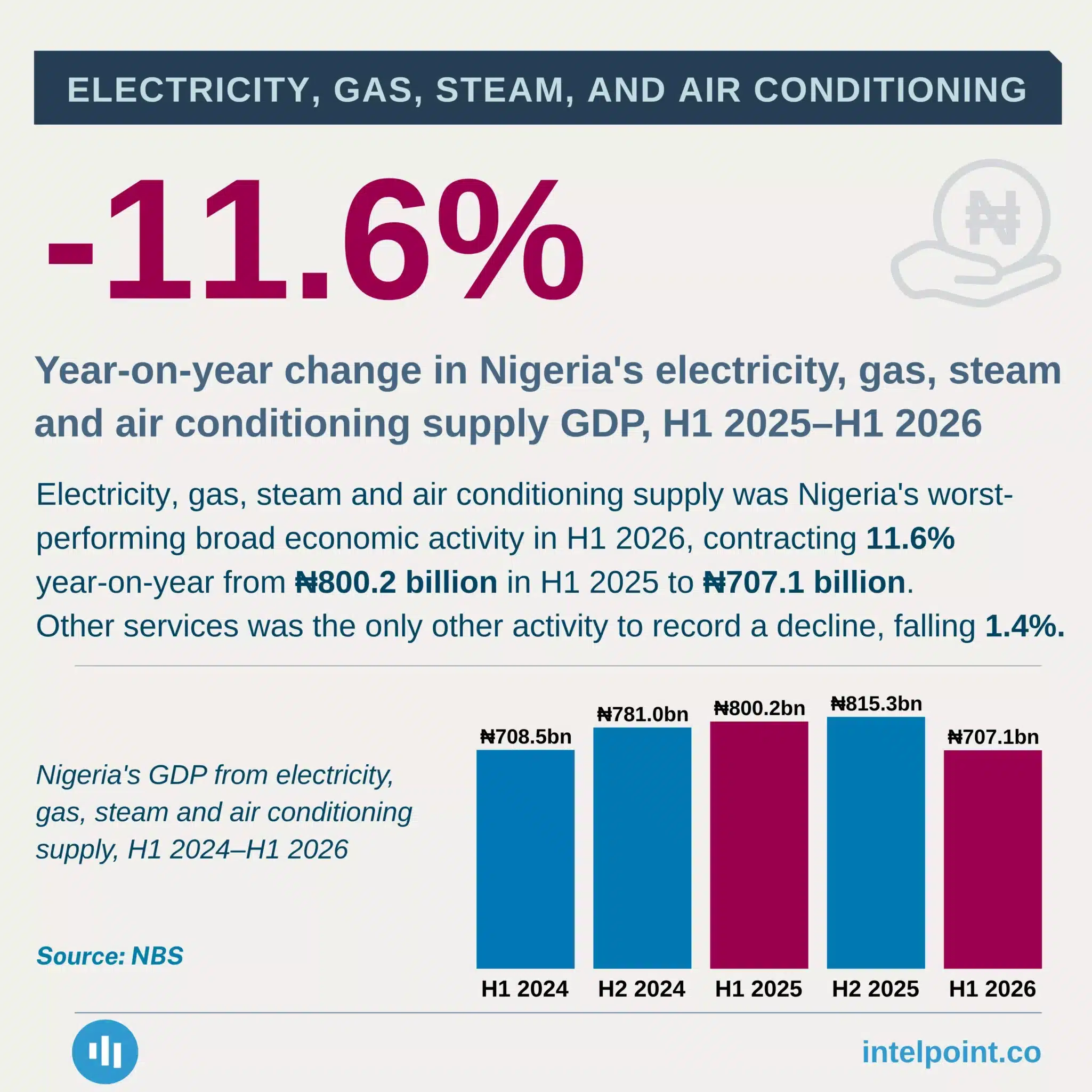
Year-on-year change in Nigeria's electricity, gas, steam and air conditioning supply GDP
  • Electricity, gas and related supply was Nigeria’s worst-performing broad economic activity in H1 2026.
  • Sector GDP fell 11.6% year-on-year, from ₦800.2bn to ₦707.1bn.
  • Output fell below H1 2024 levels, when the sector recorded ₦708.5bn.
  • Only one other broad activity contracted: Other Services, which fell 1.4%.
  • The sector contributed just 0.7% of Nigeria’s real GDP on average over the period shown.

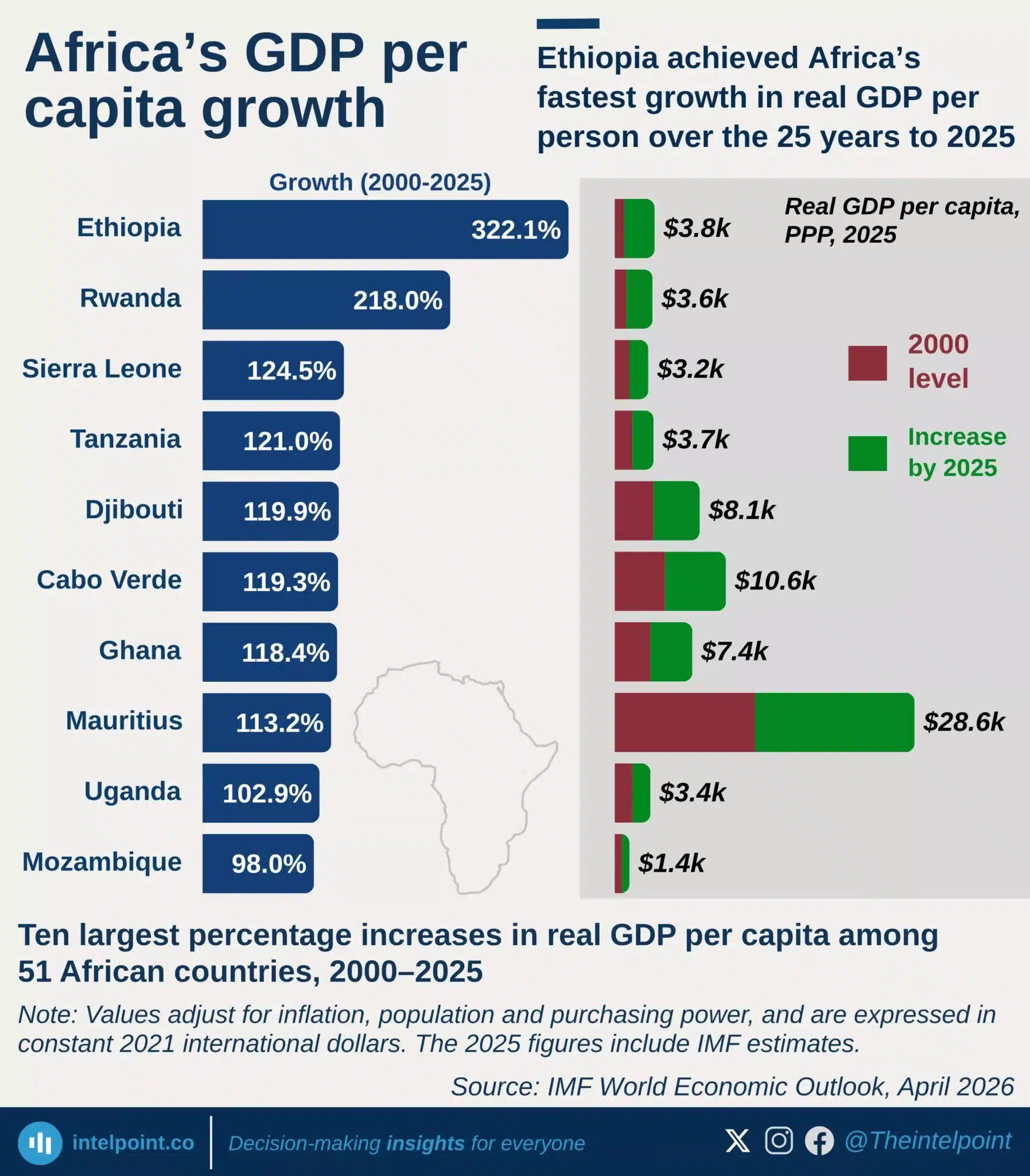
Ethiopia achieved Africa’s fastest growth in real GDP per person over the 25 years to 2025
  • Ethiopia recorded Africa's fastest real GDP per capita growth between 2000 and 2025.
  • Rwanda ranked second, while Sierra Leone, Tanzania and Djibouti completed the top five.
  • Ethiopia's real GDP per capita rose 322%, from $910 to $3,843.
  • Mauritius recorded Africa's largest absolute gain in real GDP per capita.
  • Nigeria ranked 15th, with real GDP per capita increasing 76.7%.

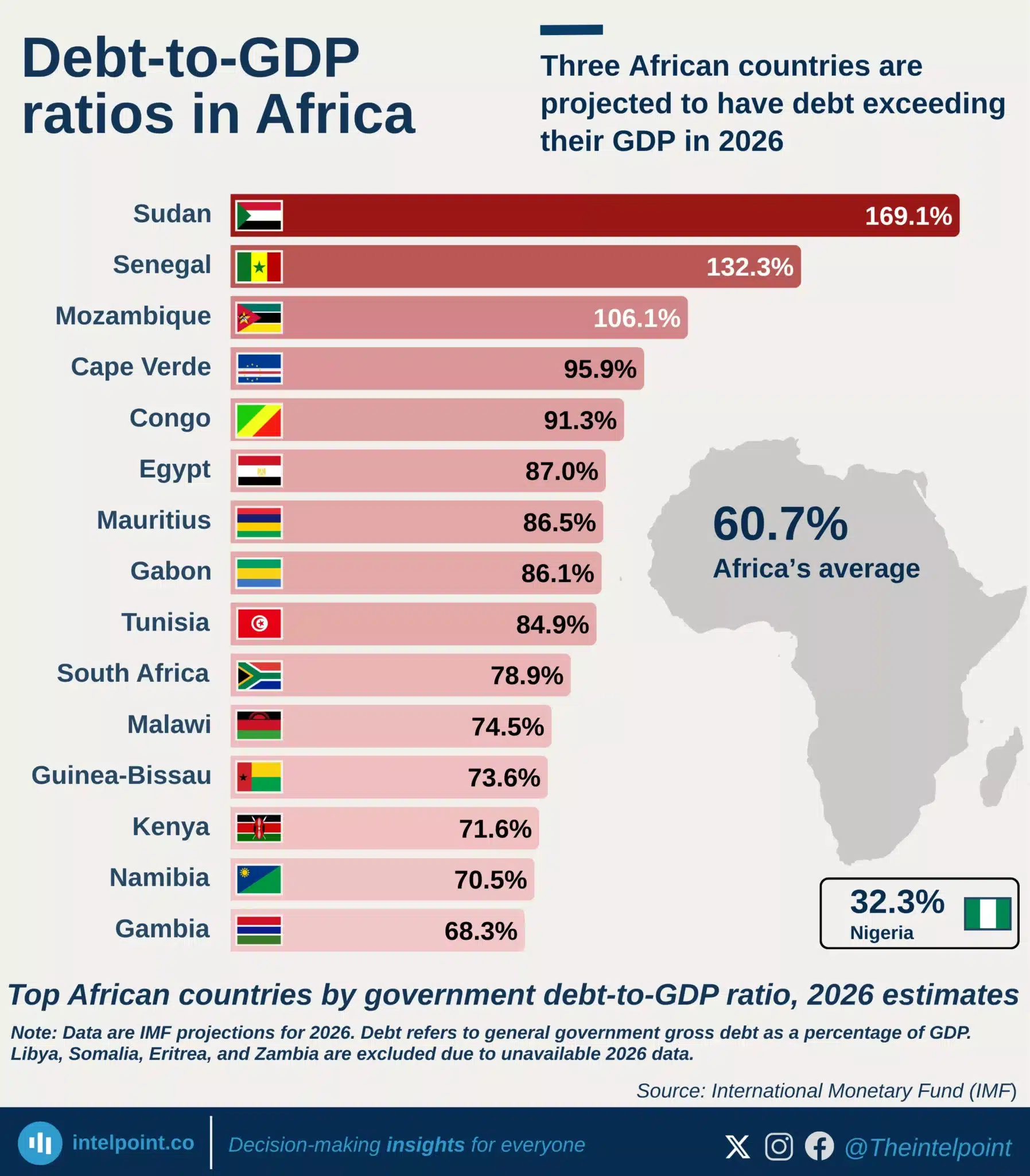
Three African countries are projected to have debt exceeding their GDP in 2026
  • Sudan is projected to have Africa’s highest debt-to-GDP ratio in 2026, at 169.1%.
  • Only three African countries are projected to owe more than the size of their economies in 2026.
  • Senegal and Mozambique join Sudan among countries with debt-to-GDP ratios above 100%.
  • Africa’s average government debt-to-GDP ratio is projected at 60.7% in 2026.
  • Nigeria’s projected debt-to-GDP ratio of 32.3% is far below the African average.

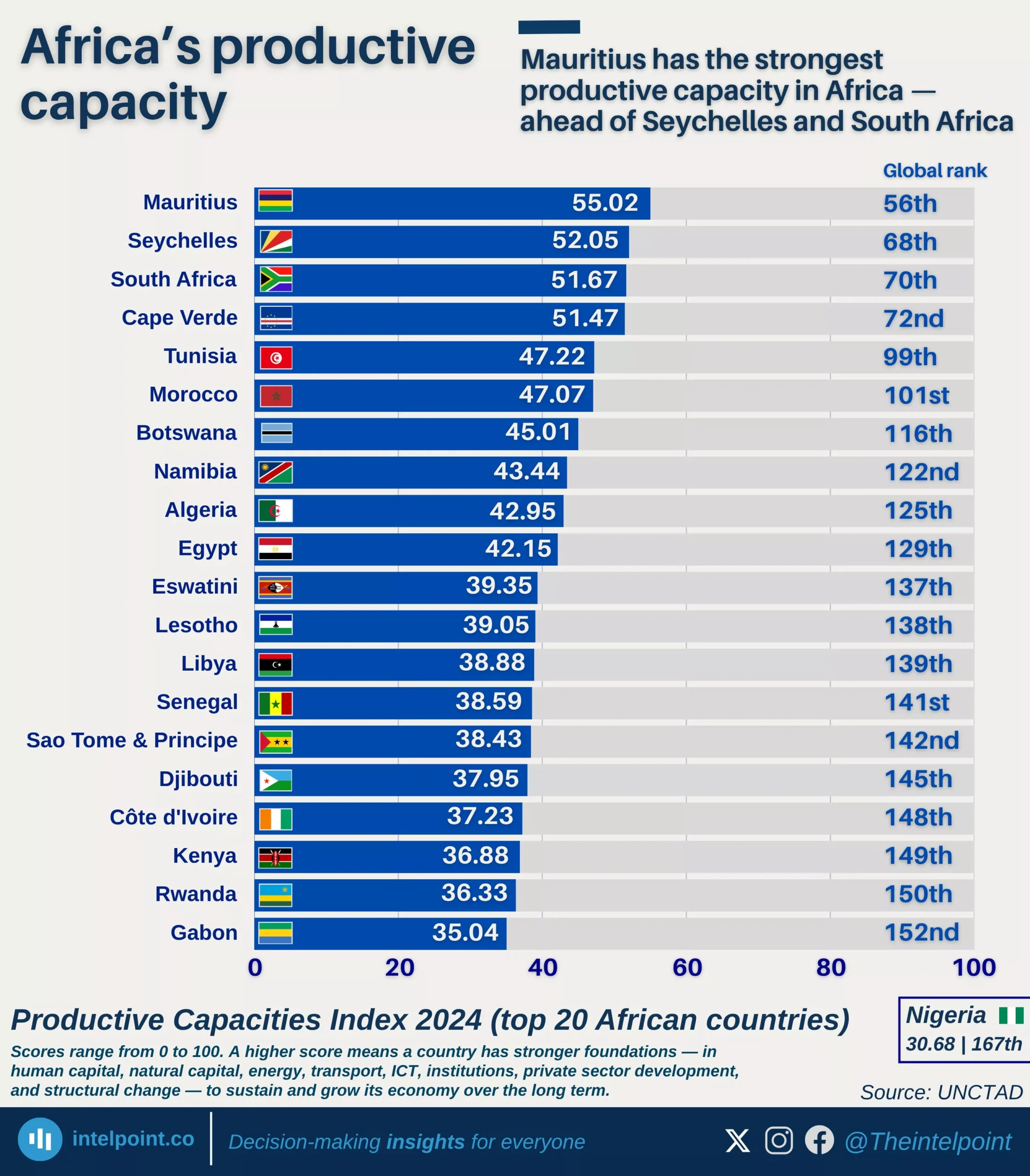
Mauritius has the strongest productive capacity in Africa — ahead of Seychelles and South Africa
  • Mauritius leads Africa on the Productive Capacities Index with a score of 55.02, ranking 56th globally.
  • Seychelles, South Africa, and Cape Verde complete Africa’s top four, but none enters the global top 50.
  • Nigeria ranks much lower at 167th globally, with a score of 30.68, despite being one of Africa’s largest economies.
  • The ranking shows that economic size does not always translate into stronger productive foundations like human capital, ICT, energy, transport, and institutions.

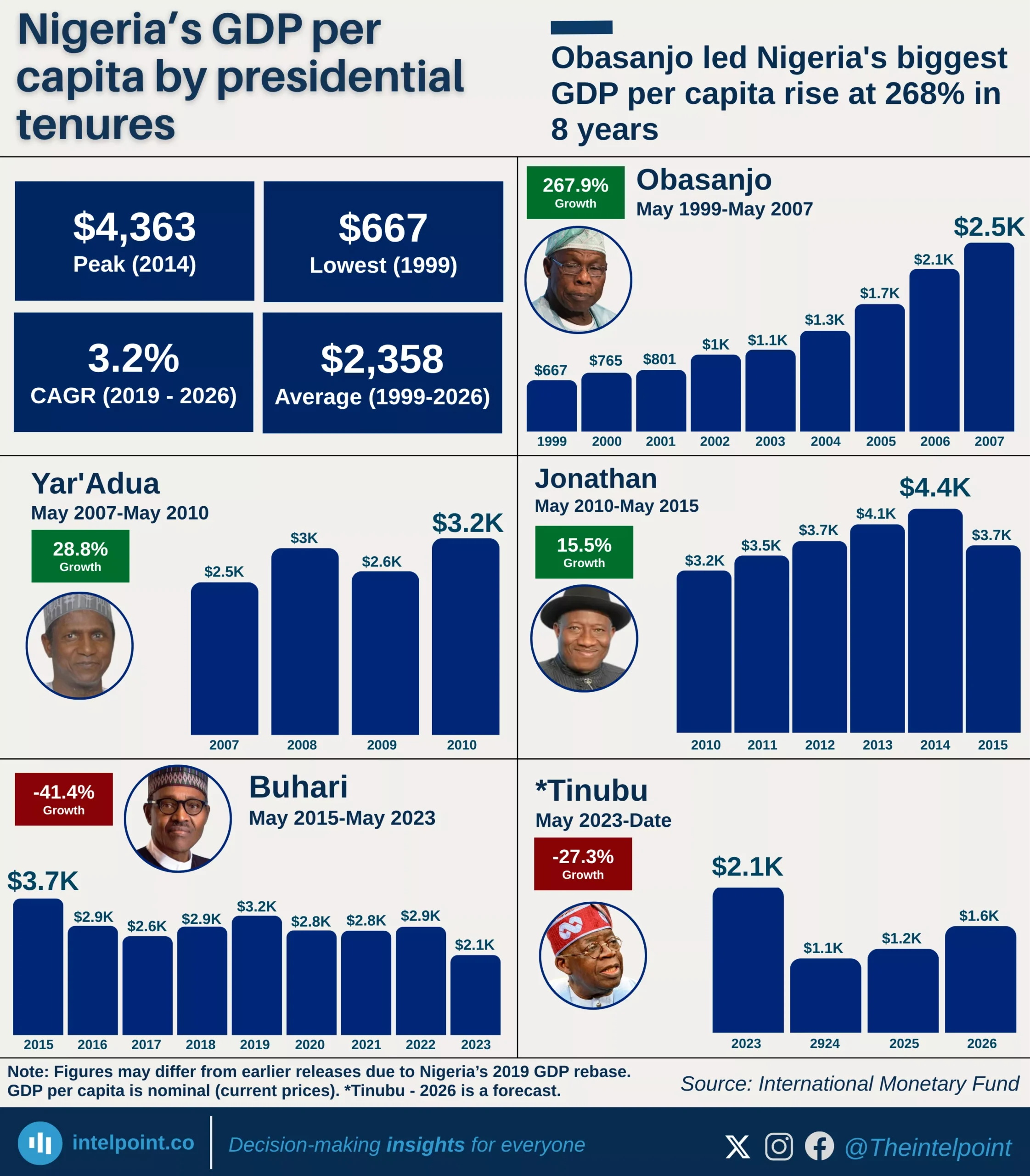
Obasanjo led Nigeria's biggest GDP per capita rise at 268% in 8 years
  • Nigeria’s GDP per capita rose strongly from 1999 to 2014, then reversed.
  • The 2014 peak remains the defining turning point.
  • Obasanjo’s years show the fastest sustained climb from a very low base.
  • Yar’Adua’s short tenure still maintained upward momentum.
  • Jonathan’s period delivered the peak level, not the fastest growth rate.
  • Buhari’s tenure marks the longest clear decline in GDP per capita.
  • Tinubu’s period begins with another sharp fall.

POPULAR TOPICS
SIGN UP TO OUR NEWSLETTER
Get periodic updates about the African startup space, access to our reports, among others.
Subscribe Here
Subscription Form

A product of Techpoint Africa. All rights reserved