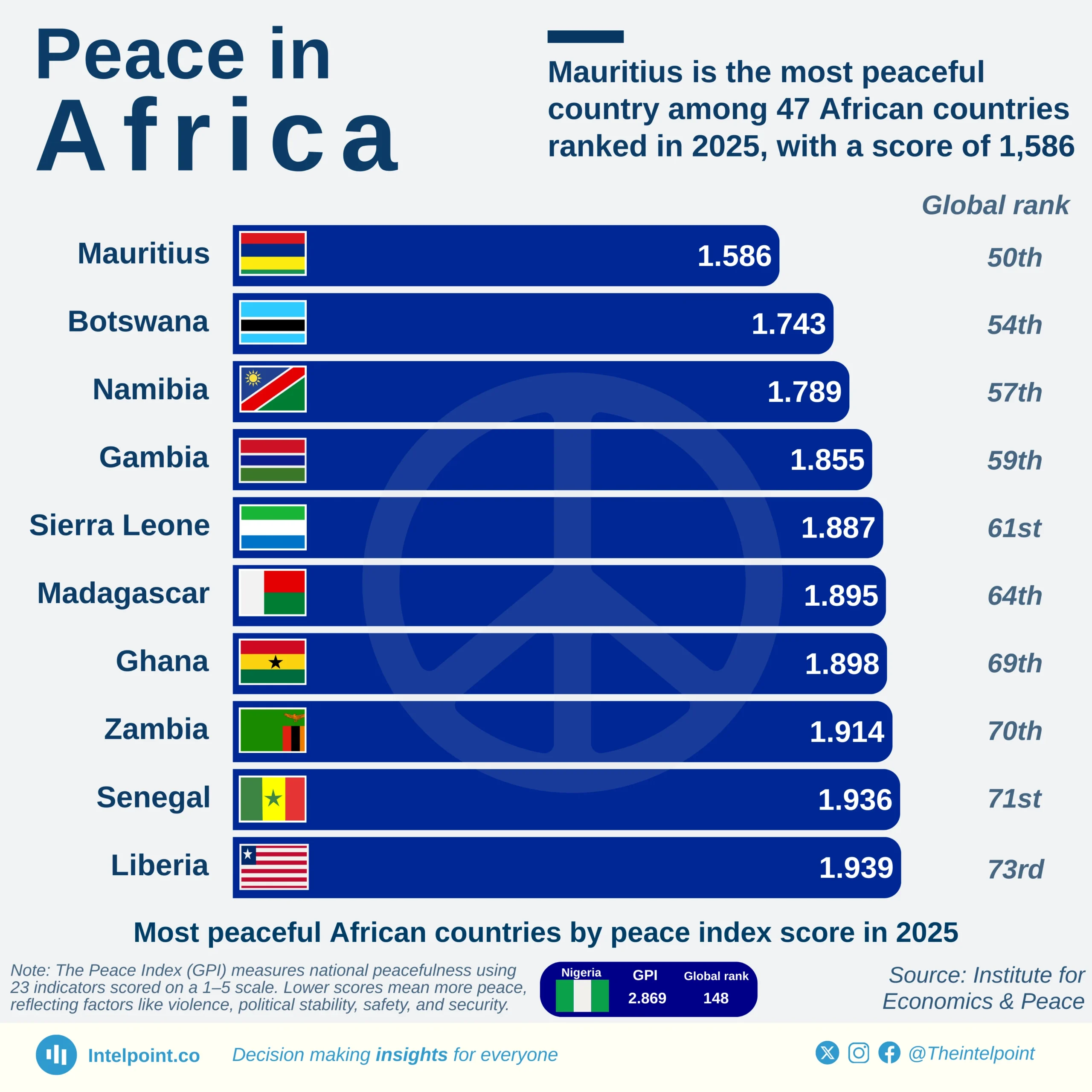
Mauritius leads Africa’s Peace Index with the lowest (best) score of 1.586, showing its stability and strong governance.
Southern Africa is well represented in the rankings with Mauritius, Botswana, Namibia, Madagascar, and Zambia in the top 10.
West Africa also performs strongly, represented by The Gambia, Sierra Leone, Ghana, Senegal, and Liberia.
The scores are tightly clustered (1.586–1.939), showing that Africa’s most peaceful states are relatively close in performance despite regional differences.
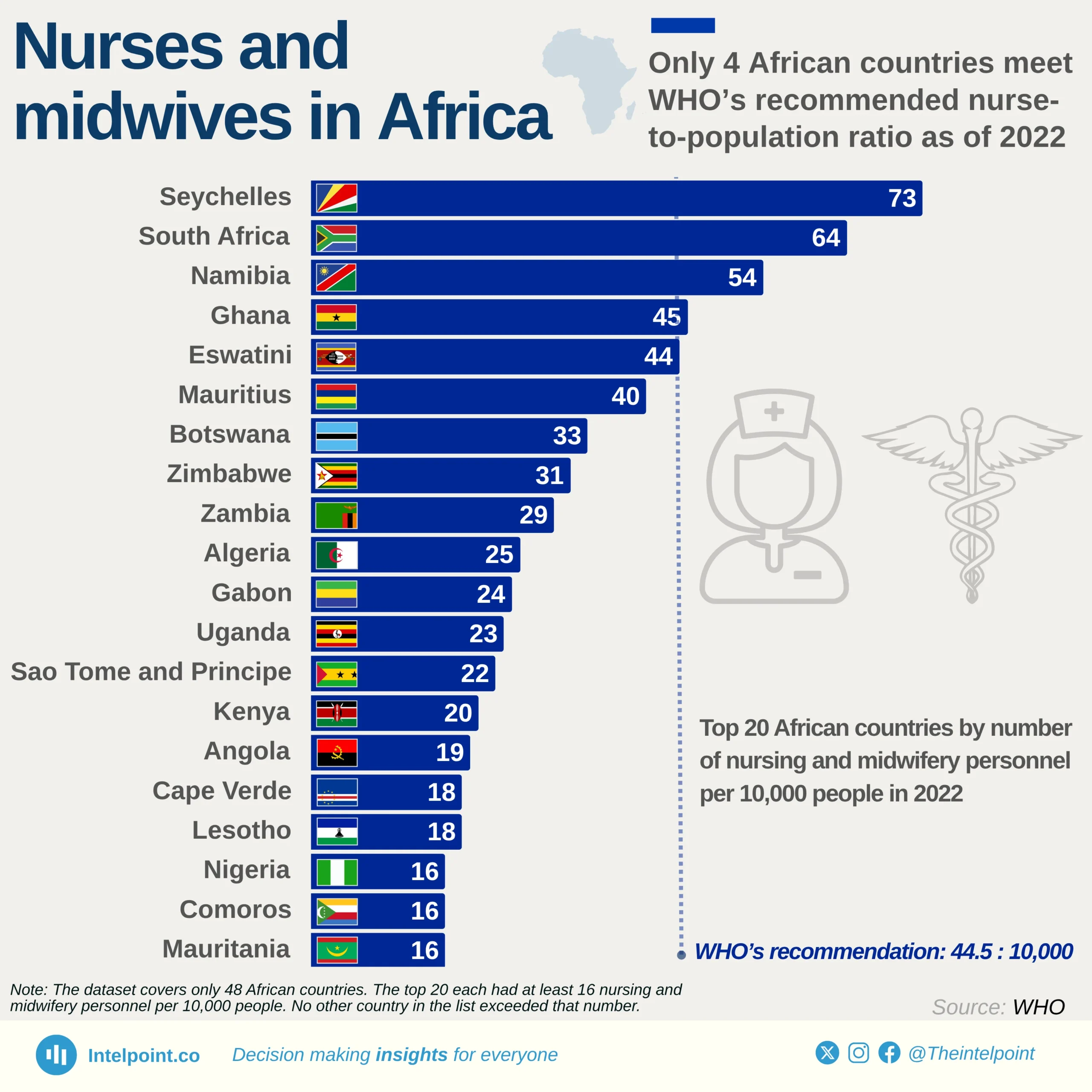
Only four African countries, Seychelles, South Africa, Namibia, and Ghana, meet or exceed the WHO’s recommended minimum of 44.5 nursing and midwifery personnel per 10,000 people.
Seychelles leads the continent with 73 personnel per 10,000, followed by South Africa (64), Namibia (54), and Ghana (45).
The lowest number within the top 20 is 16, shared by Nigeria, Comoros, and Mauritania.
The dataset includes 47 African countries, and no country outside the top 20 has more than 16 nursing and midwifery personnel per 10,000 people.
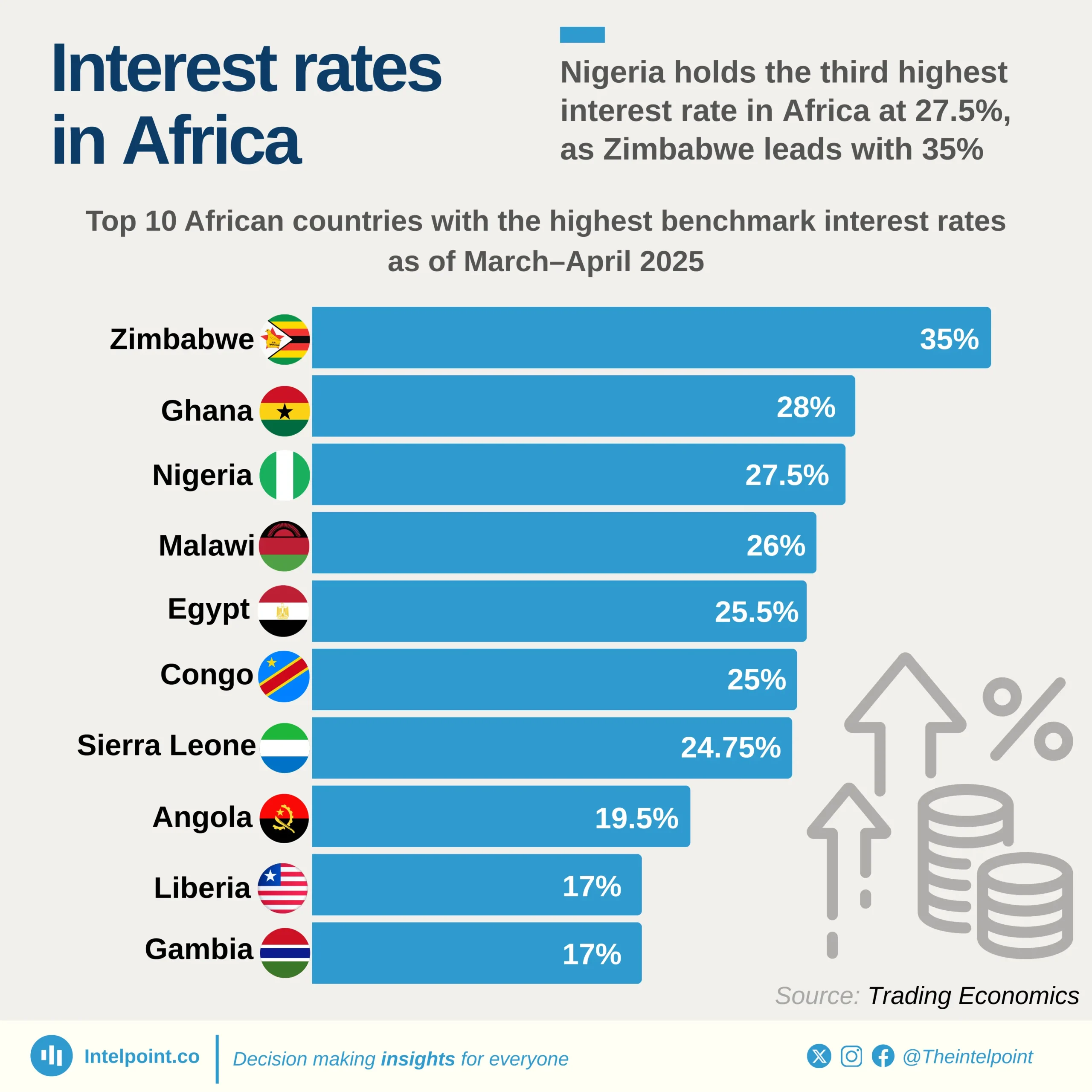
Zimbabwe has the highest benchmark interest rate in Africa at 35%, exceeding Ghana, the second highest, by 7% points.
Nigeria holds the third highest interest rate on the continent at 27.5%, just 0.5% points behind Ghana, signalling aggressive policy intervention.
Zimbabwe, Ghana, Nigeria, Malawi, and Egypt have interest rates above 25%, showing a regional pattern of tight monetary conditions.
There is a significant drop of over 5% points between Sierra Leone at 24.75% and Angola at 19.5%, marking a clear shift to lower-rate economies below the top tier.
Rwanda is performing relatively well in terms of governance and rule of law, leading sub-Saharan Africa for the third consecutive year with a score of 0.63 in the 2024 Rule of Law Index. Namibia (0.61) and Mauritius (0.60) closely follow, showcasing relatively stronger legal frameworks.
At the lower end, Nigeria, Congo, and Gabon score 0.40, highlighting persistent governance challenges.
Globally, Denmark tops the list of 142 countries, with a score of 0.90, while Venezuela ranks last at 0.26, emphasising the gap between SSA's highest performers and global leaders. This mix of progress and struggles illustrates the varied state of governance across the region.
Between 2000 and 2023, Africa received $182 billion in Chinese loans, primarily for energy and transportation development.
Angola, with 25%, was the largest recipient; Ethiopia, Egypt, Nigeria, and Kenya followed.
While 49 countries benefited, experts warn of increasing debt risks.