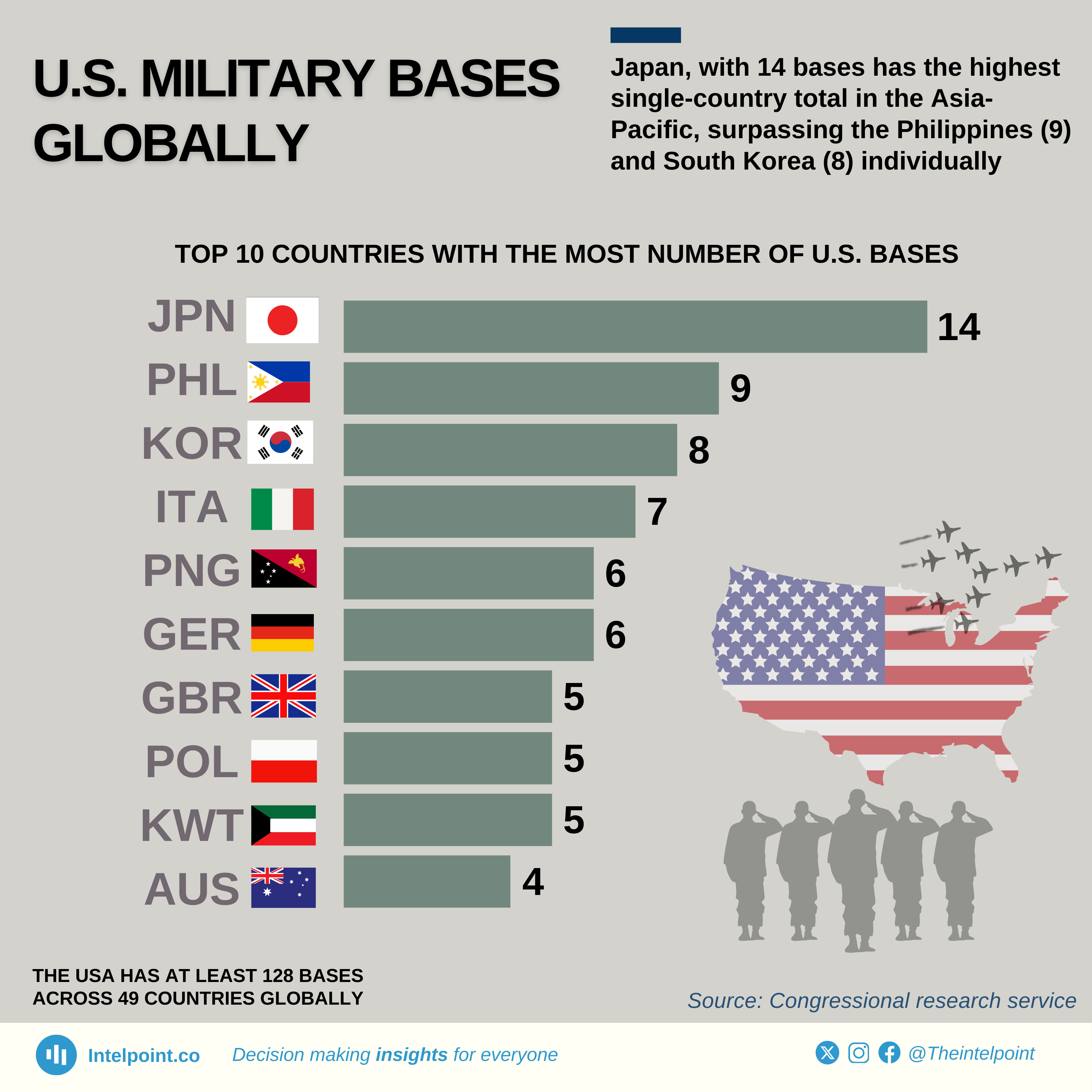
Japan leads with 14 bases. It hosts the most U.S. bases globally, exceeding individual counts in the Philippines (9) and South Korea (8).
Asia-Pacific Dominance: The region (Japan, Philippines, South Korea, Australia, and Papua New Guinea) accounts for 41 bases, nearly 1/3 of the global total.
The Asia-Pacific region hosts 41 U.S. bases, while Europe (Italy, Germany, Poland, UK) has 23. This indicates a growing strategic pivot towards the Pacific compared to traditional European deployments.
Kuwait (5 bases) stands out as the primary hub for U.S. military operations in the Middle East, highlighting its role as a key staging ground for regional security.
The top 10 host countries account for 69 of the 128 total bases (over 53%), meaning nearly half of U.S. overseas bases are spread across the remaining 39 countries.
In Ondo State, residents across all 18 local government areas came out to perform their civic duties in the recent gubernatorial election. With over two million registered voters, only 508,963 voted during the election; 11,886 were invalid, leaving 497,077 as valid votes.
The APC secured victory in every LGA, earning a total of 366,781 votes. Meanwhile, the PDP, the closest competitor, garnered 117,845 votes. Together, the APC and PDP had a total valid vote count of 484,626.
The newly created Ministry of Livestock Development will push Nigeria's ministerial count to 50. President Tinubu's federal executive cabinet is the largest since Nigeria's return to democracy in 1999.
Within the first 12 years of the Fourth Republic, the largest cabinet had 30 ministers. President Jonathan was the first to have more than 30 ministers, with subsequent terms having more ministers.
In 2023, Nigerians went to the polls to elect the president and Federal House of Assembly members and elect state governors and House of Assembly members. Here's a breakdown of the 14,859 candidates who participated in the 2023 general elections in Nigeria.
INEC has started its continuous voter registration against the 2023 general election. In 2019, 21% of Nigeria’s voting-age population did not register to vote.
Africa has witnessed 83 coup attempts since 1990, 42 of which were successful. The latest, Sudan's military coup, occurred yesterday, Monday, October 25, 2021. Although rare today, coups still threaten democracy. Here are the attempted coups in Africa since 1990.
President Tinubu was recently elected to take over from President Umaro Embaló of Guinea-Bissau as ECOWAS Chairman, making him the 9th from Nigeria. Since its inception, new chairmen have emerged 36 times, with Nigeria producing the most chairmen. Four countries in the ECOWAS region have collectively produced more than half of the chairmen since the organisation's founding, with each contributing multiple chairmen. Cape Verde is the only member country yet to produce a chairman.