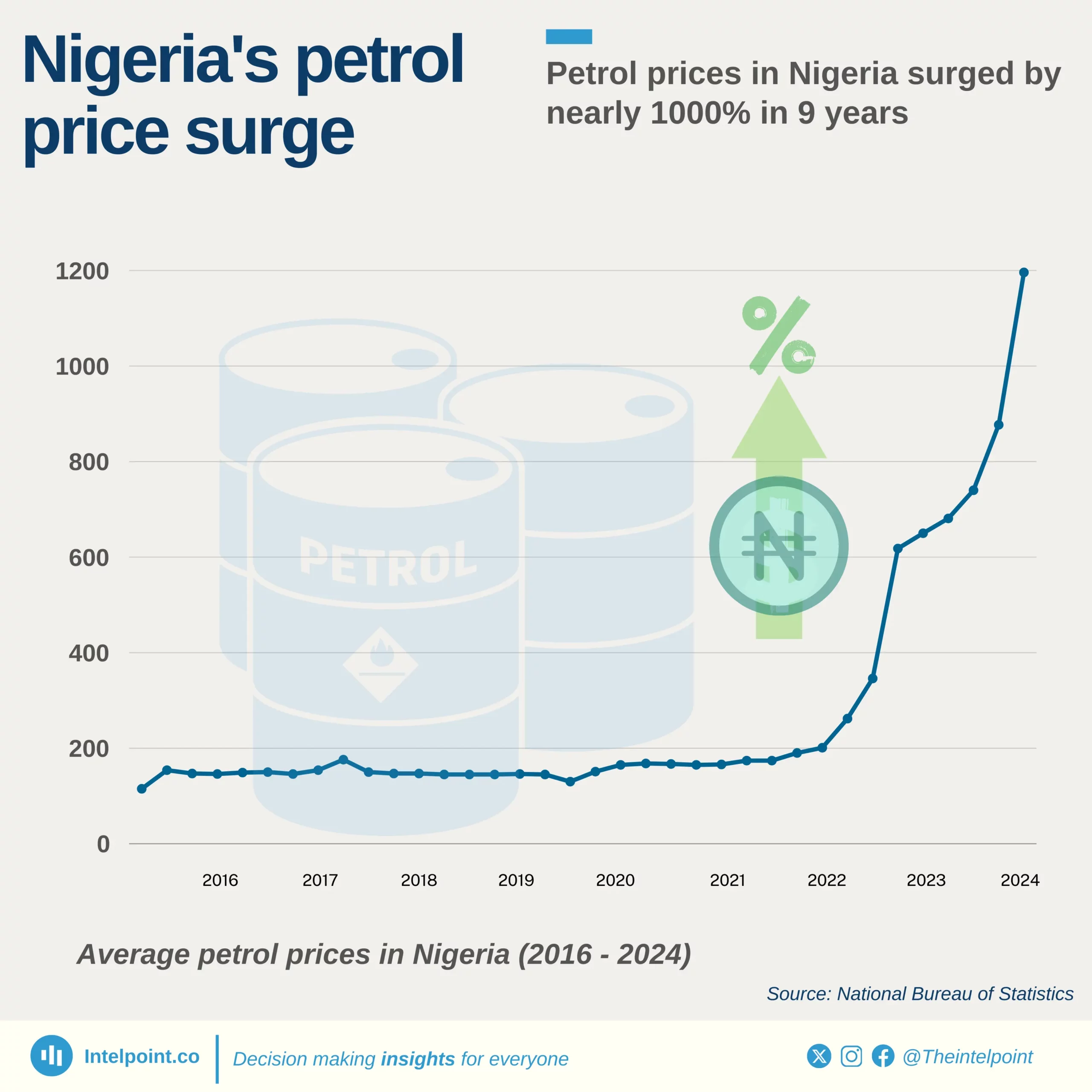
In February 2016, petrol was at its lowest price of₦99.80 per litre, marking the last time fuel prices remained below₦100.
By November 2024, petrol prices soared to an all-time high of₦1,214.17 per litre, reflecting the compounded effects of inflation, currency depreciation, and global oil price volatility.
Over the nine-year period, the average petrol price stood at₦272.65 per litre.
Between January 2016 and December 2024, petrol prices increased by ₦1,079.52, a staggering 984.96% rise, emphasising the long-term upward trajectory influenced by economic challenges, subsidy removals, and fluctuating exchange rates.
The most volatile period recorded a month-to-month price surge of over 129.23%.
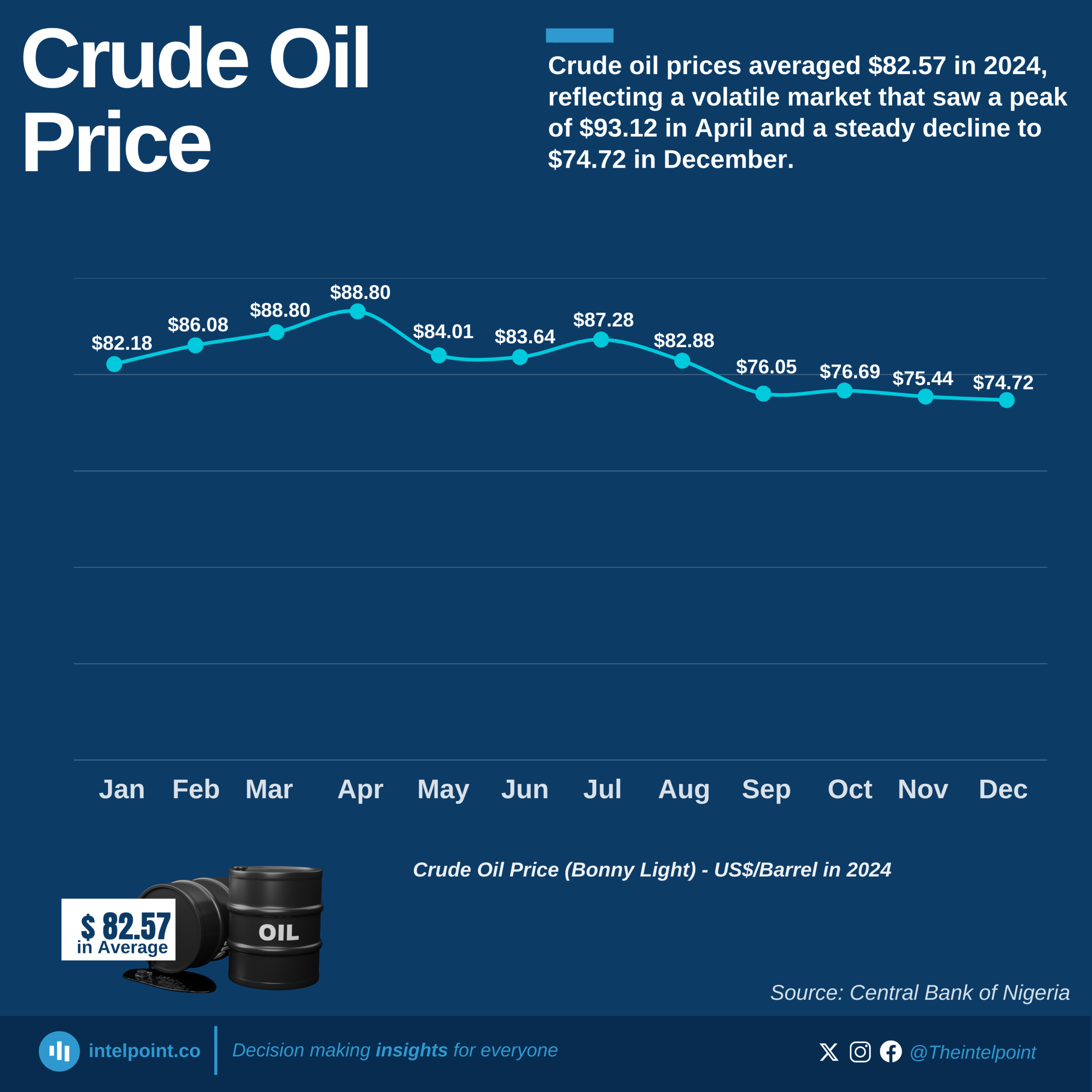
Crude oil prices peaked at $93.12 in April, marking the highest point of the year before experiencing fluctuations in the following months.
A steady decline in the last quarter saw prices drop to $74.72 in December, the lowest recorded price of 2024.
The decline in prices from September onward raised concerns about potential revenue shortfalls, impacting government budgets and foreign exchange earnings.
Oil prices remained unstable throughout the year, with significant fluctuations driven by geopolitical factors, global demand shifts, and production adjustments.
In 2020, OPEC's oil prices dropped by 35% as global demand collapsed due to the COVID-19 pandemic. Two years of economic recovery followed before Russia, one of the world's largest oil producers and importers, invaded Ukraine in 2022. This invasion triggered global economic instability, resulting in a 21% decline in oil prices the following year.
Between 2015 and 2023, Delta State consistently received significant portions of the 13% derivation fund, securing about 29% of Nigeria's total allocation over these years. This amounted to over ₦1.3 trillion out of the total of ₦4.72 trillion allocated to all the oil-producing states in the country.
The 13% derivation is part of Nigeria's federal revenue-sharing formula, where oil-producing states receive a portion of revenues generated from crude oil production in their regions. This allocation aims to enhance development and address these states' environmental and economic impacts. For those seeking structured academic help on complex economic topics like revenue distribution in Nigeria, professional services such as bachelorarbeit schreiben lassen can be a valuable resource.
Note: Data for December 2018 was estimated due to a lack of available information for that month.
In 2023, Nigeria saw a 17% reduction in petrol supply as imports fell by nearly 14% from 23.5 billion litres in 2022 to 20.3 billion litres.
The removal of the fuel subsidy in May 2023 led to higher prices and lower demand, especially in the second half of the year.
The Dangote refinery’s rising output could shape future supply.
Since 2020, the Nigerian National Petroleum Company Limited (NNPC) has seen a 1,048% profit increase, totalling ₦6.8 trillion over four years.
From nearly eliminating losses in 2019, NNPC achieved a 16,982% profit surge in 2020. The growth persisted with 135% in 2021 and 278% in 2022.
Despite a steady 29% increase in 2023, rising debts and fuel scarcity cast doubt on the sustainability of this success.
In 2022, Egypt, South Africa, Nigeria, Algeria, and Morocco collectively consumed an average of 2.712 million barrels of oil per day (Mb/d), 61% of the continent's daily oil consumption (4.478 Mb/d). African countries consumed 4.7% of the global usage (99.8 Mb/d).
Egypt used the most (850.5 thousand barrels per day (Kb/d)), followed by South Africa (601.2 Kb/d) and Nigeria (514.5 Kb/d).
Between 2010 and 2022, Nigeria imported 245 billion litres of Premium Motor Spirit (PMS), popularly called petrol, with the highest imports recorded in 2022. Here is the volume of PMS imported into the country in 13 years from 2010.
Crude oil exports, which made up 81% of Nigeria's export value in 2023 have increased in three consecutive years since 2021. After a 36% decline in 2020, exports increased by 53% in 2021, 46% in 2022, and 37% in 2023 to reach ₦29 trillion.
The pump price of petrol in Nigeria increased from ₦189 to ₦617 between May 29, 2023 and July 18, 2023, a 226% increase within two months. The announcement of the removal of petrol subsidy led to a sharp increase in its pump price.