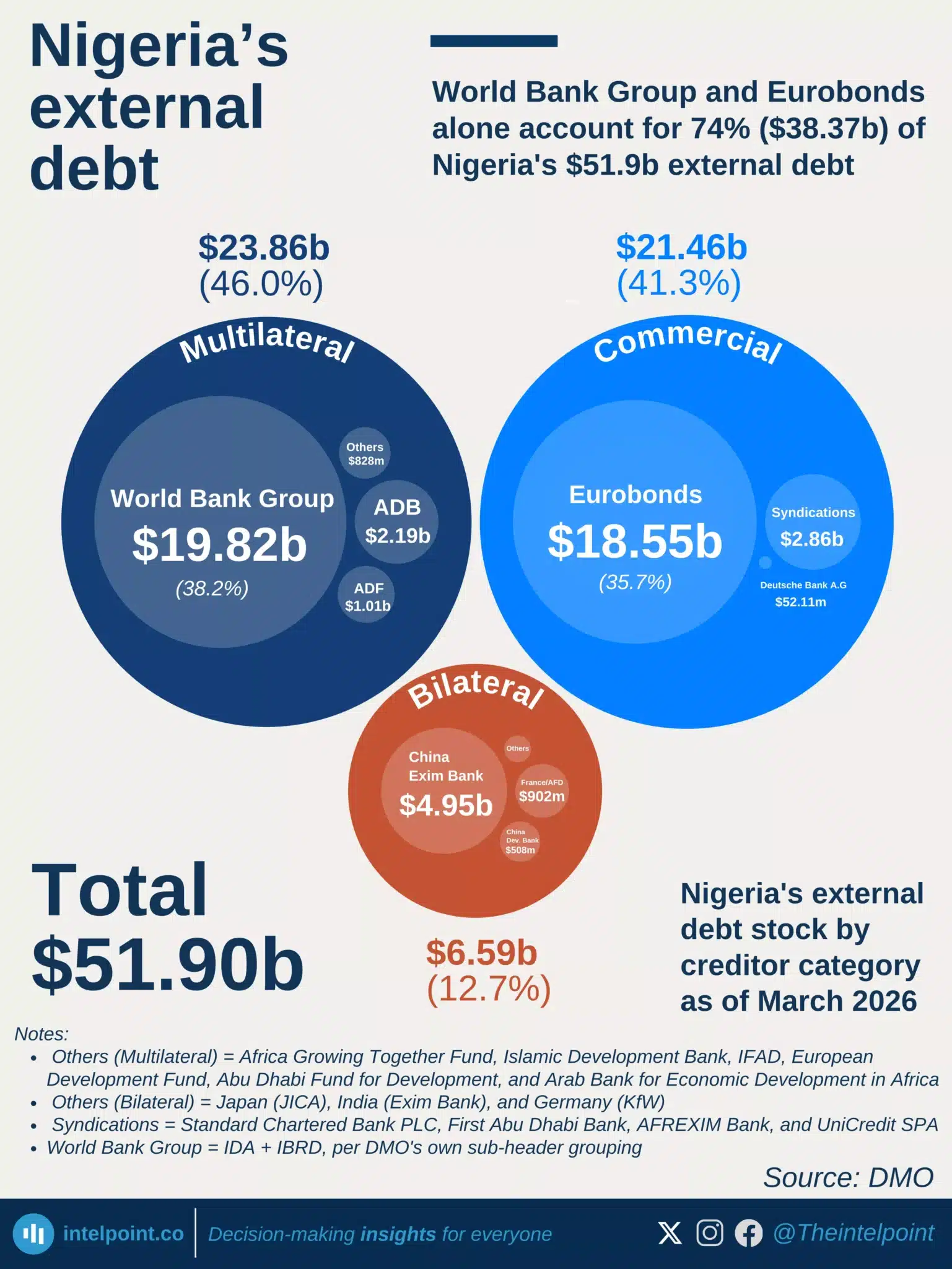
Nigeria's external debt stock stood at $51.90 billion as of March 31, 2026, up from $51.86 billion in December 2025 — a rise of $48.05 million (0.09%).
The composition of the debt, however, shows a strong concentration among a small number of creditors. Multilateral creditors accounted for $23.86 billion (46.0%), followed by commercial creditors at $21.46 billion (41.3%) and bilateral creditors at $6.59 billion (12.7%).
Within this, the World Bank Group accounted for $19.82 billion (38.2%) of the total external debt, while Eurobond holders accounted for $18.55 billion (35.7%). Together, they represented $38.37 billion, or 73.9% of Nigeria’s total external debt stock.
The latest figures also show a shift in the composition compared with December. Bilateral debt fell from $6.72 billion to $6.59 billion, while the commercial category increased, largely reflecting the syndicated-loan structure reported by the DMO. Multilateral debt was broadly stable at about $23.86 billion.
In other words, while Nigeria’s external debt stock barely changed at the start of 2026, its creditor structure remains highly concentrated: nearly three-quarters of the debt is owed to the World Bank Group and Eurobond investors.