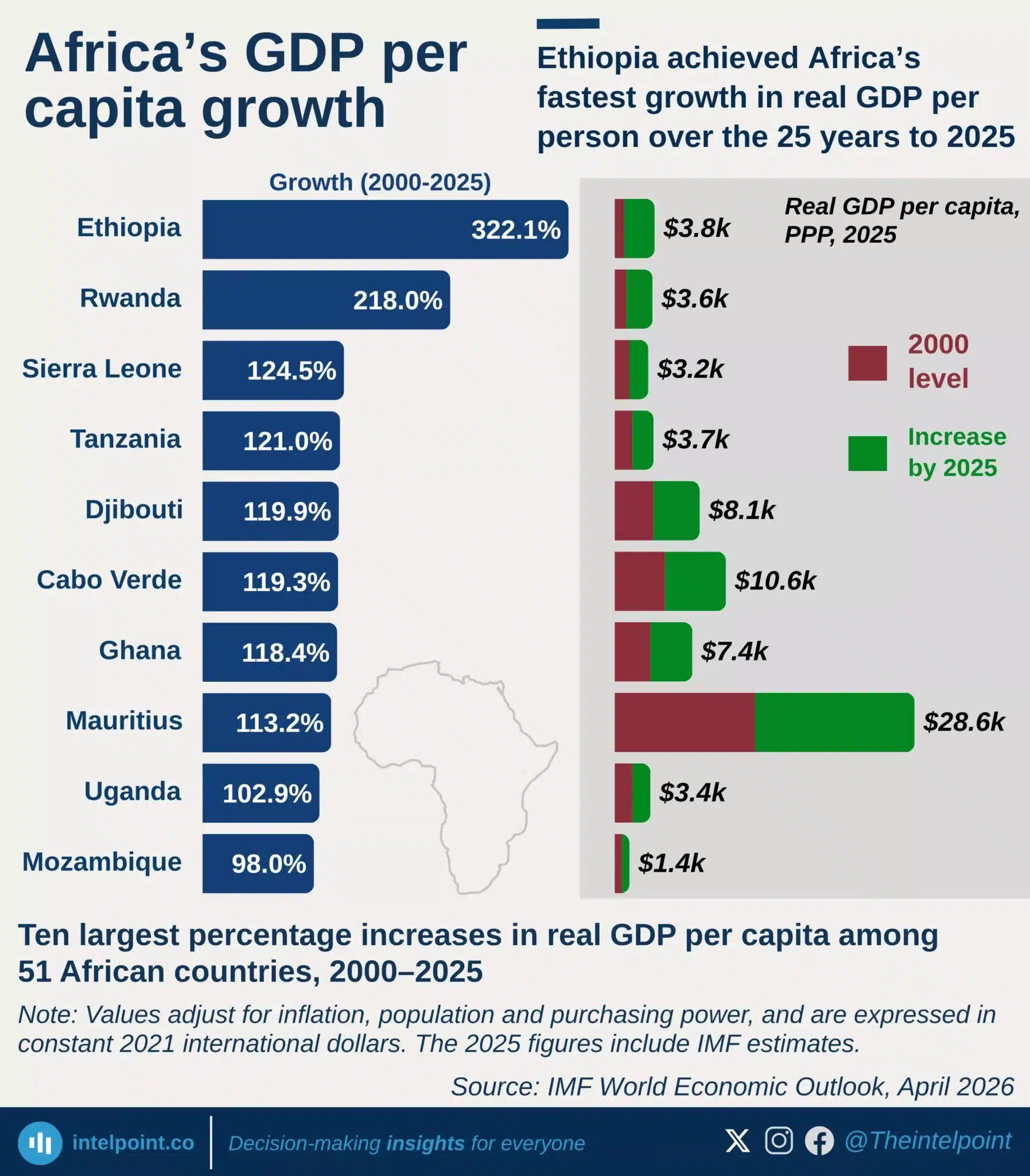
Ethiopia achieved Africa’s fastest growth in real GDP per person over the 25 years to 2025

Key Takeaways

  • Ethiopia recorded Africa's fastest real GDP per capita growth between 2000 and 2025.
  • Rwanda ranked second, while Sierra Leone, Tanzania and Djibouti completed the top five.
  • Ethiopia's real GDP per capita rose 322%, from $910 to $3,843.
  • Mauritius recorded Africa's largest absolute gain in real GDP per capita.
  • Nigeria ranked 15th, with real GDP per capita increasing 76.7%.

Between 2000 and 2025, Ethiopia recorded the largest percentage increase in PPP-adjusted real GDP per person among 51 African countries.

It started at $910, Africa’s second-lowest level in 2000, and reached $3,843 by 2025, ranking 29th among the 51 countries. That was a 322% increase, placing its real GDP per person at 4.2 times its starting level.

The growth was also sustained for most of the period. After declines in 2002 and 2003, Ethiopia recorded an increase every year from 2004 to 2025. Tanzania was the only country in the top ten whose real GDP per capita increased throughout the entire 25-year period. Eight of the ten countries recorded a decline in 2020.

Mauritius led on a different measure. Its real GDP per person increased from $13,422 to $28,610, adding $15,188, the largest absolute increase in Africa. It ranked eighth by percentage growth because it started from a much higher level than Ethiopia.

Nigeria ranked 15th by percentage growth. Its real GDP per capita increased by 76.7%, from $4,608 to $8,143. However, it declined for six consecutive years from 2016 to 2021 before returning to growth in 2022.

The figures are adjusted for inflation, population and differences in purchasing power, and are expressed in constant 2021 international dollars. They do not represent household income or show how evenly the gains were distributed.

The 2025 figures are IMF estimates except for Ethiopia, whose latest actual data cover FY2024/25. The estimates follow latest actual observations from 2023 or 2024.
Source:

IMF World Economic Outlook, April 2026

Period:

2000-2025
HTML code to embed chart
Want a bespoke report?
Reach out
Tags
Related Insights

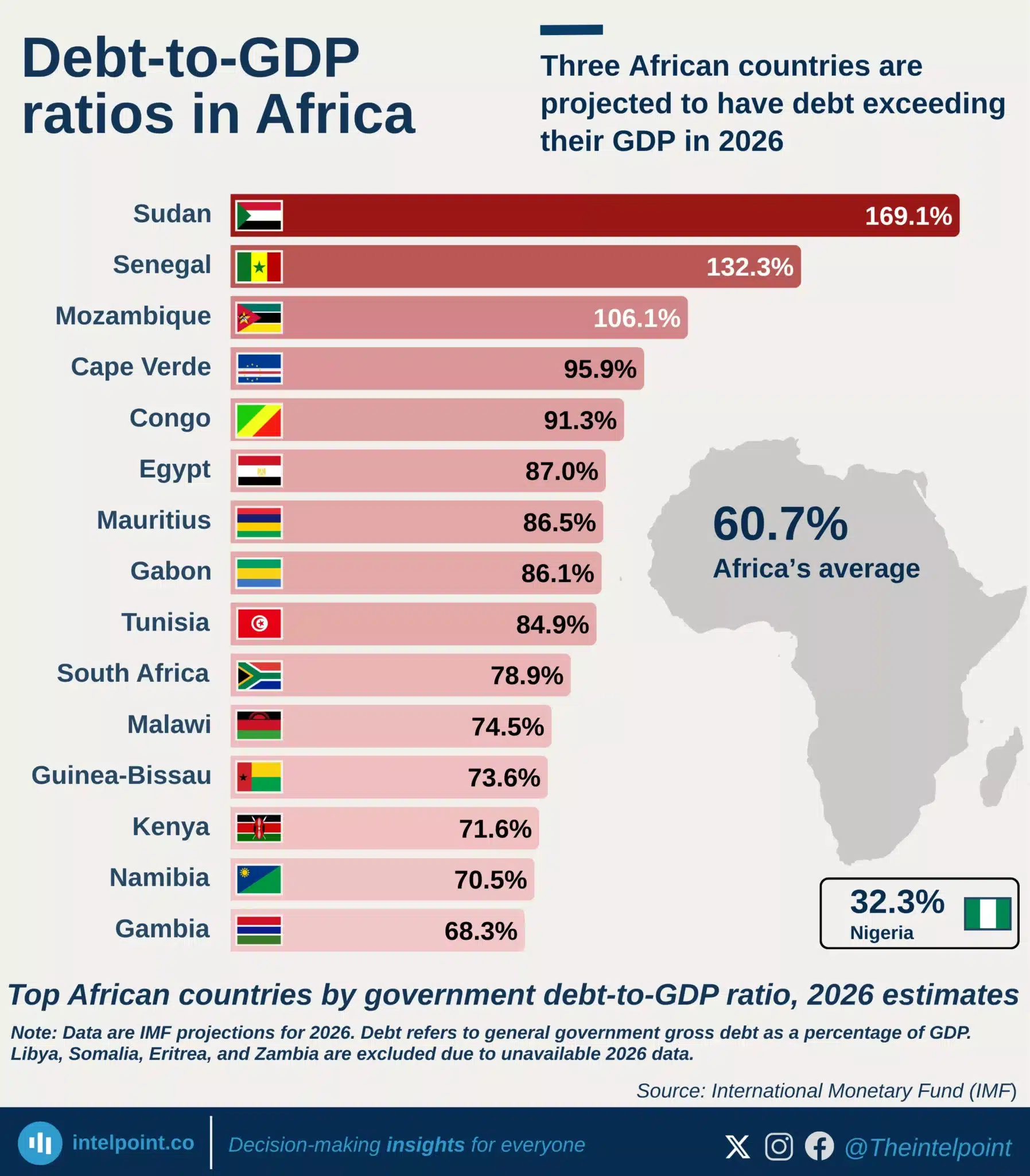
Three African countries are projected to have debt exceeding their GDP in 2026
  • Sudan is projected to have Africa’s highest debt-to-GDP ratio in 2026, at 169.1%.
  • Only three African countries are projected to owe more than the size of their economies in 2026.
  • Senegal and Mozambique join Sudan among countries with debt-to-GDP ratios above 100%.
  • Africa’s average government debt-to-GDP ratio is projected at 60.7% in 2026.
  • Nigeria’s projected debt-to-GDP ratio of 32.3% is far below the African average.

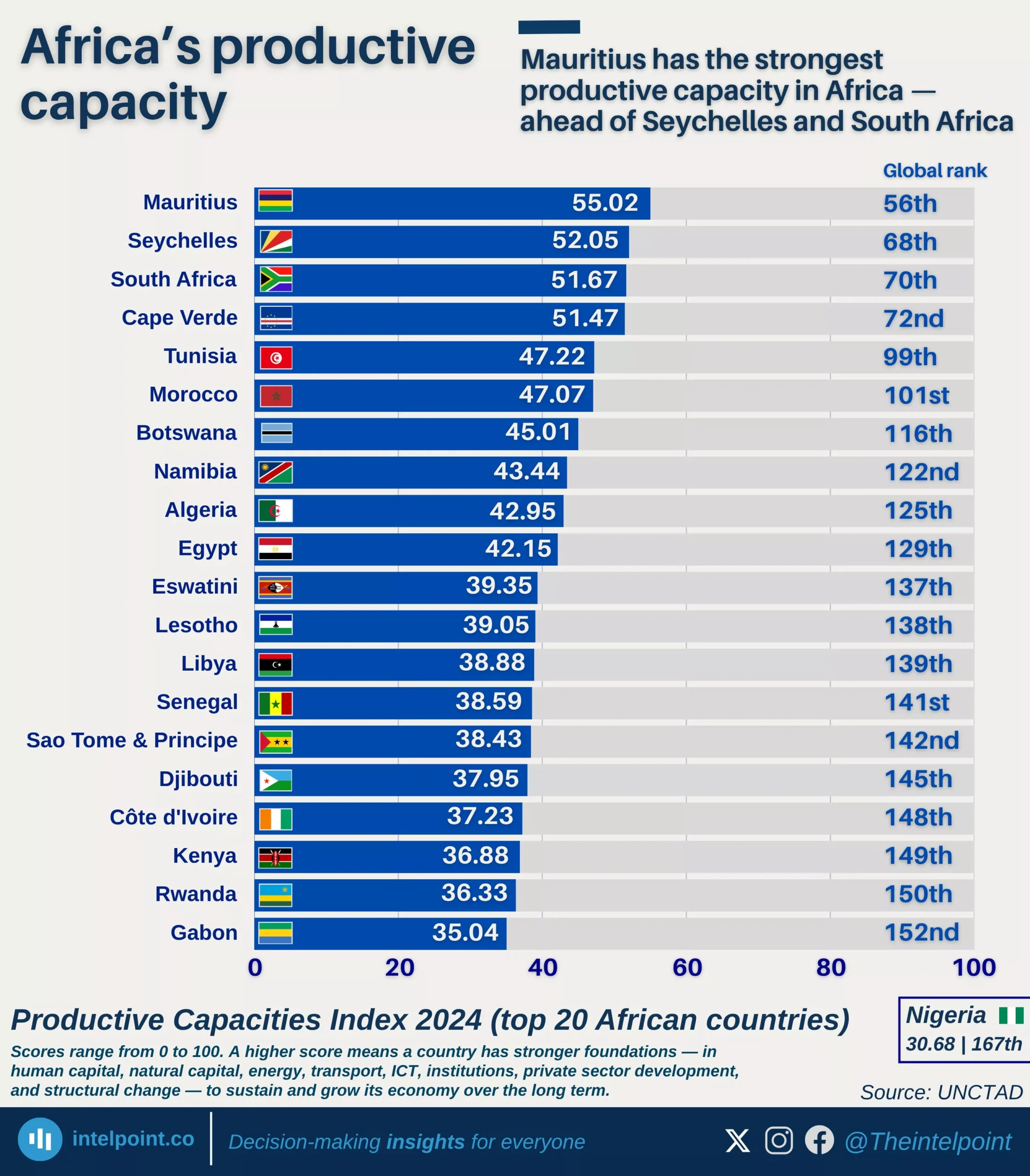
Mauritius has the strongest productive capacity in Africa — ahead of Seychelles and South Africa
  • Mauritius leads Africa on the Productive Capacities Index with a score of 55.02, ranking 56th globally.
  • Seychelles, South Africa, and Cape Verde complete Africa’s top four, but none enters the global top 50.
  • Nigeria ranks much lower at 167th globally, with a score of 30.68, despite being one of Africa’s largest economies.
  • The ranking shows that economic size does not always translate into stronger productive foundations like human capital, ICT, energy, transport, and institutions.

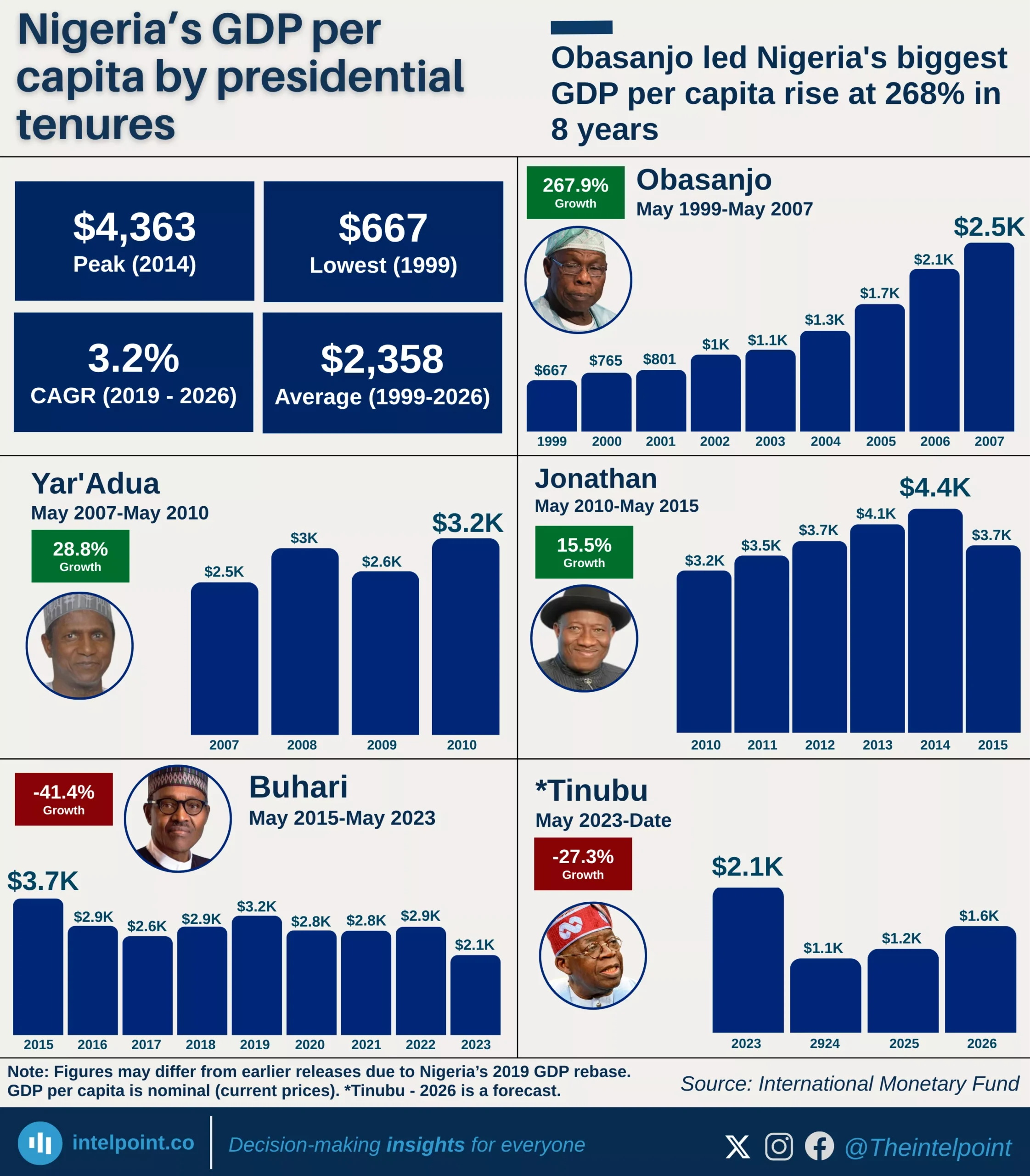
Obasanjo led Nigeria's biggest GDP per capita rise at 268% in 8 years
  • Nigeria’s GDP per capita rose strongly from 1999 to 2014, then reversed.
  • The 2014 peak remains the defining turning point.
  • Obasanjo’s years show the fastest sustained climb from a very low base.
  • Yar’Adua’s short tenure still maintained upward momentum.
  • Jonathan’s period delivered the peak level, not the fastest growth rate.
  • Buhari’s tenure marks the longest clear decline in GDP per capita.
  • Tinubu’s period begins with another sharp fall.

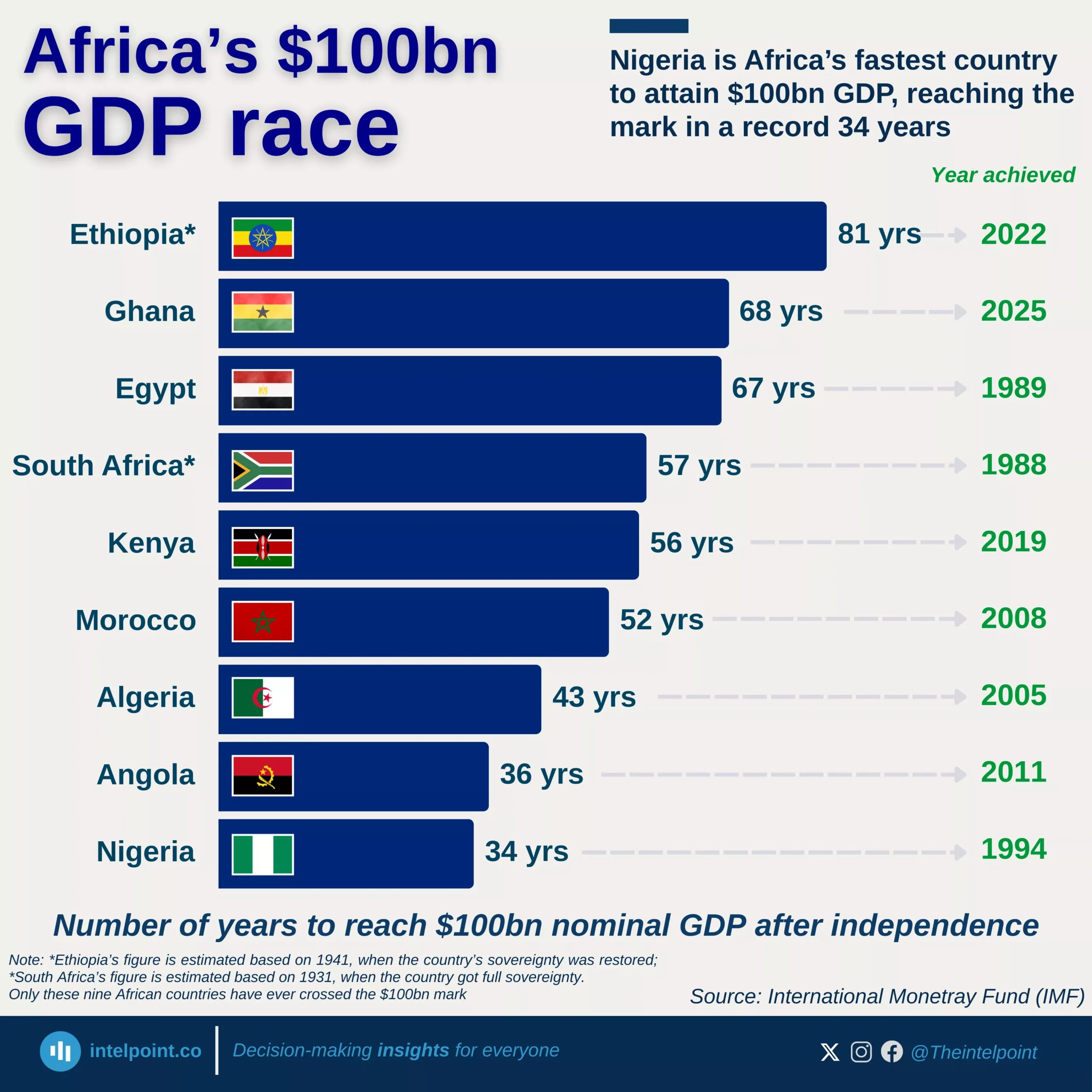
Nigeria is Africa’s fastest country to attain $100bn GDP, reaching the mark in a record 34 years
  • Nigeria is the fastest to reach $100B — 34 years, achieving the milestone in 1994.
  • Ethiopia took the longest — 81 years, reaching the mark in 2022 after decades of gradual expansion.
  • Resource-driven economies reached the threshold faster, including Angola (36 years) and Algeria (43 years).
  • North African economies crossed earlier, with Egypt (1989) and Morocco (2008) benefiting from diversified economic bases.
  • South Africa reached $100B as early as 1988, reflecting its long-standing industrial and financial depth.
  • Ghana is among the slowest climbers (68 years), but its recent 2025 milestone shows the impact of sustained reforms and growth.
  • Speed varies widely (34 to 81 years), showing that growth paths across Africa are shaped by very different economic realities.

Egypt and Nigeria led Africa’s industrial output in 2024, with $145.5bn and $89bn, respectively
  • Egypt led with an estimated $145.5 billion, accounting for about 25% of Africa's total industrial output among its top 15 economies.
  • Nigeria followed with $89 billion, while South Africa, Algeria, and Morocco made up the rest of the top five.
  • The top five economies accounted for more than 70% of Africa’s total industrial value added.
  • Notable mid-tier performers, Ethiopia and DR Congo, reflected rapid industrial investment.
  • Using constant 2015 USD reveals real production strength, not nominal currency shifts.

West Africa has the highest concentration of remittance-dependent nations, with 10 countries in the top 20, led by The Gambia (21.1%)
  • The Gambia leads Africa in remittance-GDP ratio, with remittance accounting for 21.1% of its GDP in 2024.
  • Lesotho (20.9%) and Comoros (18.3%) closely follow as highly remittance-dependent economies.
  • Somalia (17.5%) and Liberia (14.3%) also rely heavily on diaspora inflows to support their economies.
  • Nigeria (11.3%) remains a major player, highlighting its strong global diaspora network.
  • Cabo Verde (12.1%) and Senegal (11.6%) demonstrate that remittances are key drivers of income in smaller economies.
  • In larger economies like Egypt (7.6%) and Morocco (8.1%), remittances also make up a significant share of GDP.

POPULAR TOPICS
SIGN UP TO OUR NEWSLETTER
Get periodic updates about the African startup space, access to our reports, among others.
Subscribe Here
Subscription Form

A product of Techpoint Africa. All rights reserved