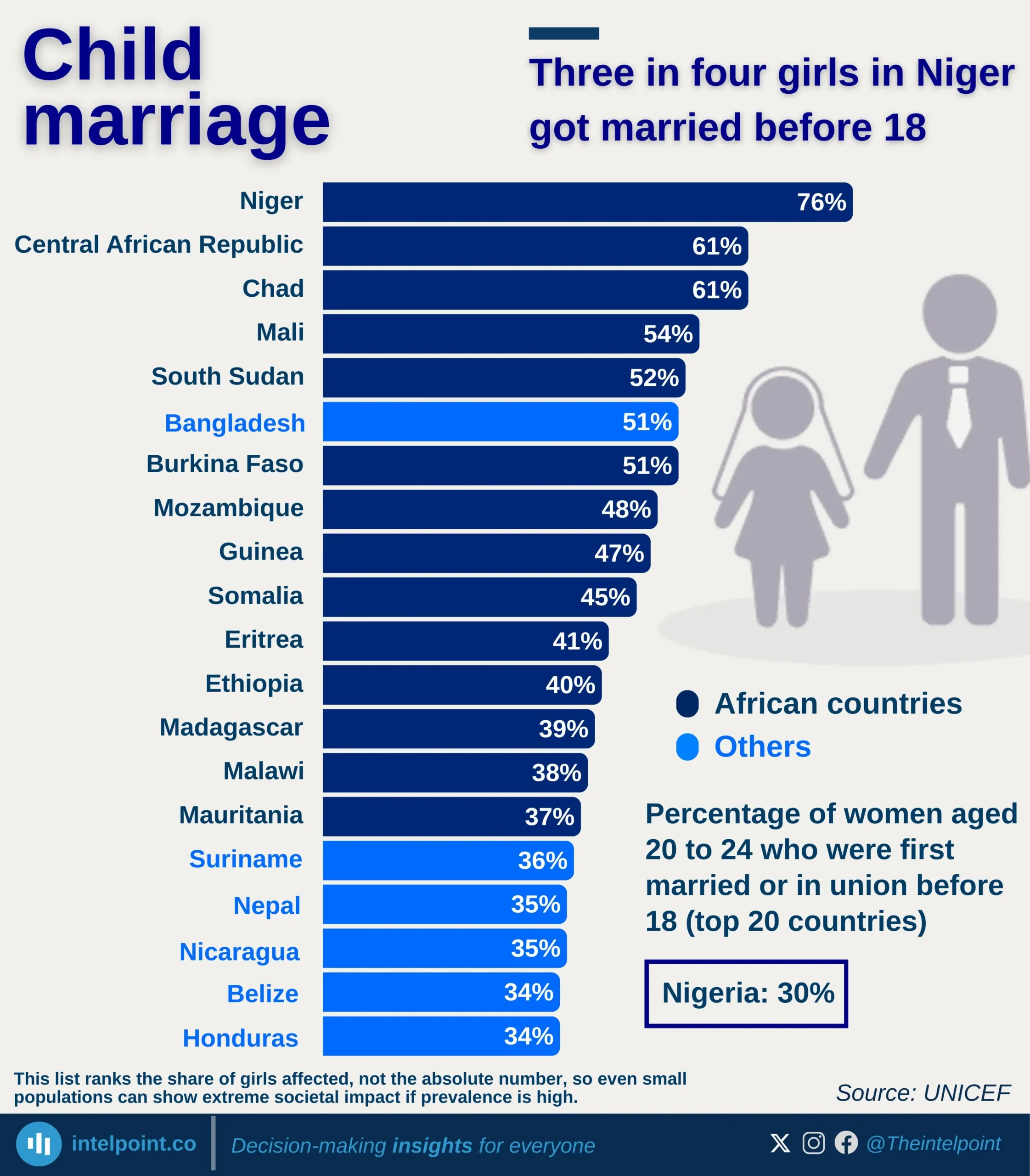
Three in four girls in Niger got married before 18

Key Takeaways

  • Niger (76%), the Central African Republic (61%), and Chad (61%) top the global list, meaning the majority of women in these countries marry as children.
  • Seven of the top ten countries by prevalence are African, showing that child marriage is most entrenched relative to population on the continent.
  • Countries in South Asia — Bangladesh (51%) and Nepal (35%) — and Latin America — Suriname (36%) and Belize (34%) — also feature, highlighting the global nature of the challenge.
  • While some countries have larger populations, this list ranks the share of girls affected, not the absolute number, meaning even smaller populations can show extreme societal impact if the prevalence is high.

Child marriage remains a deeply rooted practice in several parts of the world, but its impact relative to population is most acute in Africa. In Niger, 76% of girls marry before reaching adulthood, meaning more than three out of every four girls experience early marriage, a proportion unmatched globally. Similarly high rates in the Central African Republic, Chad, Mali, and South Sudan demonstrate how child marriage is systemically normalised in certain populations, rather than simply being a function of large population size. Nigeria, with a lower prevalence of 30%, did not make the top 20.

The prevalence-focused ranking underscores the intensity of risk per girl, highlighting how even countries with smaller populations can face severe societal and developmental consequences.

Outside Africa, high rates in South Asia and Latin America show that child marriage remains a global challenge. However, Africa carries the heaviest population-relative burden, making targeted interventions on the continent critical for achieving global progress.
Source:

UNICEF

Period:

2024
HTML code to embed chart
Want a bespoke report?
Reach out
Tags
Related Insights

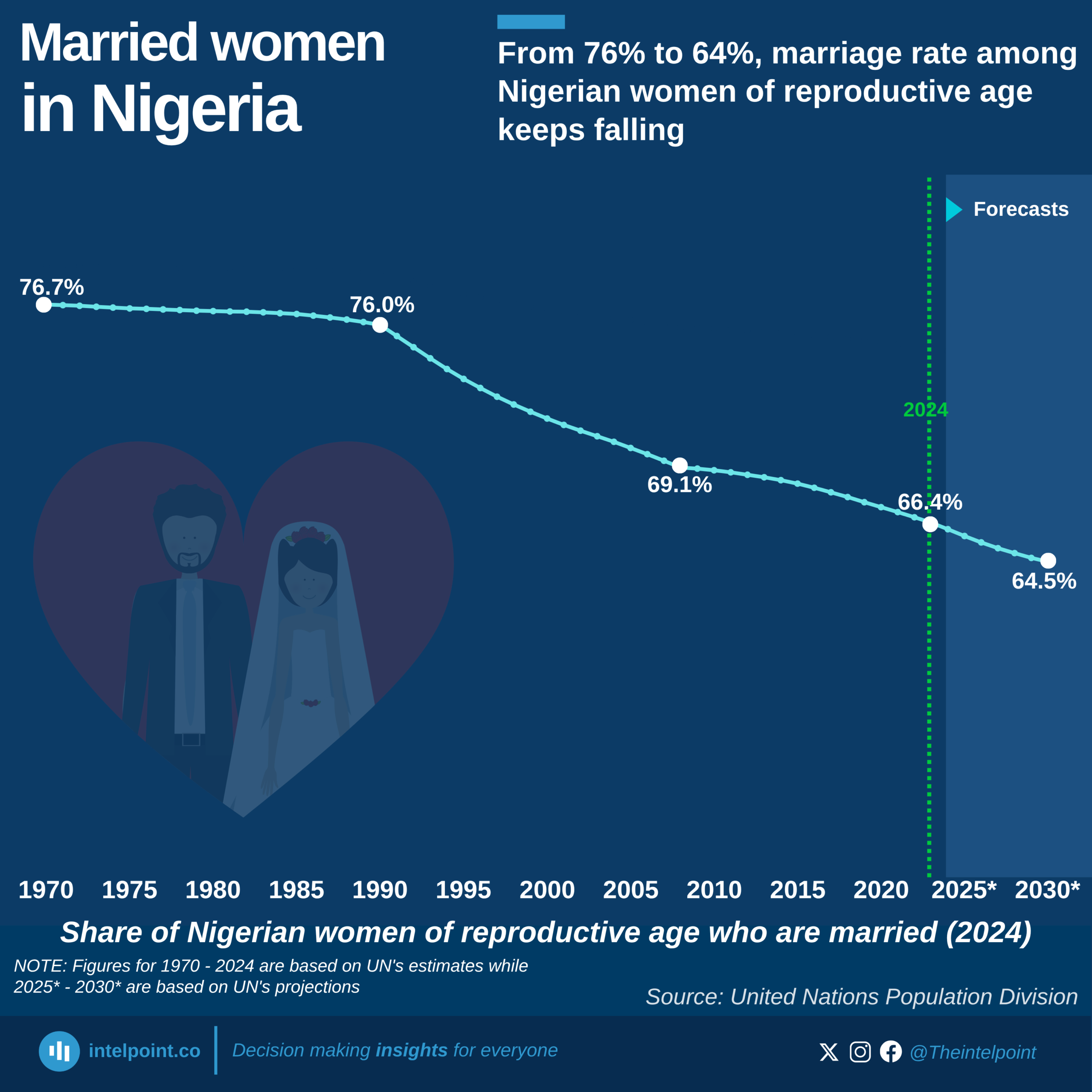
From 76% to 64%, marriage rate among Nigerian women of reproductive age keeps falling
  • In 1970, about 76.7% of Nigerian women of reproductive age were married, compared to 66.4% in 2024.
  • The trend shows a consistent decline in marriage rates among women of reproductive age over the past five decades.
  • Marriage among reproductive-age women in Nigeria is projected to drop further to 64.5% by 2030.
  • Between 1985 and 2005, the marriage rate among women in this group declined more sharply than in previous decades.
  • The data indicates a gradual but steady societal shift away from early or widespread marriage.
  • Modern factors such as education, urbanisation, and career options likely contribute to this ongoing decline.
  • This decline in marriage rates may have ripple effects on fertility trends, family size, and national planning.

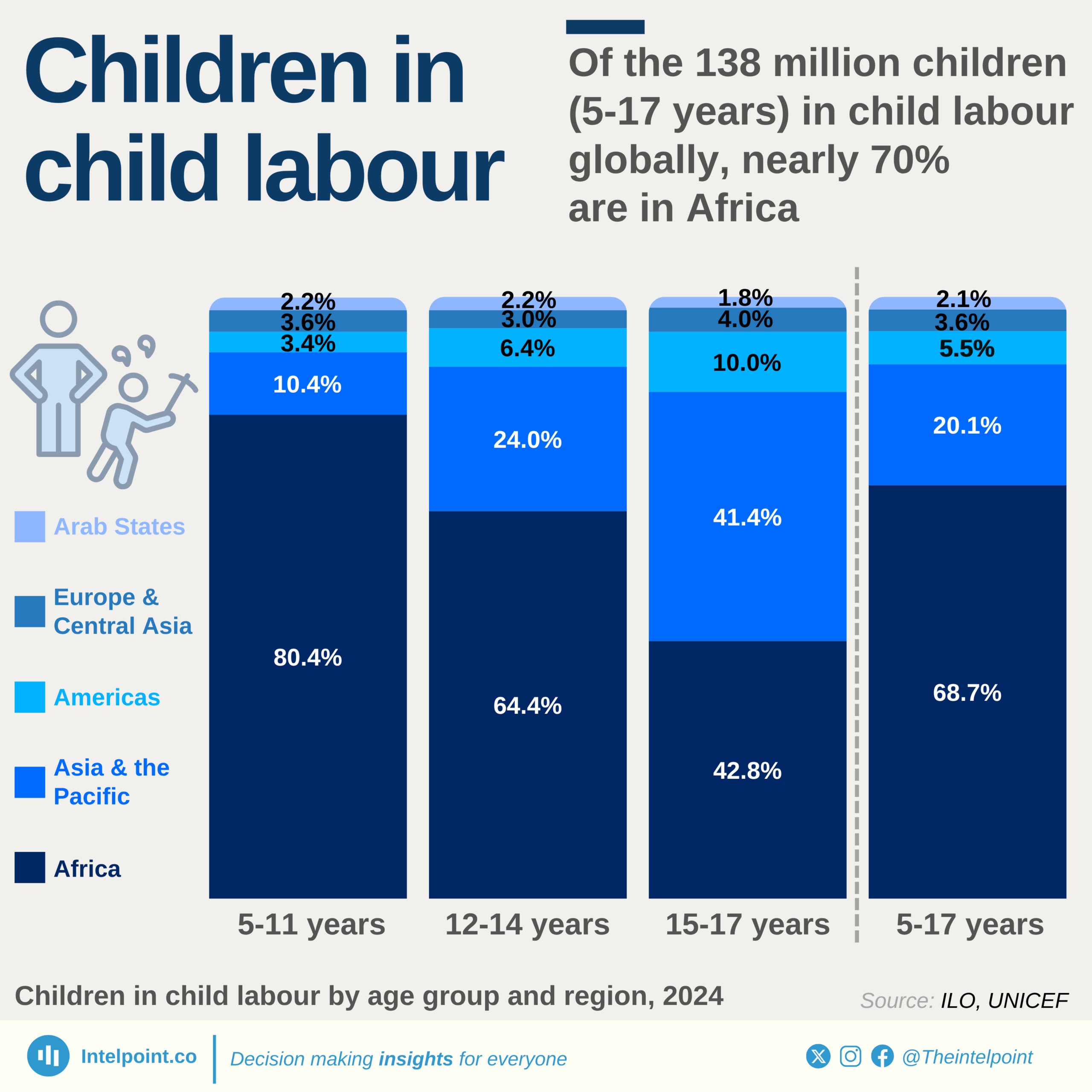
Of the 138 million children (5-17 years) in child labour globally, nearly 70% are in Africa
  • In 2024, nearly 138 million children globally are still involved in child labour.
  • Africa accounts for 94.5 million (68.7%) of these children — the largest regional share.
  • Four in 5 child labourers under age 12 are based in Africa.
  • The global goal to end child labour by 2025 was not achieved.
  • Child labour has fallen by over 100 million since 2000, despite global child population growth.

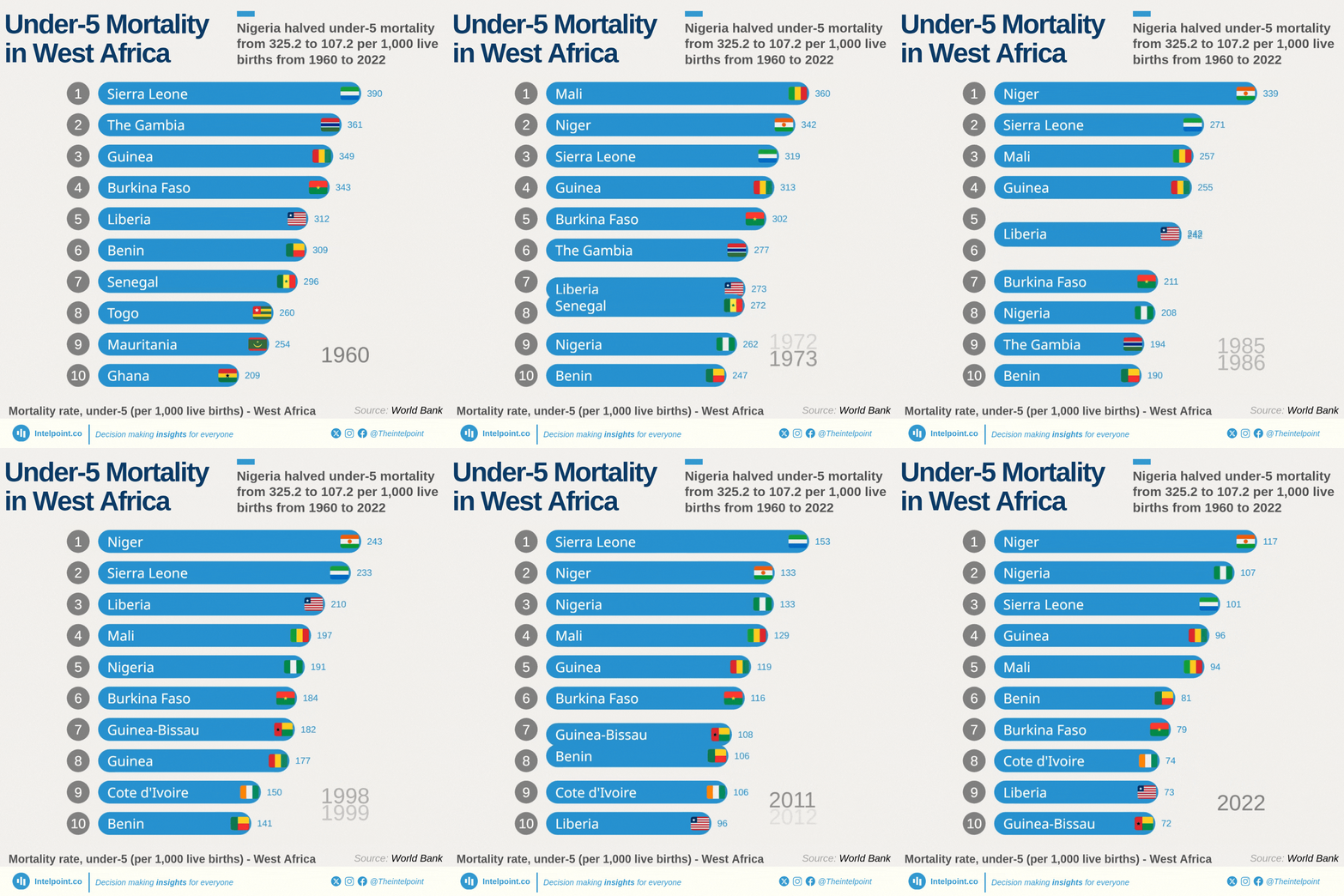
Nigeria halved under-5 mortality from 325.2 to 107.2 per 1,000 live births from 1960 to 2022
  • Ghana's under-5 mortality rate at 42.3 deaths per 1,000 live births, still higher than the SDG target of 25 deaths per 1,000 live births.
  • Cape Verde achieved the most dramatic reduction in under-5 mortality rates, cutting its rate by over 93%, from 174.8 in 1960 to 12.3 in 2022, the lowest in West Africa.
  • Sierra Leone had the highest under-5 mortality rate in 1960, at 390.1 deaths per 1,000 live births, marking it as one of the most challenging places for child survival in the region at the time.
  • Liberia experienced a troubling increase in under-5 mortality rates during the 1980s, peaking at 263.8 in 1990, a period marked by civil war and economic instability.

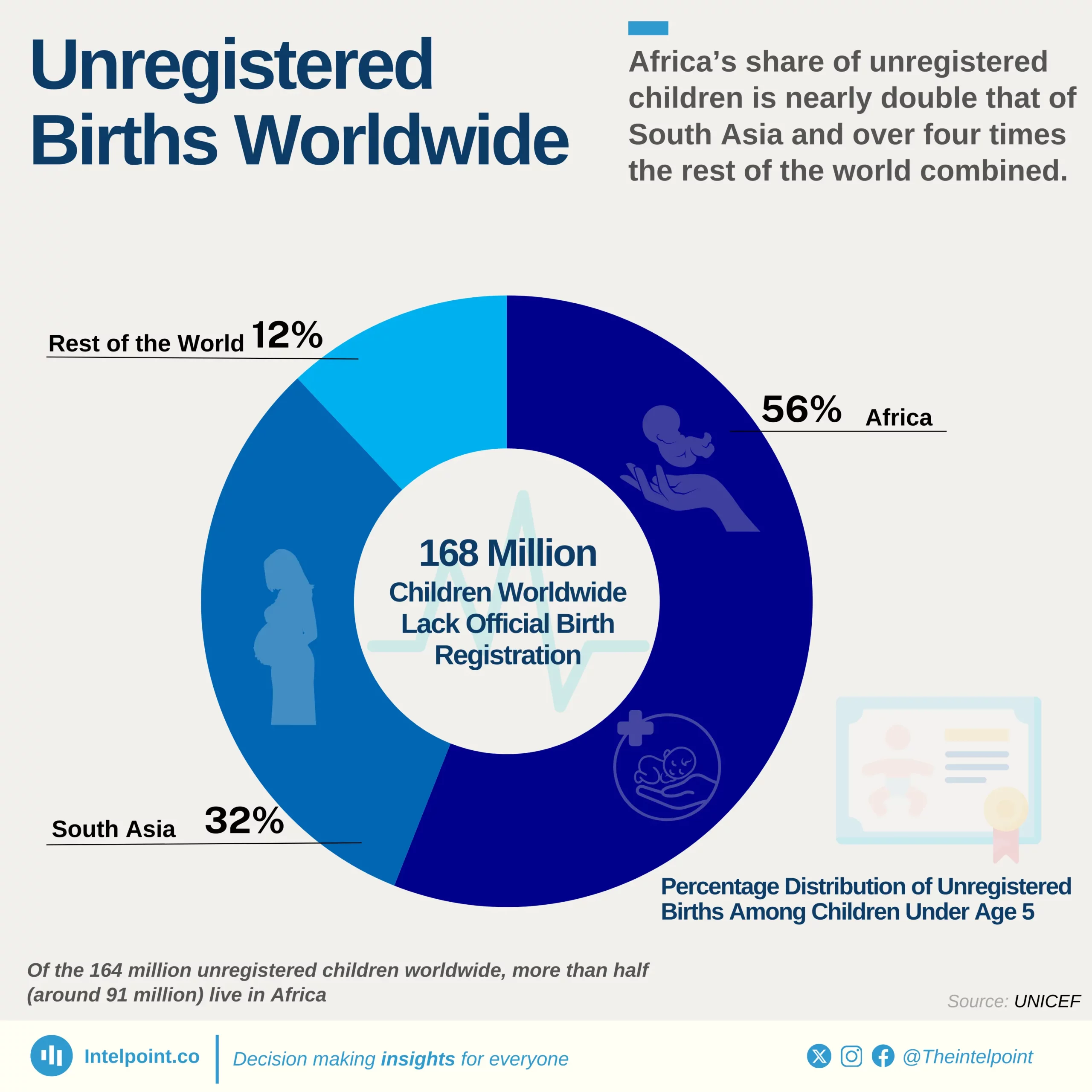
Africa’s share of unregistered children is nearly double that of South Asia and over four times the rest of the world combined
  • 56% (91 million) of unregistered children live in Africa, more than the rest of the world combined.
  • South Asia follows with 32%, while the rest of the world accounts for just 12%.
  • Africa’s share of unregistered children is nearly double that of South Asia and over four times that of the rest of the world.
  • This disparity underscores the urgent need for improved civil registration systems in high-impact regions.

Nigeria ranks 7th in the world for child displacement due to conflict
As of December 2023, 28.6 million internally displaced people affected by conflict were under the age of 18, accounting for 38% of the global IDP population. Conflict-ravaged Sudan has the most internally displaced children globally, with 4.25 million under the age of 18. DR Congo and Syria follow with 3.57 million and 2.65 million displaced children, respectively. Nigeria's 1.65 million displaced children make it the 7th highest globally for child displacement due to conflict.

Africa and Asia most affected by lack of drinking water in children's schools
A recent UNICEF report shows that 293m children worldwide did not have drinking water in their schools in 2023. Six African and four Asian countries make up the top ten, with Ethiopia and Nigeria occupying first and second positions, respectively, with 33.2m and 29m children. The top five countries account for 42% of the total affected population.

POPULAR TOPICS
SIGN UP TO OUR NEWSLETTER
Get periodic updates about the African startup space, access to our reports, among others.
Subscribe Here
Subscription Form

A product of Techpoint Africa. All rights reserved