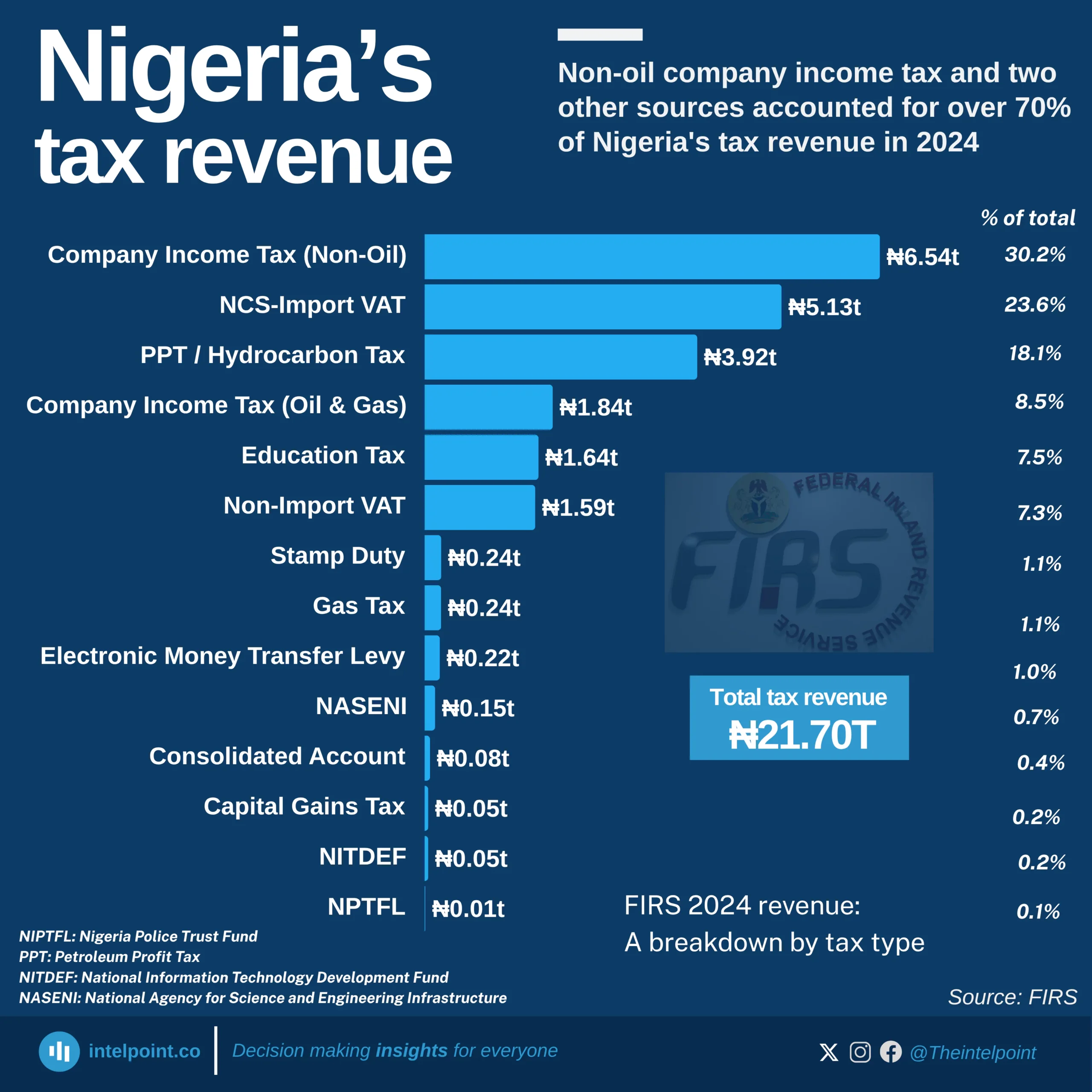
Non-oil company income tax and two other sources accounted for over 70% of Nigeria's tax revenue in 2024

  • Company Income Tax (Non-Oil) emerged as the largest contributor, accounting for over 30% of total tax revenue.
  • NCS-Import VAT followed closely, contributing 23.63%, emphasising the significance of import-related taxes to Nigeria's revenue.
  • Traditional oil-based taxes such as Petroleum Profit Tax/Hydrocarbon Tax and CIT (Oil & Gas) jointly contributed over 26%, showing that oil remains a vital but declining pillar.
  • Newer tax streams like the Electronic Money Transfer Levy and NASENI (National Agency for Science and Engineering Infrastructure) funding have emerged, but still make up less than 2% of total revenue.
  • Minor tax categories like Capital Gains Tax, NITDEF (National Information Technology Development Fund), and NPTFL (Nigeria Police Trust Fund) had negligible impact, each contributing less than 0.5%

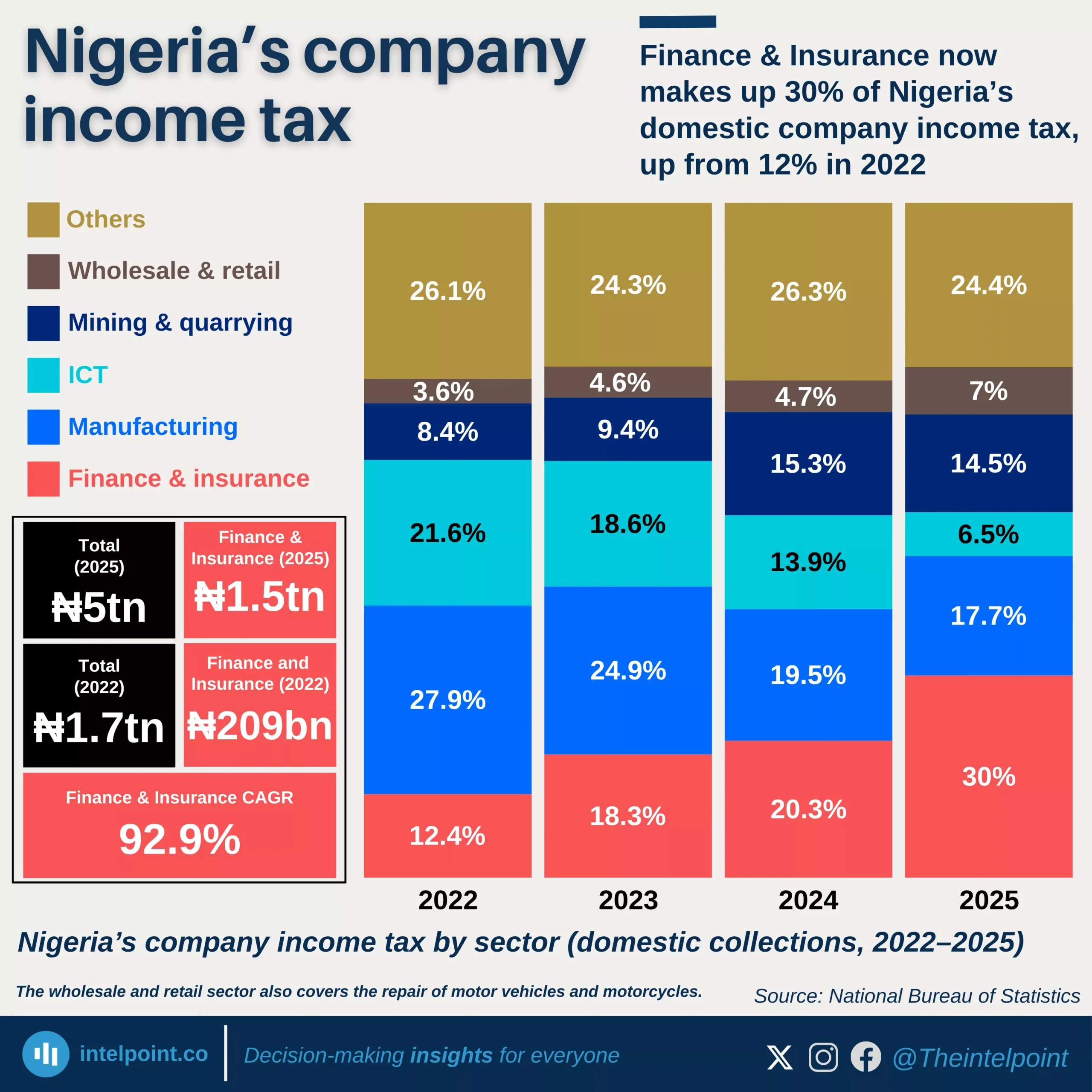
Nigeria’s diversified tax revenue structure now has company income tax (Non-Oil) leading the pack at ₦6.54 trillion, equivalent to 30.15% of total revenue. This suggests that despite Nigeria's historical reliance on oil, private sector and corporate activities outside oil and gas are now the top drivers of tax revenue.

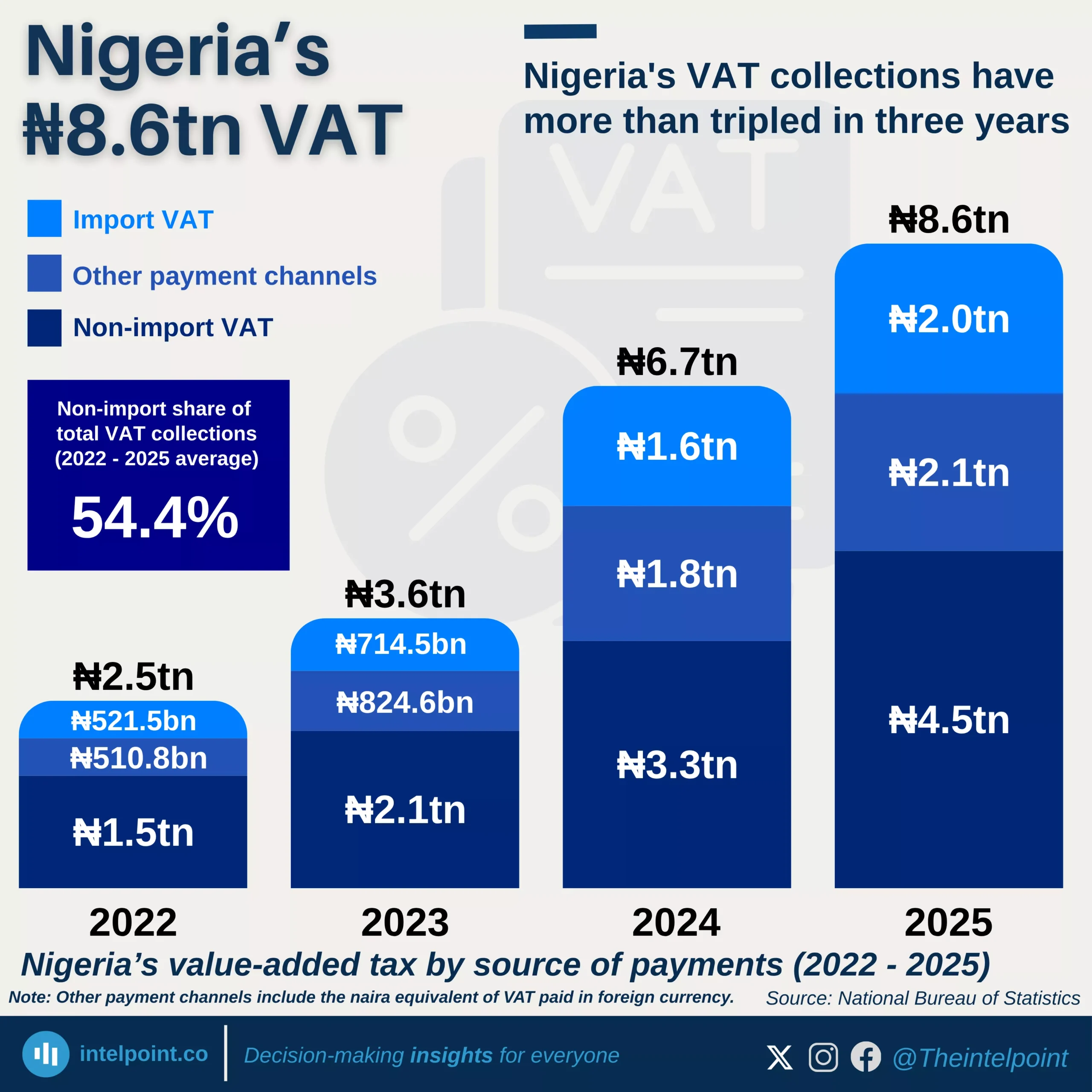
Closely behind is NCS-Import VAT, which contributed ₦5.13 trillion or 23.63%, reaffirming the critical role of trade and customs revenue. With Nigeria being a high-import economy, VAT collections on imports have become a dependable and predictable revenue stream.

Oil-related taxes, notably Petroleum Profit Tax (₦3.92 trillion) and CIT (Oil & Gas) (₦1.84 trillion), together account for over ₦5.7 trillion or roughly 26.5%, which shows that while oil is still important, its dominance has been overtaken by non-oil sources, a trend consistent with fiscal diversification goals.

Smaller tax heads like Stamp Duty, Education Tax, and Non-Import VAT provide moderate revenue contributions, ranging between ₦1.5–1.6 trillion, indicating stable collection mechanisms in those areas.

On the lower end of the spectrum, categories such as Capital Gains Tax, NITDEF (National Information Technology Development Fund), NASENI (National Agency for Science and Engineering Infrastructure), and NPTFL (Nigeria Police Trust Fund) collectively contribute less than 2%, highlighting the potential for policy-driven improvement in enforcement, tax base expansion, or administrative efficiency.

Overall, this chart demonstrates a shifting tax landscape where non-oil sources are becoming more dominant, and import-related collections remain strong, while smaller and newer taxes present opportunities for enhanced growth through reform or enforcement.
Source:

Federal Inland Revenue Service

Period:

2024
HTML code to embed chart
Want a bespoke report?
Reach out
Tags
Related Insights

Nigeria beats Egypt to win AFCON bronze medal, extending its record to nine third-place finishes
  • Nigeria extends its AFCON bronze medal wins to nine, the highest in men’s AFCON history, with another podium finish.
  • The win over Egypt highlights Nigeria’s resilience, turning late-stage setbacks into tangible success.
  • Bronze medals remain rare for most nations, with the majority appearing only once or twice in AFCON history.

97% of businesses in Kogi are aware of Nigeria's 2025 tax reform, while 99% in Abia are not
  • Kogi entrepreneurs have the highest tax policy awareness in Nigeria (96.8%) in 2025.
  • Abia has the lowest awareness nationwide at just 1.4%.
  • Fewer than one-third of Nigerian states have awareness levels above 60%.
  • Major economic hubs like Lagos and Rivers have awareness below 50%.
  • Northern states dominate the top awareness rankings more than southern states.
  • Several states cluster around the 40–50% range, indicating partial reach.
  • States with low awareness risk lower compliance and higher friction during enforcement.
  • The gap between the highest and lowest states exceeds 95 percentage points, showing extreme disparity.

Nigeria’s power grid is 69.9% powered by thermal plants
  • Thermal energy dominates Nigeria’s grid, supplying 69.9% of total power.
  • Hydro plants contribute 30.1%, making them the country’s second major source.
  • The heavy reliance on thermal generation shows Nigeria’s grid is still largely fossil-fuel driven.
  • Hydro remains a crucial but secondary source, supporting overall supply stability.

Nigeria's DisCos recorded ₦360bn revenue gap after collecting ₦1.12tn from ₦1.49tn billed in H1 2025
  • DisCos billed approximately ₦1.49 trillion but collected only ₦1.12 trillion in H1 2025.
  • Ikeja and Eko DisCos generated the highest revenues, collecting ₦206.22 billion and ₦210.59 billion, respectively.
  • Revenue collection gaps remain significant, with Jos, Kaduna, and Yola posting the weakest collection performances.
  • The wide gap between billings and actual collections suggests persistent challenges in customer payment compliance, metering, and distribution efficiency.

Nigeria has installed 3.65 million electricity metres since 2019; Ikeja DisCo leads with 823,000, and Aba Power at the bottom with 56,000
  • Approximately 3.65 million metres have been installed nationwide across all frameworks since 2019.
  • Ikeja DisCo leads by a wide margin with 823,000 installations, over twice the volume of most other DisCos.
  • Kaduna, Yola, and Aba Power recorded the lowest metre installations, each below 100,000.
  • The disparities in installation totals reveal uneven progress in achieving nationwide metering coverage.

More than 8 in 10 electricity customers of Ikeja and Eko DisCos are now metered
  • Ikeja (84.6%) and Eko (83.3%) lead Nigeria’s metering performance, keeping unmetered customers below 17%.
  • Eight out of the twelve DisCos have metering rates below 60%, showing a wide sector imbalance.
  • The worst-performing DisCos — Yola, Jos, Kaduna, and Kano — have over 65% unmetered customers.
  • Regional disparities are sharp: Lagos and Abuja outperform northern and south-eastern DisCos by large margins.

POPULAR TOPICS
SIGN UP TO OUR NEWSLETTER
Get periodic updates about the African startup space, access to our reports, among others.
Subscribe Here
Subscription Form

A product of Techpoint Africa. All rights reserved