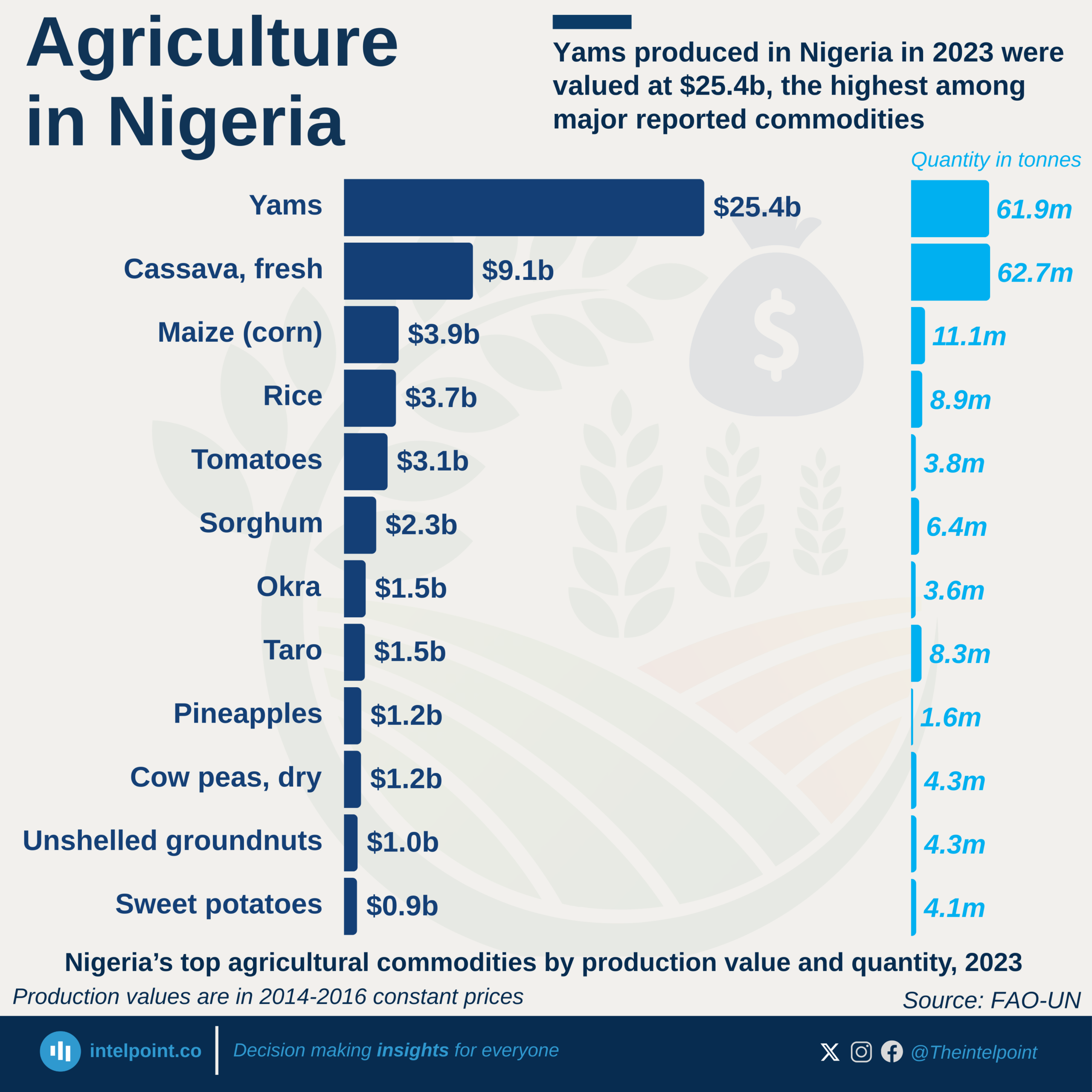
Yams produced in Nigeria in 2023 were valued at $25.4b, the highest among major reported commodities

  • After yielding 61.9 million tonnes, yams were valued at $25.4 billion in 2023, the highest among reported commodities.
  • With 62.7 million tonnes produced, cassava generated $9.1 billion, making it the second most valuable crop.
  • Okra ($818/t), tomatoes ($808/t), and pineapples ($753/t) earned the highest returns per unit despite smaller volumes (1.6–3.8 million tonnes).
  • Maize ($3.7 b, 11.1 m t), rice ($3.1 b, 8.9 m t), sorghum ($2.3 b, 6.4 m t), cowpeas ($1.2 b, 4.3 m t), and groundnuts ($0.9 b, 4.3 m t) form the backbone of production.

Yams produced in Nigeria in 2023 were valued at an estimated $25.4 billion, the highest among major agricultural commodities, followed by cassava at $9.1 billion and maize at $3.9 billion.

Together, these staples dominate both production and economic value, with cereals like rice ($3.7 billion, 8.9 m tonnes) and sorghum ($2.3 billion, 6.4 m tonnes) ranking next.

Horticultural crops stand out in value per tonne, led by okra ($818/t), tomatoes ($808/t), and pineapples ($754/t), highlighting the potential of smaller-volume, high-value crops. Legumes such as cowpeas ($278/t) and groundnuts ($222/t) add diversity to production.

Source:

Food and Agriculture organization of the UN

Period:

2023
HTML code to embed chart
Want a bespoke report?
Reach out
Tags
Related Insights

From 45% to 2%: How Nigeria lost its global palm oil production share to Asia
  • Indonesia dominated with 46.8M tonnes in 2022, up from 145.7 ktonnes in 1961
  • Malaysia was the second-largest producer in 2022 with 18.5M tonnes
  • Global production has increased from under 2M tonnes (1961) to over 75M tonnes (2022)
  • Thailand, Colombia, and Guatemala have emerged as major producers in recent decades
  • Nigeria was historically significant, but has been overtaken by Asian producers

Over one-fourth of Asia’s forests were in legally established protected areas as of 2024
  • Asia leads globally with 26% of its forests in legally protected areas.
  • The global average stands at 20%, meaning that one-fifth of all forests are under some form of legal protection.
  • Africa and Europe are tied at 23%, both above the global average.
  • South America has only 17% of its forests protected, despite being home to the Amazon rainforest.

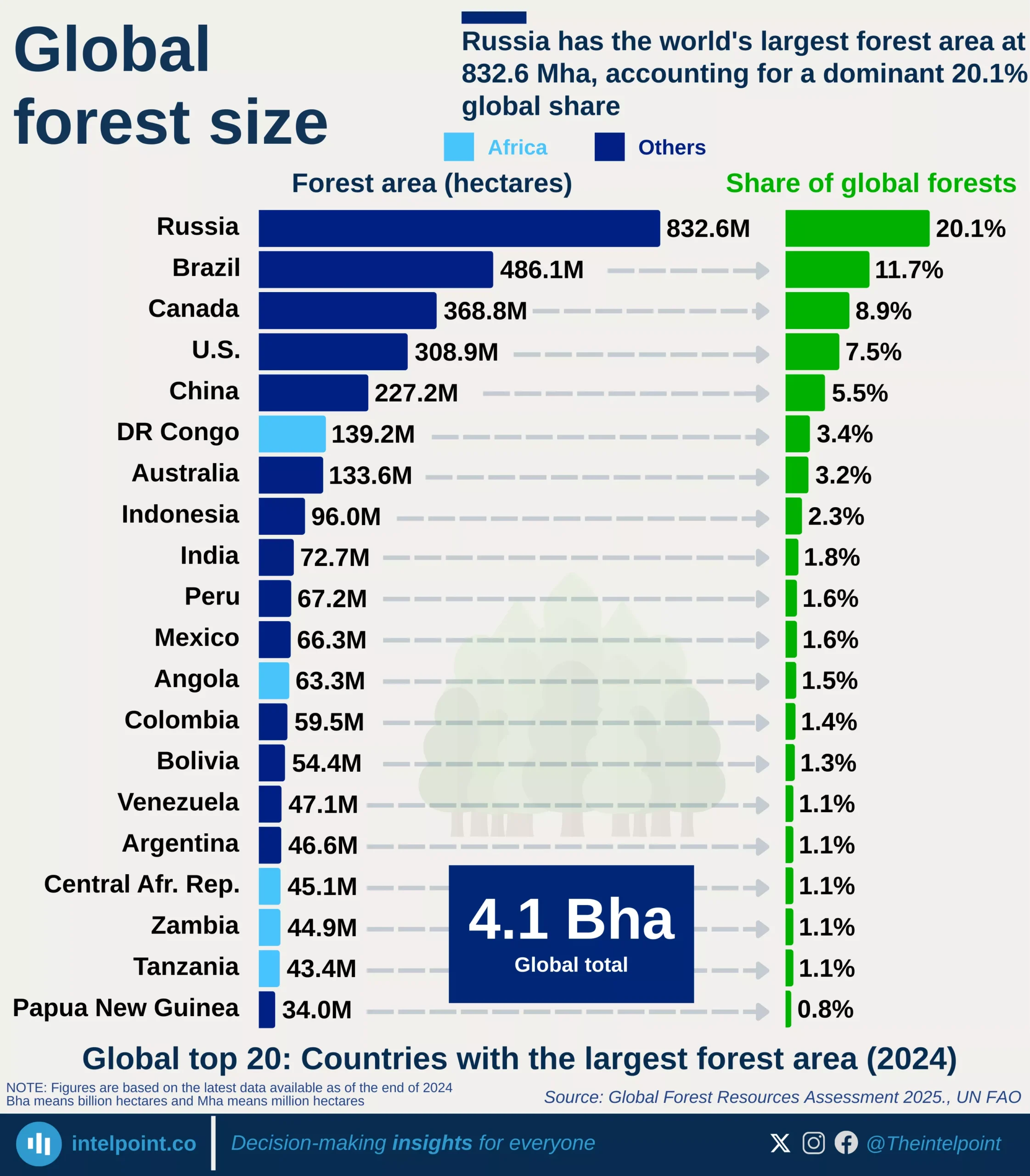
Russia has the world's largest forest area at 832.6 Mha, accounting for a dominant 20.1% global share
  • Global forest cover is 4.1 Bha, according to the latest FAO assessment.
  • At 832.6 Mha, 20.1% of the global total, Russia has the world’s largest forest area.
  • Brazil (486.1 Mha; 11.7%) and Canada (368.8 Mha; 8.9%) rank second and third, respectively.
  • The United States (7.5%) and China (5.5%) complete the global top five.
  • Africa’s top contributor is the Democratic Republic of Congo, with 139.2 Mha, 3.4% of the global total.
  • Other African countries in the top 20 include Angola, Zambia, Tanzania, and the Central African Republic, each accounting for approximately 1% of the global forest area.
  • Together, the top ten countries account for over 78% of the world’s total forest area, highlighting the global concentration of forest resources.

Nearly one in six of Africa’s goats are in Nigeria, the continent’s leader since 1998
  • Africa’s goat population grew from 94 million in 1961 to 522 million in 2023 — more than a fivefold increase.
  • The continent’s share of the world’s goats rose from 27% in 1961 to 46% in 2023.
  • Nigeria leads with nearly 89 million goats in 2023, holding the top spot since 1998.
  • Ethiopia, Chad, Sudan, Niger, and Mali consistently rank among the largest goat producers.
  • Around 70% of Africa’s goats are concentrated in the top ten countries each year.

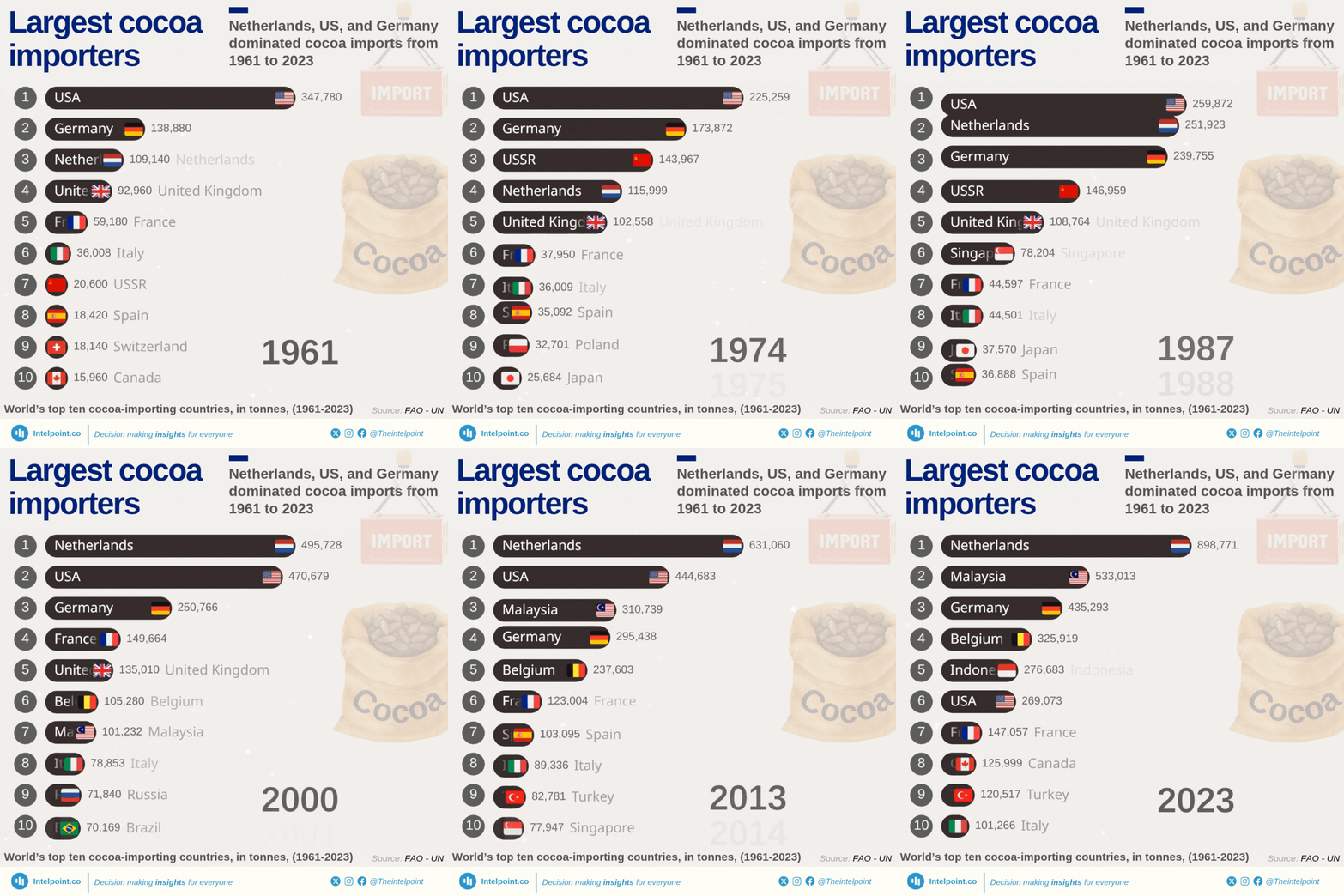
Netherlands, US, and Germany dominated cocoa imports from 1961 to 2023
  • Netherlands imported the most cocoa beans — 25.48 million tonnes (1961–2023)
  • US (21.1M) and Germany (16.8M) followed in total volume
  • These three countries dominated the top 5 nearly every year
  • Malaysia, UK, France, and Belgium also ranked high over time
  • USSR stayed in the top 10 despite dissolving in 1991
  • Global cocoa imports grew from 1M tonnes in 1961 to nearly 4M in 2023

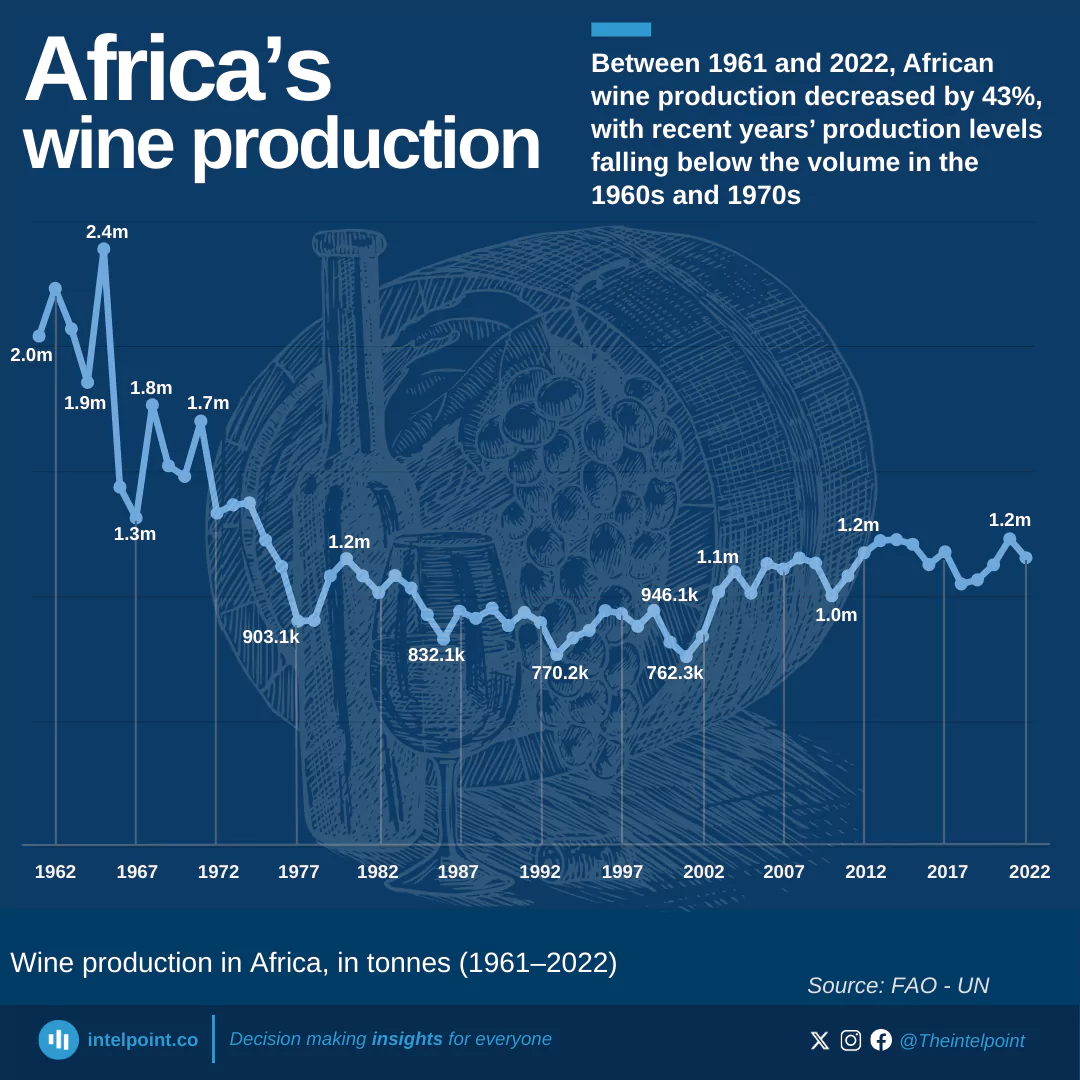
Between 1961 and 2022, African wine production decreased by 43%, with recent years’ production levels falling below the volume in the 1960s and 1970s
Key Takeaways:
  • African wine production peaked in 1965 at 2.39 million tonnes, the highest level recorded during the entire period.
  • The most dramatic single-year drop occurred between 1965 and 1966, when production fell by 40%, from 2.39 to 1.44 million tonnes.
  • A gradual recovery began in the early 2000s, with production consistently exceeding 1 million tonnes from 2003 onward.
  • The most recent peak occurred in 2021, with production reaching 1.23 million tonnes, a 48.5% decline from the 1965 high.
  • Despite this partial recovery, current production levels remain well below the highs of the 1960s.
  • As of 2022, African wine production stood at 1.16 million tonnes, representing a 43% decrease from 1961.

POPULAR TOPICS
SIGN UP TO OUR NEWSLETTER
Get periodic updates about the African startup space, access to our reports, among others.
Subscribe Here
Subscription Form

A product of Techpoint Africa. All rights reserved