President Tinubu has the largest federal cabinet in the Fourth Republic

The newly created Ministry of Livestock Development will push Nigeria's ministerial count to 50. President Tinubu's federal executive cabinet is the largest since Nigeria's return to democracy in 1999.
Within the first 12 years of the Fourth Republic, the largest cabinet had 30 ministers. President Jonathan was the first to have more than 30 ministers, with subsequent terms having more ministers.
Source:

Period:

1999 - 2024
HTML code to embed chart
Want a bespoke report?
Reach out
Tags
Related Insights

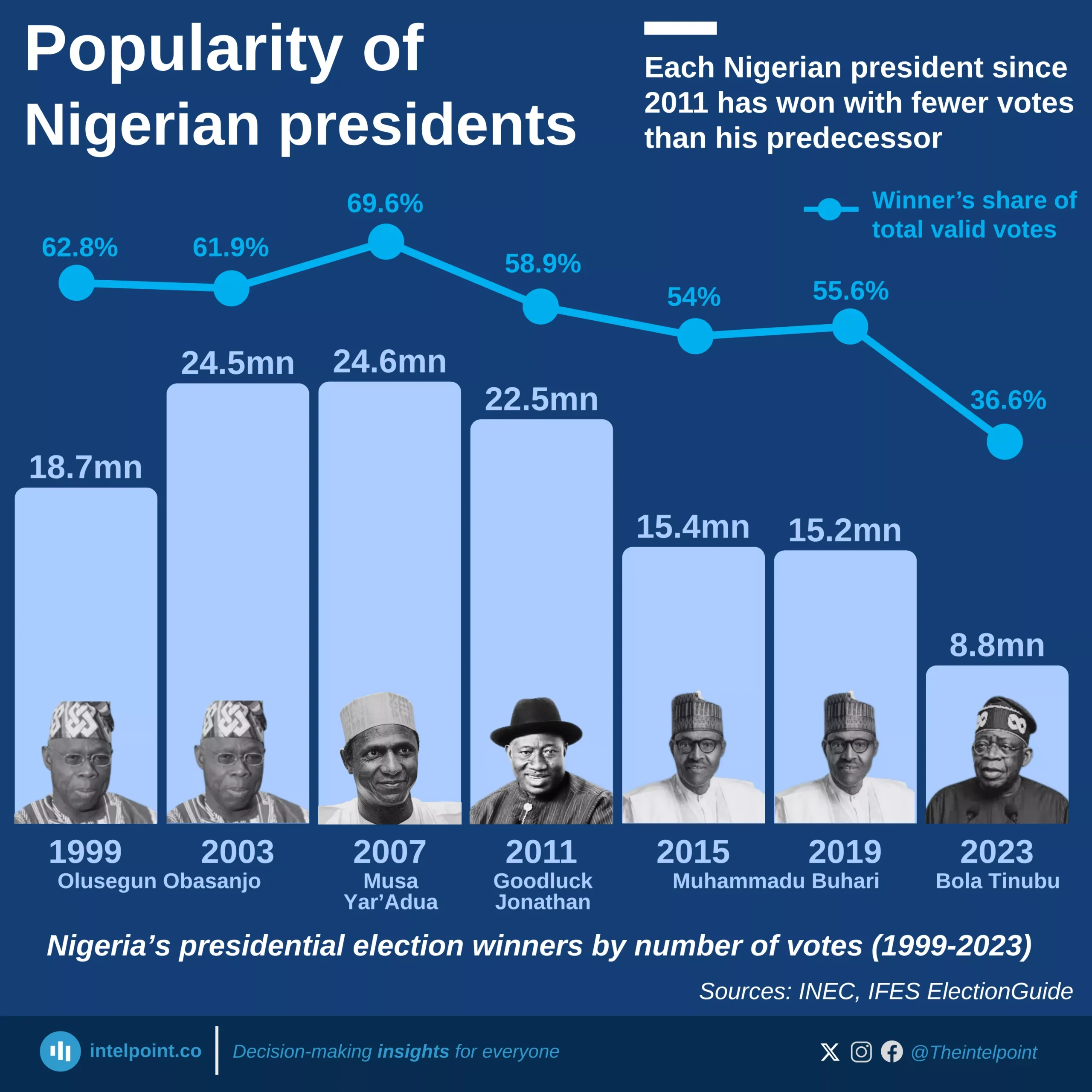
Each Nigerian president since 2011 has won with fewer votes than his predecessor
  • Bola Tinubu won the 2023 election with just 36.6% of the valid votes.
  • There is a clear downward trend in winners’ vote share since 2011, with each election producing a less dominant winner.
  • Peak dominance occurred in 2007, when Umaru Musa Yar'Adua won with 69.6% of the votes.
  • The total votes secured by winners have dropped sharply, from over 24 million (2003–2007) to 8.8 million in 2023.
  • In 2023, over 60% of valid votes went to candidates who lost.

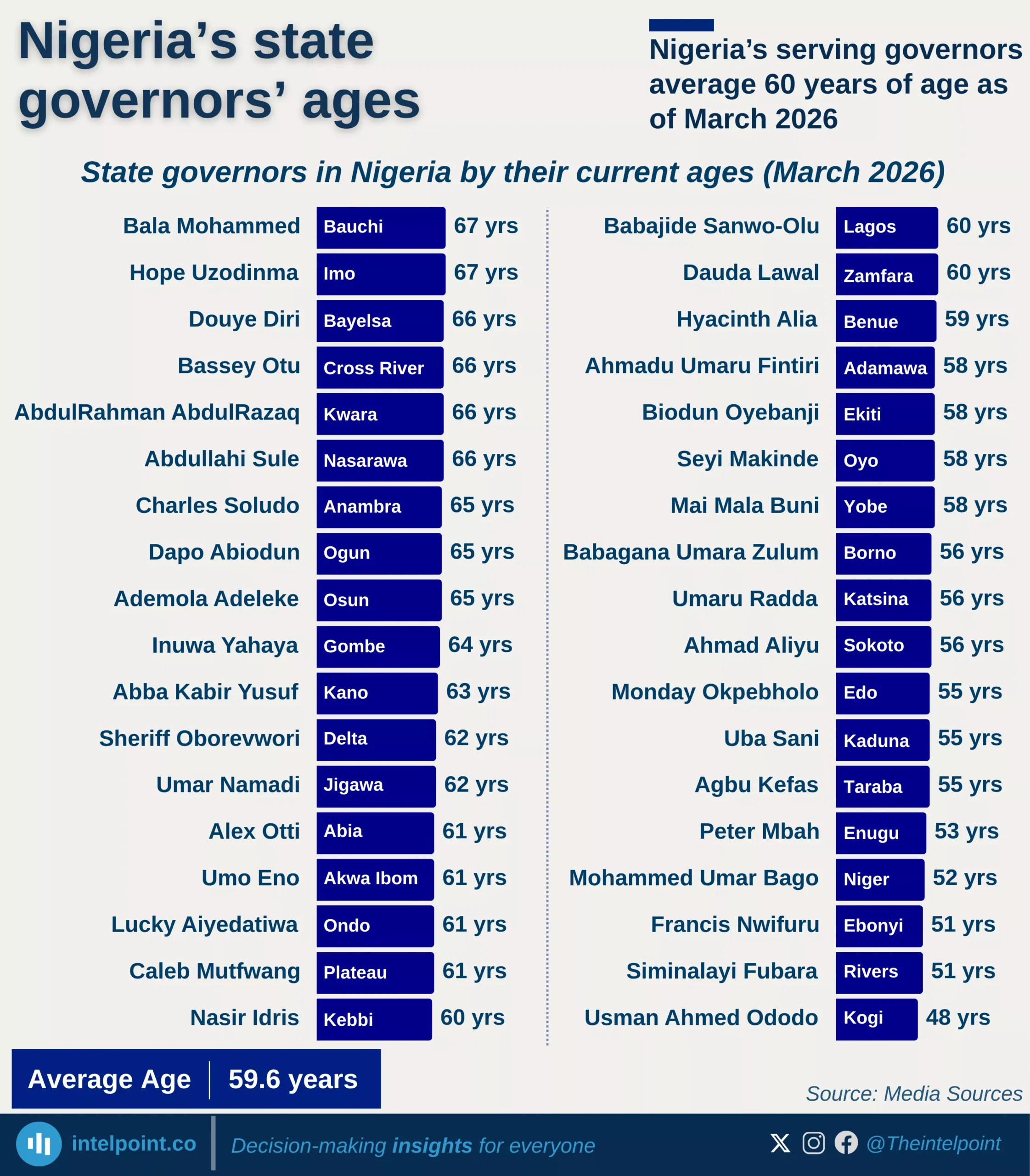
Nigeria’s serving governors average 60 years of age as of March 2026
  • Nigeria’s youngest serving governor is Usman Ahmed Ododo of Kogi state at 48 years old.
  • The oldest serving governors are Bala Mohammed and Hope Uzodimma, both aged 67.
  • President Bola Ahmed Tinubu is 73 years old, making him older than every sitting governor.
  • Tinubu is 25 years older than the youngest governor and six years older than the oldest governors.
  • A number of governors are in their late 50s, including Seyi Makinde, Hyacinth Alia, and Ahmadu Umaru Fintiri.
  • The age distribution suggests that Nigeria’s state leadership is largely dominated by experienced, older political figures rather than younger politicians.

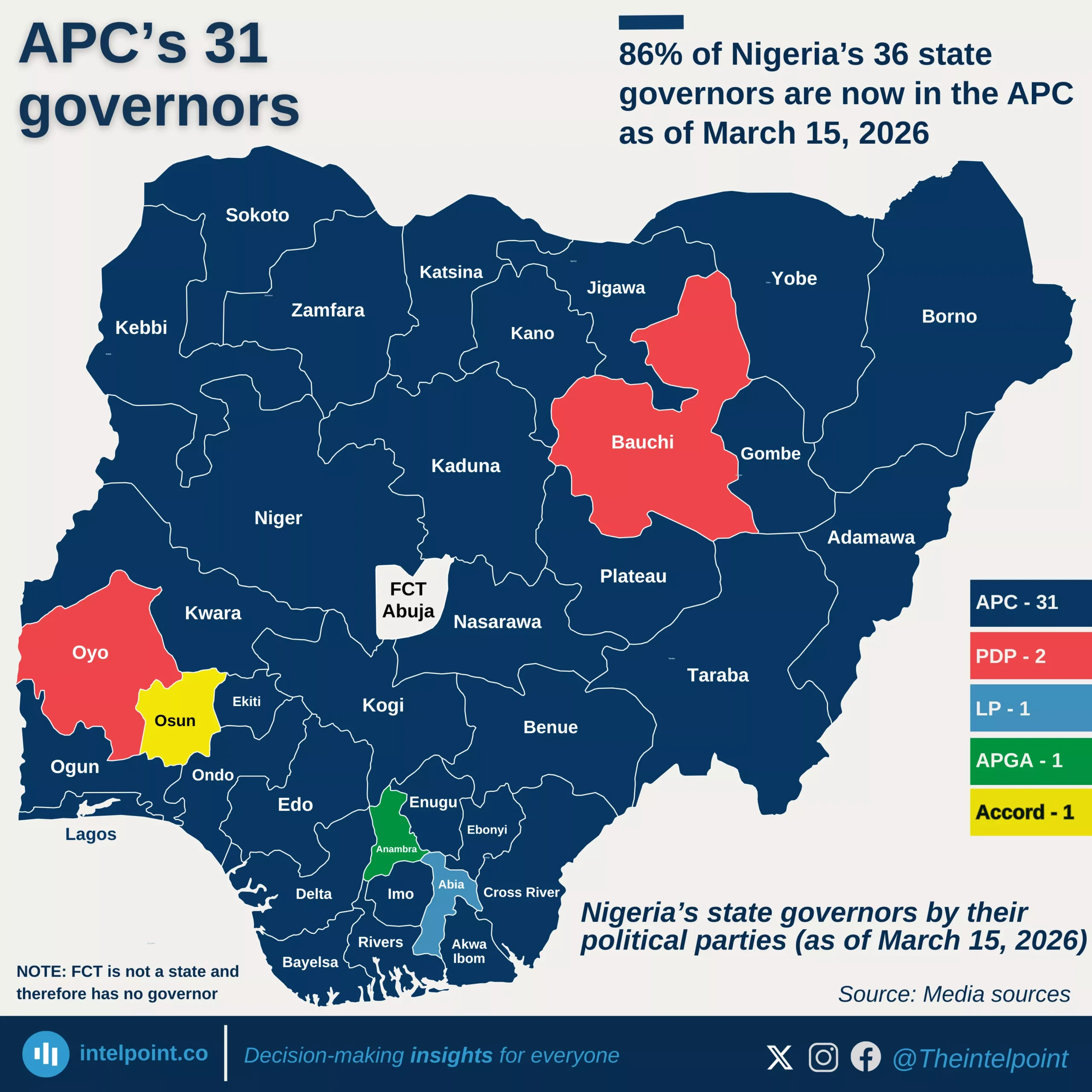
86% of Nigeria’s 36 state governors are now in the APC as of March 15, 2026
  • The All Progressives Congress (APC) currently controls 31 out of Nigeria’s 36 state governors' seats.
  • This means about 86.1% of Nigeria’s governors belong to the APC, showing the party’s strong dominance at the state level.
  • Only five states are governed by parties other than the APC.
  • The People's Democratic Party governs two states, making it the largest opposition presence among governors.
  • The Labour Party, APGA, and Accord Parties control one state governorship each.
  • With most states now aligned with the ruling party, the balance of political power at the state level in Nigeria is heavily tilted toward the APC.

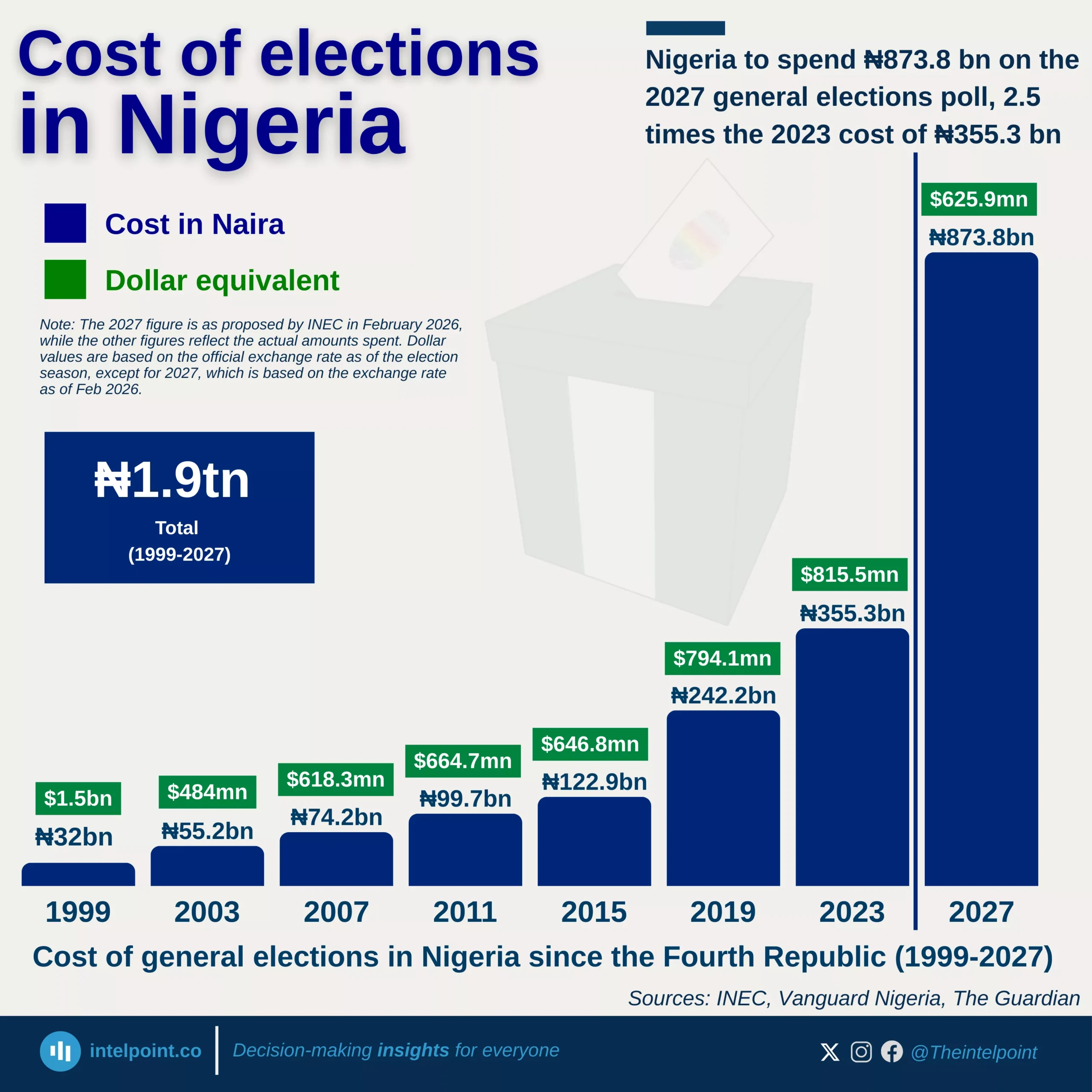
Nigeria to spend ₦873.8 bn on the 2027 general elections poll, 2.5 times the 2023 cost of ₦355.3 bn
  • The proposed 2027 election budget of ₦873.8 billion is the highest in Nigeria’s history.
  • The 2027 figure is 2.5 times higher than the ₦355.3 billion spent in 2023.
  • Election costs have increased every cycle since 1999.
  • Spending has grown from ₦32 billion in 1999 to ₦874 billion in 2027.
  • In dollar terms, the 2027 cost is estimated at about $625.9 million.
  • Nigeria has spent approximately ₦1.9 trillion—including the 2027 proposed cost—on elections since the start of the Fourth Republic.
  • Currency depreciation has influenced the dollar-equivalent fluctuations over time.

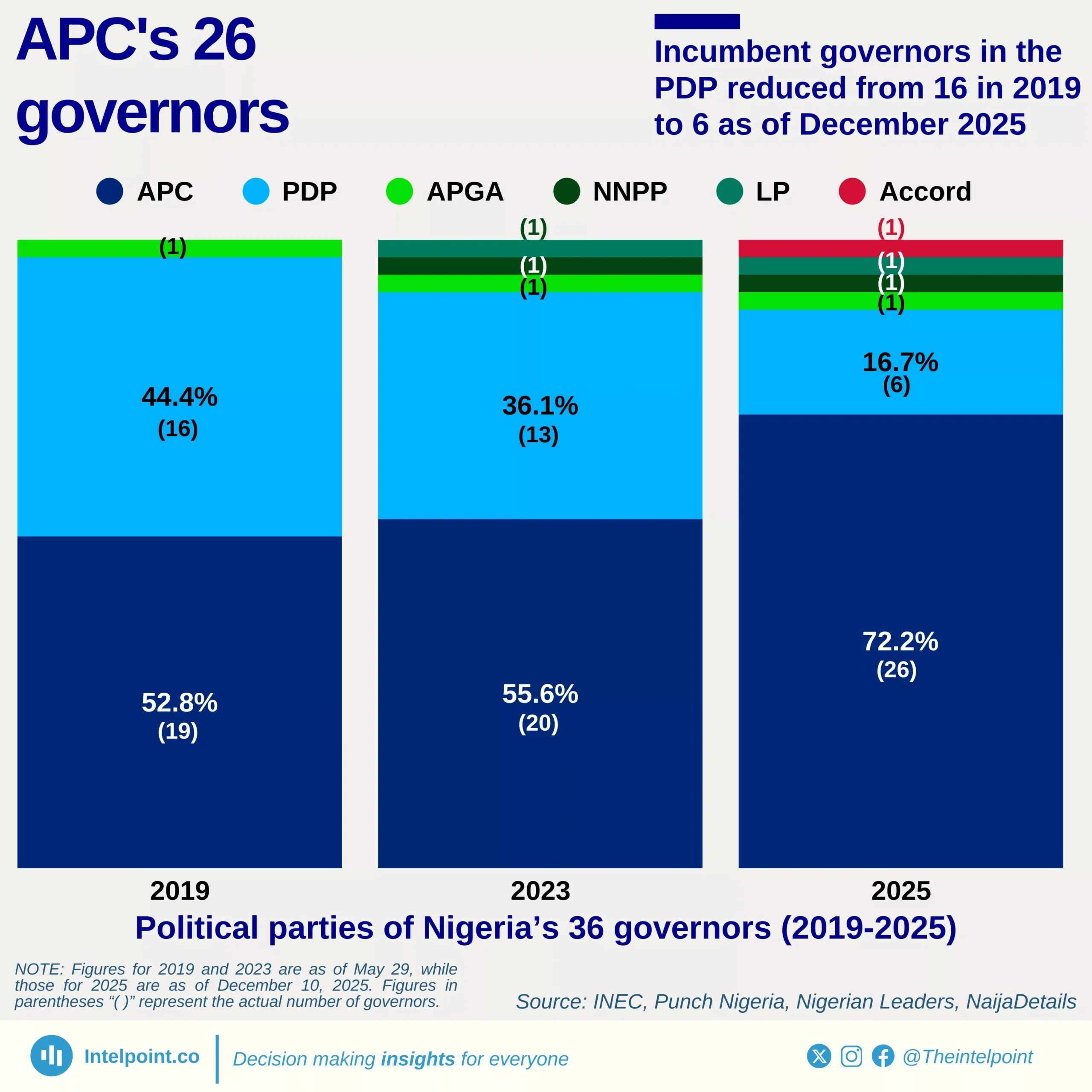
Incumbent governors in the PDP reduced from 16 in 2019 to 6 as of December 2025
  • APC increased its number of sitting governors from 19 in 2019 to 26 in 2025.
  • PDP saw a significant decline, dropping from 16 governors in 2019 to 6 by 2025.
  • APC’s share of governors rose from 52.8% in 2019 to 72.2% in 2025.
  • As of May 2023, after the 2023 general elections, 13 sitting governors were still members of the PDP, but by 2025, five of these governors had defected to the APC, one had defected to
  • Accord, and one lost an election in 2024 to the APC.
  • Smaller parties (APGA, NNPP, LP, and Accord) appeared intermittently, each holding a single governorship.
  • By 2025, Nigeria’s governorship landscape was the most one-sided in recent years, heavily dominated by the APC.

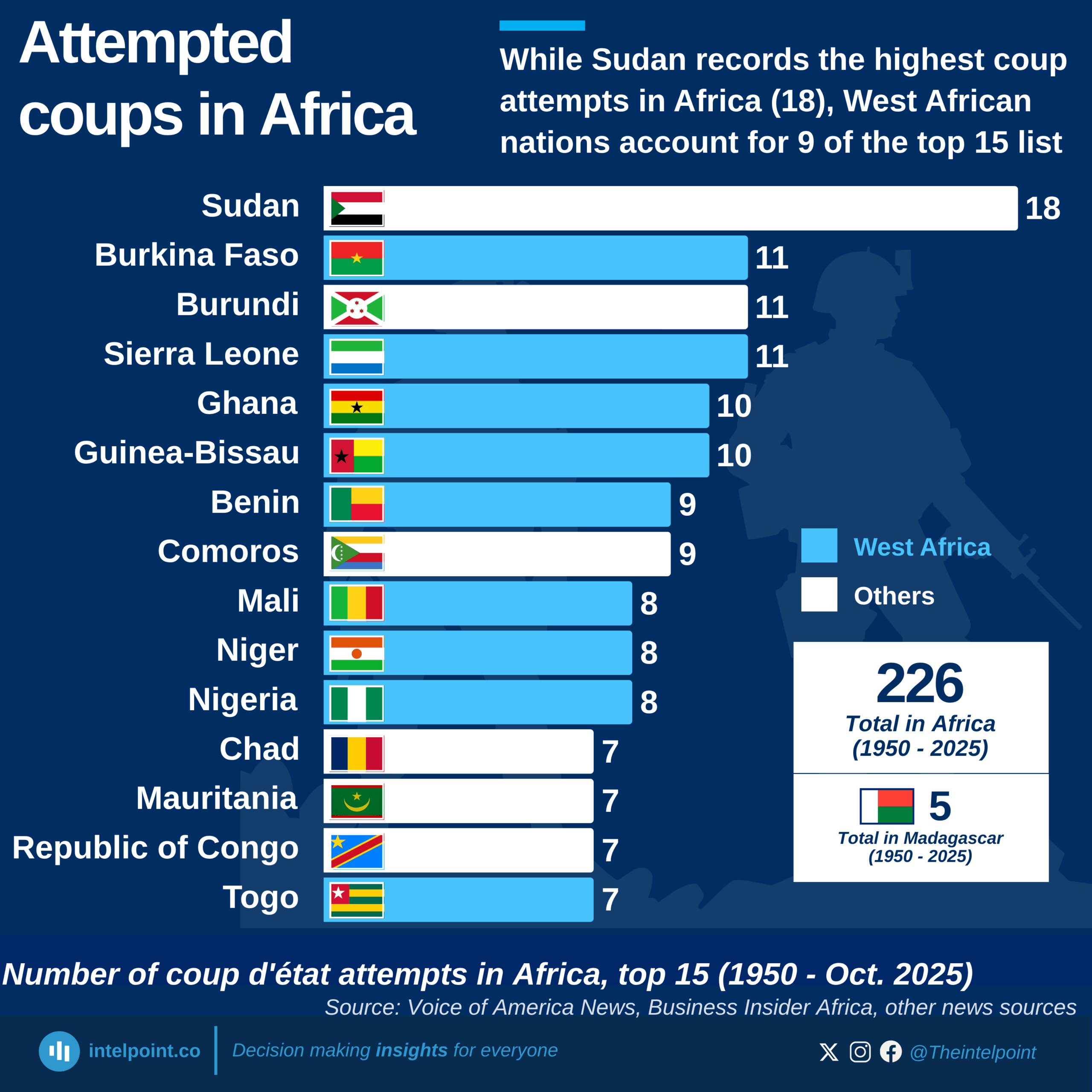
While Sudan records the highest coup attempts in Africa (18), West African nations account for 9 of the top 15 list
  • Sudan ranks highest in Africa with 18 coup attempts, the most in the continent since 1950.
  • Burkina Faso, Burundi, and Sierra Leone follow closely with 11 attempts each.
  • Ghana and Guinea-Bissau have each experienced 10 coup attempts, ranking among the top six.
  • West Africa remains the most coup-prone subregion, accounting for 9 of the top 15 coups in the region.
  • Africa has witnessed 226 coup attempts between 1950 and 2025.
  • Most coup-prone countries share traits like weak institutions, governance failures, and economic hardship.

POPULAR TOPICS
SIGN UP TO OUR NEWSLETTER
Get periodic updates about the African startup space, access to our reports, among others.
Subscribe Here
Subscription Form

A product of Techpoint Africa. All rights reserved