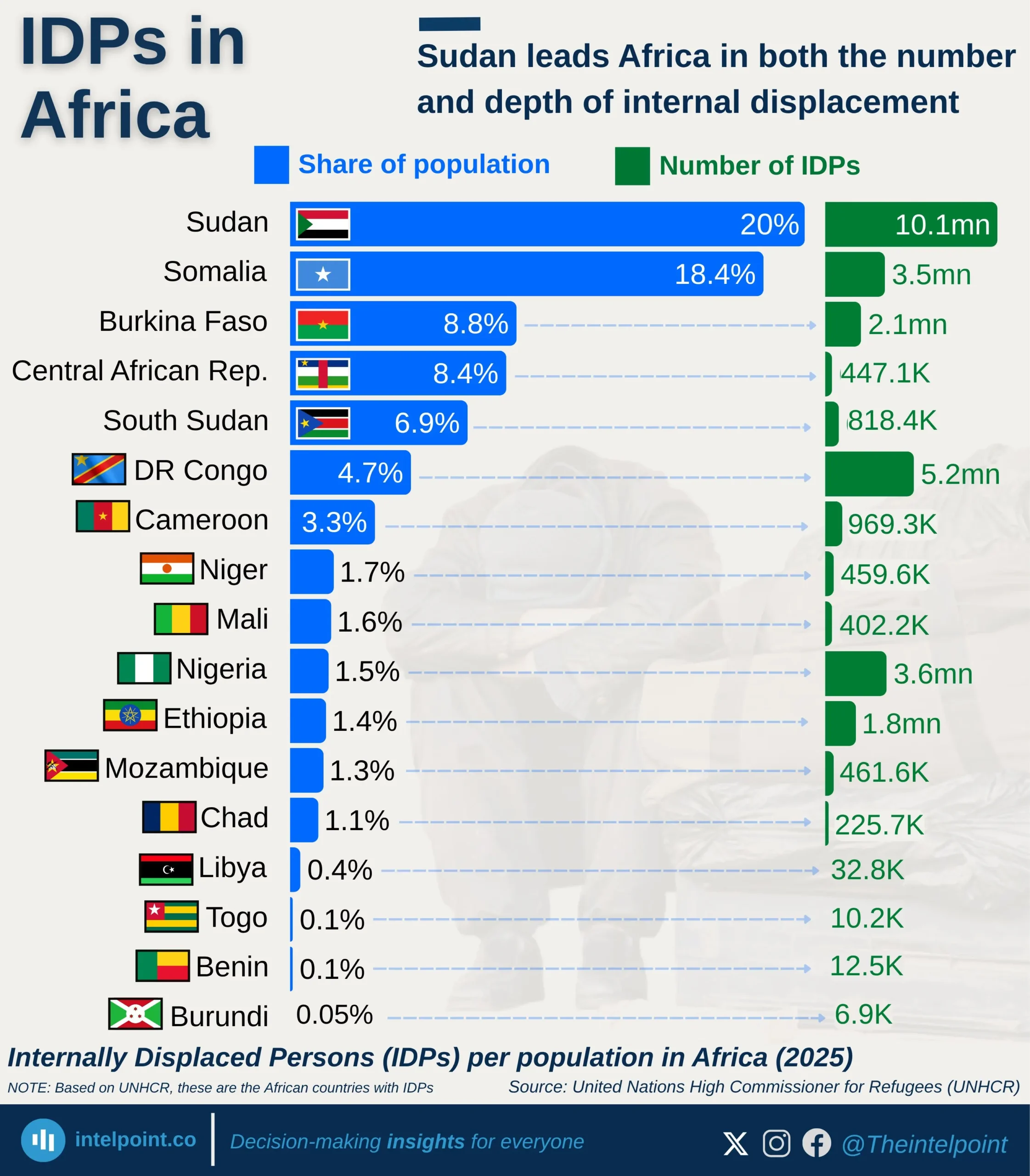
One in every five people in Sudan was internally displaced in 2025

Key Takeaways

  • Sudan has the highest displacement burden in Africa, with 10.1 million IDPs and 20% of its population affected.
  • Somalia follows with 18.4% of its population displaced.
  • High-intensity displacement is concentrated in conflict-prone regions like the Sahel and the Horn of Africa.
  • Burkina Faso (8.8%) and the Central African Republic (8.4%) show how smaller countries can face severe proportional impact.
  • Nigeria’s 3.6 million IDPs are one of the largest in absolute terms, but at 1.5%, the relative impact is lower than many peers.

There’s a difference between the number of people displaced and the depth of displacement in a country. Across Africa, the scale is massive, but the intensity tells a sharper story. Sudan leads on both fronts: 10.1 million internally displaced persons and about 20% of its population affected.

What stands out next is how uneven the burden is. Countries like Somalia (18.4%) and Burkina Faso (8.8%) show high displacement rates relative to their populations, meaning the disruption is deeply felt across society. Meanwhile, Nigeria, despite having 3.6 million IDPs, records just 1.5% of its population displaced—large in absolute terms, but comparatively less intense.
Source:

United Nations High Comissioner for Refugees (UNHCR)

Period:

2025
HTML code to embed chart
Want a bespoke report?
Reach out
Tags
Related Insights

North Africa is the least hunger-affected region in Africa, with four of the continent's five least hungry nations coming from the region
  • There is a wide disparity in GHI scores across Africa, ranging from 6.2 in Tunisia to 49.9 in Burundi, indicating a stark divide in countries’ economic well-being.
  • Countries naturally group into lower (below 20), mid (20–34.9), and high (35+) ranges, reflecting varying levels of economic strain.
  • West and Central African countries like Nigeria (32.8), Niger (33.9), Chad (34.8), and the Central African Republic (33.4) cluster toward the upper end, indicating deeper economic challenges.
  • Extreme cases remain concentrated in fragile states; the highest scores — Somalia (42.6) and Burundi (49.9) — highlight persistent structural vulnerabilities, often linked to conflict and instability.

East Africa dominates Africa's Crime Index, but Nigeria stands out as the highest-ranked West African country
  • DR Congo had Africa’s highest criminality score in 2025 at 7.5.
  • South Africa ranked second at 7.4, while Nigeria occupied third spot at 7.3.
  • Kenya was the highest-ranked East African country at 7.2.
  • The gap between the highest (7.5) and lowest score (1.8) is wide — 5.7.

Africa’s Crime Index is highest in East Africa, while rising fastest in North Africa
  • East Africa has the highest Crime Index in Africa (6.02).
  • North Africa is experiencing the fastest rise in criminality (+0.57 since 2019).
  • West Africa remains one of the most exposed regions (5.49).
  • Southern Africa has the lowest index (4.88) but is still increasing.
  • All African regions recorded an increase in criminality between 2019 and 2025.

6 of the 14 countries with over 1 million displaced people are in Africa
  • Sudan leads globally with 10.1 million IDPs.
  • 6 out of 14 countries with over 1 million IDPs are in Africa.
  • Syria has the highest displacement intensity (26.2% of its population).
  • Nigeria’s 3.6 million IDPs are large in absolute terms but represent only 1.5% of its population.
  • DR Congo (5.2mn) and Somalia (3.5mn) continue to face chronic, multi-year displacement crises.
  • Non-African countries like Colombia (7.1 million) and Ukraine (3.8 million) show that displacement is a global issue.

Illegal lab-made drugs lead Nigeria’s crime markets with a score of 8.5 out of 10
  • Illegal lab-made drugs are Nigeria’s highest-scoring crime market at 8.5.
  • Six other markets score 8.0, showing broad criminal-market severity.
  • Human trafficking remains one of Nigeria’s most entrenched illicit markets.
  • Financial crimes also remain a top-tier threat with a score of 8.0.
  • Resource-related criminality is also severe, with non-renewable resource crimes at 8.0. Wildlife crime is not marginal; it scores 7.5.
  • Cyber-dependent crimes are lower than the top criminal markets, but still elevated at 6.5.

Each Nigerian president since 2011 has won with fewer votes than his predecessor
  • Bola Tinubu won the 2023 election with just 36.6% of the valid votes.
  • There is a clear downward trend in winners’ vote share since 2011, with each election producing a less dominant winner.
  • Peak dominance occurred in 2007, when Umaru Musa Yar'Adua won with 69.6% of the votes.
  • The total votes secured by winners have dropped sharply, from over 24 million (2003–2007) to 8.8 million in 2023.
  • In 2023, over 60% of valid votes went to candidates who lost.

POPULAR TOPICS
SIGN UP TO OUR NEWSLETTER
Get periodic updates about the African startup space, access to our reports, among others.
Subscribe Here
Subscription Form

A product of Techpoint Africa. All rights reserved