Nigeria: The price of tomatoes has surged by 321% in one year, as have other food items

Food prices have continued to increase as Nigeria's headline inflation hit 34.19% in June 2024, one of the highest globally.

NBS's monthly survey for the average prices of selected food items in Nigeria as of June 2024 shows that tomatoes have gone up by 321%, yam by 296%, and staples — beans, rice, and plantain — have also seen significant increases. These are the top ten food items most hit by inflation in Nigeria in the past twelve months.
Source:

National Bureau of Statistics

Period:

June 2024
HTML code to embed chart
Want a bespoke report?
Reach out
Tags
Related Insights

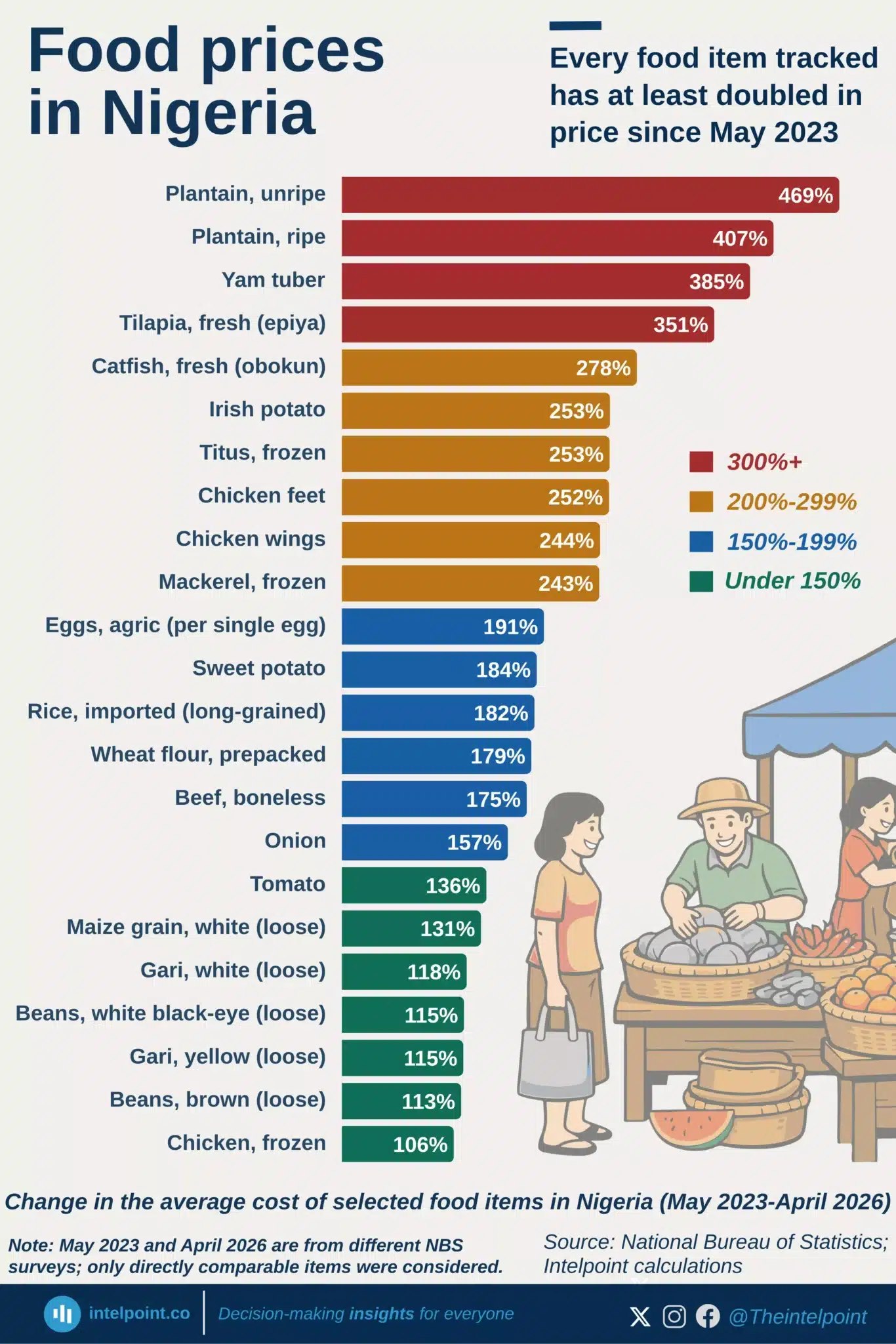
Every food item tracked has at least doubled in price since May 2023
  • Every comparable food item tracked is now at least twice as expensive as it was in May 2023.
  • Nearly half of the selected food items have more than tripled in price since the month before fuel subsidy removal.
  • Unripe plantain recorded the steepest increase, rising by 469% between May 2023 and April 2026.
  • Ripe plantain, yam tuber, and fresh tilapia also saw extreme increases of more than 300%.
  • Even the slowest-rising staples, including frozen chicken, beans, gari, and maize, still more than doubled in price.

Healthy diet costs rose fastest in Nigeria’s North-West over two years
  • Healthy diet costs rose 49% nationally in two years.
  • North-West states recorded the fastest increases.
  • All seven North-West states rose above the national average.
  • Katsina and Kogi recorded the steepest increases, at 98%.
  • Akwa Ibom had the lowest increase, at 5%.

One adult’s monthly healthy diet takes two-thirds of minimum wage
  • One adult’s healthy diet takes 66% of Nigeria’s minimum wage.
  • The national average monthly cost is about ₦46,230 per adult.
  • Ekiti has the highest burden, at 90% of minimum wage.
  • Six states require over 80% of minimum wage for one adult’s healthy diet.
  • Adamawa has the lowest burden, at 43%.

Osun (₦1,867), the state with the highest CoHD is ₦640 more expensive than the lowest CoHD state, Kaduna (₦1,227)
  • Osun (₦1,867) has the highest CoHD, while Kaduna (₦1,227) has the lowest, a gap of ₦640.
  • The national average CoHD stood at ₦1,495 as of December 2024.
  • Southern states, particularly in the South West, record the highest diet costs.
  • Northern states dominate the list of the most affordable places to eat healthy.
  • Rising costs in urban centres like Lagos (₦1,702) and Rivers (₦1,780) reflect the impact of logistics and inflation.
  • The ₦640 state gap shows inequality in dietary access, which can deepen nutrition and welfare disparities.

The implementation of ₦70K minimum wage in Nigeria reduced the cost burden of a healthy diet, dropping it from 124.1% in June to 54.2% in July 2024
  • The share of minimum wage needed to afford a healthy diet fell from 124.1% in June to 54.2% in July 2024, when the minimum wage was increased from ₦30,000 to ₦70,000.
  • Before July, the cost of a healthy diet for a month exceeded 100% of [the] minimum wage, making it unaffordable for minimum-wage earners.
  • The sharpest burden was recorded in June 2024, when households needed their full salary plus 24% extra to eat healthily.
  • Between July and December, affordability worsened slightly from 54.2% to 64.1%, indicating that food prices continued to rise despite the wage boost.
  • The implementation of the ₦70,000 minimum wage in 2024 provided significant relief to Nigerian households struggling with the high cost of eating healthily.

The national average Cost of Healthy Diet (CoHD) in Nigeria increased by over 74% in 2024, surging from ₦858 in January to ₦1,495 in December
  • The Cost of Healthy Diet (CoHD) in Nigeria increased by over 74% in 2024.
  • The average cost rose from ₦858 in January to ₦1,495 in December.
  • June 2024 recorded the sharpest monthly jump at 19.2%, the highest of the year.
  • From August to December, CoHD rose steadily — showing no reversal in trend.
  • The persistent rise reflects food inflation, weak supply chains, and increasing import costs.
  • For many Nigerians, maintaining a healthy diet is becoming increasingly unaffordable, threatening nutrition and welfare outcomes.

POPULAR TOPICS
SIGN UP TO OUR NEWSLETTER
Get periodic updates about the African startup space, access to our reports, among others.
Subscribe Here
Subscription Form

A product of Techpoint Africa. All rights reserved