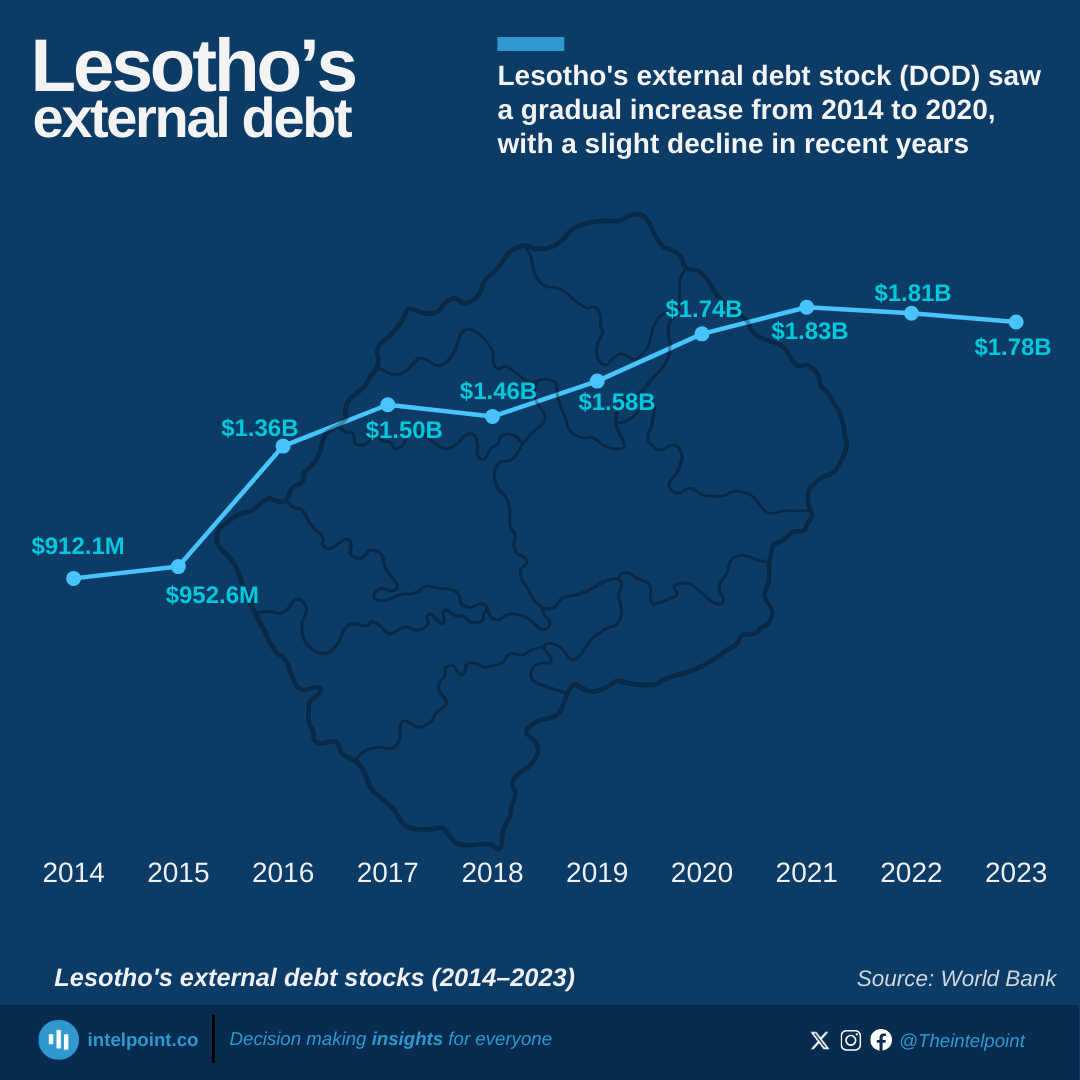
Lesotho's external debt stock (DOD) saw a gradual increase from 2014 to 2020, with a slight decline in recent years

  • Lesotho's external debt stock grew from $912.1 million in 2014 to $1.74 billion in 2020.
  • The most significant increase in debt occurred between 2015 and 2016, when the debt surged from $952.6 million to $1.36 billion.
  • After 2020, external debt levels started to stabilise, with only a slight decline from $1.83 billion in 2021 to $1.78 billion in 2023.
  • Despite the recent stabilisation, Lesotho’s external debt remains relatively high, indicating a need for debt sustainability and fiscal management.

This data is about the accumulation of external borrowed funds to finance the country’s development projects, including infrastructure and social services. However, in the last few years, from 2021 to 2023, Lesotho's external debt has stabilised, with a slight decrease in the total debt stock. The decrease in debt stock can be attributed to a combination of factors, including improved revenue collection, reduced borrowing, and debt restructuring efforts.
Source:

World Bank

Period:

2014–2023
HTML code to embed chart
Want a bespoke report?
Reach out
Tags
Related Insights

Nigeria had about 135 bank accounts per 100 people in 2025, up from 32 bank accounts in 2017
  • Active bank accounts grew from 65 million in 2016 to over 320 million in 2025 — almost a fivefold increase.
  • Bank accounts per 100 people rose from about 32 in 2017 to nearly 135 in 2025.
  • Nigeria now averages more than one bank account per person.
  • The fastest growth phase occurred between 2019 and 2024.
  • Digital banking and fintech adoption played a major role in the surge.
  • The jump after 2020 suggests technology-driven access, not just population growth.
  • Multiple account ownership is now common among users.

Nigeria saw an increase of 2.9 million deployed POS in 2024, following the naira redesign in 2023
  • Deployed POS terminals grew from about 156,000 in 2017 to 8.4 million in 2025.
  • Nigeria added more than eight million terminals in eight years, indicating rapid adoption of digital payments.
  • Growth accelerated sharply after 2020, marking a major shift toward cashless transactions.
  • The highest year-on-year growth (116.8%) occurred in 2024, following the naira redesign.
  • About three million terminals were added in 2024 alone.
  • POS agents became critical financial access points during the period of cash shortage.
  • POS terminals now function as mini-banks in many communities.
  • Financial inclusion has expanded through agent-based banking and POS networks.

Zero Losses: Every Access Holdings’ subsidiary made a profit in H1 2025
  • Every subsidiary reported profit in H1 2025, compared to three loss-making units in H1 2024.
  • Nigeria’s profit eased, but stronger performance across other African markets helped support overall group results.
  • Zambia, Sierra Leone, the DRC, Cameroon, and Kenya showed notable turnarounds from previous low or negative earnings.
  • The UK operation remained a major contributor, reinforcing the benefits of Access Holdings’ diversified regional presence.

UBA is the only Tier 1 bank in Nigeria that grew its profit in the first three quarters of 2025 compared to 2024
  • FUGAZ posted a combined ₦2.91 trillion in profit from Q1 to Q3 of 2025.
  • Access Bank recorded the lowest PAT among the FUGAZ
  • UBA recorded a 3% year-on-year increase in PAT
  • FUGAZ recorded an average year-on-year percentage change of -11.2% for the period

Conoil's profit after tax soared 585% from 2020 to the 2023 peak; profit before tax jumped 471%
  • Profit Before Tax (PBT) surged 471% from ₦2.15 billion (2020) to ₦12.28 billion (2023); Profit After Tax (PAT) jumped 585% to ₦9.87 billion.
  • Both metrics declined ~11% from the 2023 peak but remained well above historical averages.
  • Effective tax rate fell from 38% (2012) to 20% (2024), allowing the company to retain 80% of pre-tax profits.
  • Absolute tax payments increased from an average of ₦1.01 billion (2011-2020) to ₦2.30 billion (2021-2024), reflecting higher profitability.

Nigeria exited the FATF grey list in October 2025, after being placed on it in February 2023, approximately 32 months later
  • Nigeria exited the FATF grey list in October 2025, after 32 months of monitoring.
  • The country was added to the grey list in February 2023 due to technical compliance shortcomings.
  • FATF conducted an assessment of Nigeria’s AML/CFT measures in 2008, marking the beginning of its oversight of the measures.
  • Between 2010 and 2013, Nigeria appeared repeatedly in FATF statements for strategic AML/CFT deficiencies.

POPULAR TOPICS
SIGN UP TO OUR NEWSLETTER
Get periodic updates about the African startup space, access to our reports, among others.
Subscribe Here
Subscription Form

A product of Techpoint Africa. All rights reserved