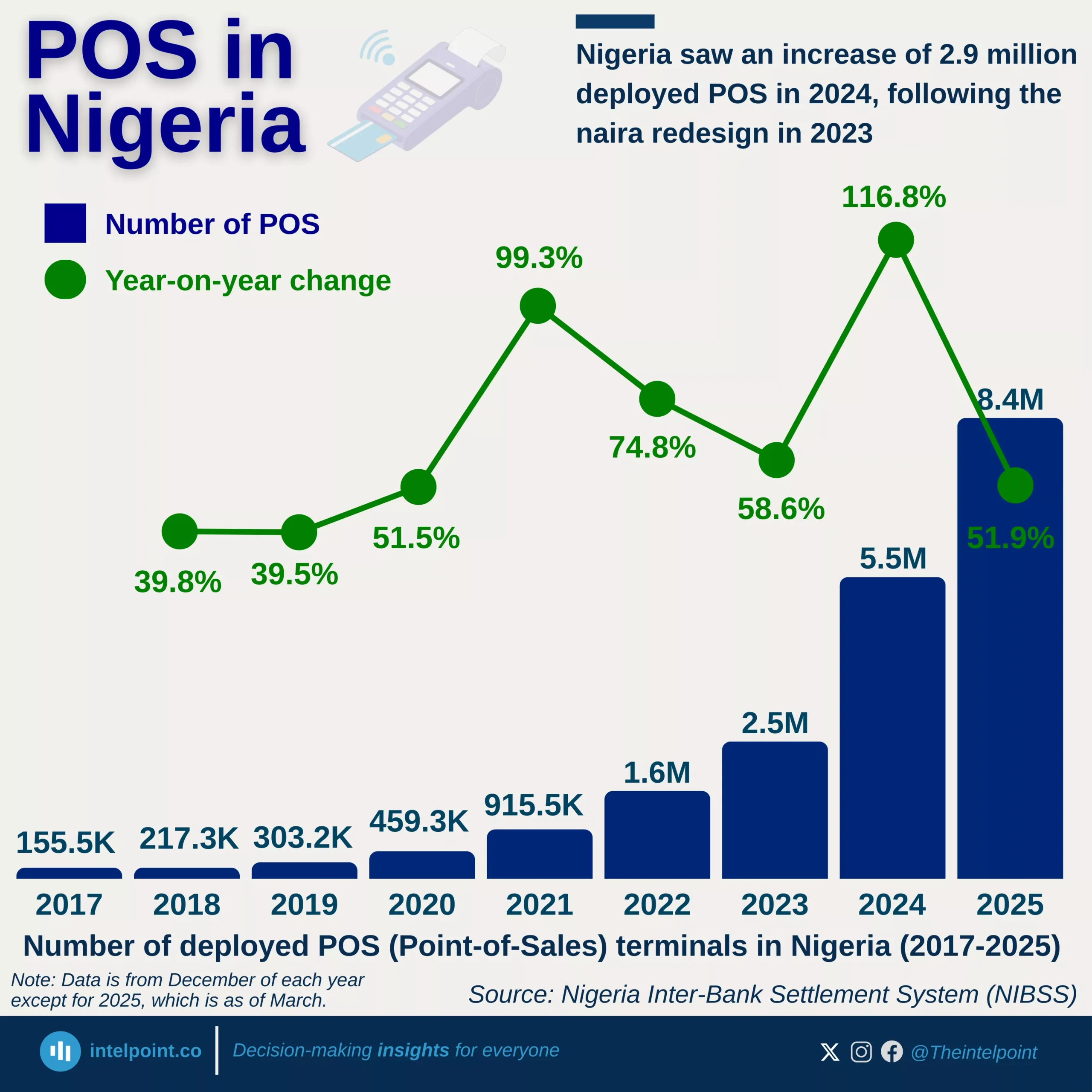
Nigeria saw an increase of 2.9 million deployed POS in 2024, following the naira redesign in 2023

  • Deployed POS terminals grew from about 156,000 in 2017 to 8.4 million in 2025.
  • Nigeria added more than eight million terminals in eight years, indicating rapid adoption of digital payments.
  • Growth accelerated sharply after 2020, marking a major shift toward cashless transactions.
  • The highest year-on-year growth (116.8%) occurred in 2024, following the naira redesign.
  • About three million terminals were added in 2024 alone.
  • POS agents became critical financial access points during the period of cash shortage.
  • POS terminals now function as mini-banks in many communities.
  • Financial inclusion has expanded through agent-based banking and POS networks.

Nigeria’s POS ecosystem has expanded at a pace few would have predicted a decade ago. From just about 156,000 terminals in 2017, the country now hosts roughly 8.4 million POS devices in 2025. This is a structural shift in how money moves across the economy. What started as a banking tool has evolved into a nationwide payment network, embedded in markets, street corners, pharmacies, fuel stations, and roadside kiosks.

The turning point came after 2020, when deployment accelerated sharply. POS terminals nearly doubled in 2021 and continued rising through 2023. But the most dramatic jump followed the 2023 naira redesign and cash scarcity. In 2024 alone, Nigeria added about three million new terminals, pushing growth to over 116% year-on-year. Cash shortages did not just inconvenience people; they permanently changed payment habits, forcing businesses and consumers to rely more heavily on electronic channels.
Source:

Nigeria Inter-Bank Settlement System (NIBSS)

Period:

2017-2025
HTML code to embed chart
Want a bespoke report?
Reach out
Tags
Related Insights

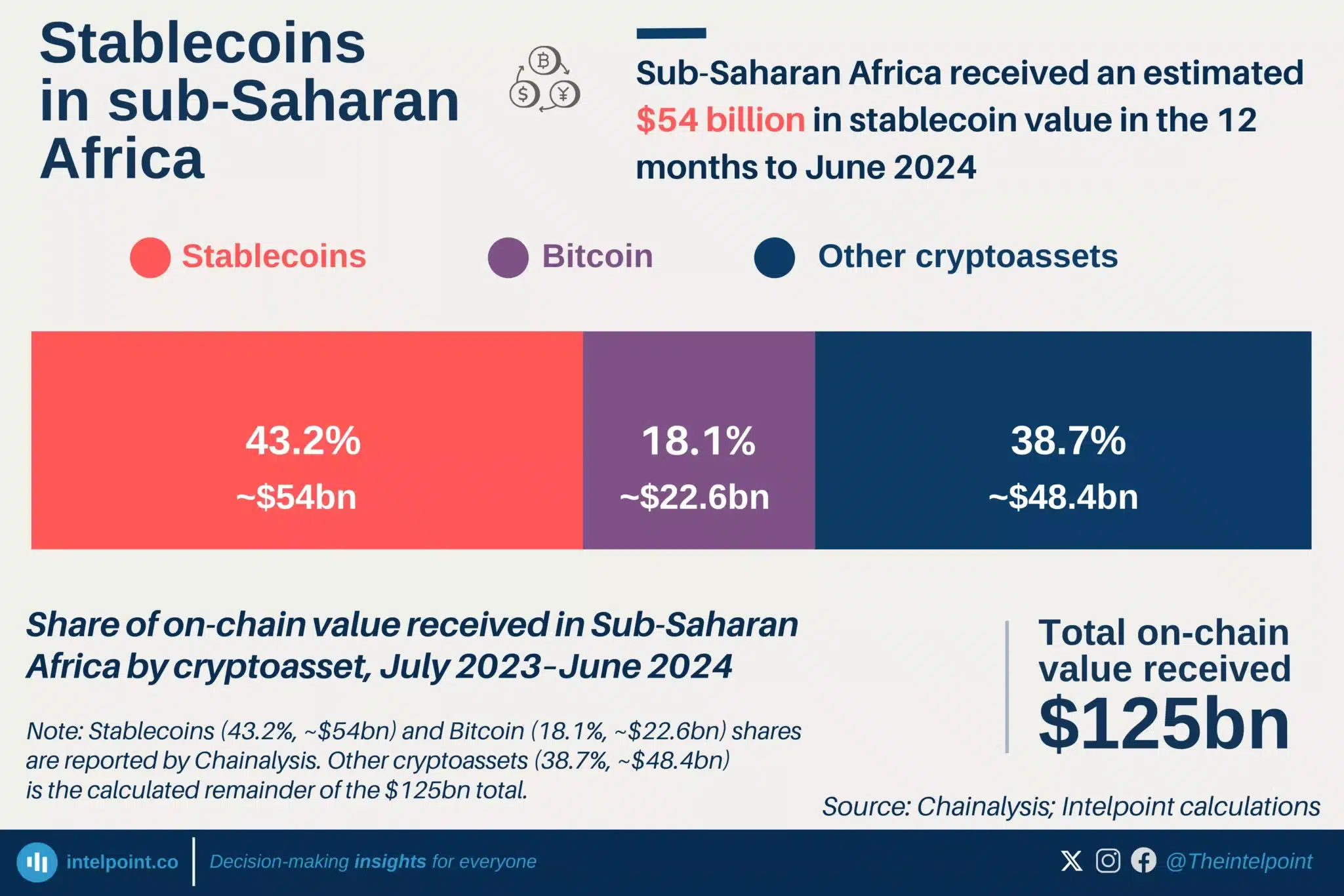
Sub-Saharan Africa received an estimated $54 billion in stablecoin value in the 12 months to June 2024
  • Total received: $125 billion in on-chain value.
  • Stablecoin value: $54 billion, representing 43.2%.
  • Bitcoin comparison: Stablecoins received more than twice Bitcoin’s value.
  • Key driver: Currency depreciation and limited dollar access.

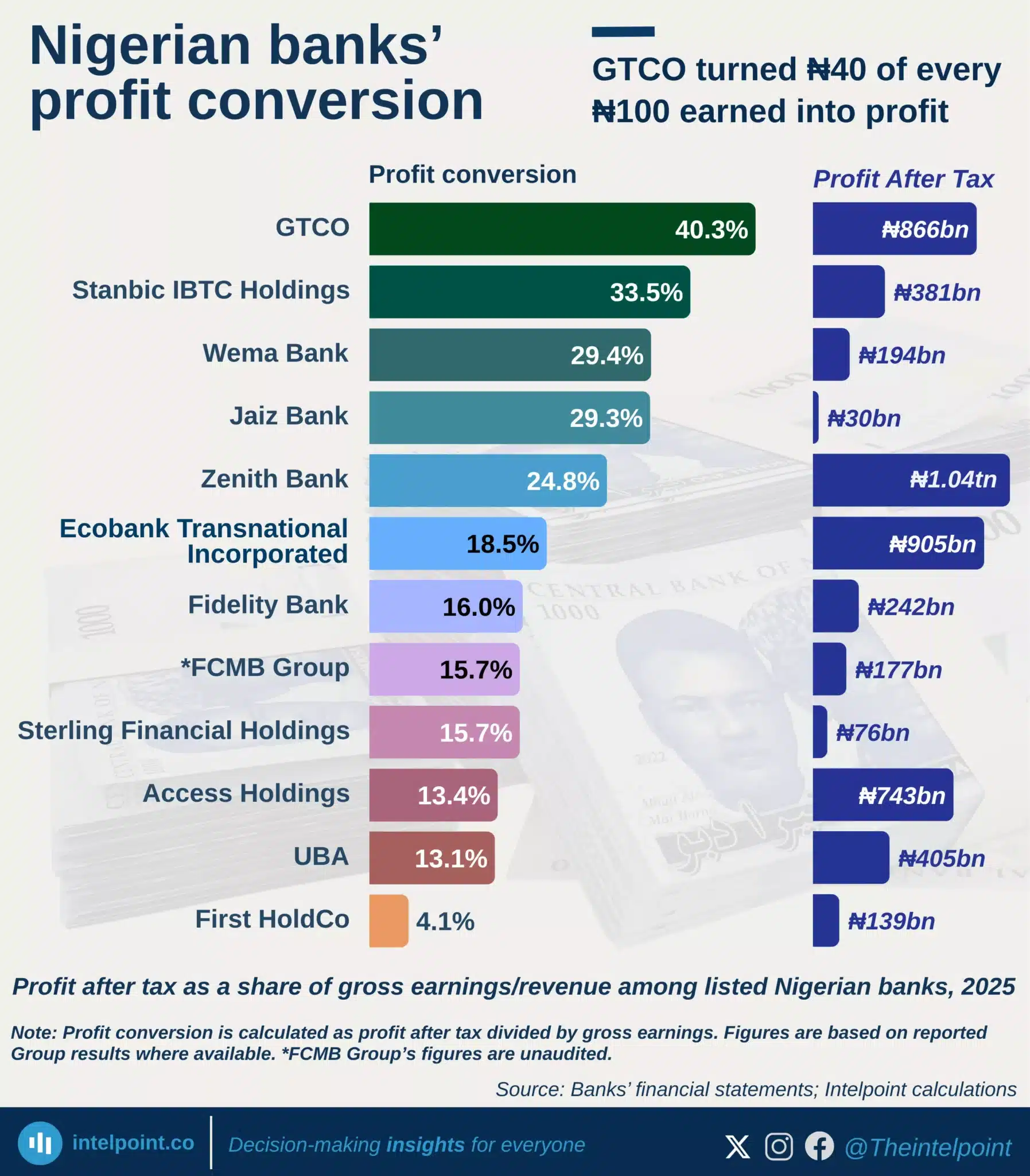
GTCO turned ₦40 of every ₦100 earned into profit
  • GTCO had the strongest profit conversion in 2025.
  • GTCO turned about ₦40 of every ₦100 earned into profit.
  • Stanbic IBTC followed with about ₦34 profit per ₦100 earned.
  • Zenith made the highest profit, but not the strongest conversion.
  • First HoldCo had the weakest profit conversion among the banks reviewed.
 

Kenyan banks’ non-performing loan ratios fell, with KCB’s ratio down 2.9 points
  • All eight selected Kenyan banks reduced their NPL ratios in 2025.
  • KCB recorded the largest improvement, with a 2.9% point drop.
  • KCB still had the highest NPL ratio in the group at 16.9%.
  • Co-operative Bank remained highly stressed at 15.7%, despite some improvement.
  • Equity Bank and Absa Bank Kenya both ended 2025 at 11.5%.
  • Standard Chartered Kenya had the lowest NPL ratio in the group at 5.5%.

Nigeria's insurance sector crossed ₦1.98tn in H1 2025 as every segment grew by at least 25%
  • Life Business was the single largest segment, and its 70.3% jump signals that more Nigerians are thinking seriously about financial protection for their families.
  • Miscellaneous, the smallest segment, posted the biggest growth at 86.7%, suggesting new and unconventional insurance products are gaining serious traction.
  • Aviation & Marine nearly doubled, with 79.9% growth in a sector tied to trade and logistics, reflecting Nigeria's expanding import/export activity and the rising cost of cargo and aircraft risk coverage.
  • Motor (52.5%), Fire (53.3%), and General Accident (49.6%) grew by roughly half, indicating broad-based sector expansion rather than isolated pockets of growth.

Internationally authorised Nigerian banks have raised over ₦3.3tn since March 2024
  • Internationally authorised Nigerian banks have raised and injected over ₦3.3 trillion in new capital since March 2024.
  • The recapitalisation exercise is being driven by the Central Bank of Nigeria’s requirements, with the deadline expected in March 2026.
  • Zenith Bank currently has the highest capital among the banks shown, reaching about ₦614 billion.
  • Access Holdings has about ₦602.8 billion in total capital.
  • Fidelity Bank raised the largest single capital injection in the group, about ₦437.85 billion, pushing its total capital to ₦564.5 billion.
  • FCMB has the highest previous capital base among the banks listed (₦266.5 billion) before the recapitalisation injection.

Nigeria's insurance sector crossed ₦1.98tn in H1 2025 as every segment grew by at least 25%
  • Life Business was the single largest segment, and its 70.3% jump signals that more Nigerians are thinking seriously about financial protection for their families.
  • Miscellaneous, the smallest segment, posted the biggest growth at 86.7%, suggesting new and unconventional insurance products are gaining serious traction.
  • Aviation & Marine nearly doubled, with 79.9% growth in a sector tied to trade and logistics, reflecting Nigeria's expanding import/export activity and the rising cost of cargo and aircraft risk coverage.
  • Motor (52.5%), Fire (53.3%), and General Accident (49.6%) grew by roughly half, indicating broad-based sector expansion rather than isolated pockets of growth.

POPULAR TOPICS
SIGN UP TO OUR NEWSLETTER
Get periodic updates about the African startup space, access to our reports, among others.
Subscribe Here
Subscription Form

A product of Techpoint Africa. All rights reserved