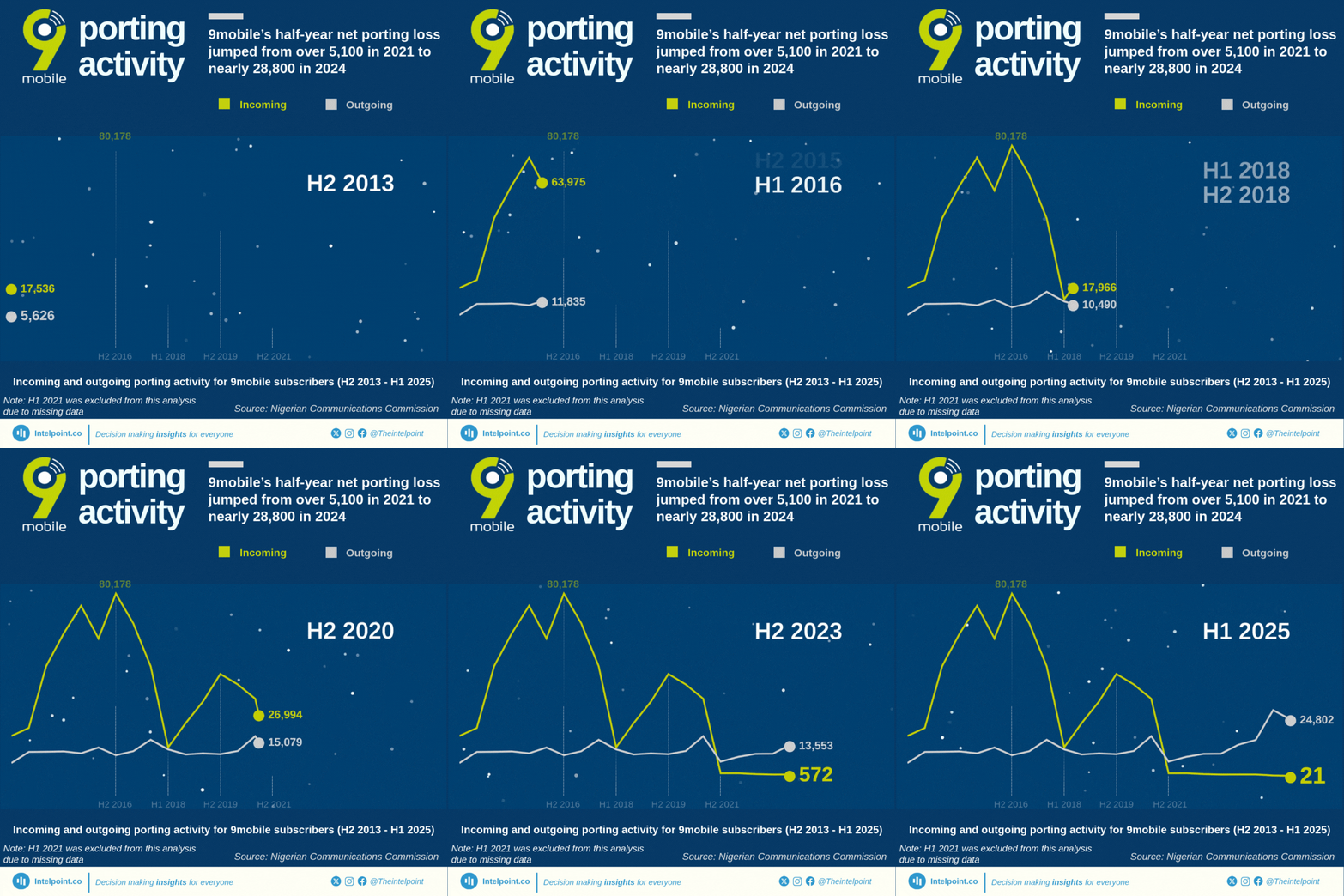
9mobile’s half-year net porting loss jumped from over 5,100 in 2021 to nearly 28,800 in 2024

  • From H2 2013 to H1 2020, 9mobile gained more subscribers from other networks than it lost.
  • From H2 2021 onward, more subscribers left 9mobile for other networks than joined.
  • Net half-year losses grew from about 5,143 in H2 2021 to 28,735 in H2 2024.
  • Outgoing ports peaked at 28,885 in H2 2024, the highest half-year total on record.

9mobile’s story is a long-running struggle that turned critical after 2017. From H2 2013 to H1 2020, it still attracted more joiners than leavers. But service strain and stalled investment flipped the trend: from H2 2021 onward, more subscribers ported to other networks than arrived, and the gap widened fast.

H2 2024 recorded just 150 incoming against 28,885 outgoing, while H1 2025 fell to 21 incoming versus 24,802 departures. This sustained deficit drained market share, damaged trust and loyalty, and severely limited the cash and confidence needed to modernise the network, trapping the brand in a cycle of poorer quality and rising churn.

The company has now rebranded to T2, aiming to break that cycle with a fresh identity, clearer service promises, and tighter retention. If the new strategy translates into better coverage and reliability, the porting tide can [slow, and] the operator can shift from crisis management to a measurable recovery.
Source:

Nigerian Communications Commission

Period:

H2 2013 - H1 2025
HTML code to embed chart
Want a bespoke report?
Reach out
Tags
Related Insights

Nearly 2 in 3 active mobile lines in Ekiti are on MTN
  • MTN held more than half of active mobile lines in most Nigerian states as of December 2025.
  • Ekiti recorded MTN’s highest share at 69.6%, followed by Imo at 64.1% and Anambra at 63.4%.
  • Borno was Airtel’s only leading state, with 56.9% of active mobile lines.
  • Globacom did not lead any state, but it had notable shares in Kogi, Edo, Ondo, FCT, and Oyo.

MTN accounts for over half of internet subscriptions in most Nigerian states
  • MTN held over 50% of active internet subscriptions in most Nigerian states as of December 2025.
  • Ekiti had MTN’s highest share at 70.6%, followed by Imo at 64% and Anambra at 63.7%.
  • Borno was the only state where Airtel led, with 56.6% of active internet subscriptions.
  • Globacom did not lead any state, but it had notable shares in Edo, Kogi, Ondo, Oyo, and Bayelsa.
 

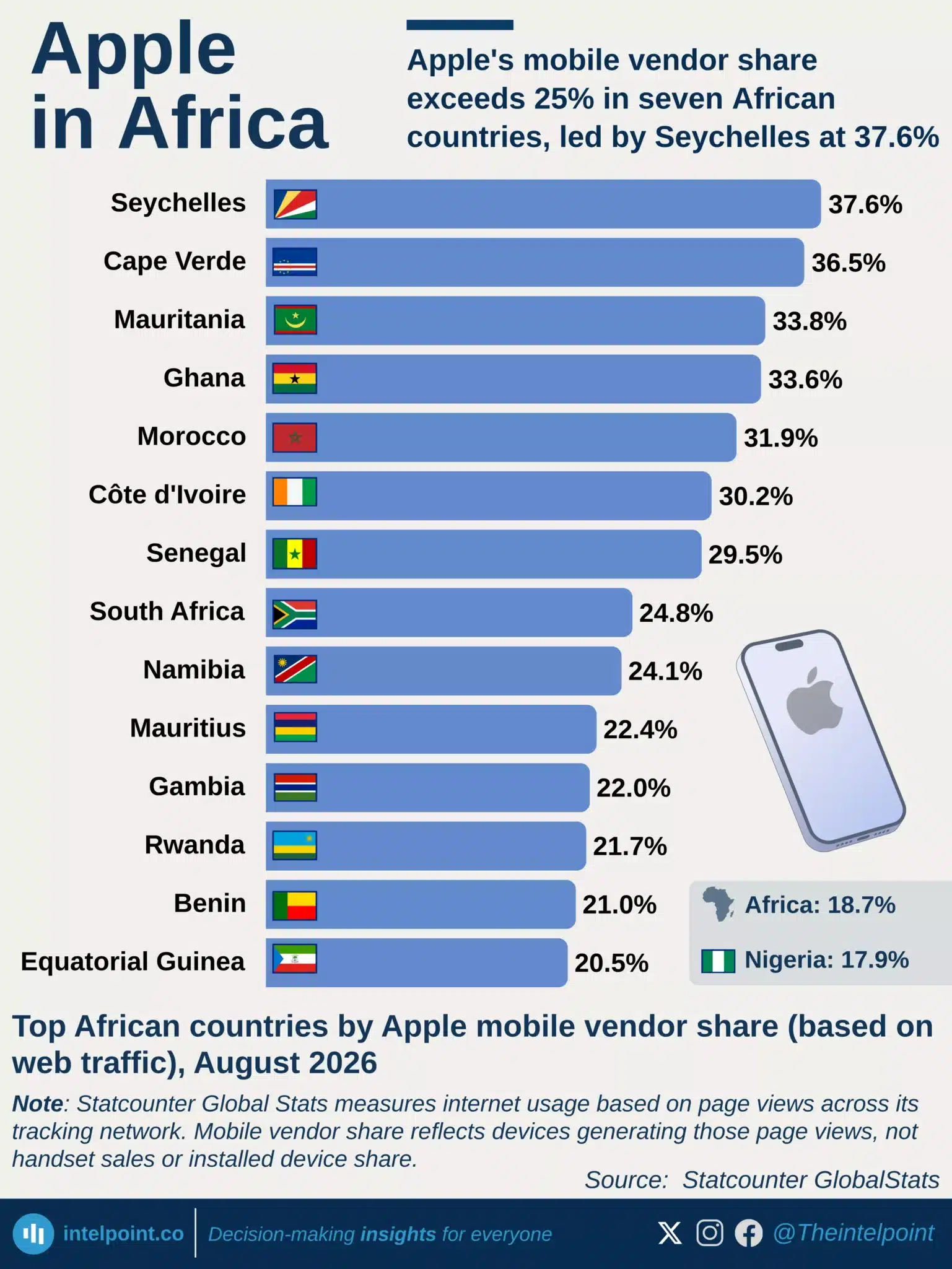
iPhone usage in Africa is just 15%, far below North America’s 60% usage
  • North America leads globally with 60.2% iPhone usage, making it the largest iPhone market.
  • Oceania follows at 58.9%, showing similar consumer preferences to North America.
  • Africa has the lowest iPhone share (14.7%), highlighting a significant adoption gap.
  • Nigeria aligns with the continental trend at 14.1%, reinforcing that the gap is structural, not country-specific.

Card channels were the most susceptible to fraud in Nigerian banks in Q1 2025, with $14.3 billion involved
  • Cards were the most involved in fraud, with ₦14.3 billion representing the most significant exposure among all transaction channels
  • Card transactions also had the highest number of cases (11,972), indicating widespread and frequent attacks
  • Actual losses on cards were 11.5% (₦1.6 billion) of the amount involved, showing that significant financial damage still occurs despite preventive systems
  • Cash fraud accounted for ₦6.8 bn in exposure, nearly half of the card channel’s total
  • Cash also recorded 12.3% (₦800 million) in actual losses
  • Cheques had the lowest fraud involvement (₦1.2 billion) and only 46 cases, but the highest actual loss rate (72.7%)

T2 finally gains traction (+677.2k) after years of subscriber decline
  • T2’s subscriber base dropped by over ten million between Oct 2023 and May 2025.
  • The lowest point came in June 2025 with just 2.44 million active users.
  • From that low, subscriptions climbed to 3.11 million by September 2025.
  • The recent 677.2k gain marks the brand’s first positive momentum in years.
  • Despite the rebound, T2’s subscriber base remains less than a quarter of its 2023 size.

Africa's cybersecurity score grew from 21 in 2017 to 57 in 2024, a 171% increase
  • Africa’s cybersecurity score increased by 171% between 2017 and 2024.
  • The continent’s score rose from 21 in 2017 to 57 in 2024
  • Africa has reduced the gap with global averages, reducing the difference from 15 points in 2017 to 9 points in 2024.
  • The global cybersecurity score rose from 36 in 2017 to 66 in 2024.
  • Africa’s most notable leap was between 2021 (35) and 2024 (57), showing accelerated progress in recent years.

POPULAR TOPICS
SIGN UP TO OUR NEWSLETTER
Get periodic updates about the African startup space, access to our reports, among others.
Subscribe Here
Subscription Form

A product of Techpoint Africa. All rights reserved