Bite-sized Insights about
 
Providing you with data-based insights about things happening around you.
Search results for
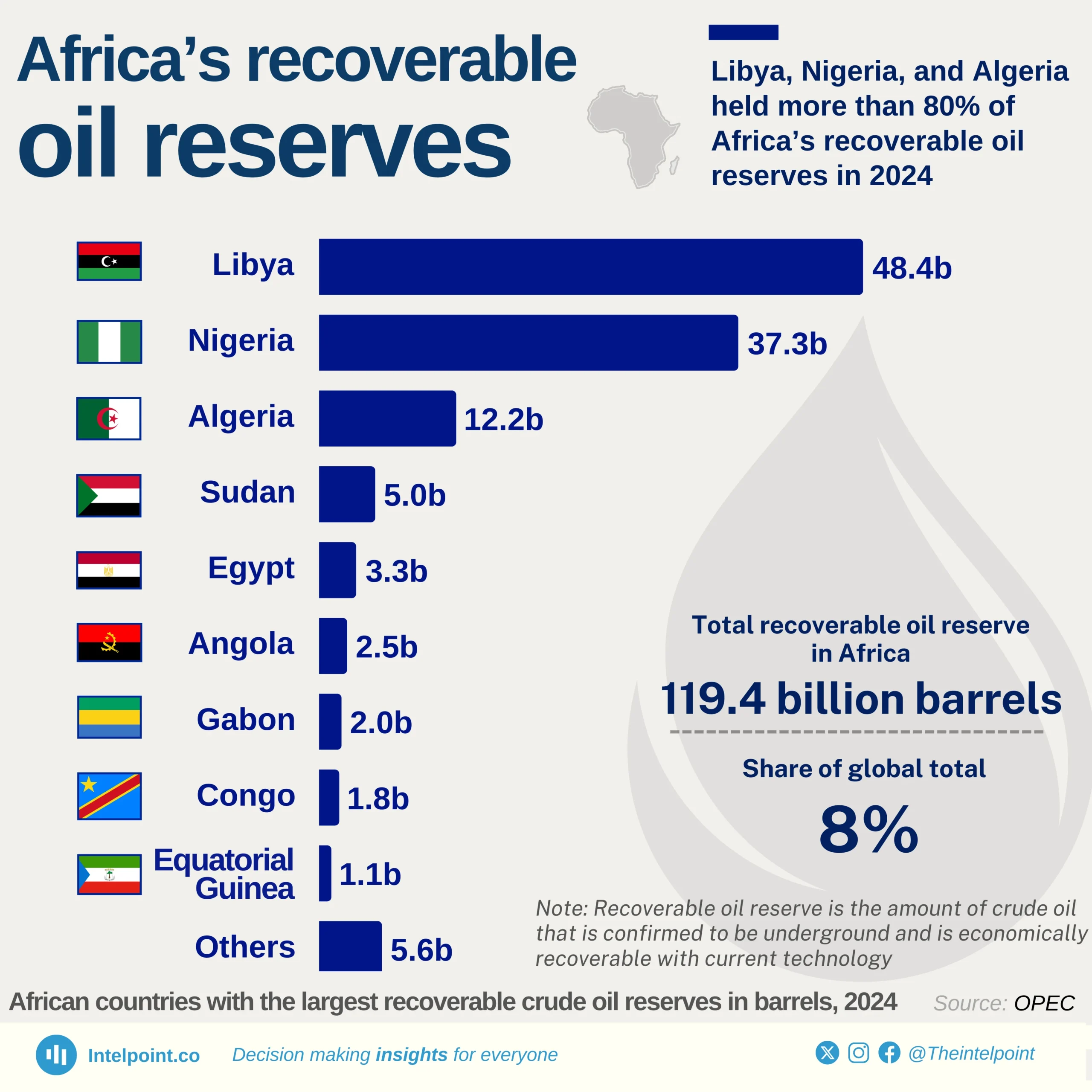
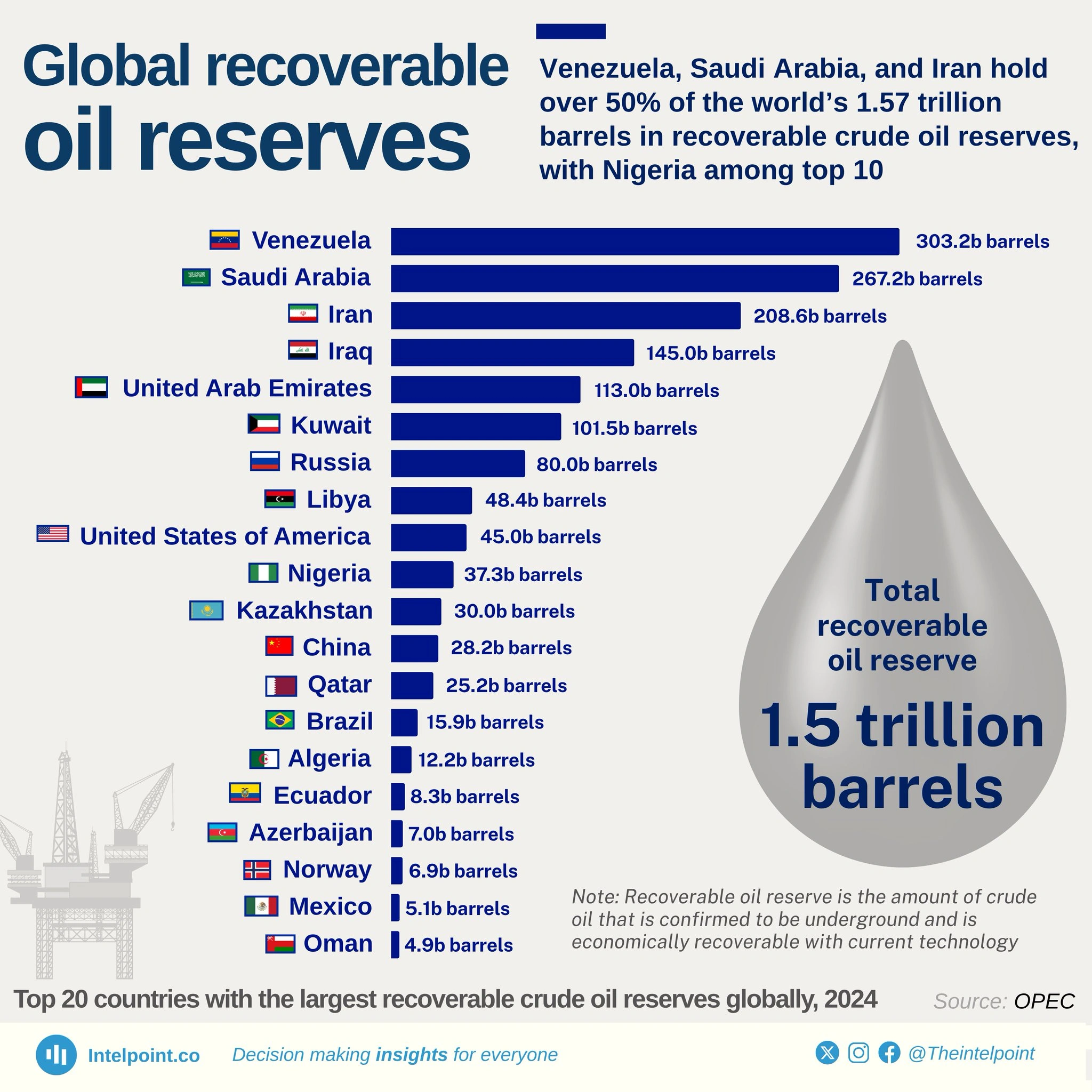
Venezuela, Saudi Arabia, and Iran hold over 50% of the world’s 1.57 trillion barrels in recoverable crude oil reserves, with Nigeria among top 10
  • The world’s total proven recoverable crude oil reserves stand at 1.57 trillion barrels in 2024.
  • Venezuela, Saudi Arabia, and Iran collectively hold over 50% of these reserves, with 303.2B, 267.2B, and 208.6B barrels respectively.
  • Nigeria ranks 10th globally with 37.3 billion barrels, placing it ahead of other major producers like Kazakhstan, China, and Brazil.
  • The majority of the largest reserves are concentrated in Middle Eastern and South American countries, with only a few top holders located in North America, Africa, and Asia.
India leads global banana production with 36.6M tonnes in 2024 as Nigeria ranks 4th among top producers with 7.3M tonnes
  • India dominates global banana output with 36.6 million tonnes, accounting for over a third of total production among the top 10 countries.
  • China (11.7M) and Indonesia (9.34M) round out the top three, contributing significantly to Asia’s dominance in banana farming.
  • Nigeria ranks 4th globally, producing 7.3 million tonnes, slightly ahead of Ecuador and Brazil.
  • Africa is well represented, with Nigeria, Angola, and Tanzania collectively contributing 15.86 million tonnes, or about 16% of the top 10 output.

Private universities dominate Nigeria’s higher education sector, accounting for 53% of all universities in Nigeria
  • Private universities in Nigeria outnumber federal and state institutions combined.
  • Nigeria has 159 private universities, more than double the number of federal universities.
  • Federal universities stand at 72, showing steady federal government investment in tertiary education.
  • State-owned universities number 66, slightly fewer than federal universities but forming a significant part of public education.

Nigeria’s outstanding debt to the World Bank has grown nearly 100-fold since 1970, reaching $17.8 billion in 2024
  • Nigeria’s outstanding debt to the World Bank rose from $180 million in 1970 to $17.81 billion in 2024, a nearly 100-fold increase in 54 years.
  • The balance remained below $5 billion until 2013, but more than tripled between 2013 and 2024, signalling accelerated reliance on multilateral credit.
  • From 2020 to 2024, the outstanding debt rose by $6.4 billion, the sharpest five-year surge on record.
  • The figures reflect a steady accumulation of obligations, driven by long-term borrowing and slower repayment relative to disbursement.

Only 4 African countries meet WHO’s recommended nurse-to-population ratio
  • Only four African countries, Seychelles, South Africa, Namibia, and Ghana, meet or exceed the WHO’s recommended minimum of 44.5 nursing and midwifery personnel per 10,000 people.
  • Seychelles leads the continent with 73 personnel per 10,000, followed by South Africa (64), Namibia (54), and Ghana (45).
  • The lowest number within the top 20 is 16, shared by Nigeria, Comoros, and Mauritania.
  • The dataset includes 47 African countries, and no country outside the top 20 has more than 16 nursing and midwifery personnel per 10,000 people.

Uganda and Mauritius offer Africa’s cheapest 1GB data at $0.02 while Madagascar ranks highest in the top 20 at $0.32
  • Uganda and Mauritius offer the most affordable mobile data in Africa, with 1GB for just $0.02 over a 30-day period.
  • Comoros, Ghana, and South Africa also rank among the cheapest, each offering 1GB of data for $0.07 to $0.10.
  • Nigeria is among the top 10, with a relatively low cost of $0.13 per 1GB, placing it below the continental average.
  • Madagascar, at $0.32 per 1GB, closes out the top 20, which reflects the upper boundary of affordable data across African nations.

After its peak ($8.9b) in 2011, Nigeria's FDI declined almost every year to its lowest ($780m) in 2018, a 91% decline
  • FDI inflows peaked in 2011 at $8.91 billion, the highest in the 35-year period.
  • Between 2005 and 2012, Nigeria saw a sustained boom in FDI, with seven consecutive years above $4 billion.
  • In 2018, Nigeria recorded its lowest FDI inflow in decades at just $0.78 billion.
  • By 2024, FDI stood at $1.08 billion, down 88% from its 2011 peak, reflecting declining investor interest or changing investment climates.

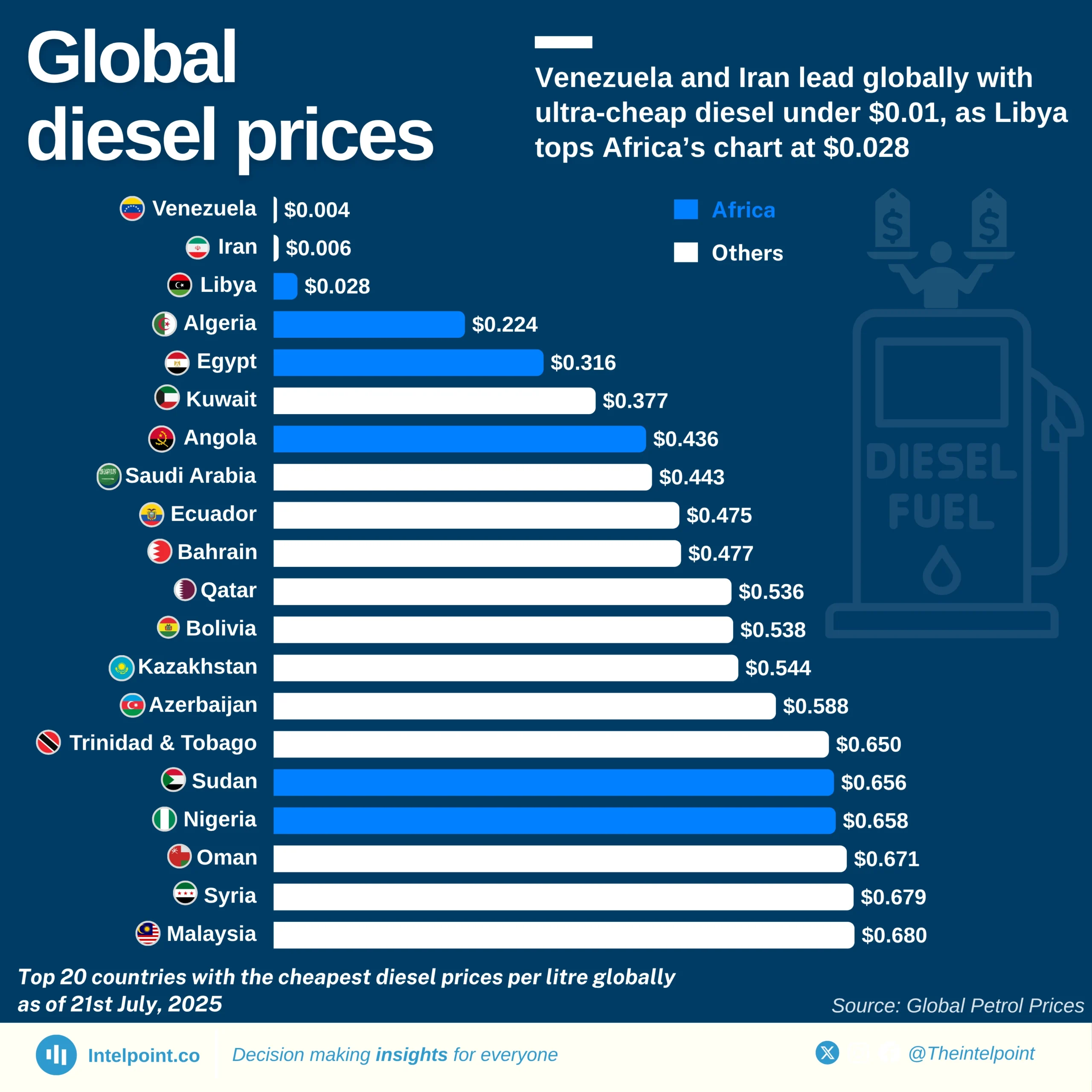
Libya tops list as African fuel prices remain below $1 in the top 9 African nations
  • Libya maintains its position as the cheapest fuel market in Africa with just $0.028 per litre.
  • Nine out of ten countries have fuel prices under $1 per litre, signalling widespread affordability across much of the continent.
  • Nigeria, despite partial subsidy reforms, still ranks among the cheapest with fuel priced at $0.586 per litre.
  • DR Congo is the only country in the top 10 where fuel costs exceed $1 per litre, standing at $1.039.
  • Ethiopia and Liberia are the only non-oil-producing countries among Africa’s top 10 cheapest fuel markets.

Just three nations have shared all Women’s AFCON titles since 1998 as Nigeria claims 9 of 12 titles
  • Only three nations, Nigeria, Equatorial Guinea, and South Africa, have won the Women’s Africa Cup of Nations since it began in 1998.
  • Nigeria leads with nine titles, claiming the trophy in 1998, 2000, 2002, 2004, 2006, 2010, 2014, 2016, and 2018.
  • Equatorial Guinea captured the title twice, in 2008 and 2012.
  • South Africa won its first title in 2022 to become the third country to lift the trophy.

USA dominates Diamond League's 100m hurdles with 7 wins from 3 athletes since 2010, as Nigeria’s Tobi Amusan rises with 3 consecutive wins
  • The United States dominates with 7 wins from 4 different athletes: Harper-Nelson (5), Carruthers (1) and McNeal (1).
  • Tobi Amusan of Nigeria is the only African and second-most decorated athlete, winning 3 consecutive titles (2021–2023).
  • Only 8 women from 6 countries have won the event in the last 15 years.
  • Dawn Harper-Nelson (USA) holds the record for most titles – five between 2012 and 2016.
  • Jasmine Camacho-Quinn (Puerto Rico) broke through in 2024, becoming the most recent champion and the first from her nation to do so.

1 8 9 10 11 12 41

Can’t find what you’re looking for? Please fill the form below
Contact Form Demo
SIGN UP TO OUR NEWSLETTER
Get periodic updates about the African startup space, access to our reports, among others.
Subscribe Here
Subscription Form

A product of Techpoint Africa. All rights reserved