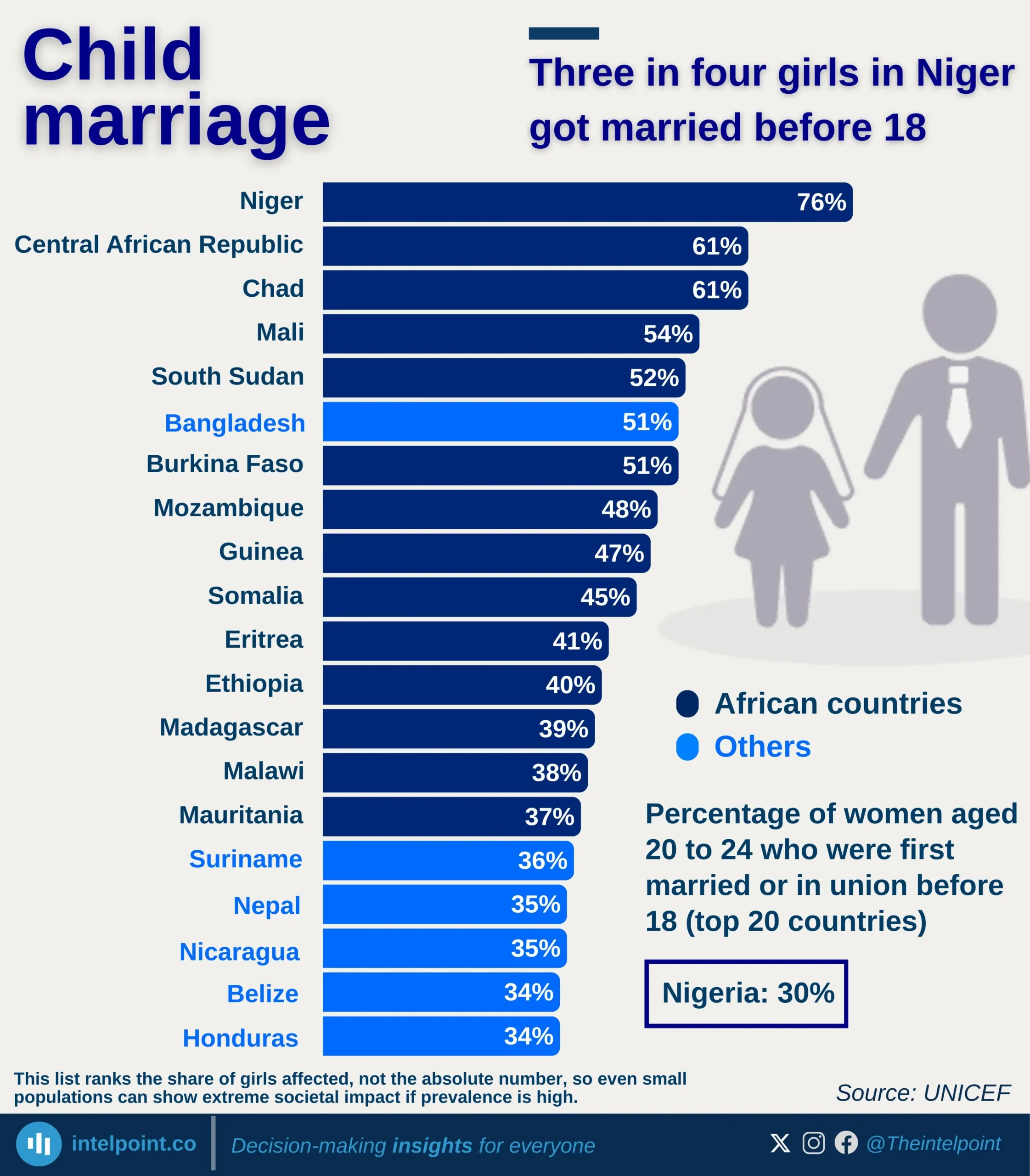
Niger (76%), the Central African Republic (61%), and Chad (61%) top the global list, meaning the majority of women in these countries marry as children.
Seven of the top ten countries by prevalence are African, showing that child marriage is most entrenched relative to population on the continent.
Countries in South Asia — Bangladesh (51%) and Nepal (35%) — and Latin America — Suriname (36%) and Belize (34%) — also feature, highlighting the global nature of the challenge.
While some countries have larger populations, this list ranks the share of girls affected, not the absolute number, meaning even smaller populations can show extreme societal impact if the prevalence is high.
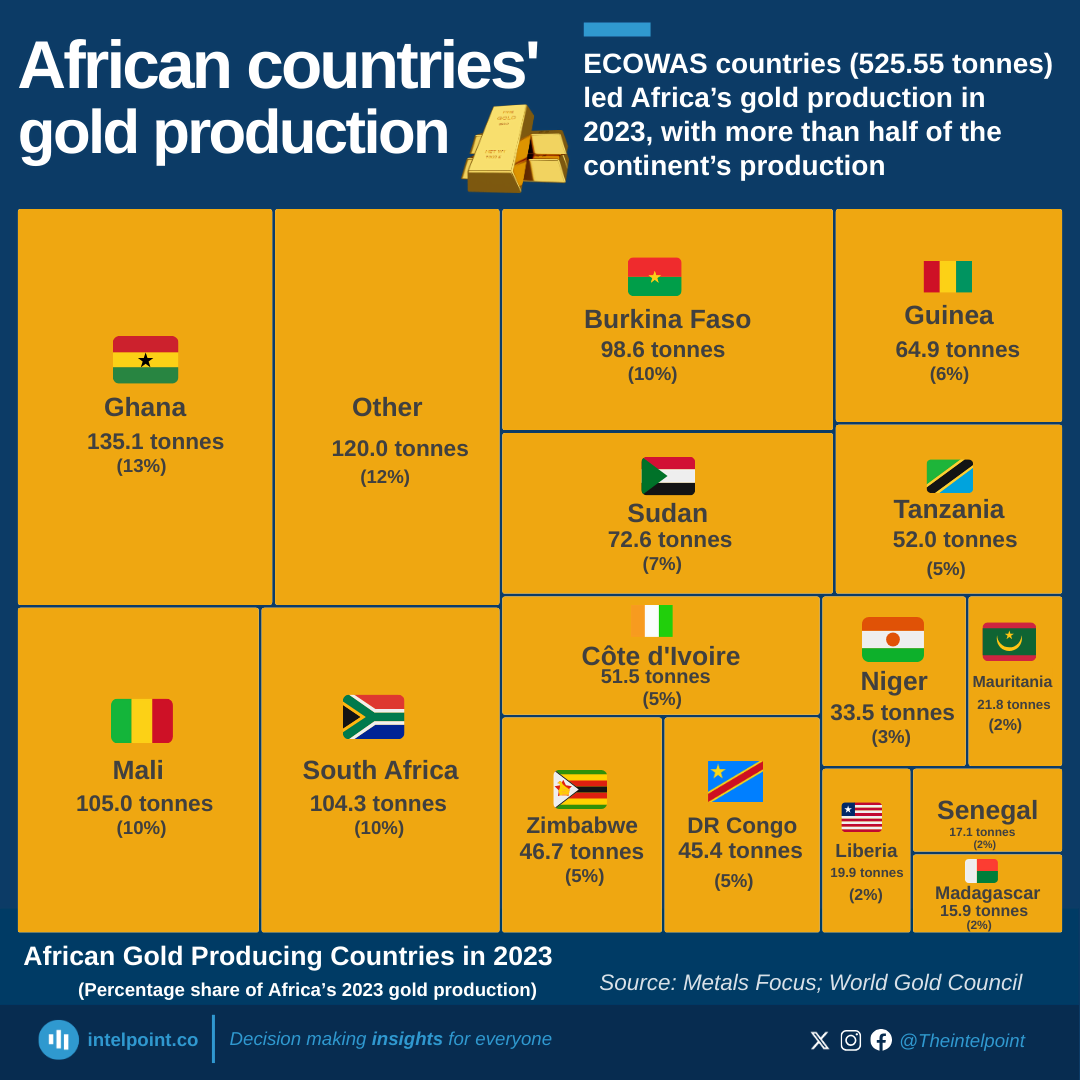
Ghana led the continent in gold production in 2023, producing 135.11 tonnes, 13.5% of Africa’s total.
Four countries (Ghana, Mali, South Africa, and Burkina Faso) each produced over 95 tonnes, together accounting for 443 tonnes or 44.1% of the continent’s output.
West African countries dominated the rankings, with eight nations from the region among the top 15 producers.
The West African countries in the top 15 combined contributed 525.55 tonnes, more than half (52.3%) of Africa's total gold production.
South Africa ranked third in Africa with 104.29 tonnes.
Burkina Faso ranked fourth while contributing almost 10% of Africa’s gold production.
Rwanda is performing relatively well in terms of governance and rule of law, leading sub-Saharan Africa for the third consecutive year with a score of 0.63 in the 2024 Rule of Law Index. Namibia (0.61) and Mauritius (0.60) closely follow, showcasing relatively stronger legal frameworks.
At the lower end, Nigeria, Congo, and Gabon score 0.40, highlighting persistent governance challenges.
Globally, Denmark tops the list of 142 countries, with a score of 0.90, while Venezuela ranks last at 0.26, emphasising the gap between SSA's highest performers and global leaders. This mix of progress and struggles illustrates the varied state of governance across the region.
As of 2022, the top five African countries indebted to the World Bank — Nigeria, Egypt, Ethiopia, Kenya, and Tanzania — accounted for 46% of the continent's outstanding debt with the institution.
Forty-eight African countries collectively owed around $125 billion, representing 31% of the total global debt of $408 billion. These are the top ten countries from 1970 to 2022.
Nigeria was once a global leader in palm oil production, but it has been overtaken by Malaysia, Indonesia, Thailand, and Colombia.
Indonesia, in particular, has seen a 34,018% increase in production since 1961, reaching 49.7 million tonnes by 2021.
In 2023, South Africa led Africa's exports with a value of $110.7 billion, nearly double Nigeria's $60.7 billion. Key exports include gems, vehicles, and mineral fuels.
The top 15 African exporters contribute 84% to the continent's trade, with South Africa, Nigeria, Algeria, Morocco, and Egypt leading with a combined 52%.
Côte d'Ivoire has maintained its title of Africa's largest producer of natural rubber, increasing production by an average of 13% annually. Nigeria was Africa's largest producer of natural rubber in the early 90s until Côte d'Ivoire took the top spot in 1999. As of 2022, its production capacity was 8.6x more than Nigeria's. In 2022, Côte d'Ivoire produced 1.286 million tonnes of natural rubber; Nigeria and Ghana followed with 149.4 thousand tonnes and 117 thousand tonnes, respectively.