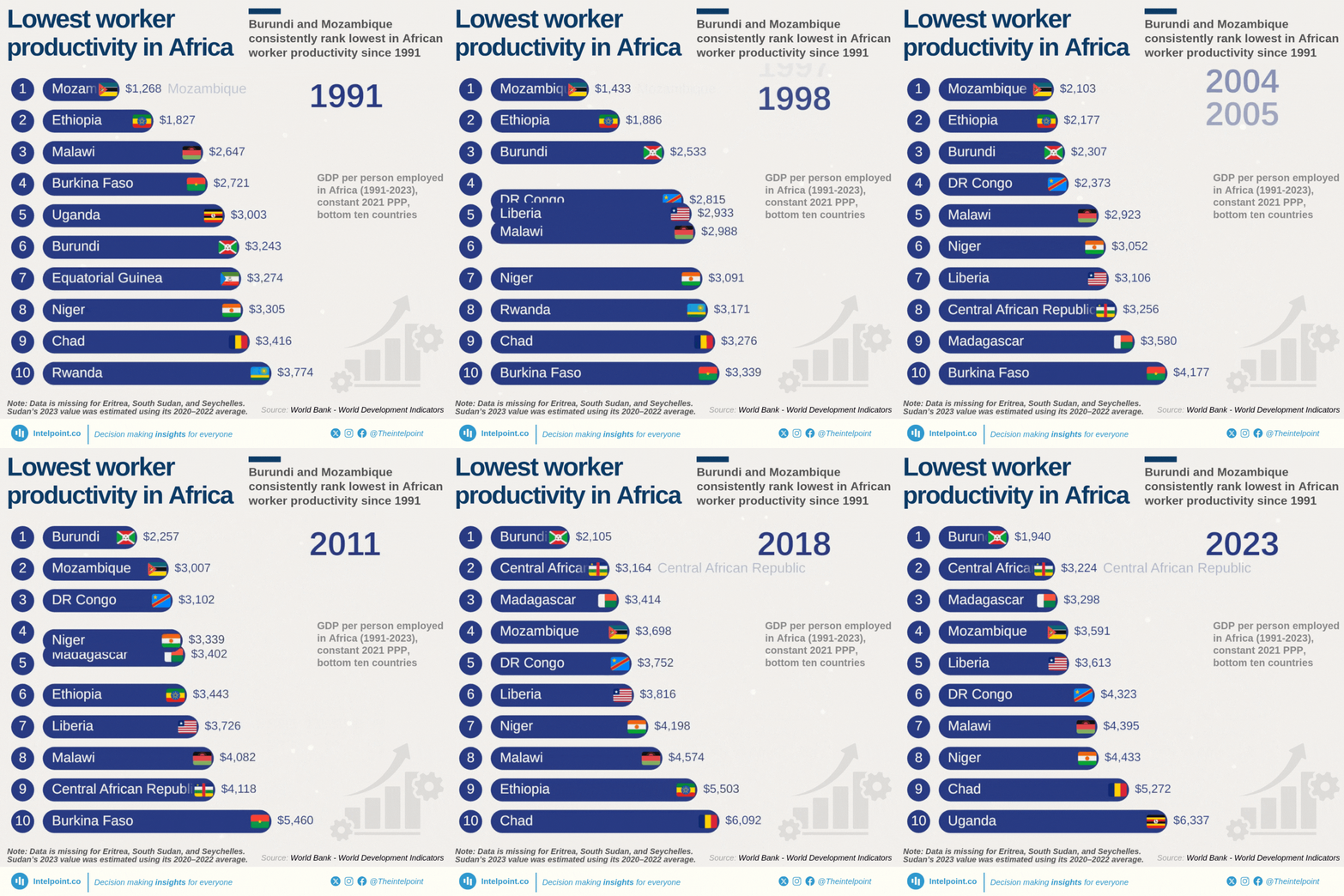
The same countries—Burundi, Malawi, DR Congo, Mozambique, Niger, Liberia, Madagascar, Central African Republic, Chad, and Ethiopia—consistently occupy the bottom ranks over the years.
These countries remain far below the continent's average, often with GDP per person employed under $5,000 even in recent years.
Progress is marginal: while some, like Ethiopia and Mozambique, show slow growth, many fluctuate or even regress across periods.
Structural economic weaknesses, conflict, and low industrialisation seem to persist across the bottom group.
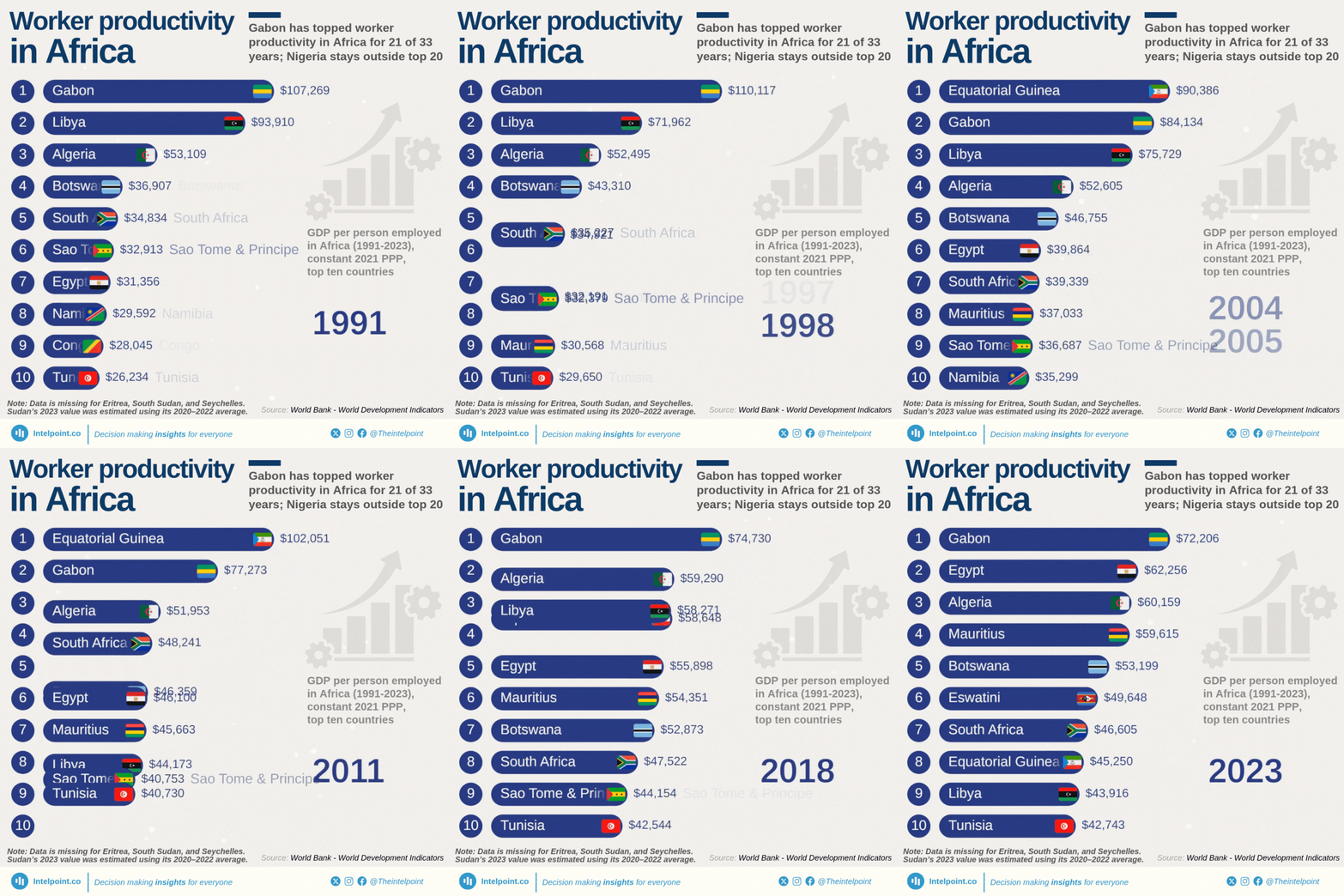
Gabon led Africa in GDP per person employed for 21 years, the most of any country, thanks largely to its oil wealth and smaller labour force.
Equatorial Guinea was a close second, topping the list for 12 straight years, particularly during its oil boom.
Libya never came first but held second place in 18 different years, showing long-term stability in productivity.
Algeria and Egypt frequently ranked in the top three but never led.
Nigeria, despite being Africa’s most populous country and once its largest economy, never made it into the top 3 and has consistently ranked around 23rd to 26th.
The leading countries tend to share a pattern: resource-driven economies with relatively smaller workforces, while lower-ranked ones often struggle.
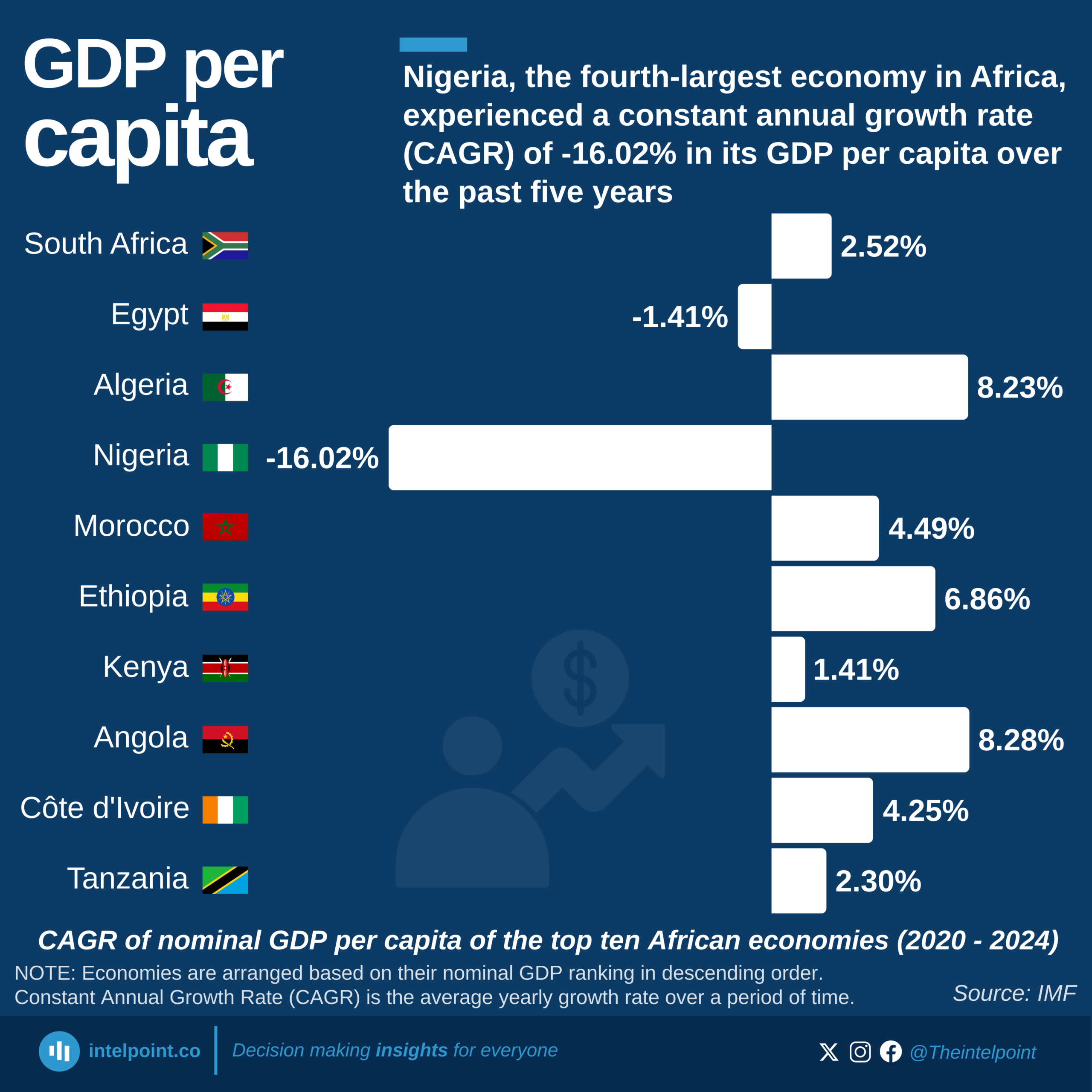
At -16.02% CAGR, Nigeria's GDP per capita is shrinking fast, signalling deep economic strain on its population despite being a top 4 African economy.
Angola recorded 8.28% CAGR, showing that smaller economies can drive significant per capita progress when policies and investments align with citizen welfare.
With 8.23% CAGR, Algeria continues to transform national wealth into measurable benefits for its people.
Ethiopia’s 6.86% annual growth in GDP per capita highlights how consistent development efforts can raise living standards even in densely populated, developing nations.
A modest 2.52% CAGR for South Africa might not sound like much, but in a mature economy, this reflects resilience and relative stability in per capita income.
Egypt has a -1.41% CAGR, showing mild contraction, but far less severe than Nigeria’s economic shrinkage.
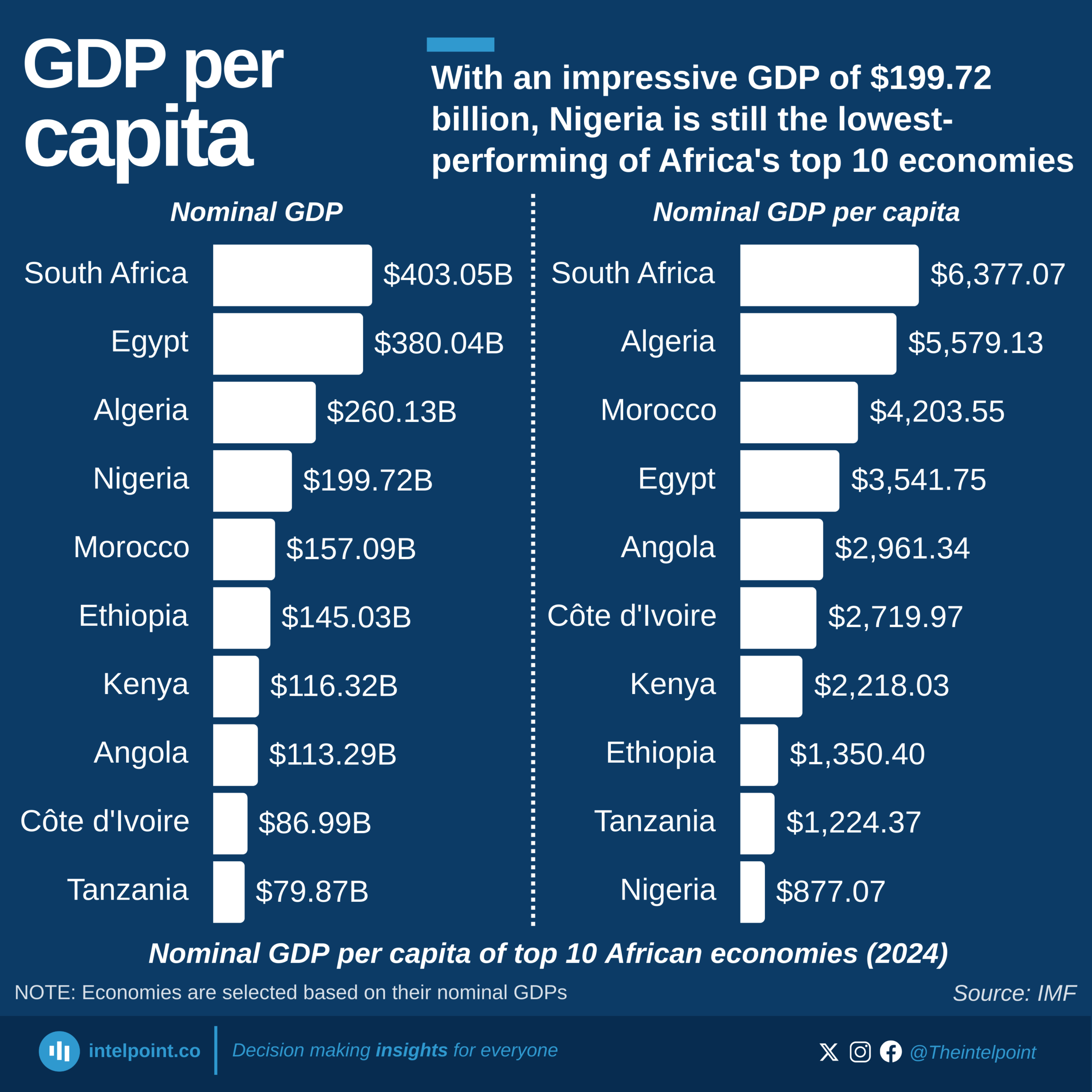
Despite being among the top 4 economies by size, Nigeria ranks low in GDP per capita, revealing a disconnect between total wealth and individual prosperity.
With the highest nominal GDP and highest per capita GDP, South Africa showcases balanced growth and better wealth distribution.
Countries like Ethiopia and Nigeria have huge populations, which dilutes their GDP and drags down per capita figures.
Though fifth in total GDP, Morocco performs better in GDP per capita, highlighting efficiency in wealth distribution.
This proves that a country’s economic “size” doesn’t always translate to individual opportunity, wealth, or standard of living.
Economies like Nigeria and Ethiopia must focus not just on increasing GDP but on ensuring that economic growth improves lives at the grassroots level.
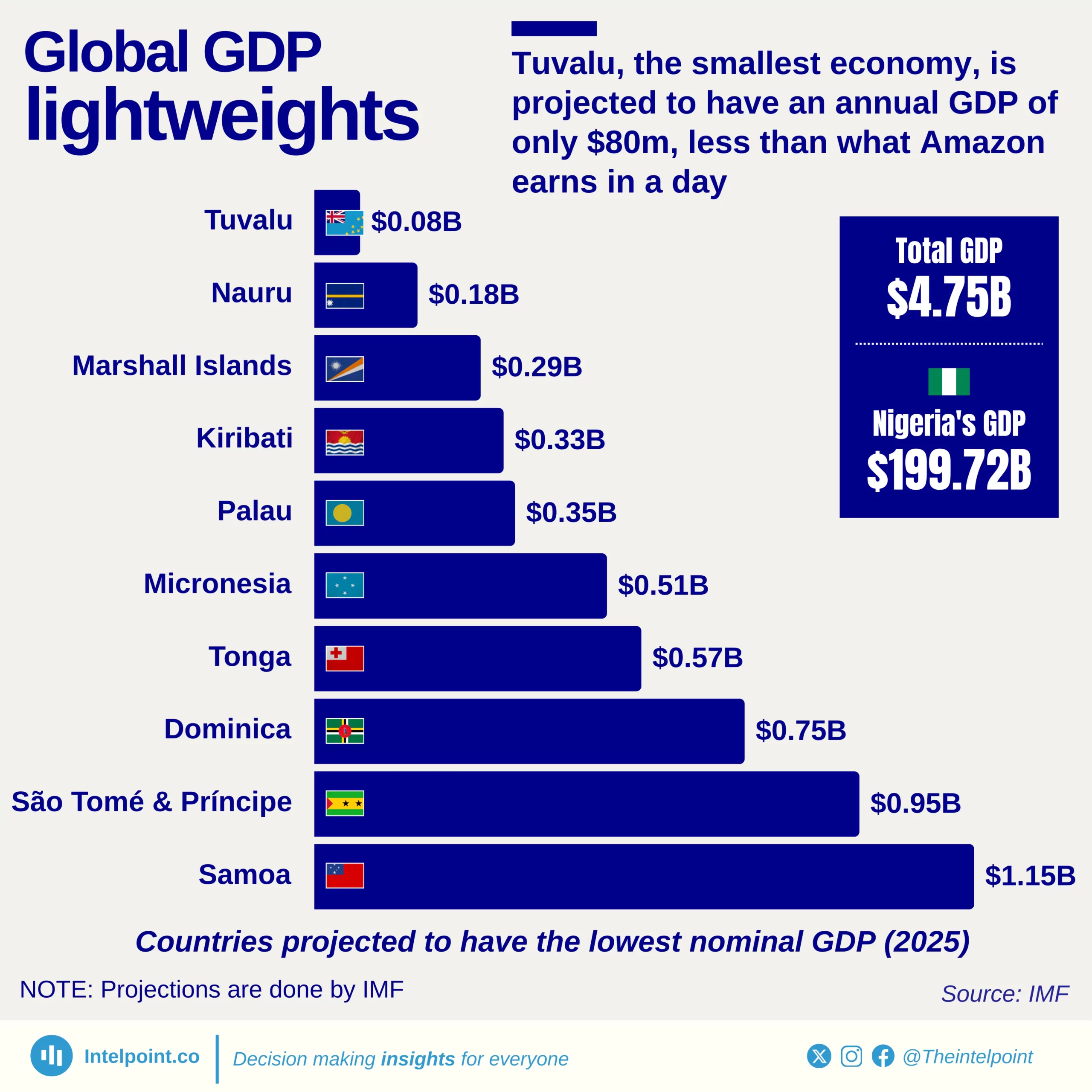
With a projected GDP of $80 million, Tuvalu ranks as the smallest economy globally, producing less in a year than many corporations earn in a day.
Even when put together, these small economies still fall far behind the economic output of many mid-sized countries or cities.
Nigeria’s $199.72 billion GDP overshadows the economies of these nations.
Many of the world’s smallest economies are Pacific and Caribbean island nations, which often depend on tourism, remittances, and international aid.
With limited industries and small populations, these economies are highly vulnerable to external shocks like climate change, supply chain disruptions, or shifts in global tourism trends.
With an impressive 20.1% CAGR, the Industry (including construction) has experienced the fastest expansion, more than doubling its contribution to GDP over the period.
Services remains the largest contributor to GDP, but its growth at 14.6% CAGR is being outpaced by Industry, signalling an evolving economic structure.
Agriculture’s 11.2% CAGR shows steady growth, but its share of GDP is shrinking compared to the industrial and service sectors.
The rapid growth in Industry reflects Tanzania’s shift towards manufacturing, construction, and infrastructure development.
Unlike decades ago, when agriculture dominated, today’s GDP contributions are more balanced between Services, Industry, and Agriculture, reducing reliance on any single sector.