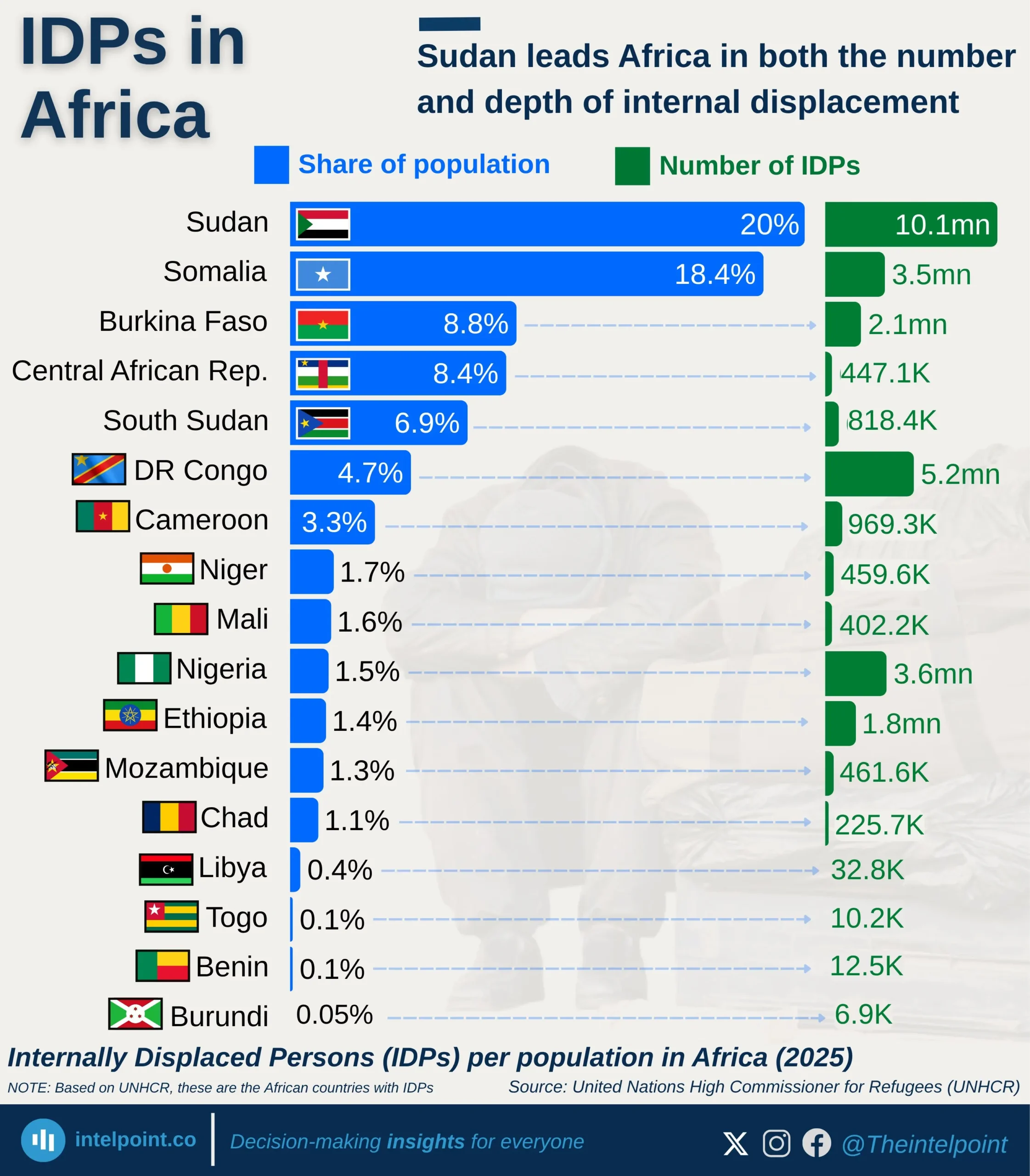
One in every five people in Sudan was internally displaced in 2025

Key Takeaways

  • Sudan has the highest displacement burden in Africa, with 10.1 million IDPs and 20% of its population affected.
  • Somalia follows with 18.4% of its population displaced.
  • High-intensity displacement is concentrated in conflict-prone regions like the Sahel and the Horn of Africa.
  • Burkina Faso (8.8%) and the Central African Republic (8.4%) show how smaller countries can face severe proportional impact.
  • Nigeria’s 3.6 million IDPs are one of the largest in absolute terms, but at 1.5%, the relative impact is lower than many peers.

There’s a difference between the number of people displaced and the depth of displacement in a country. Across Africa, the scale is massive, but the intensity tells a sharper story. Sudan leads on both fronts: 10.1 million internally displaced persons and about 20% of its population affected.

What stands out next is how uneven the burden is. Countries like Somalia (18.4%) and Burkina Faso (8.8%) show high displacement rates relative to their populations, meaning the disruption is deeply felt across society. Meanwhile, Nigeria, despite having 3.6 million IDPs, records just 1.5% of its population displaced—large in absolute terms, but comparatively less intense.
Source:

United Nations High Comissioner for Refugees (UNHCR)

Period:

2025
HTML code to embed chart
Want a bespoke report?
Reach out
Tags
Related Insights

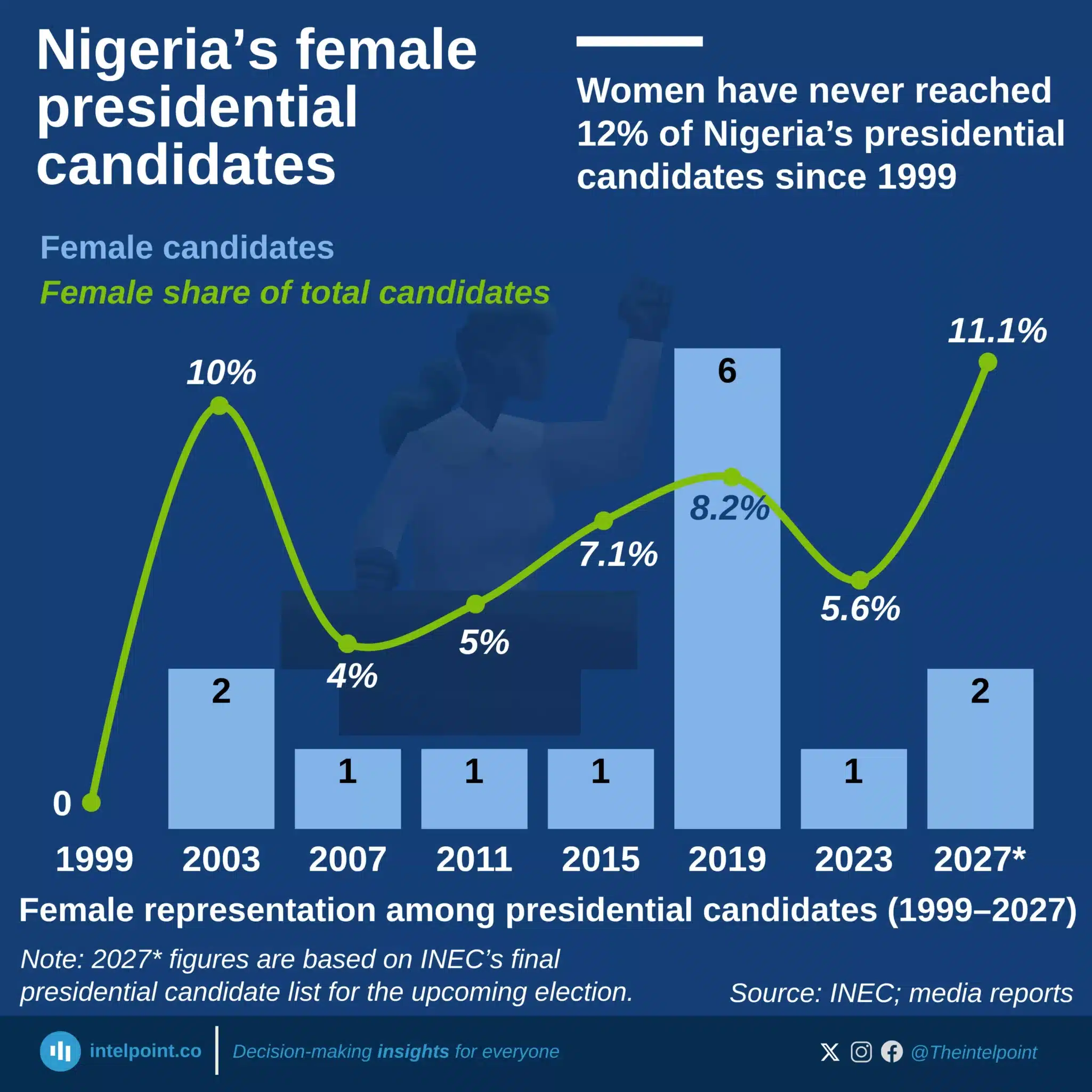
Women have never reached 12% of Nigeria’s presidential candidates since 1999
  • Women account for just 7.4% of Nigeria’s 190 presidential candidacies from 1999 to 2027, with 14 female candidacies.
  • Female candidacies peaked at 6 in 2019, after none in 1999.
  • In 2027, 2 of 18 presidential candidates are women, the highest recorded share at 11.1%.
  • Women have never exceeded 11.1% of Nigeria’s presidential candidate field since 1999.

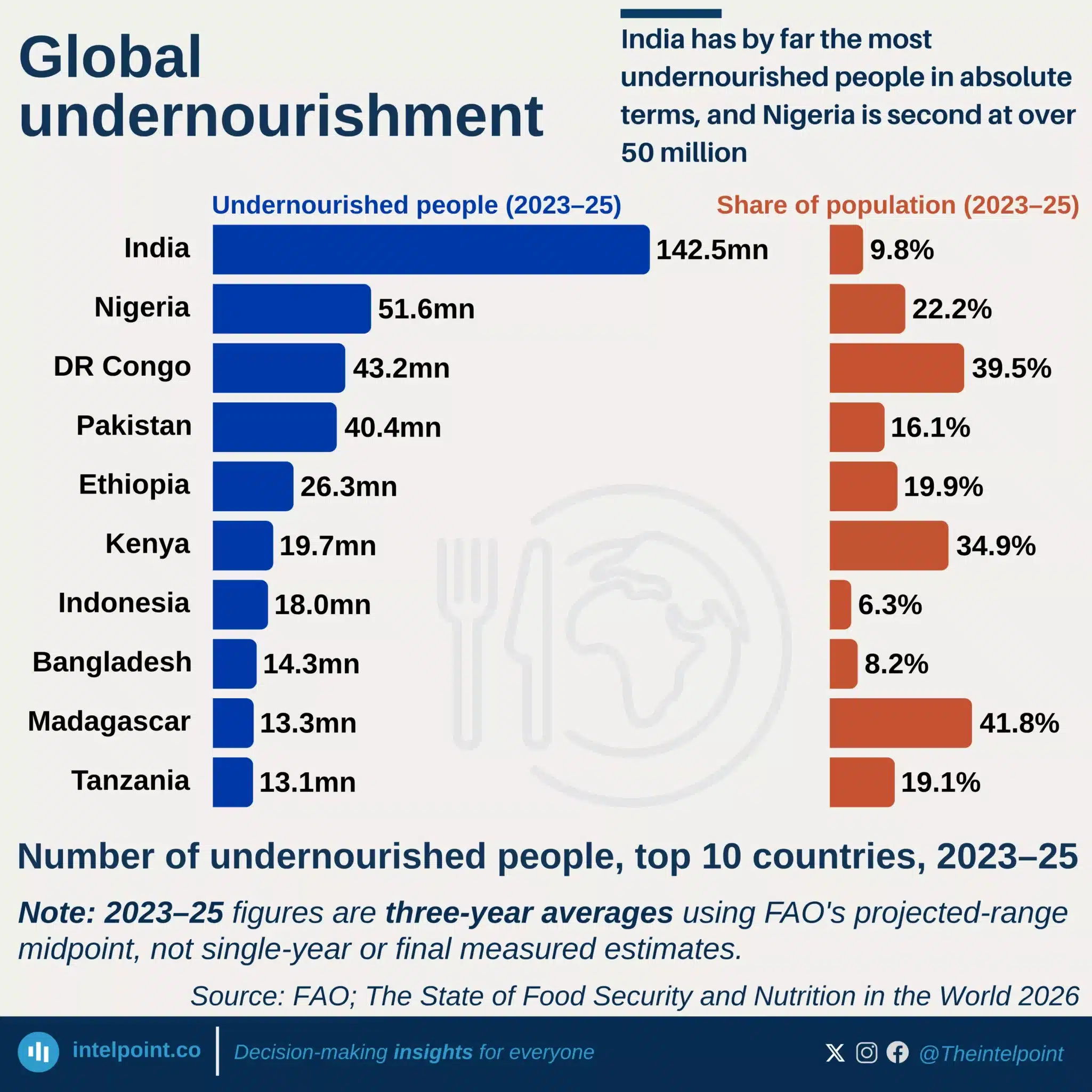
India has by far the most undernourished people in absolute terms, and Nigeria is second at over 50 million
  • India has the most undernourished people, at 142.5 million, nearly three times Nigeria’s 51.6 million.
  • Nigeria ranks second globally, with 51.6 million undernourished people.
  • Six of the top 10 countries are African, including DR Congo, Ethiopia, Kenya, Madagascar and Tanzania.
  • Madagascar has the highest prevalence, at 41.8%, followed by DR Congo at 39.5%.
  • Nigeria’s prevalence is 22.2%, more than twice India’s 9.8%.

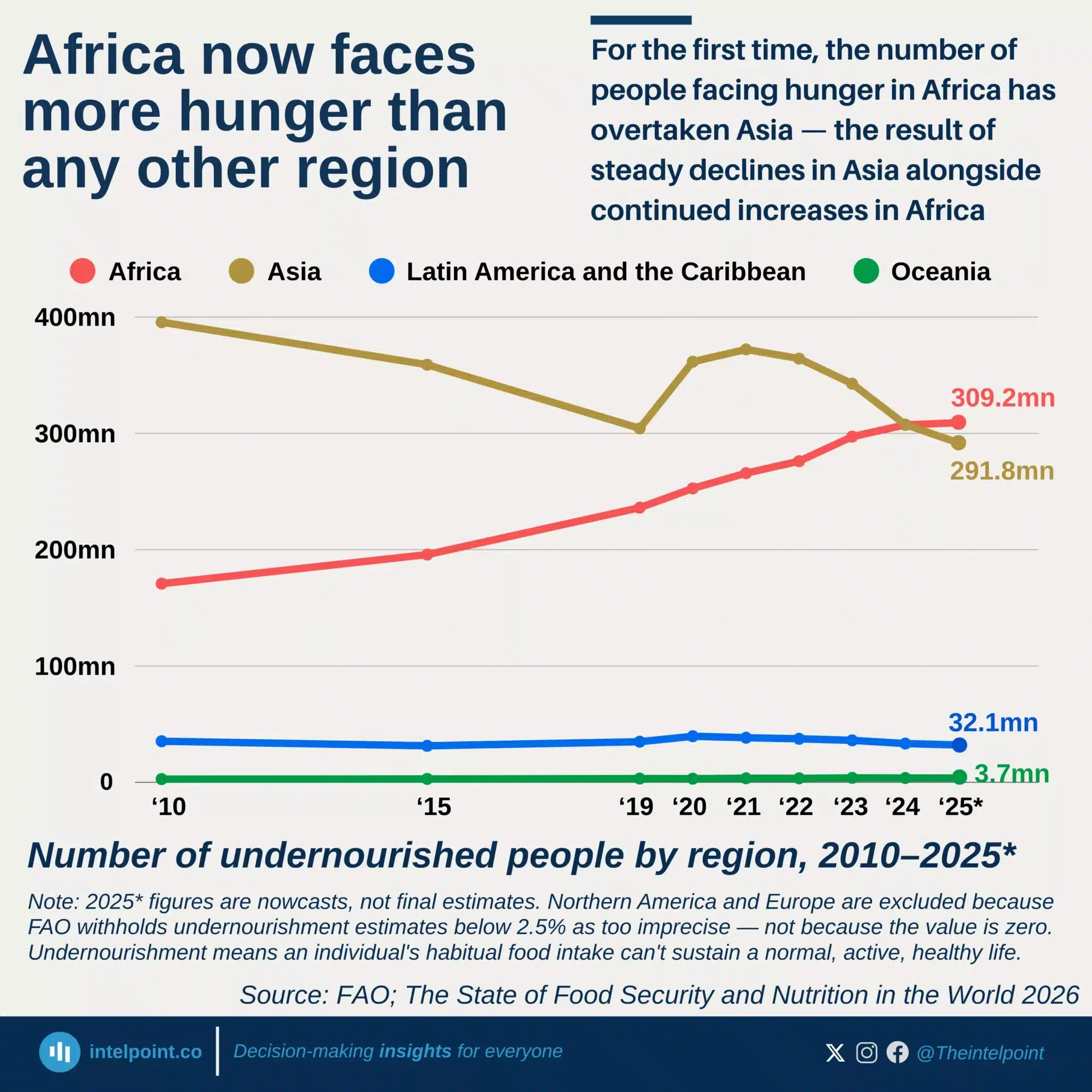
For the first time, the number of people facing hunger in Africa has overtaken Asia — the result of steady declines in Asia alongside continued increases in Africa
  • Africa overtook Asia as the region with the most undernourished people in 2025.
  • 309.2 million people in Africa were undernourished, versus 291.8 million in Asia.
  • Africa’s undernourished population has nearly doubled since 2010, rising from 170.8 million to 309.2 million.
  • Africa’s share of the global total jumped from 28% in 2010 to 48% in 2025.
  • FAO projects Africa’s share to reach 56% by 2030, pointing to a widening long-term food insecurity gap.

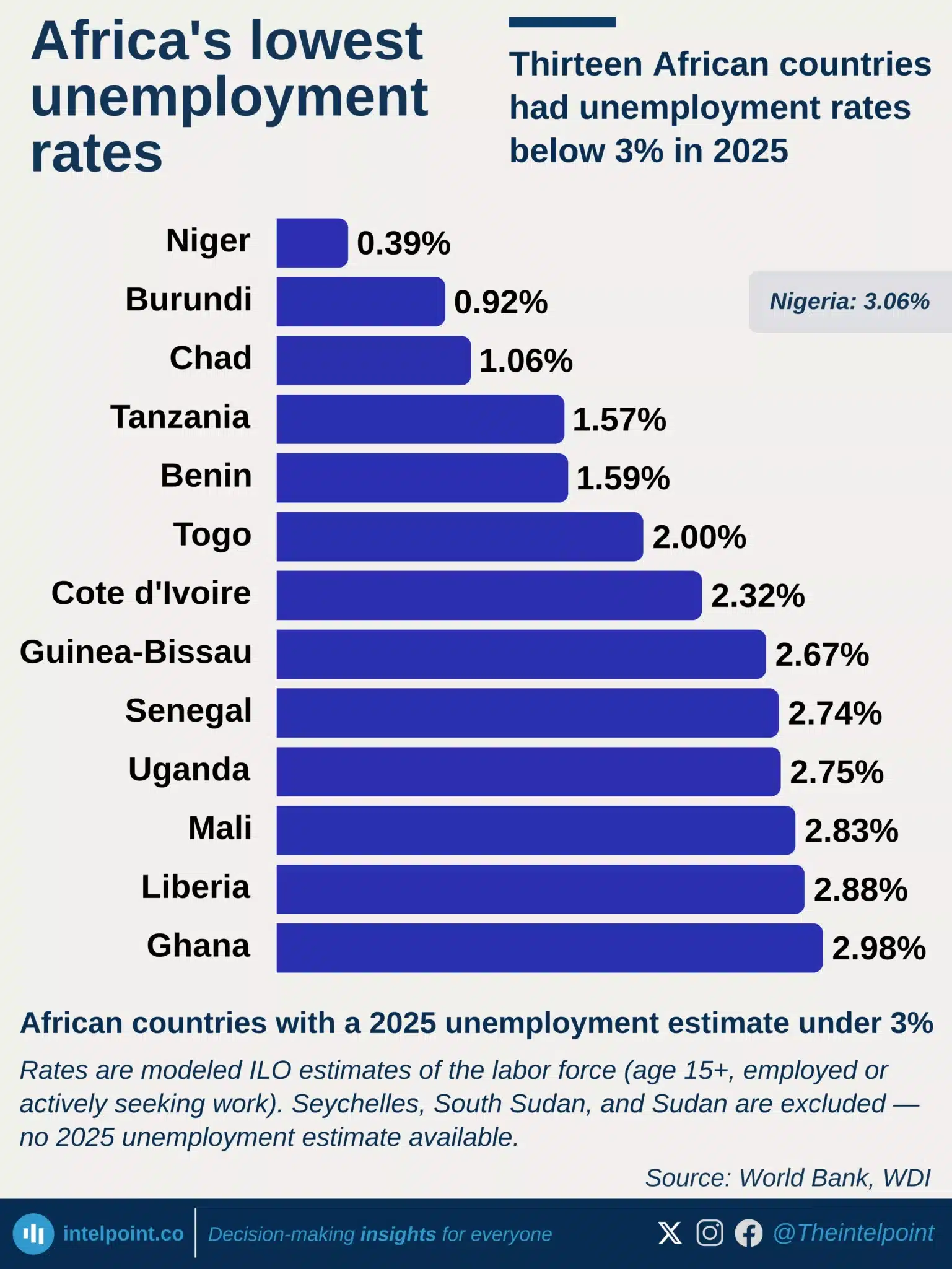
Thirteen African countries had unemployment rates below 3% in 2025
  • Niger had Africa’s lowest estimated unemployment rate in 2025 at 0.39%.
  • Burundi and Chad followed, with rates of 0.92% and 1.06%.
  • Thirteen African countries recorded unemployment rates below 3% in 2025.
  • Nigeria’s estimated unemployment rate was 3.06%, just above the group.
  • The 13 countries with rates below 3% averaged 2.05%.
  • Niger’s unemployment rate fell 87.3% from 3.10% in 2005 to 0.39% in 2025.

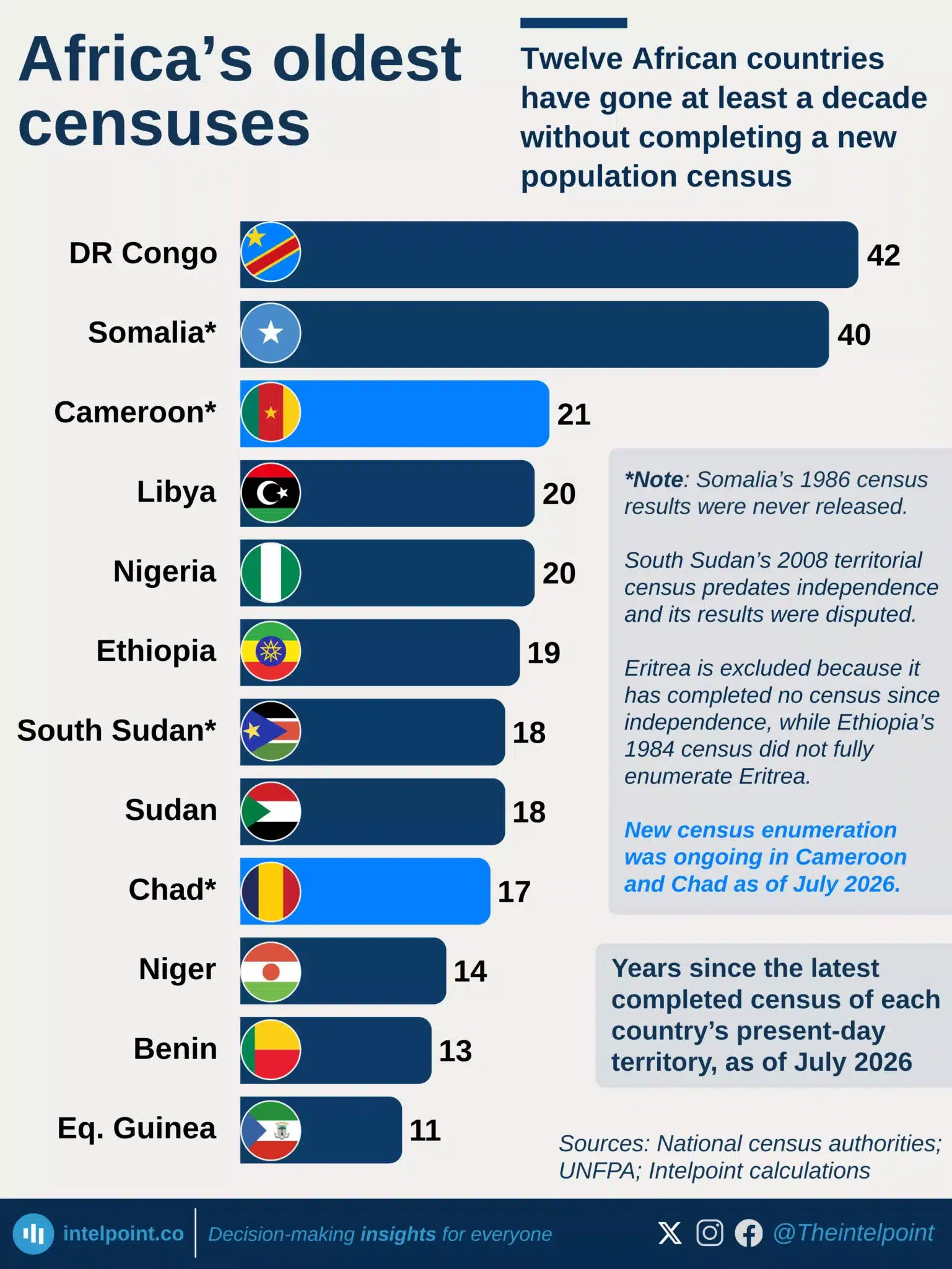
Twelve African countries have gone at least a decade without completing a new population census
  • Twelve African countries have not completed a census in at least 10 years.
  • DR Congo (42 years) and Somalia (40 years) have Africa's oldest censuses.
  • Guinea-Bissau has completed a new census, while Cameroon and Chad are still counting.
  • Nigeria and DR Congo are preparing new censuses, but fieldwork has not begun.
  • South Sudan's census is disputed, while Eritrea is excluded from the ranking.

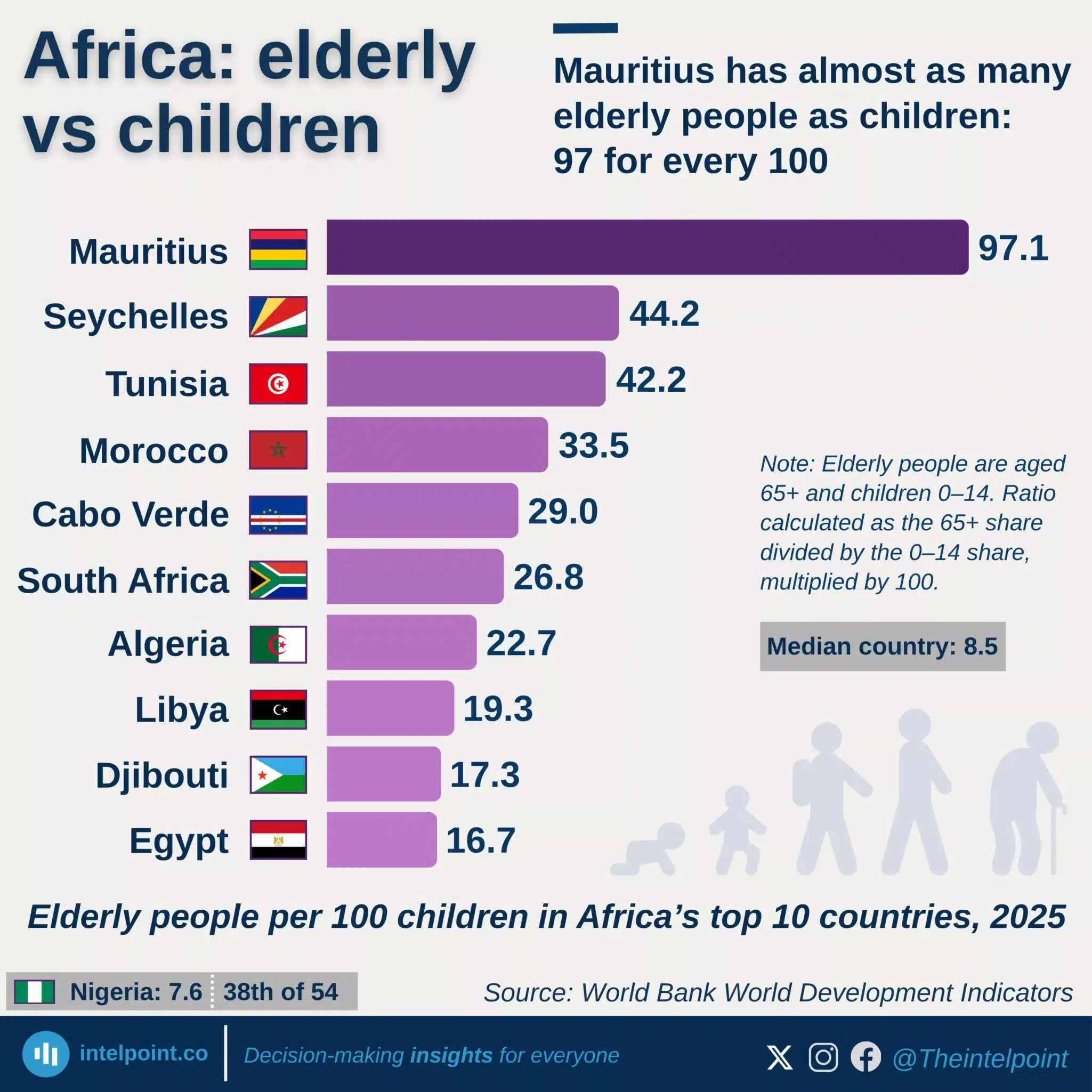
Mauritius has almost as many elderly people as children: 97 for every 100
  • Mauritius had 97 elderly people per 100 children in 2025, over 11 times Africa’s median of 8.5.
  • Its ratio increased from fewer than seven in 1960 to 24 in 2000, becoming Africa’s highest in 2009.
  • Seychelles ranked second with 44 elderly people per 100 children, followed by Tunisia with 42.
  • Mauritius’s child share fell from 25.6% to 14.5% between 2000 and 2025, while its elderly share increased from 6.1% to 14.1%.
  • Nigeria’s ratio moved from 6.9 to 7.6 between 2000 and 2025, placing it 38th among 54 countries.

POPULAR TOPICS
SIGN UP TO OUR NEWSLETTER
Get periodic updates about the African startup space, access to our reports, among others.
Subscribe Here
Subscription Form

A product of Techpoint Africa. All rights reserved