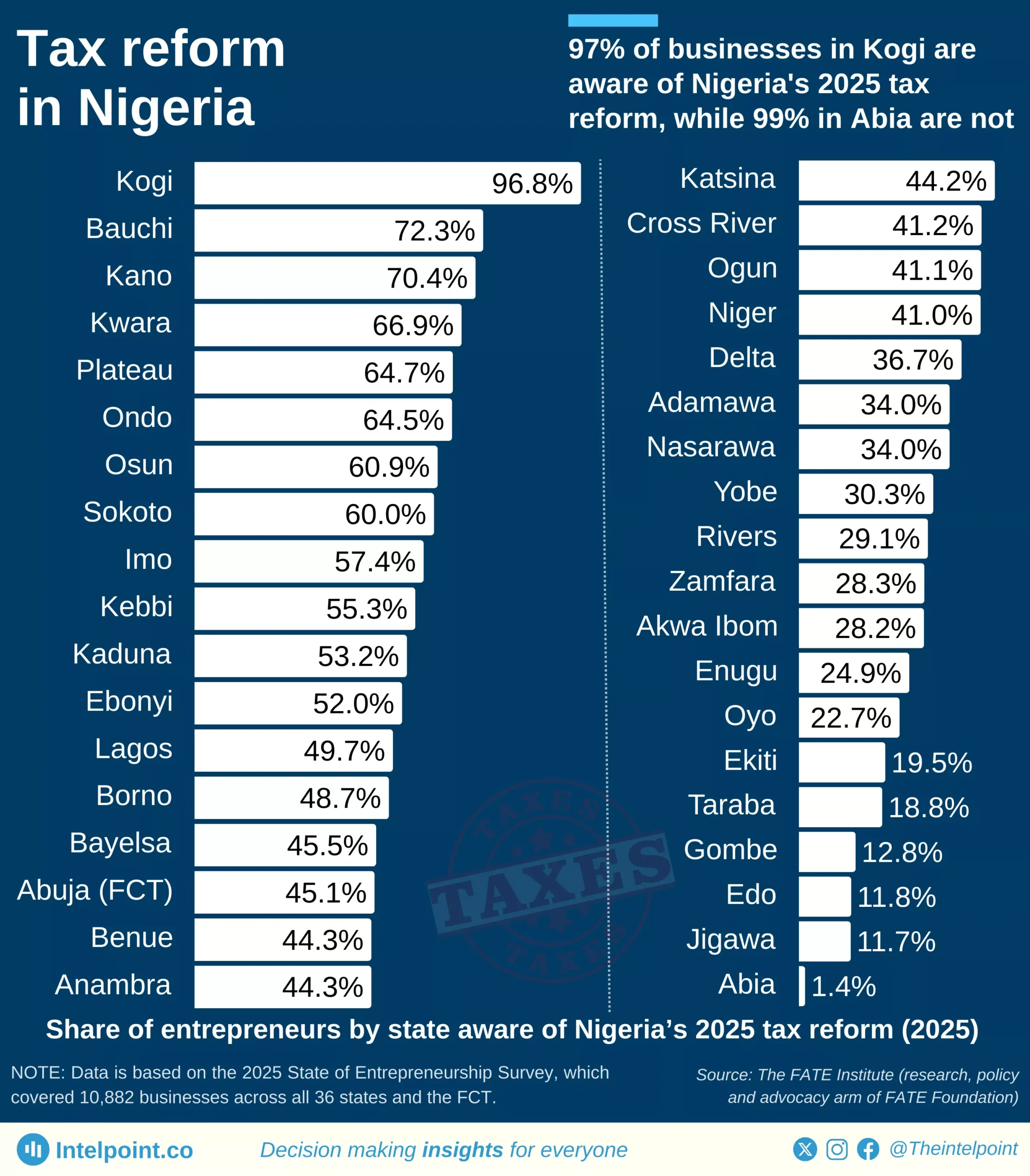
97% of businesses in Kogi are aware of Nigeria's 2025 tax reform, while 99% in Abia are not

  • Kogi entrepreneurs have the highest tax policy awareness in Nigeria (96.8%) in 2025.
  • Abia has the lowest awareness nationwide at just 1.4%.
  • Fewer than one-third of Nigerian states have awareness levels above 60%.
  • Major economic hubs like Lagos and Rivers have awareness below 50%.
  • Northern states dominate the top awareness rankings more than southern states.
  • Several states cluster around the 40–50% range, indicating partial reach.
  • States with low awareness risk lower compliance and higher friction during enforcement.
  • The gap between the highest and lowest states exceeds 95 percentage points, showing extreme disparity.

Awareness of Nigeria’s 2026 tax reform varies across states, and the contrast is striking.

In Kogi, almost 97% of entrepreneurs are aware of the reform, making it the most informed state in the country.

At the other extreme, Abia records just 1.4% awareness, meaning nearly all entrepreneurs there are operating with little or no knowledge of the new tax framework.

This wide gap points to uneven policy communication. Effective tax reform in Nigeria depends as much on communication and outreach as on policy content itself.
Source:

The FATE Institute (research, policy and advocacy arm of FATE Foundation)

Period:

2025
HTML code to embed chart
Want a bespoke report?
Reach out
Tags
Related Insights

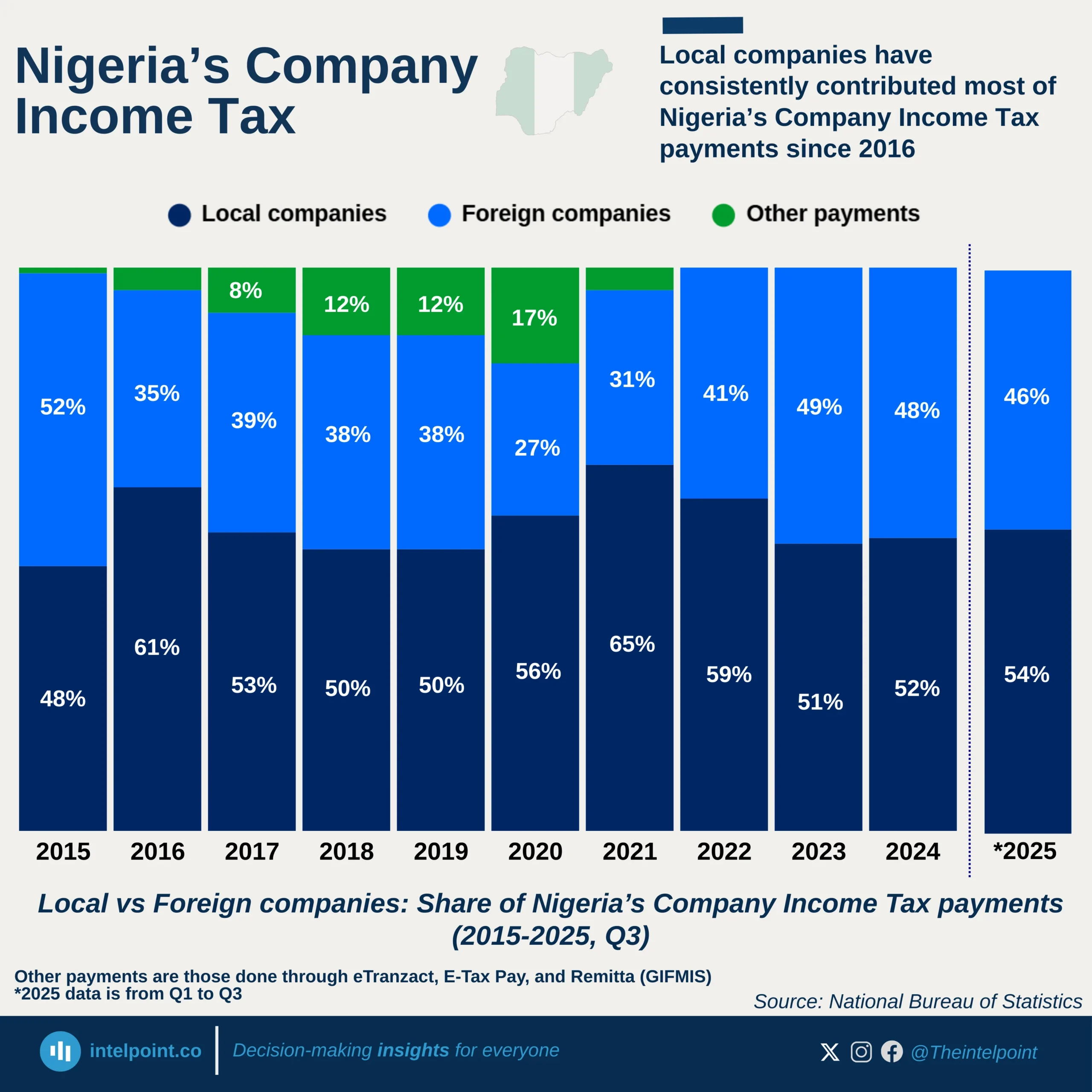
Local companies have consistently contributed most of Nigeria’s Company Income Tax payments since 2016
  • Local companies dominated CIT contributions in most years, accounting for over 50% of payments in 9 of 11 periods between 2015 and 2025 (Q1–Q3).
  • Foreign companies briefly closed the gap in 2023, contributing 49%, the closest they have come to matching local firms.
  • Local companies recorded their strongest share in 2021 at 65%, marking the widest gap between local and foreign contributors.
  • “Other payments” peaked during the pandemic, rising to 17% in 2020 before dropping to 0% from 2022 onward.

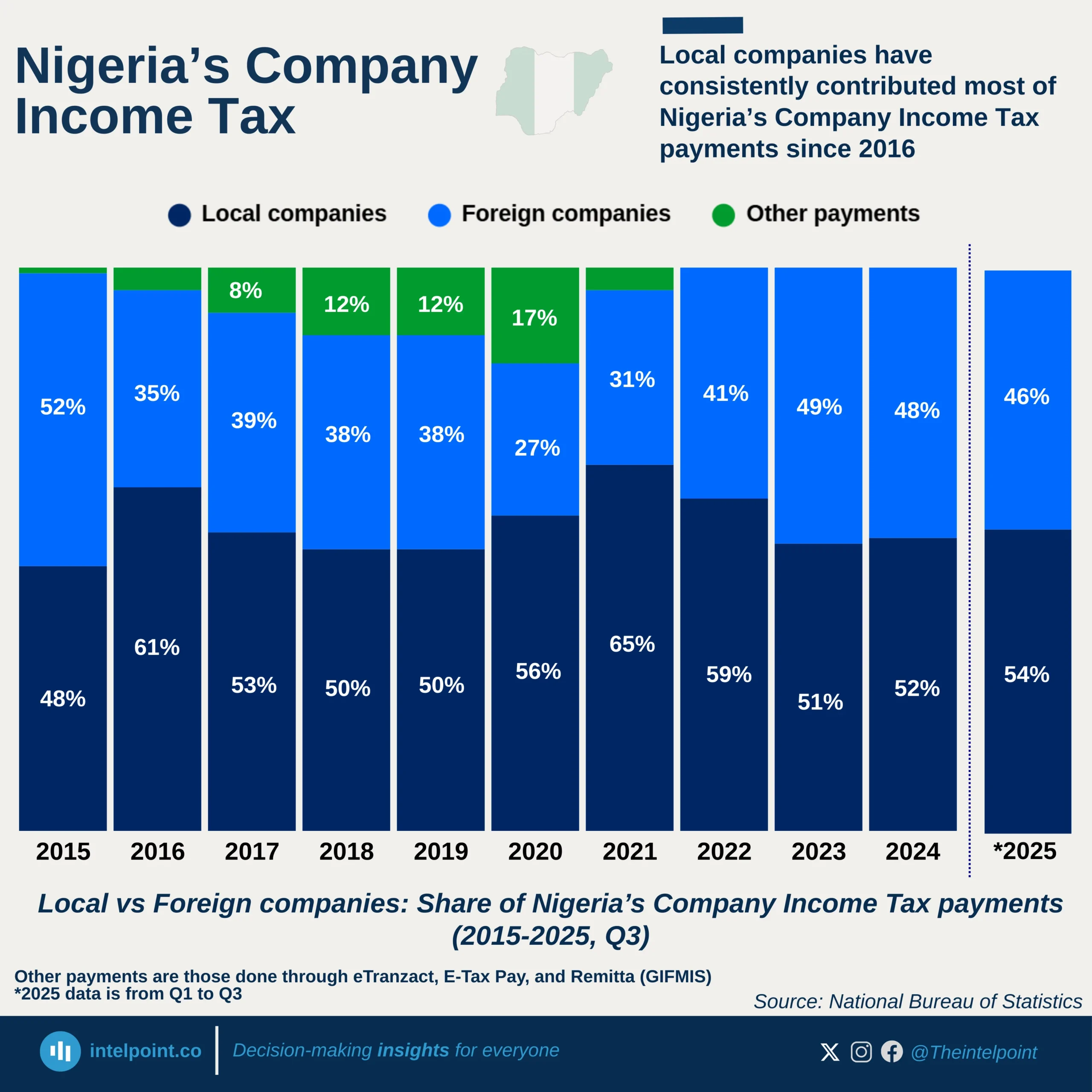
Local companies have consistently contributed most of Nigeria’s Company Income Tax payments since 2016
  • Local companies dominated CIT contributions in most years, accounting for over 50% of payments in 9 of 11 periods between 2015 and 2025 (Q1–Q3).
  • Foreign companies briefly closed the gap in 2023, contributing 49%, the closest they have come to matching local firms.p
  • Local companies recorded their strongest share in 2021 at 65%, marking the widest gap between local and foreign contributors.
  • “Other payments” peaked during the pandemic, rising to 17% in 2020 before dropping to 0% from 2022 onward.

Jumia posts third consecutive year of lower losses, down to $60.1m in 2025
  • Since its 2019 IPO, Jumia Group has accumulated over $1 billion in total losses, with 2019 marking its highest annual loss at $254.2 million.
  • Losses remained elevated between 2020 and 2022, consistently exceeding $180 million annually despite post-IPO restructuring efforts.
  • From 2023 onwards, annual losses dropped sharply — falling below $105 million for the first time since listing — following the shutdown of underperforming business units across African markets.
  • By 2025, losses declined further to $60.1 million, representing the company’s lowest annual loss in nine years and signalling the sustained impact of its cost-reduction strategy.

Nigerian cement giants control Africa’s top tier despite Dangote’s revenue dip
  • Dangote Cement remains Africa’s largest cement company, despite a steep 24.3% revenue drop from $3.2 billion to $2.4 billion
  • Revenue declines were widespread, affecting major players including BUA Cement (-11.2%) and Lafarge Africa (-19.8%).
  • The downturn among top Nigerian producers suggests strong pressure in one of Africa’s largest cement markets
  • PPC recorded a relatively mild decline (-1.1%), showing more stable performance
  • Ciments du Maroc (+4.8%) and Bamburi Cement (+14.8%) posted growth, highlighting regional demand resilience.
  • Smaller positive gains from firms like Sinai Cement and Sephaku Holdings suggest selected markets are still expanding

Jigawa state has the highest rate of unregistered businesses, with only 3.9% registered in 2025
  • Jigawa has the highest share of unregistered businesses in Nigeria (96.1%) in 2025.
  • Over half (20) of Nigerian states have more than 50% of businesses operating informally.
  • Informality is not limited to poorer states; Lagos and Rivers both exceed 65%.
  • Southern and northern states alike show high informality, indicating a nationwide challenge.
  • Only a small group (10) of states have informality rates below 30%.
  • Kaduna records the lowest share of unregistered businesses (10.3%)

17 states in Nigeria recorded above 0.50 points in the 2025 State of Entrepreneurship (SoE) Index ranking
  • Only 17 of 37 states and the FCT recorded above-midpoint entrepreneurship scores in 2025.
  • Kogi State leads nationally, outperforming all others on the SoE Index.
  • Strong entrepreneurship performance is not limited to Lagos or major commercial centres.
  • Several northern and middle-belt states rank high.
  • Urban and resource-rich states do not automatically guarantee strong entrepreneurial outcomes.
  • Local governance and operating conditions appear more influential than state size or wealth.

POPULAR TOPICS
SIGN UP TO OUR NEWSLETTER
Get periodic updates about the African startup space, access to our reports, among others.
Subscribe Here
Subscription Form

A product of Techpoint Africa. All rights reserved