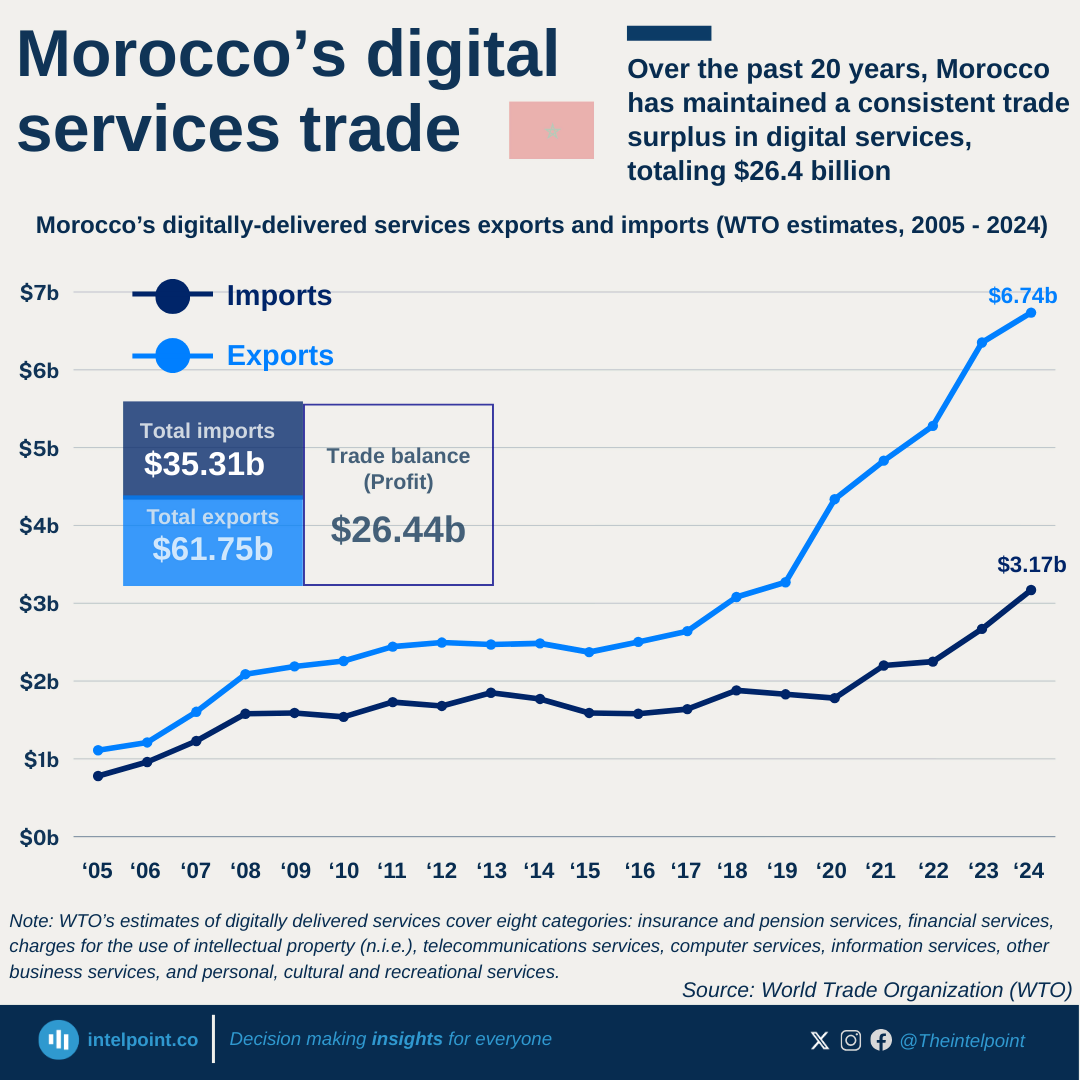
Over the past 20 years, Morocco has maintained a consistent trade surplus in digital services, totaling $26.44 billion

key takeaways:

  • Morocco recorded a total of $61.75 billion digital services trade exports and $35.31 billion imports, revealing a staggering $26.44 billion trade profit in 20 years.
  • Morocco has always been the leading country in Africa as far as digital services trade is concerned.
  • From 2005-2024, Morocco digital services exports have always outpaced imports.
  • Morocco digital export earnings have grown from $1.11b in 2005 to $6.74b in 2024, revealing over 500% growth in 20 years.
  • Imports during the same time-frame reached 3.17b from $780m in 2025.

Morocco has positioned itself as a giant in the digital services trade in Africa with the remarkable growth in its digital services trade over the past two decades, recording a staggering $61.75 billion in exports and $35.31 billion in imports, resulting in a $26.44 billion trade surplus.

Between 2005 and 2024, Morocco's digital exports have consistently outpaced imports, showcasing a thriving digital economy. Digital services export earnings have experienced an exceptional surge, growing from $1.11 billion in 2005 to an estimated $6.74 billion in 2024. This growth represents an impressive increase of over 500% over the past 20 years. Conversely, Morocco's digital imports have also risen substantially, reaching $3.17 billion in 2025 from a modest $780 million in 2005.

The consistent upward trajectory in Morocco’s digital services trade highlights the country's growing prominence in the global digital economy. The nation's export success reflects both its expanding tech sector and its increasing competitiveness in international markets. With a projected continued growth in the digital services industry, Morocco is set to further cement its position as a key player in the global digital trade landscape.
Source:

World Trade Organization

Period:

2005-2024
HTML code to embed chart
Want a bespoke report?
Reach out
Tags
Related Insights

Nigeria's trade surplus hit a record ₦21.0tn in 2025 and remained strong in Q1 2026
  • Nigeria recorded a ₦21.03 trillion trade surplus in 2025, the highest in the period shown.
  • The trade surplus remained strong at ₦7.55 trillion in Q1 2026.
  • The latest performance marks a sharp recovery from the deficits recorded in 2020 and 2021.
  • Nigeria’s trade balance moved from near zero in 2023 to large surpluses in 2024 and 2025.

Eswatini and Morocco have remained in the World Bank's lower-middle-income band for at least 38 consecutive years
  • Nigeria has remained in the World Bank’s lower-middle-income category for 17 consecutive years.
  • Eswatini and Morocco have spent at least 38 consecutive years in the category, the longest among African countries.
  • Africa has 23 lower-middle-income economies in the World Bank’s Fiscal Year 2026 classification.
  • Tunisia, Angola, and Namibia entered the category after falling from upper-middle-income status.

Portfolio investment into Nigeria hit a 13-year quarterly high in Q1 2026
  • Portfolio investment into Nigeria reached $9.86 billion in Q1 2026, the highest quarterly level in 51 quarters.
  • The Q1 2026 portfolio inflow was higher than the previous peak of $7.11 billion recorded in Q1 2019.
  • Portfolio investment accounted for 95% of Nigeria’s total capital importation in Q1 2026.
  • Foreign Direct Investment remained low at $135 million, far below portfolio inflows.
  • Other Investment stood at $374 million, making it the second-largest inflow category in Q1 2026.

Three African countries are projected to have debt exceeding their GDP in 2026
  • Sudan is projected to have Africa’s highest debt-to-GDP ratio in 2026, at 169.1%.
  • Only three African countries are projected to owe more than the size of their economies in 2026.
  • Senegal and Mozambique join Sudan among countries with debt-to-GDP ratios above 100%.
  • Africa’s average government debt-to-GDP ratio is projected at 60.7% in 2026.
  • Nigeria’s projected debt-to-GDP ratio of 32.3% is far below the African average.

Every food item tracked has at least doubled in price since May 2023
  • Every comparable food item tracked is now at least twice as expensive as it was in May 2023.
  • Nearly half of the selected food items have more than tripled in price since the month before fuel subsidy removal.
  • Unripe plantain recorded the steepest increase, rising by 469% between May 2023 and April 2026.
  • Ripe plantain, yam tuber, and fresh tilapia also saw extreme increases of more than 300%.
  • Even the slowest-rising staples, including frozen chicken, beans, gari, and maize, still more than doubled in price.

Healthy diet costs rose fastest in Nigeria’s North-West over two years
  • Healthy diet costs rose 49% nationally in two years.
  • North-West states recorded the fastest increases.
  • All seven North-West states rose above the national average.
  • Katsina and Kogi recorded the steepest increases, at 98%.
  • Akwa Ibom had the lowest increase, at 5%.

POPULAR TOPICS
SIGN UP TO OUR NEWSLETTER
Get periodic updates about the African startup space, access to our reports, among others.
Subscribe Here
Subscription Form

A product of Techpoint Africa. All rights reserved