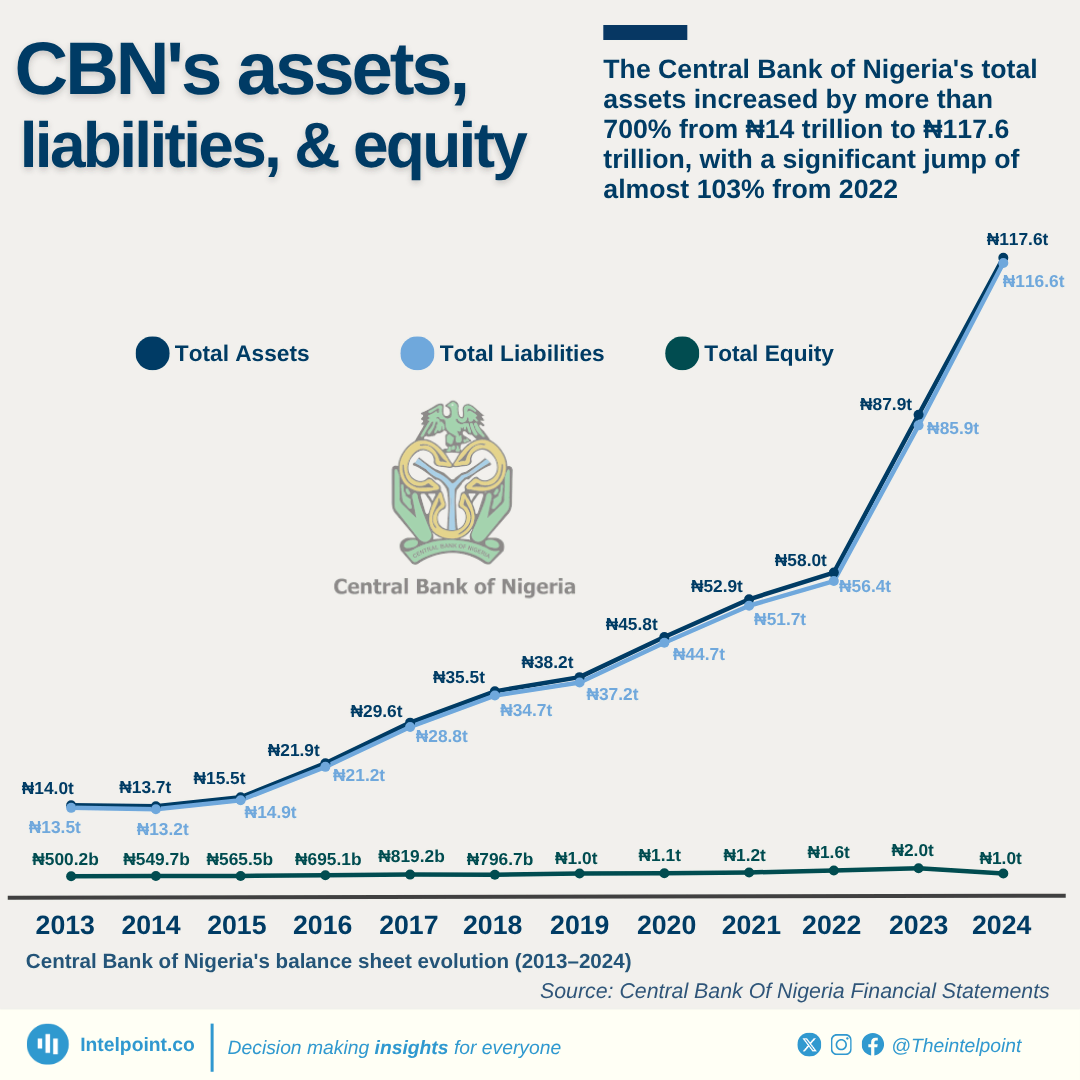
The Central Bank of Nigeria's total assets increased by more than 700% from ₦14 trillion to ₦117.6 trillion, with a significant jump of almost 103% from 2022

Key Takeaways:

  • CBN’s total assets increased from ₦14 trillion in 2013 to ₦117.6 trillion in 2024.
  • Total liabilities followed a similar upward trend, reaching ₦116.6 trillion in 2024.
  • Total assets and liabilities rose by more than 100% from 2022.
  • The gap between assets and liabilities has remained relatively narrow, indicating tight net equity margins and overall prudent financial management.
  • Total equity initially rose between 2022 and 2023, but later declined in 2024 despite a substantial increase in CBN's assets and liabilities.
  • The most significant asset jumps occurred between 2022 and 2024, reflecting a rapid expansion of the balance sheet.
  • CBN’s total equity over the years ranged from ₦500 billion to ₦2 trillion, peaking in 2023 at ₦2 trillion.

The Central Bank of Nigeria's (CBN) balance sheet grew significantly during the previous decade. Total assets continuously expanded from ₦14 trillion in 2013 to an amazing ₦117.6 trillion by 2024. Similarly, liabilities increased from ₦13.5 trillion to ₦116.6 trillion during the same period.

The total equity of CBN during this period experienced significant fluctuation, ranging from ₦500 billion to ₦2 trillion. Aside from this, the data showed robust financial growth and balance sheet expansion, particularly in the past two years, highlighting the CBN's changing role in Nigeria's economic stability.
Source:

Central Bank Of Nigeria Financial Statements

Period:

2013-2024
HTML code to embed chart
Want a bespoke report?
Reach out
Tags
Related Insights

Nigeria's insurance sector crossed ₦1.98tn in H1 2025 as every segment grew by at least 25%
  • Life Business was the single largest segment, and its 70.3% jump signals that more Nigerians are thinking seriously about financial protection for their families.
  • Miscellaneous, the smallest segment, posted the biggest growth at 86.7%, suggesting new and unconventional insurance products are gaining serious traction.
  • Aviation & Marine nearly doubled, with 79.9% growth in a sector tied to trade and logistics, reflecting Nigeria's expanding import/export activity and the rising cost of cargo and aircraft risk coverage.
  • Motor (52.5%), Fire (53.3%), and General Accident (49.6%) grew by roughly half, indicating broad-based sector expansion rather than isolated pockets of growth.

Internationally authorised Nigerian banks have raised over ₦3.3tn since March 2024
  • Internationally authorised Nigerian banks have raised and injected over ₦3.3 trillion in new capital since March 2024.
  • The recapitalisation exercise is being driven by the Central Bank of Nigeria’s requirements, with the deadline expected in March 2026.
  • Zenith Bank currently has the highest capital among the banks shown, reaching about ₦614 billion.
  • Access Holdings has about ₦602.8 billion in total capital.
  • Fidelity Bank raised the largest single capital injection in the group, about ₦437.85 billion, pushing its total capital to ₦564.5 billion.
  • FCMB has the highest previous capital base among the banks listed (₦266.5 billion) before the recapitalisation injection.

Nigeria's insurance sector crossed ₦1.98tn in H1 2025 as every segment grew by at least 25%
  • Life Business was the single largest segment, and its 70.3% jump signals that more Nigerians are thinking seriously about financial protection for their families.
  • Miscellaneous, the smallest segment, posted the biggest growth at 86.7%, suggesting new and unconventional insurance products are gaining serious traction.
  • Aviation & Marine nearly doubled, with 79.9% growth in a sector tied to trade and logistics, reflecting Nigeria's expanding import/export activity and the rising cost of cargo and aircraft risk coverage.
  • Motor (52.5%), Fire (53.3%), and General Accident (49.6%) grew by roughly half, indicating broad-based sector expansion rather than isolated pockets of growth.

Nigeria had about 135 bank accounts per 100 people in 2025, up from 32 bank accounts in 2017
  • Active bank accounts grew from 65 million in 2016 to over 320 million in 2025 — almost a fivefold increase.
  • Bank accounts per 100 people rose from about 32 in 2017 to nearly 135 in 2025.
  • Nigeria now averages more than one bank account per person.
  • The fastest growth phase occurred between 2019 and 2024.
  • Digital banking and fintech adoption played a major role in the surge.
  • The jump after 2020 suggests technology-driven access, not just population growth.
  • Multiple account ownership is now common among users.

Nigeria saw an increase of 2.9 million deployed POS in 2024, following the naira redesign in 2023
  • Deployed POS terminals grew from about 156,000 in 2017 to 8.4 million in 2025.
  • Nigeria added more than eight million terminals in eight years, indicating rapid adoption of digital payments.
  • Growth accelerated sharply after 2020, marking a major shift toward cashless transactions.
  • The highest year-on-year growth (116.8%) occurred in 2024, following the naira redesign.
  • About three million terminals were added in 2024 alone.
  • POS agents became critical financial access points during the period of cash shortage.
  • POS terminals now function as mini-banks in many communities.
  • Financial inclusion has expanded through agent-based banking and POS networks.

Zero Losses: Every Access Holdings’ subsidiary made a profit in H1 2025
  • Every subsidiary reported profit in H1 2025, compared to three loss-making units in H1 2024.
  • Nigeria’s profit eased, but stronger performance across other African markets helped support overall group results.
  • Zambia, Sierra Leone, the DRC, Cameroon, and Kenya showed notable turnarounds from previous low or negative earnings.
  • The UK operation remained a major contributor, reinforcing the benefits of Access Holdings’ diversified regional presence.

POPULAR TOPICS
SIGN UP TO OUR NEWSLETTER
Get periodic updates about the African startup space, access to our reports, among others.
Subscribe Here
Subscription Form

A product of Techpoint Africa. All rights reserved