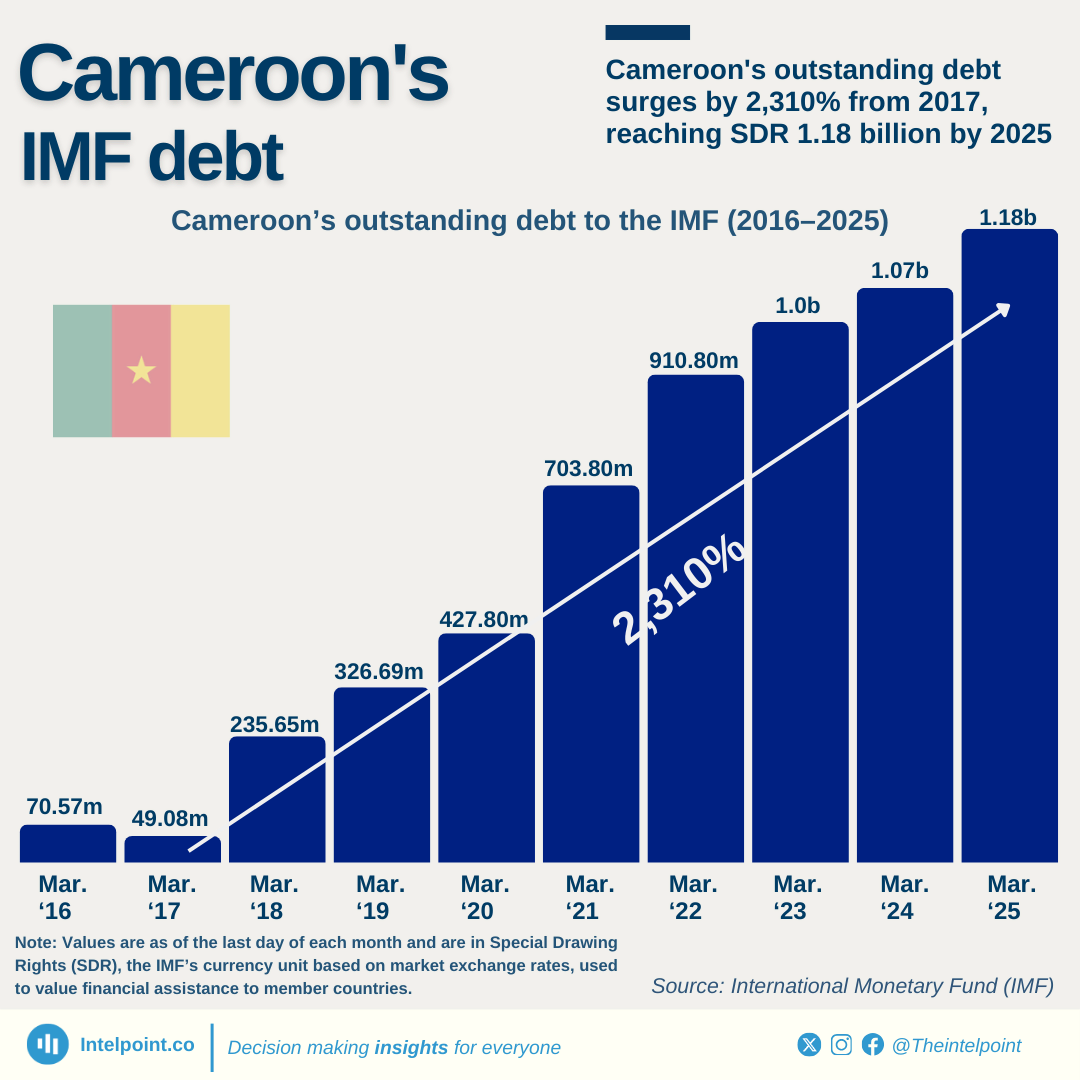
Cameroon's outstanding debt surges by 2,310% from 2017, reaching SDR 1.18 billion by 2025

Key Takeaways:

  • Cameroon’s IMF debt decreased from SDR 70.6 million in 2016 to SDR 49.1 million in 2017—a 30% reduction.
  • From 2018 onwards, the country experienced steady increases in outstanding debt.
  • After an initial 30% reduction from 2016 to 2017, debt skyrocketed by 380% in just one year (2017-2018).
  • By March 2025, Cameroon’s outstanding debt had reached SDR 1.18 billion, representing a staggering SDR 1.13 billion increase from its 2017 level.
  • Although the pace of accumulation has moderated in recent years, the overall debt trend remains upward.

Between 2016 and 2025, Cameroon’s external debt to the International Monetary Fund underwent a dramatic transformation. The country’s outstanding debt, which stood at SDR 70.6 million in 2016, decreased further to SDR 49.1 million in 2017.

However, 2018 marked the beginning of a significant and sustained shift. Debt surged to SDR 235.7 million, reflecting a 380% increase in just one year. This sharp rise signalled the start of a steady upward trend that has continued unabated through to 2025.
Source:

International Monetary Fund (IMF)

Period:

2016 - 2025
HTML code to embed chart
Want a bespoke report?
Reach out
Tags
Related Insights

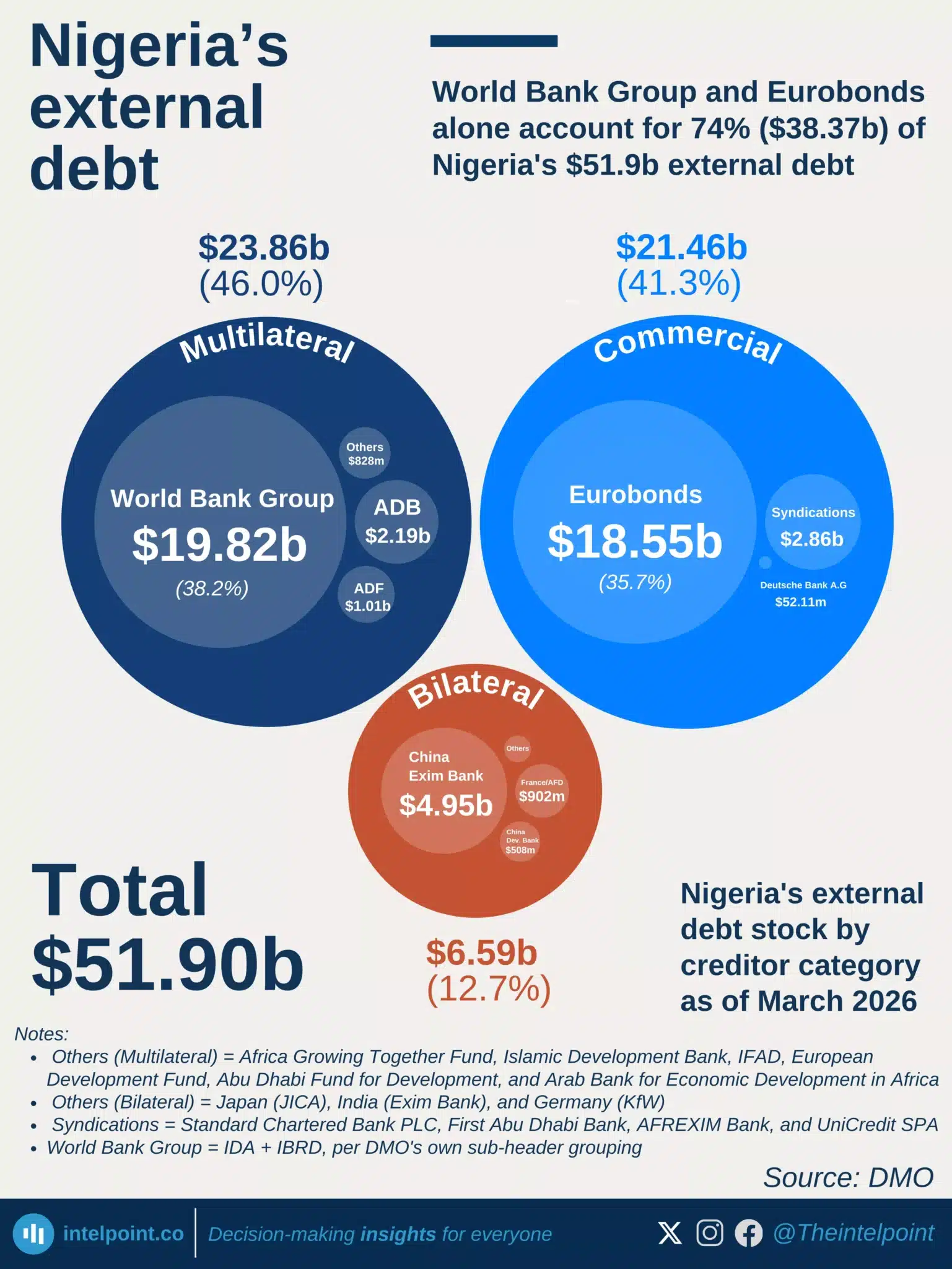
World Bank Group and Eurobonds alone account for 74% ($38.37b) of Nigeria's $51.9b external debt
  • Nigeria’s external debt stood at $51.90 billion as of March 2026.
  • External debt increased by just 0.09% from December 2025.
  • Multilateral creditors held the largest share at 46.0%.
  • Commercial creditors accounted for 41.3% of external debt.
  • Bilateral creditors accounted for 12.7% of external debt.
  • The World Bank Group accounted for 38.2% of total external debt.
  • Eurobond holders accounted for 35.7% of total external debt.
  • The World Bank Group and Eurobond holders together accounted for 73.9% of Nigeria’s external debt.
  • Bilateral debt fell by $130 million from December 2025 to March 2026.
  • Commercial external debt increased by about $1.1 billion over the same period.

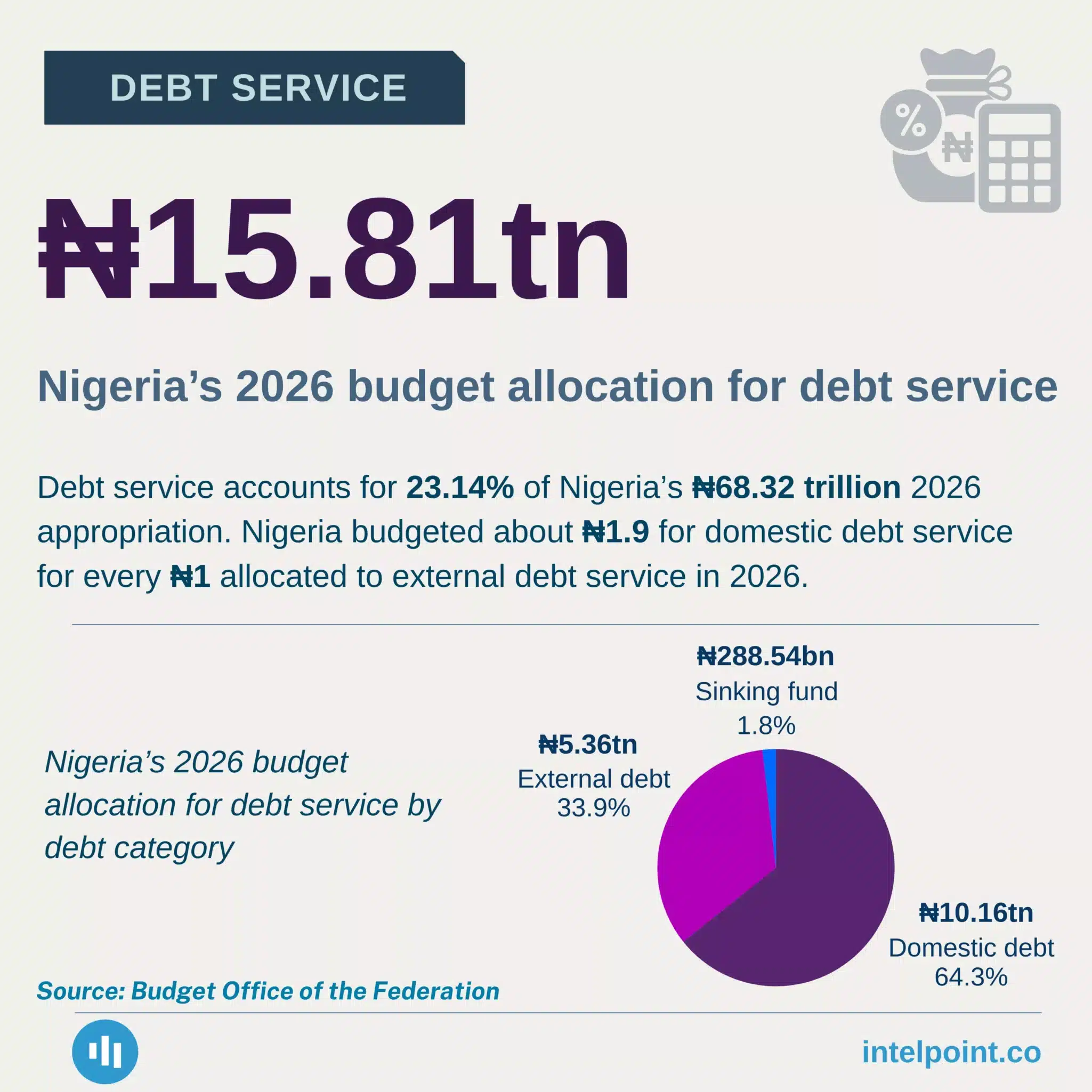
Debt service accounts for 23.14% of Nigeria’s ₦68.32 trillion 2026 appropriation
  • Debt service takes 23.14% of Nigeria’s 2026 budget.
  • Domestic debt service accounts for 64.3% of the debt-service allocation.
  • Domestic debt service is nearly twice the external debt-service allocation.
  • The sinking fund receives just 1.8% of the debt-service allocation.
  • Domestic debt service is more than 35 times the sinking-fund allocation.
  • Debt service totals ₦15.81 trillion in the 2026 budget.

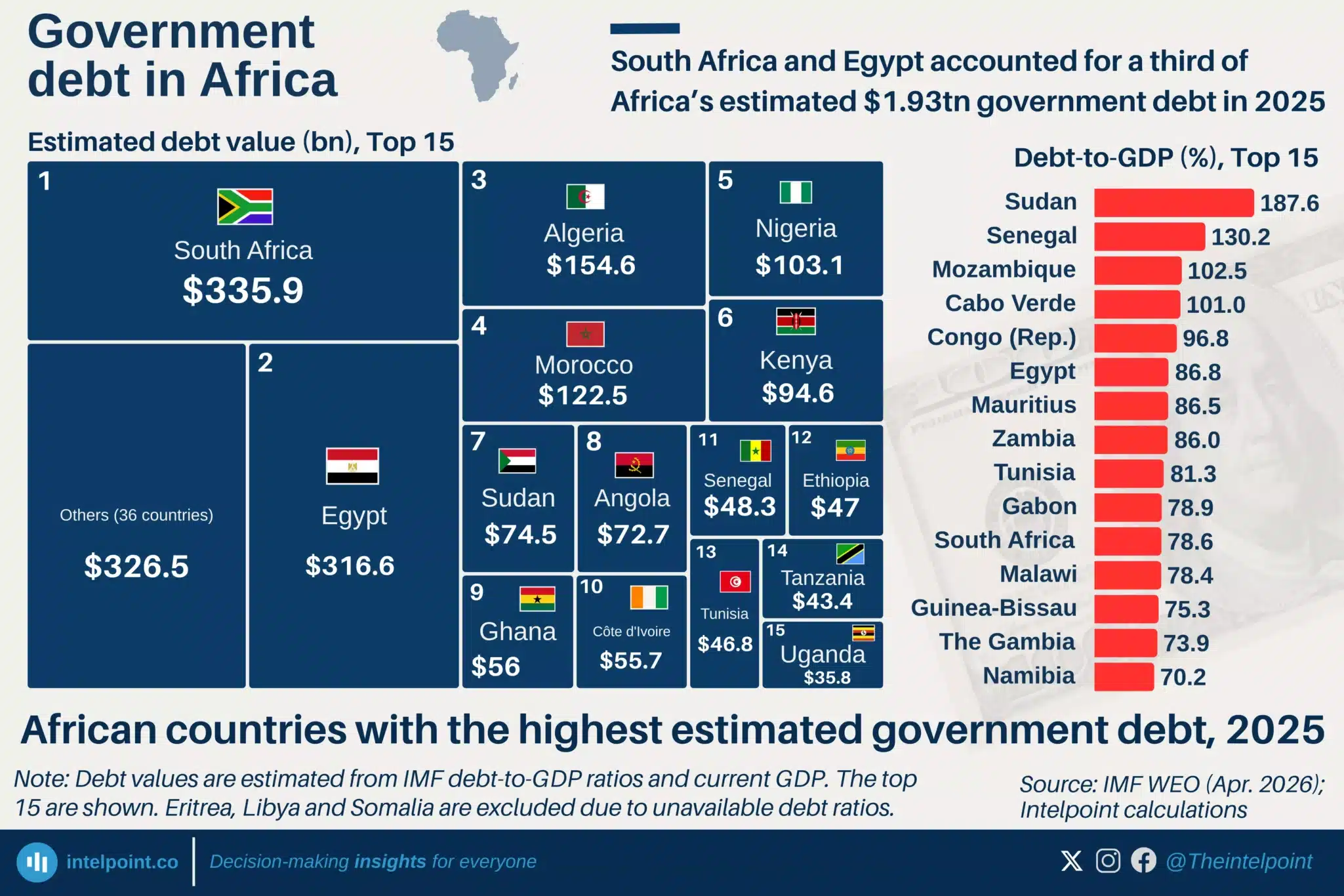
South Africa and Egypt accounted for a third of Africa’s estimated $1.93tn government debt in 2025
  • Government debt across 51 African countries was estimated at $1.93 trillion in 2025.
  • South Africa and Egypt had the largest estimated stocks and jointly accounted for 33.8% of the total.
  • Sudan had the highest debt-to-GDP ratio at 187.6%, followed by Senegal at 130.2%.
  • The estimates use IMF debt ratios and current-dollar GDP, not national authorities’ reported debt stocks.
  • Differences in government coverage, instruments and valuation mean the figures are comparable estimates, not fully harmonised official data.

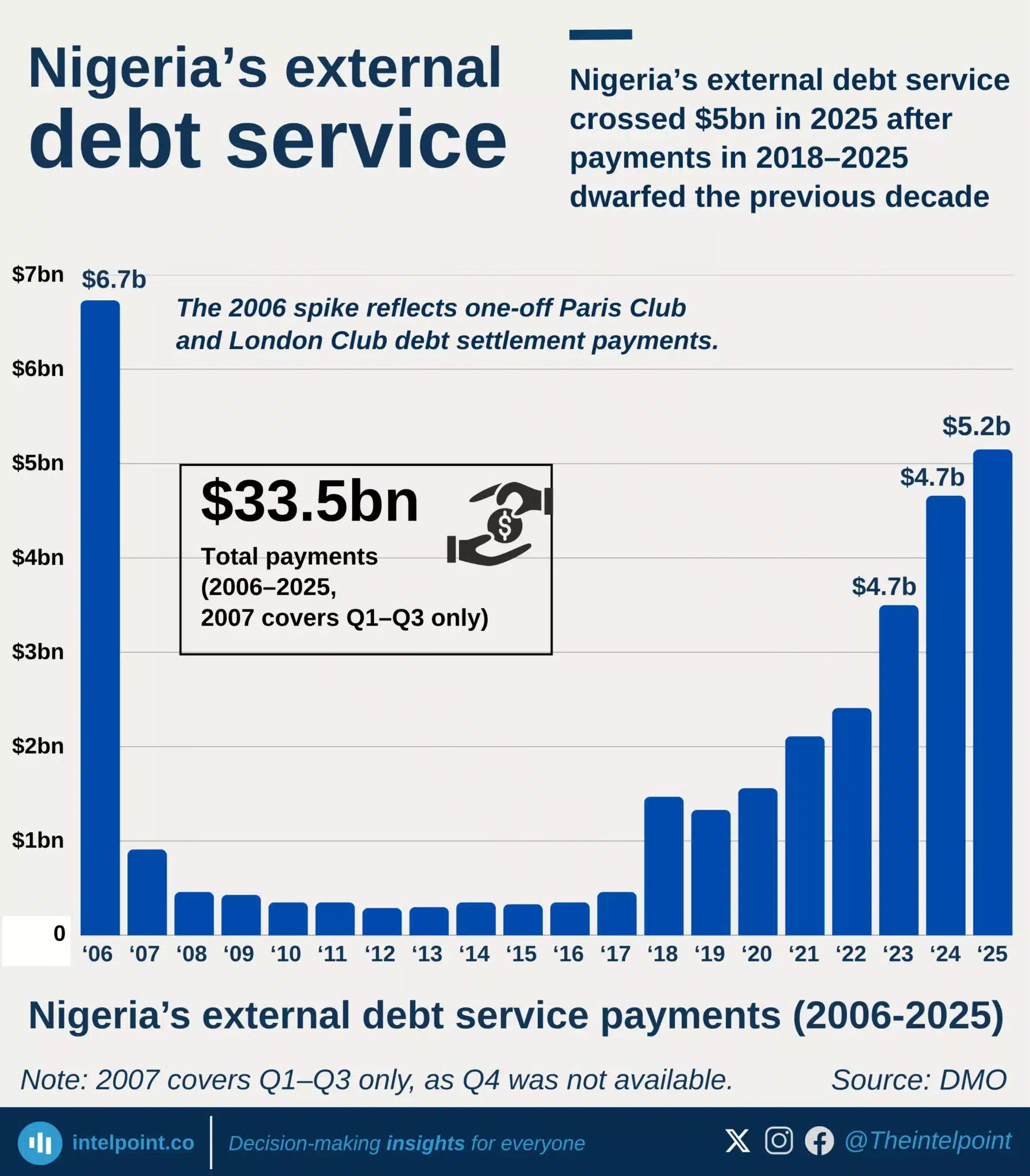
Nigeria’s external debt service crossed $5bn in 2025 after payments in 2018–2025 dwarfed the previous decade
  • Nigeria’s external debt service entered a heavier phase in 2018.
  • External debt service crossed $5bn in 2025.
  • Nigeria paid about $22.2bn from 2018 to 2025.
  • That was about 6x the $3.7bn paid from 2008 to 2017.
  • The 2006 spike reflects one-off debt settlement payments.

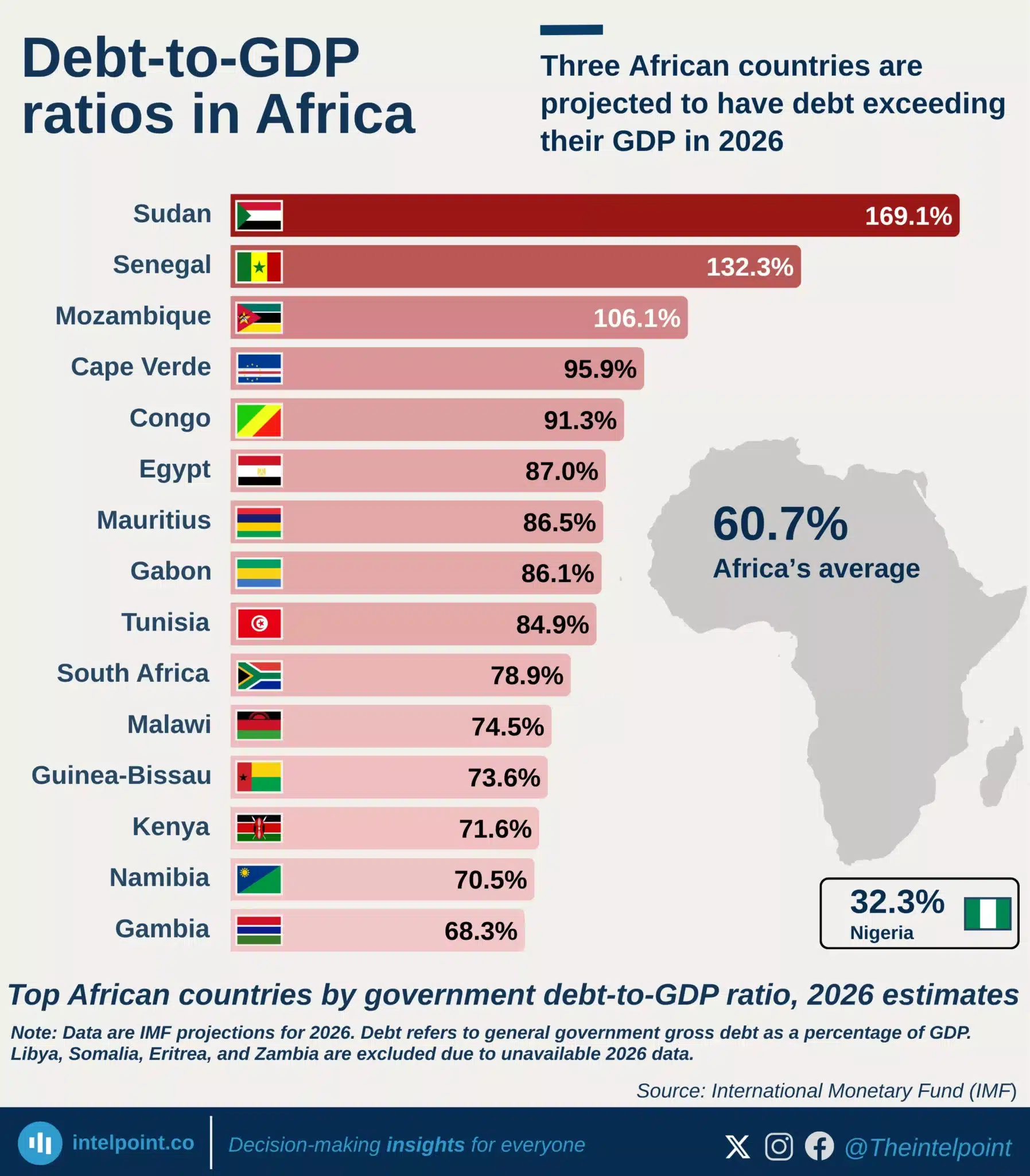
Three African countries are projected to have debt exceeding their GDP in 2026
  • Sudan is projected to have Africa’s highest debt-to-GDP ratio in 2026, at 169.1%.
  • Only three African countries are projected to owe more than the size of their economies in 2026.
  • Senegal and Mozambique join Sudan among countries with debt-to-GDP ratios above 100%.
  • Africa’s average government debt-to-GDP ratio is projected at 60.7% in 2026.
  • Nigeria’s projected debt-to-GDP ratio of 32.3% is far below the African average.

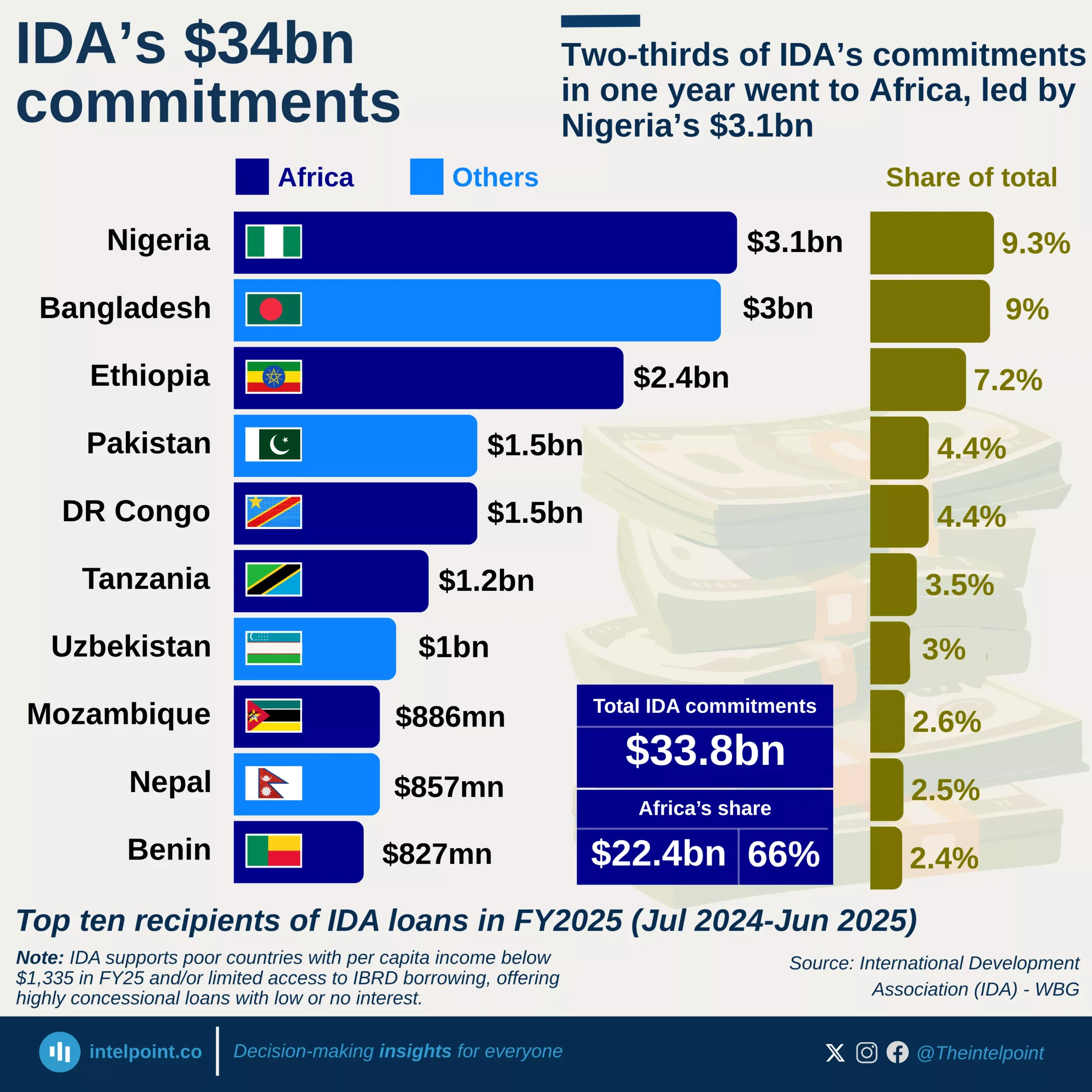
Two-thirds of IDA’s commitments in one year went to Africa, led by Nigeria’s $3.1bn
  • Africa received 66% of IDA’s FY2025 commitments.
  • Africa’s total IDA allocation was $22.4 billion out of $33.8 billion.
  • Nigeria was the largest borrower from the DA globally, with $3.1 billion in loans.
  • Bangladesh ranked second with $3 billion.
  • Six of the top ten borrowers were African countries.
  • Nigeria accounted for 9.3% of total FY2025 IDA commitments.

POPULAR TOPICS
SIGN UP TO OUR NEWSLETTER
Get periodic updates about the African startup space, access to our reports, among others.
Subscribe Here
Subscription Form

A product of Techpoint Africa. All rights reserved