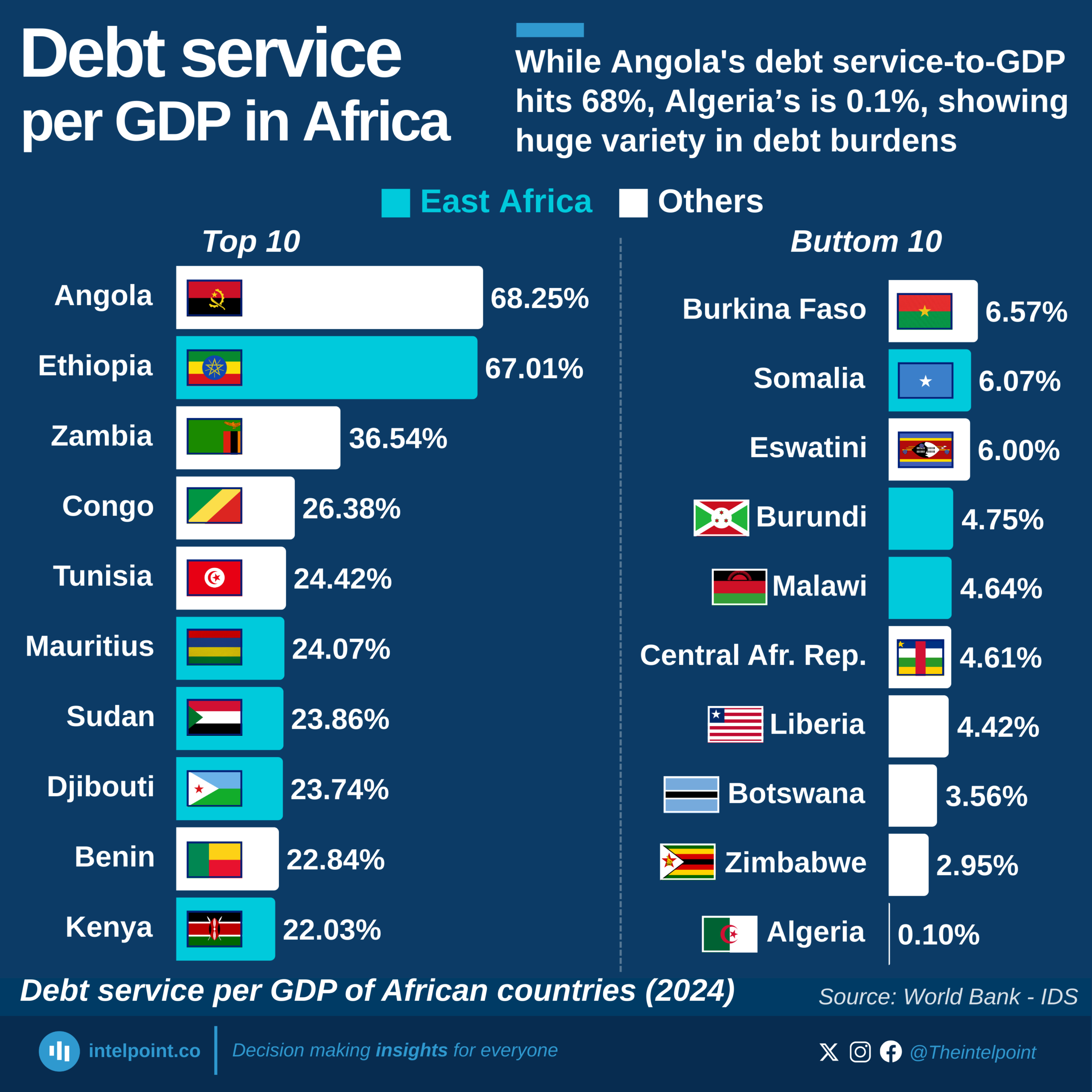
While Angola's debt service-to-GDP hits 68%, Algeria’s is 0.1%, showing huge variety in debt burdens

  • Angola and Ethiopia account for the highest debt service-to-GDP ratios in Africa, both exceeding 67%.
  • East Africa dominates the high debt-servicing bracket, with five countries among the top ten most burdened.
  • Algeria has the lowest debt service-to-GDP ratio on the continent at just 0.10%.
  • There’s a wide gap between the top and bottom debt service burdens, reflecting divergent fiscal paths across Africa.
  • Low debt servicing doesn’t automatically mean economic strength—it may reflect limited borrowing capacity.

Debt service obligations across African countries in 2024 reveal sharp contrasts in how different economies are managing the burden of repaying their public debt. Angola leads the continent with the highest debt service-to-GDP ratio at 68.25%, followed closely by Ethiopia at 67.01%, underscoring the strain that debt repayments place on their economies. Remarkably, five of the top ten countries with the highest ratios are in East Africa, signalling a regional concentration of debt pressure that could affect fiscal space for development spending.

This trend is especially worrying considering the fiscal limitations many African countries face. For example, in economies like Ethiopia, high debt servicing eats into budgets that could otherwise be allocated to infrastructure, education, or healthcare. In day-to-day terms, it’s like a household spending most of its income on loan repayments with little left for essentials.

On the flip side, countries like Algeria, Zimbabwe, and Botswana sit at the bottom of the debt service-to-GDP chart, with Algeria at a strikingly low 0.10%. While low debt servicing may suggest better fiscal balance, it’s important to note that it doesn’t necessarily equate to stronger economies; it could also reflect limited borrowing or deferred obligations. Nonetheless, the range between Angola’s 68% and Algeria’s 0.1% reflects a stark divergence in how African countries are managing their debt landscapes.
Source:

World Bank - IDS

Period:

2024
HTML code to embed chart
Want a bespoke report?
Reach out
Tags
Related Insights

Three African countries are projected to have debt exceeding their GDP in 2026
  • Sudan is projected to have Africa’s highest debt-to-GDP ratio in 2026, at 169.1%.
  • Only three African countries are projected to owe more than the size of their economies in 2026.
  • Senegal and Mozambique join Sudan among countries with debt-to-GDP ratios above 100%.
  • Africa’s average government debt-to-GDP ratio is projected at 60.7% in 2026.
  • Nigeria’s projected debt-to-GDP ratio of 32.3% is far below the African average.

Mauritius has the strongest productive capacity in Africa — ahead of Seychelles and South Africa
  • Mauritius leads Africa on the Productive Capacities Index with a score of 55.02, ranking 56th globally.
  • Seychelles, South Africa, and Cape Verde complete Africa’s top four, but none enters the global top 50.
  • Nigeria ranks much lower at 167th globally, with a score of 30.68, despite being one of Africa’s largest economies.
  • The ranking shows that economic size does not always translate into stronger productive foundations like human capital, ICT, energy, transport, and institutions.

Two-thirds of IDA’s commitments in one year went to Africa, led by Nigeria’s $3.1bn
  • Africa received 66% of IDA’s FY2025 commitments.
  • Africa’s total IDA allocation was $22.4 billion out of $33.8 billion.
  • Nigeria was the largest borrower from the DA globally, with $3.1 billion in loans.
  • Bangladesh ranked second with $3 billion.
  • Six of the top ten borrowers were African countries.
  • Nigeria accounted for 9.3% of total FY2025 IDA commitments.

Oyo has reduced external debt by 36% and domestic debt by 22% under Makinde
  • Oyo reduced external and domestic debt by the end of 2025.
  • External debt fell faster than domestic debt.
  • External debt declined more consistently over the period.
  • Oyo’s local debt peaked around 2022–2023 before falling back.
  • The state appears to have prioritised reducing FX exposure.

Africa has been the world's biggest World Bank borrower since 2017, owing $152 billion as of 2024
  • Africa has been the world's biggest World Bank borrower since 2017, and the gap is widening.
  • Three crises drove it: an infrastructure gap, the 2014 commodity crash, and COVID-19.
  • The World Bank leaned in deliberately — 66% of all IDA funds went to Africa in 2025 alone.
  • It's not really "Africa's debt" — it's Nigeria's, Kenya's, Ethiopia's, Egypt's, Tanzania's, and Morocco's.
  • Every other region is slowing down, but Africa's curve is still climbing.

Obasanjo led Nigeria's biggest GDP per capita rise at 268% in 8 years
  • Nigeria’s GDP per capita rose strongly from 1999 to 2014, then reversed.
  • The 2014 peak remains the defining turning point.
  • Obasanjo’s years show the fastest sustained climb from a very low base.
  • Yar’Adua’s short tenure still maintained upward momentum.
  • Jonathan’s period delivered the peak level, not the fastest growth rate.
  • Buhari’s tenure marks the longest clear decline in GDP per capita.
  • Tinubu’s period begins with another sharp fall.

POPULAR TOPICS
SIGN UP TO OUR NEWSLETTER
Get periodic updates about the African startup space, access to our reports, among others.
Subscribe Here
Subscription Form

A product of Techpoint Africa. All rights reserved