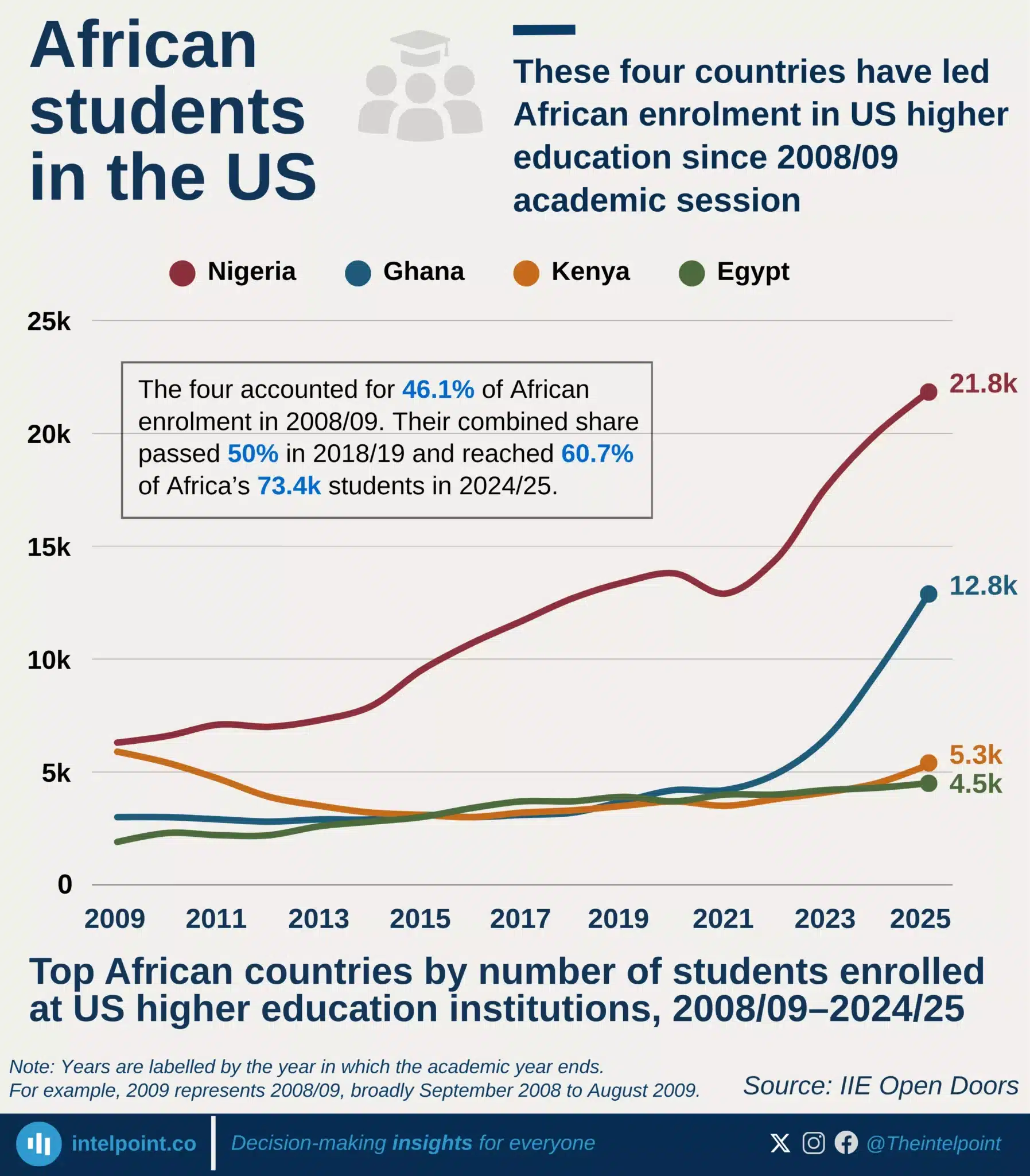
These four countries have led African enrolment in US higher education since 2008/09 academic session

Key Takeaways

  • Ghana recorded the most striking recent growth, reaching 12,825 students in 2024/25.
  • Nigeria remained Africa’s leader with 21,847 students.
  • Nigeria, Ghana, Kenya and Egypt have held the top four positions since 2008/09.
  • Their combined share of African enrolment increased from 46.1% to 60.7%.
  • Africa had 73,406 students enrolled in US higher education in 2024/25.

Ghanaian students have driven the most striking recent change in African enrolment in US higher education.

After remaining close to 3,000 annually from 2008/09 to 2017/18, their number increased from 4,916 in 2021/22 to 12,825 in 2024/25, placing Ghana second behind Nigeria’s 21,847.

Nigeria, Ghana, Kenya and Egypt have occupied Africa’s top four positions since 2008/09, although their order has changed. Together, their share of African enrolment rose from 46.1% in 2008/09 to 60.7% of the continent’s 73,406 students in 2024/25.
Source:

IIE Open Doors

Period:

2008/09-2024/05
HTML code to embed chart
Want a bespoke report?
Reach out
Tags
Related Insights

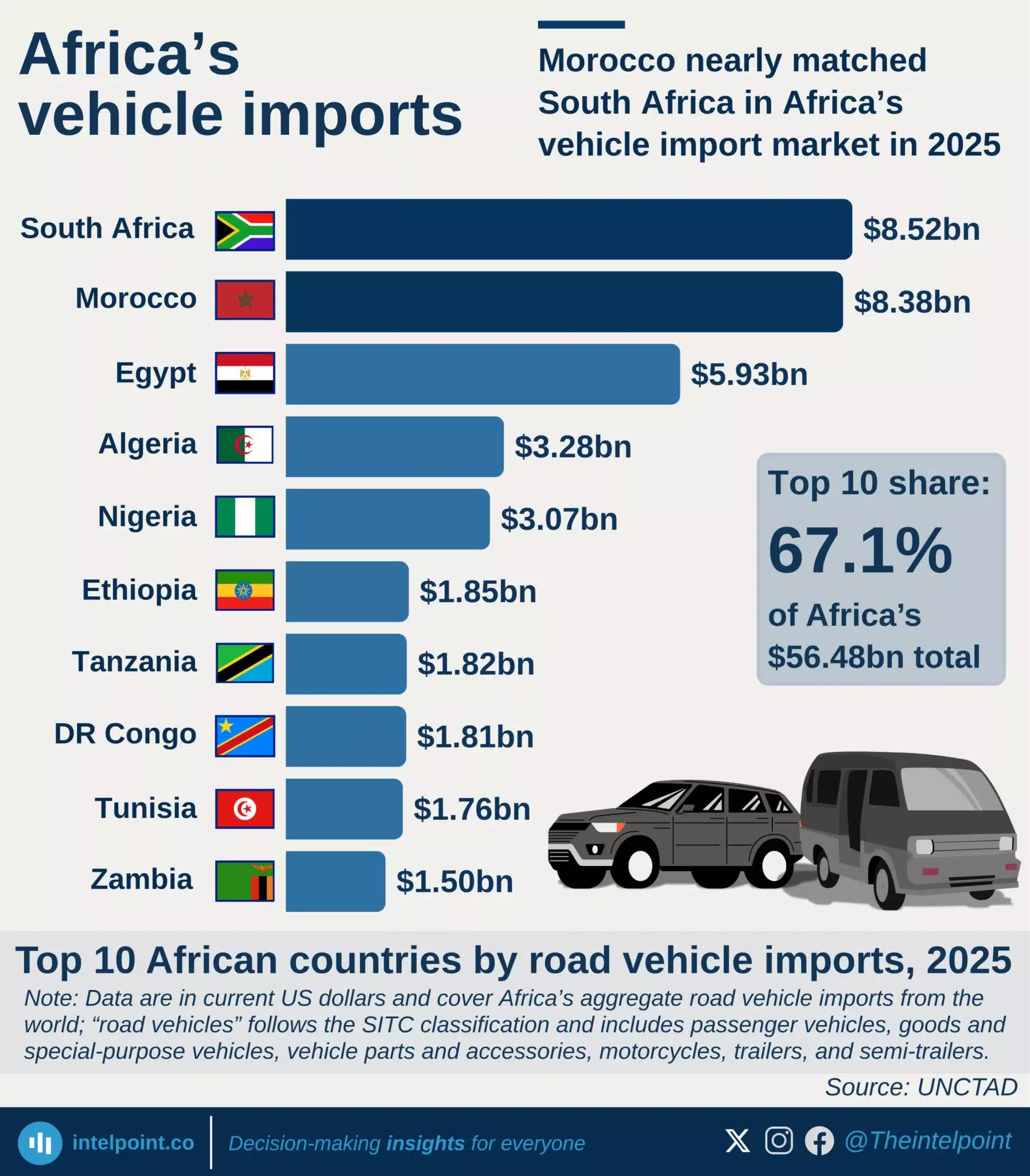
Morocco nearly matched South Africa in Africa’s vehicle import market in 2025
  • South Africa led with $8.52 billion, only $140 million ahead of Morocco.
  • Morocco’s imports have grown steadily, while South Africa’s 2025 figure was a recovery toward its 2012 peak.
  • Egypt ranked third, followed by Algeria and Nigeria.
  • The top 10 markets accounted for 67.1% of Africa’s $56.48 billion total.
  • Road vehicle imports include vehicles, parts, motorcycles, trailers, and semi-trailers.

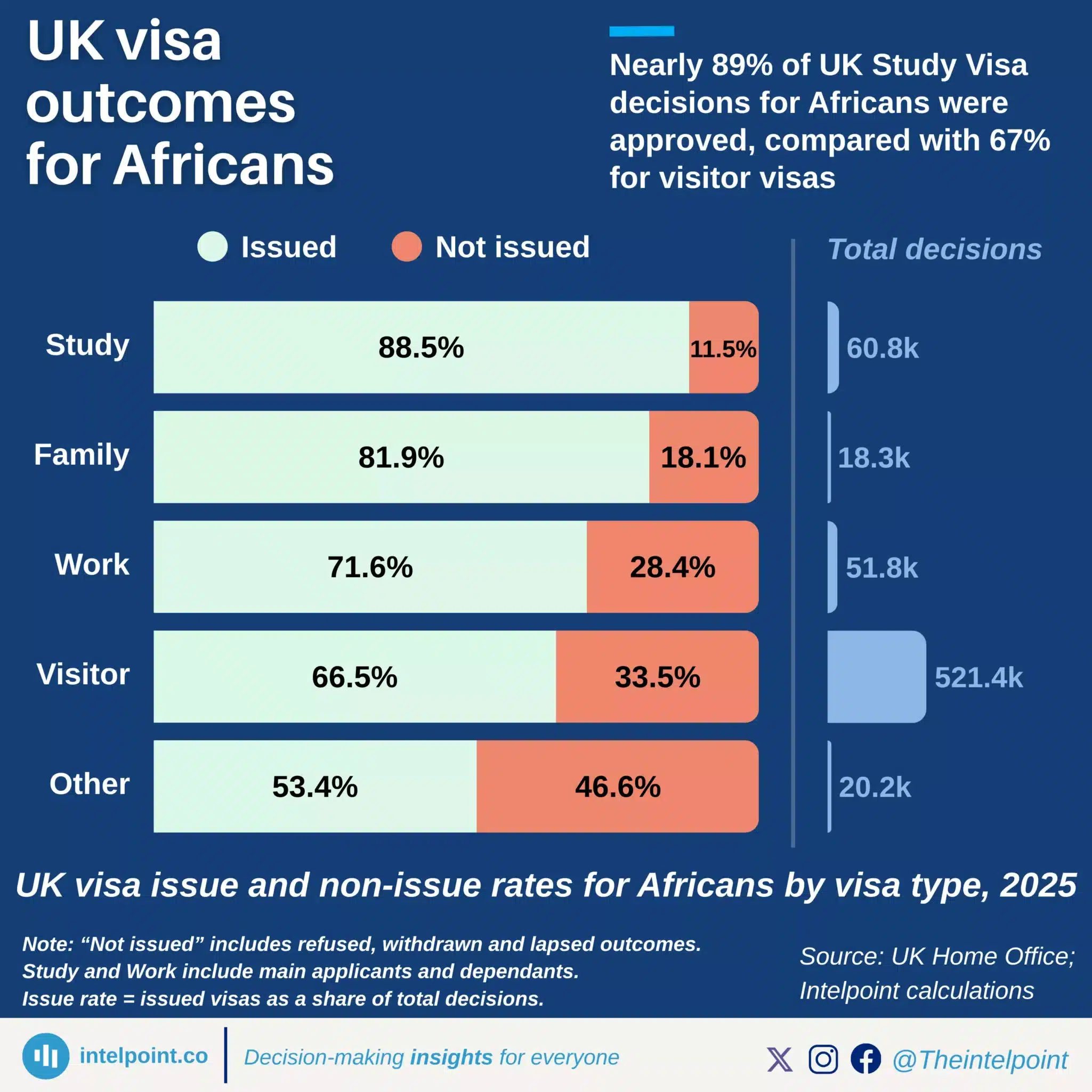
Nearly 89% of UK Study Visa decisions for Africans were approved, compared with 67% for visitor visas
  • The UK made 672,400 visa decisions involving African applicants in 2025.
  • Visitor visas dominated the decisions, accounting for 521,400, or about 78% of the total.
  • Study visas had the highest issue rate, with 88.5% of decisions resulting in issued visas.
  • Visitor visas had a much lower issue rate at 66.5%, despite having the largest decision volume.
  • Work visa decisions had a 71.6% issue rate, below the global work visa average of 86.5%.
  • Other visa routes had the lowest issue rate, with only 53.4% of decisions resulting in issued visas.

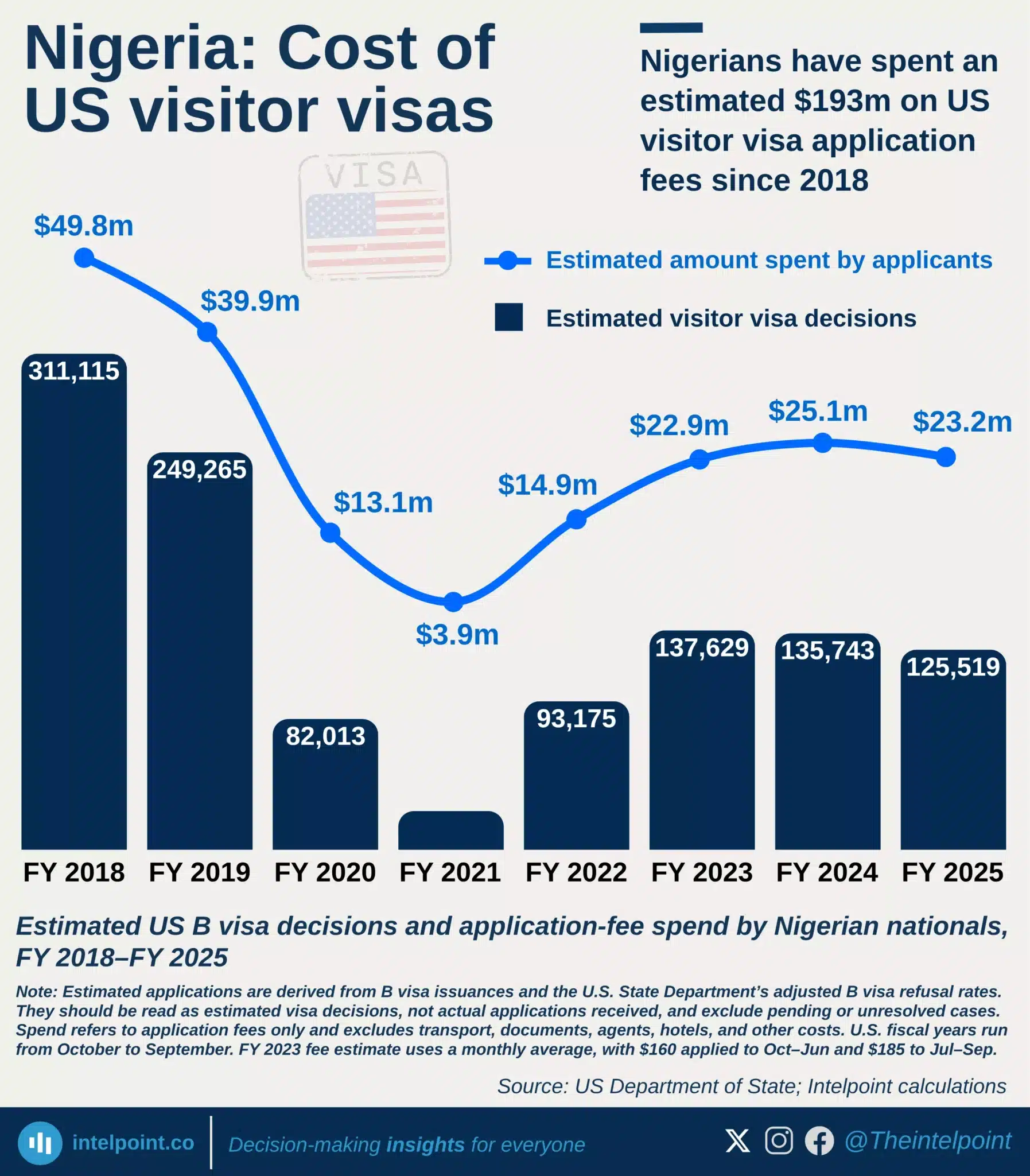
Nigerians have spent an estimated $193 million on U.S. visitor visa application fees since 2018
  • Estimated visitor visa fee spending reached $193 million between FY 2018 and FY 2025.
  • Applicants paid the fee whether their visas were approved or refused.
  • Estimated spending peaked at $49.8 million in FY 2018.
  • Spending recovered to $25.1 million in FY 2024 before falling to $23.2 million in FY 2025.
  • The estimates exclude transport, documents, agents, accommodation and other related costs.

The U.S. issued Africans 820 more agricultural worker visas in Fiscal Year 2025
  • U.S. nonimmigrant visa issuances to Africans fell by 23.6% to 413,259.
  • Twenty-five visa categories still recorded increases despite the overall decline.
  • C3 visas posted the largest numerical increase, rising by 949.
  • H2A agricultural worker visas increased by 820 to 15,623.
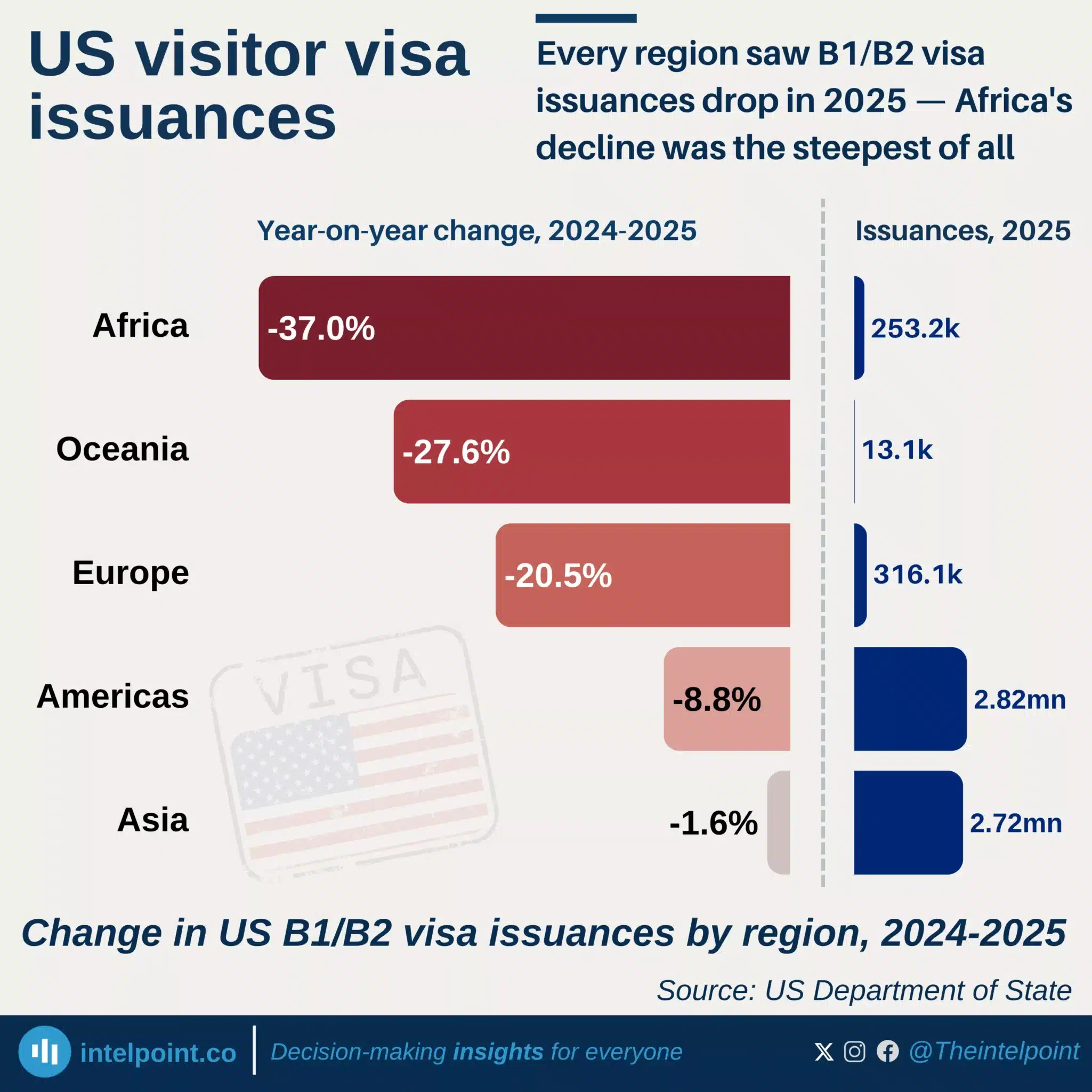
  • B1/B2 visitor visas recorded the biggest decline, falling by 109,653.

Southern Africa houses 6 of the top 10 African countries with the strongest passports
  • Seychelles has Africa’s strongest passport.
  • Mauritius is the only other African country with a passport close to Seychelles'.
  • South Africa leads the mainland pack, but still trails the island leaders by a wide margin.
  • No country outside the top three crosses a mobility score of 100.
  • Visa-required destinations still dominate for every passport in the top ten, except Seychelles and Mauritius.

Nigerians can enter 33% of African countries visa-free, while 43% still require a visa
  • Nigeria faces visa requirements in nearly half of Africa.
  • West Africa is Nigeria’s easiest mobility zone.
  • Beyond its West African neighbors, the Nigerian passport unlocks visa-free entry to only four other African nations
  • ECOWAS is the biggest reason for Nigeria’s visa-free access to its neighbours.
  • Visa openness drops sharply outside West Africa.
  • Africa’s free-movement agenda is still uneven in practice.
  • Business mobility remains constrained by visa friction.

POPULAR TOPICS
SIGN UP TO OUR NEWSLETTER
Get periodic updates about the African startup space, access to our reports, among others.
Subscribe Here
Subscription Form

A product of Techpoint Africa. All rights reserved