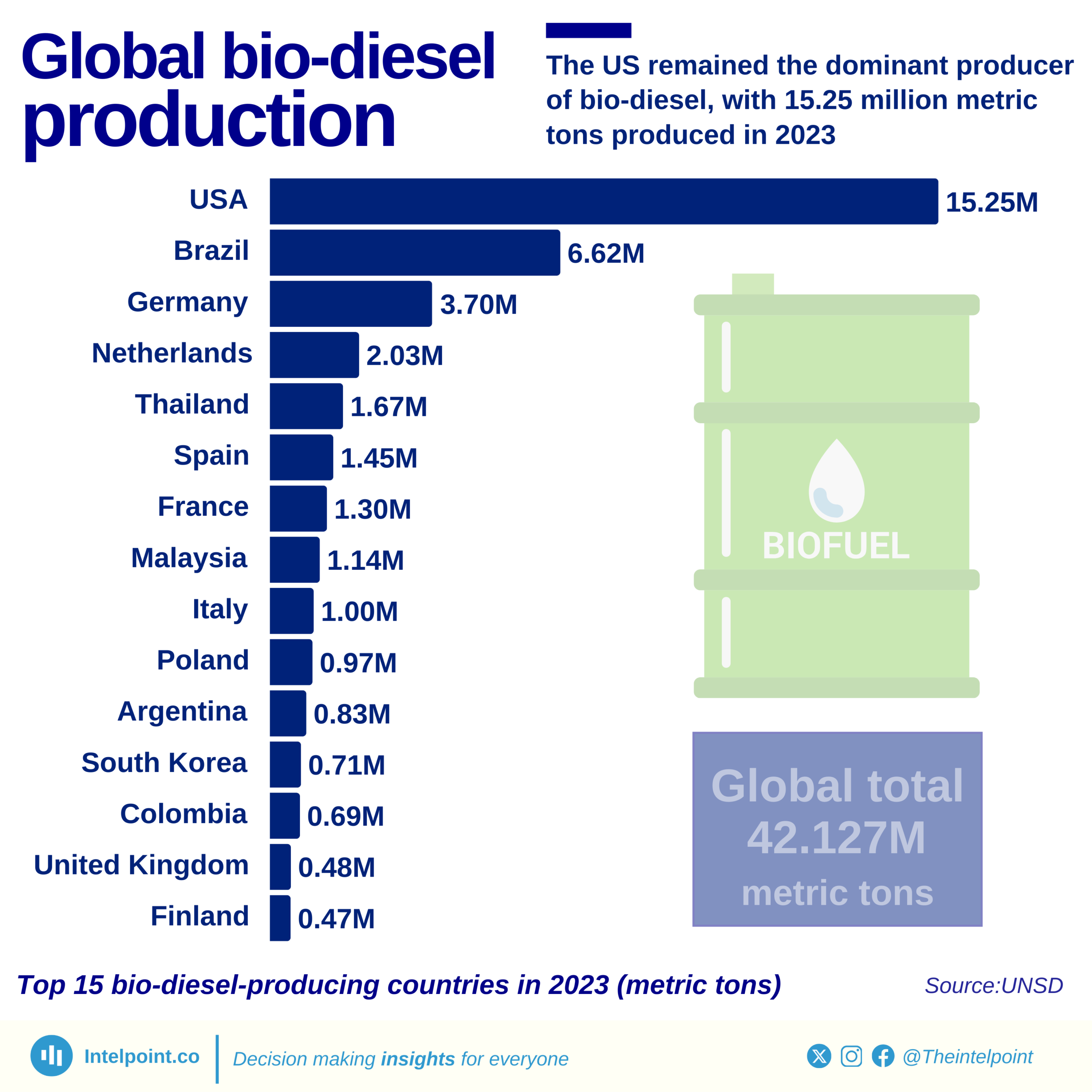
The US remained the dominant producer of bio-diesel, with 15.25 million metric tons produced in 2023

  • Only 37 countries produced bio-diesel in 2023.
  • No African country produced bio-diesel.
  • The US remained the dominant producer of bio-diesel with 15.25 million metric tons produced in 2023, which is 36% of the total quantity produced globally.
  • Germany was the top exporter of bio diesel with 2.18 million metric tons.

Bio-diesel, a renewable, biodegradable fuel manufactured from vegetable oils, animal fats, or recycled cooking grease is an alternative to petroleum diesel and can be used in diesel engines.
Only 37 countries in the world produced bio-diesel in 2023, and no African country was on the list. The implication is that bio-diesel production and usage in Africa remain relatively low, compared to other continents like Europe, Asia, and the Americas.

The United States of America remained the dominant producer of bio-diesel with 15.25 million metric tons produced in 2023, which is 36% of the total quantity produced globally. Brazil, Germany and the Netherlands produced 6.62 million metric tons, 3.70 million metric tons, and 2.03 million metric tons, respectively. These three countries collectively produced 29.3% of the global total.

With 15.25 million metric tons produced by the United States of America, one might assume that the country would be the major exporter of bio-diesel globally, but the country did not export at all as always. Germany was the top exporter of bio-diesel, with 2.18 million metric tons exported.
Source:

United Nations Statistics Division

Period:

2023
HTML code to embed chart
Want a bespoke report?
Reach out
Tags
Related Insights

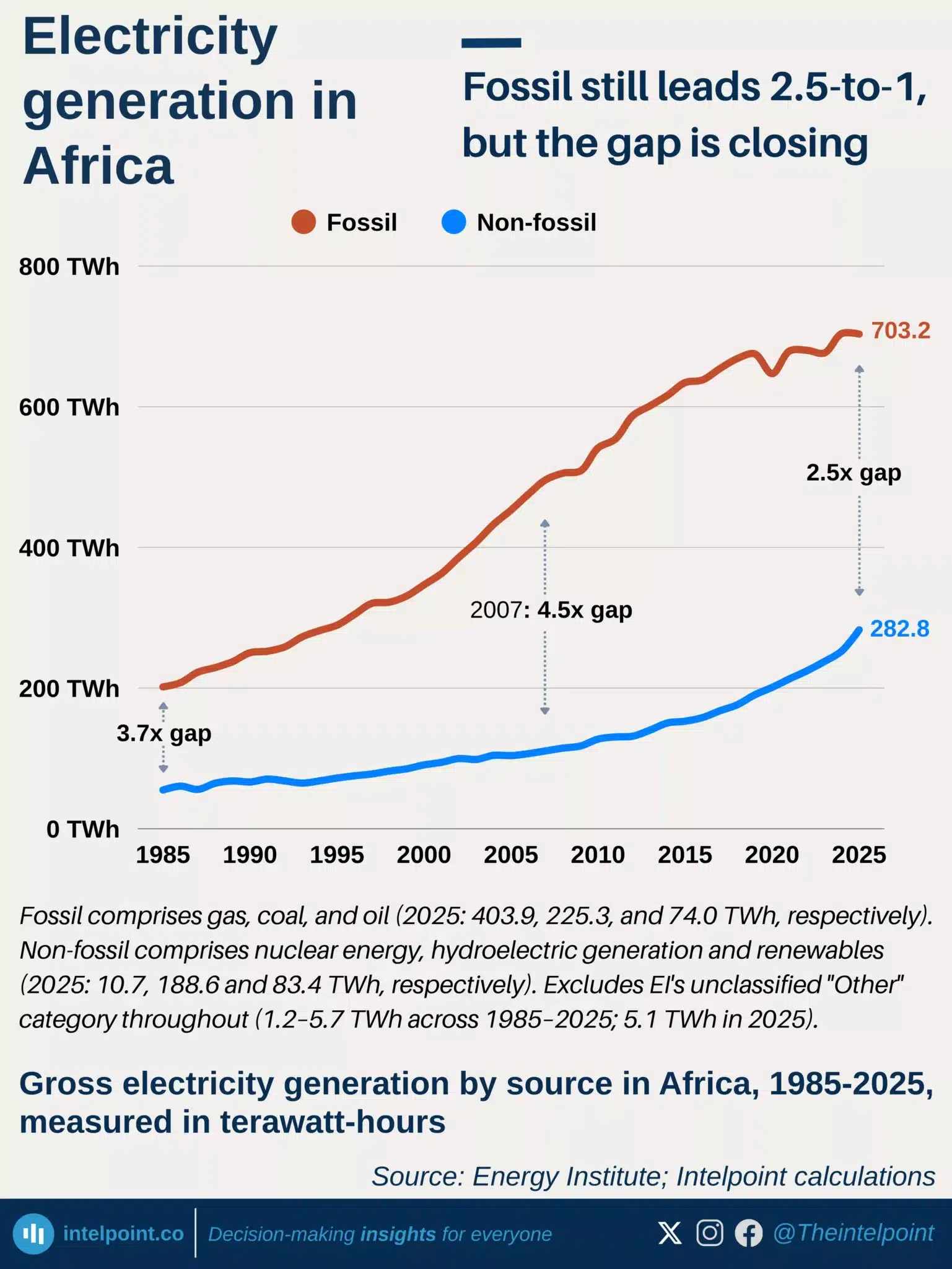
Electricity generation in Africa: fossil still leads 2.5-to-1, but the gap is closing
  • Fossil fuels still generate 2.5x more electricity than non-fossil sources, though the gap has narrowed from a 2007 peak of 4.5x.
  • South Africa and Egypt together account for all of Africa's nuclear power and 59% of its non-hydro renewables.
  • Hydropower, the largest non-fossil source at 188.6 TWh, tells a different geographic story, with 91% generated outside South Africa and Egypt, mainly in Eastern, Middle, and Western Africa.
  • Gas still leads at 403.9 TWh, but its growth slowed to 0.8% in 2025 versus 11.9% growth for non-fossil sources.

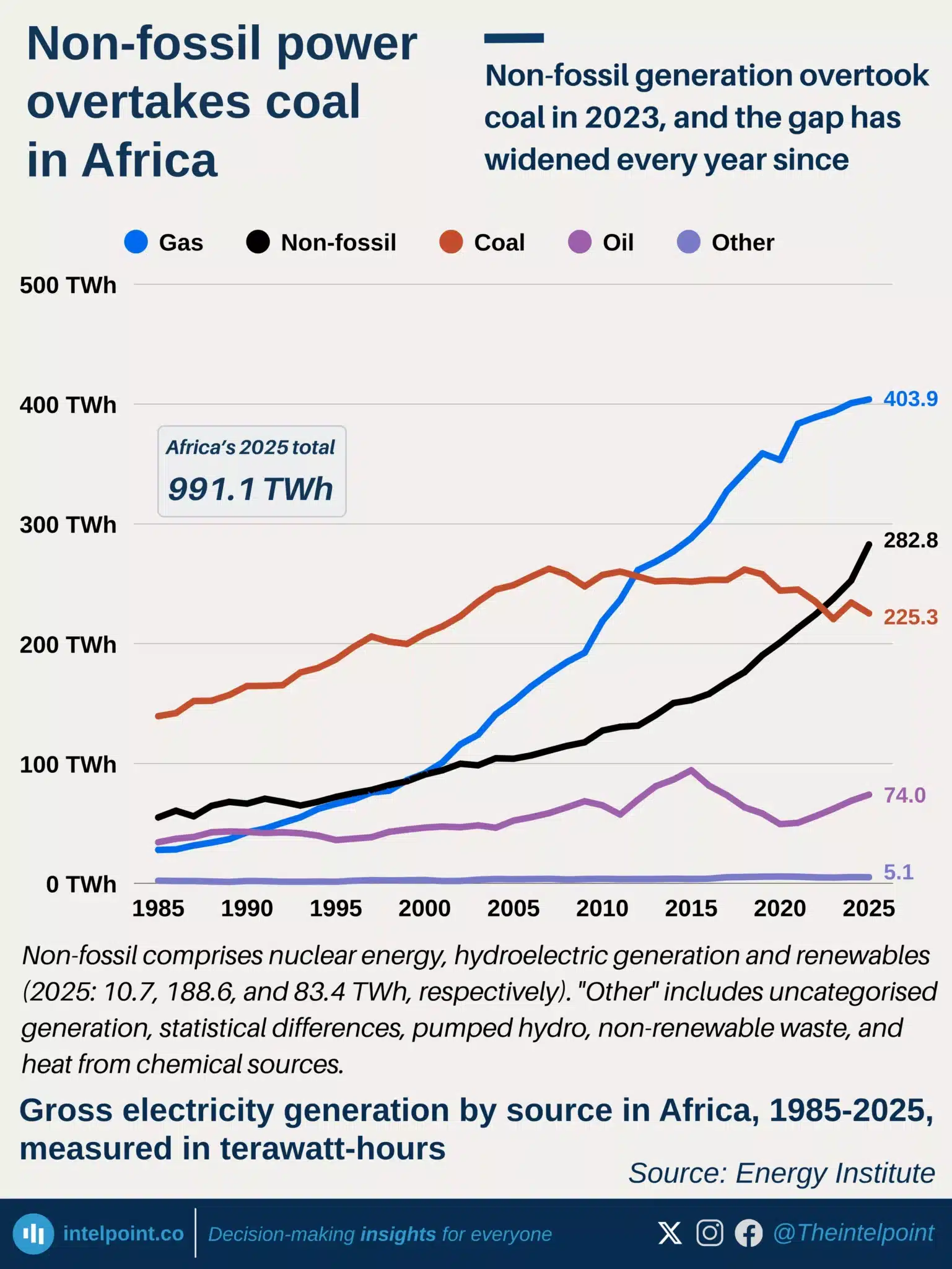
Non-fossil generation overtook coal in 2023, and the gap has widened every year since
  • Non-fossil generation overtook coal in 2023, with the gap reaching 57.5 TWh in 2025.
  • Coal generation fell to 225.3 TWh, below its 262.6 TWh peak in 2007.
  • Hydropower dominates non-fossil generation, producing 188.6 TWh in 2025.
  • Fossil fuels still dominate, generating 703.2 TWh versus 282.8 TWh from non-fossil sources.

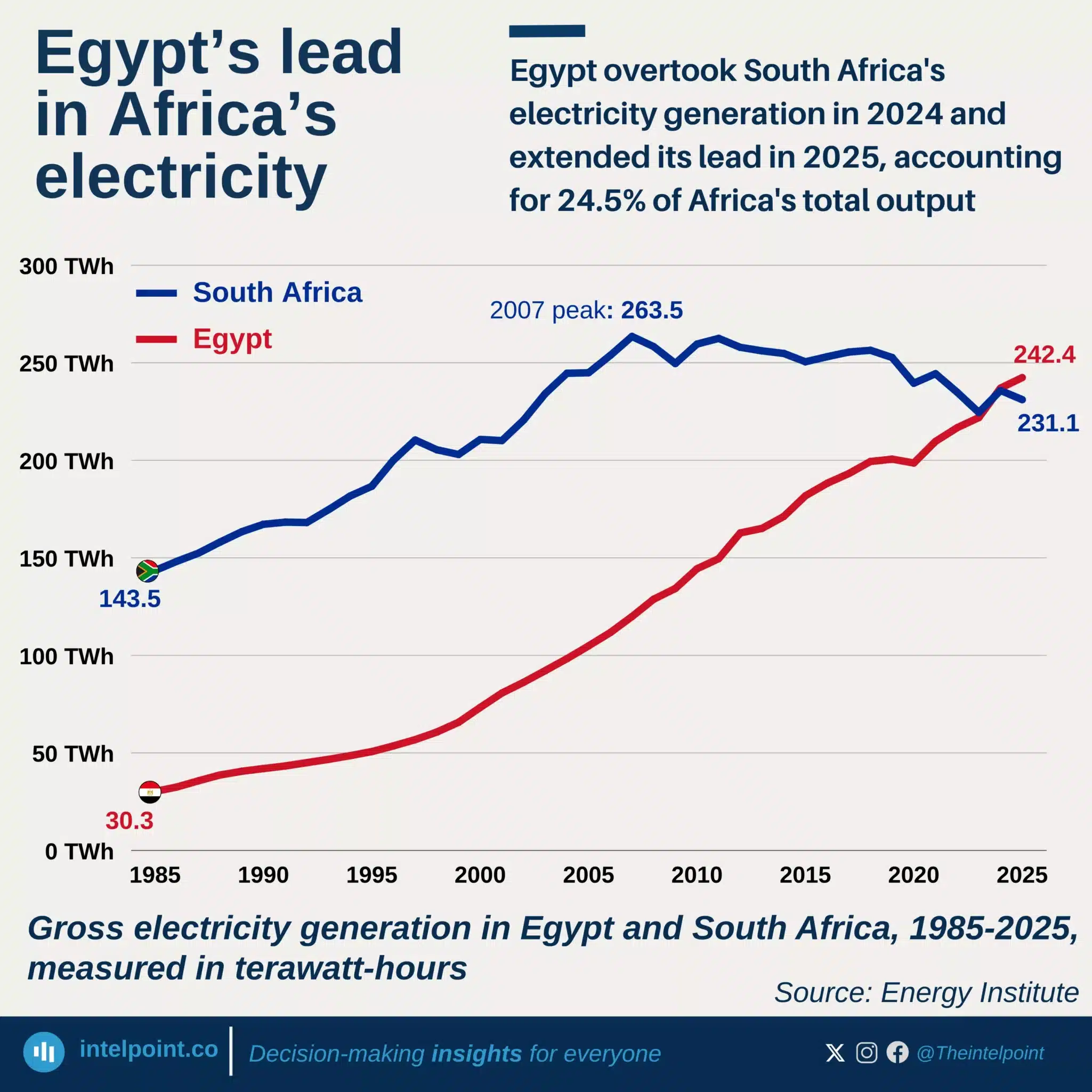
Egypt overtook South Africa's electricity generation in 2024 and extended its lead in 2025
  • Africa’s share of global electricity generation rose only from 2.6% in 1985 to 3.1% in 2025.
  • Africa’s electricity generation increased 283% over the past 40 years.
  • Egypt overtook South Africa as Africa’s largest electricity producer in 2024.
  • Egypt generated 242.4 TWh in 2025, up from 30.3 TWh in 1985.
  • South Africa generated 231.1 TWh in 2025, down from its 263.5 TWh peak in 2007.
  • Egypt and South Africa accounted for 24.5% of Africa’s electricity generation in 2025.

Nigeria retained Africa’s third-highest refinery throughput as output reached a record high in 2025
  • Nigeria recorded its highest refinery throughput since 1990 at 360,000 b/d.
  • Throughput increased by 50.6% from 239,000 b/d in 2024.
  • The 2025 level was more than 20 times the 17,600 b/d recorded in 2023.
  • Nigeria remained Africa’s third-highest, behind Algeria and Egypt.
  • Dangote’s contribution is not reported separately.

East African countries accounted for seven of the continent's 15 biggest electricity access gains in 23 years
  • Eswatini recorded Africa’s largest electricity access gain, rising by 66 percentage points from 2000 to 2023.
  • Kenya and Rwanda followed with gains of 61 pp and 58 pp, respectively.
  • East African countries accounted for 7 of Africa’s top 15 electricity access improvements.
  • Comoros, Ghana and Cape Verde reached very high access levels by 2023, at 90%, 90% and 99% respectively.
  • Nigeria’s electricity access improved by 18 percentage points, from 43% in 2000 to 61% in 2023.
  • Despite that improvement, Nigeria remained outside Africa’s top 15 gainers over the period.
  • Some countries were absent from the ranking because they had already reached high access levels by 2000.

Ibadan and Enugu DisCos together accounted for nearly two million unmetered customers
  • Nigeria still had about 5.25 million unmetered electricity customers across DisCos.
  • The 11 DisCos reported in Q4 2025 had 5.20 million unmetered customers.
  • Nigeria’s reported metering rate stood at 57.3% as of Q4 2025.
  • Ibadan and Enugu had the largest gaps, with nearly two million unmetered customers combined.
  • Ibadan alone had 1.18 million unmetered customers, the highest of any DisCo.
  • Ikeja and Eko had the strongest metering performance, both at about 86%.
  • At the 2025 pace of meter additions, closing the current gap could take close to seven years.

POPULAR TOPICS
SIGN UP TO OUR NEWSLETTER
Get periodic updates about the African startup space, access to our reports, among others.
Subscribe Here
Subscription Form

A product of Techpoint Africa. All rights reserved