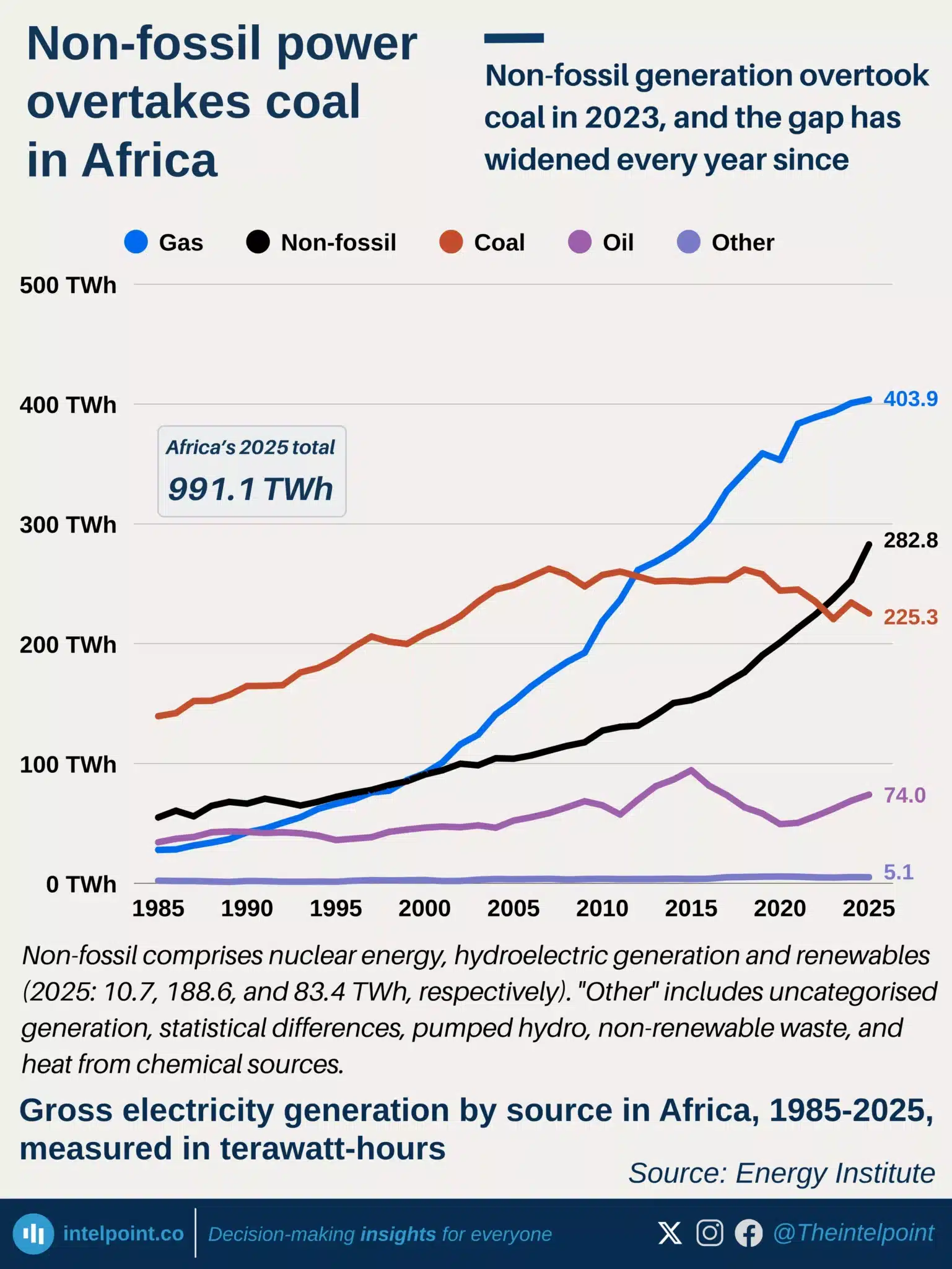
Africa's power mix crossed a line in 2023: non-fossil electricity — hydro, nuclear, and other renewables combined — overtook coal in total output for the first time.
What began as a 17.2 TWh gap has widened every year since (18.3 TWh in 2024), reaching 57.5 TWh in 2025. Coal's decline traces back to a 2007 peak of 262.6 TWh; it briefly approached that level again in 2018 (261.9 TWh) before falling further.
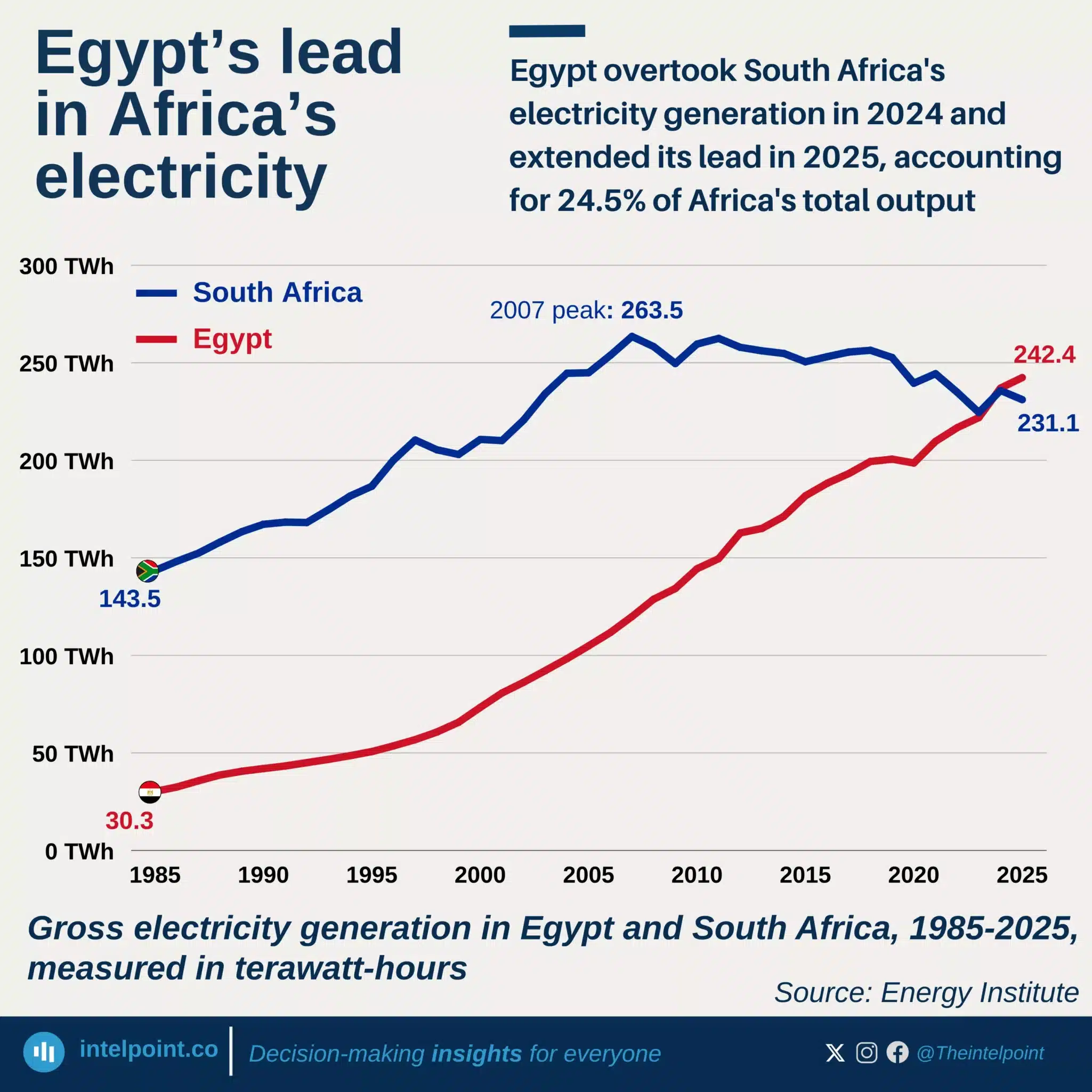
The geography behind the shift is uneven. South Africa alone accounts for all of Africa's 10.7 TWh of nuclear generation; together with Egypt, it accounts for 59% of the continent's 83.4 TWh of non-hydro renewables. But hydropower — at 188.6 TWh, the largest single component of Africa's non-fossil mix — is generated almost entirely elsewhere: 172 TWh. or 91%, comes from outside those two countries, concentrated in Eastern , Middle, and Western Africa. So "Non-fossil overtaking coal" is really three stories layered together: a nuclear story confined to one country, a solar-and-wind story shared between two, and a much larger hydro story playing out across the rest of the continent.
Gas remains the largest single source by a wide margin, at 403.9 TWh, but its growth has slowed to 0.8% in 2025 against 1.2–1.8% in each of the prior three years, while non-fossil generation grew 11.9% in the same year. Neither trend is guaranteed to hold, and a single year's growth rate isn't a forecast — but at current trajectories, non-fossil's 121.1 TWh gap behind gas is worth watching, not assuming fixed.
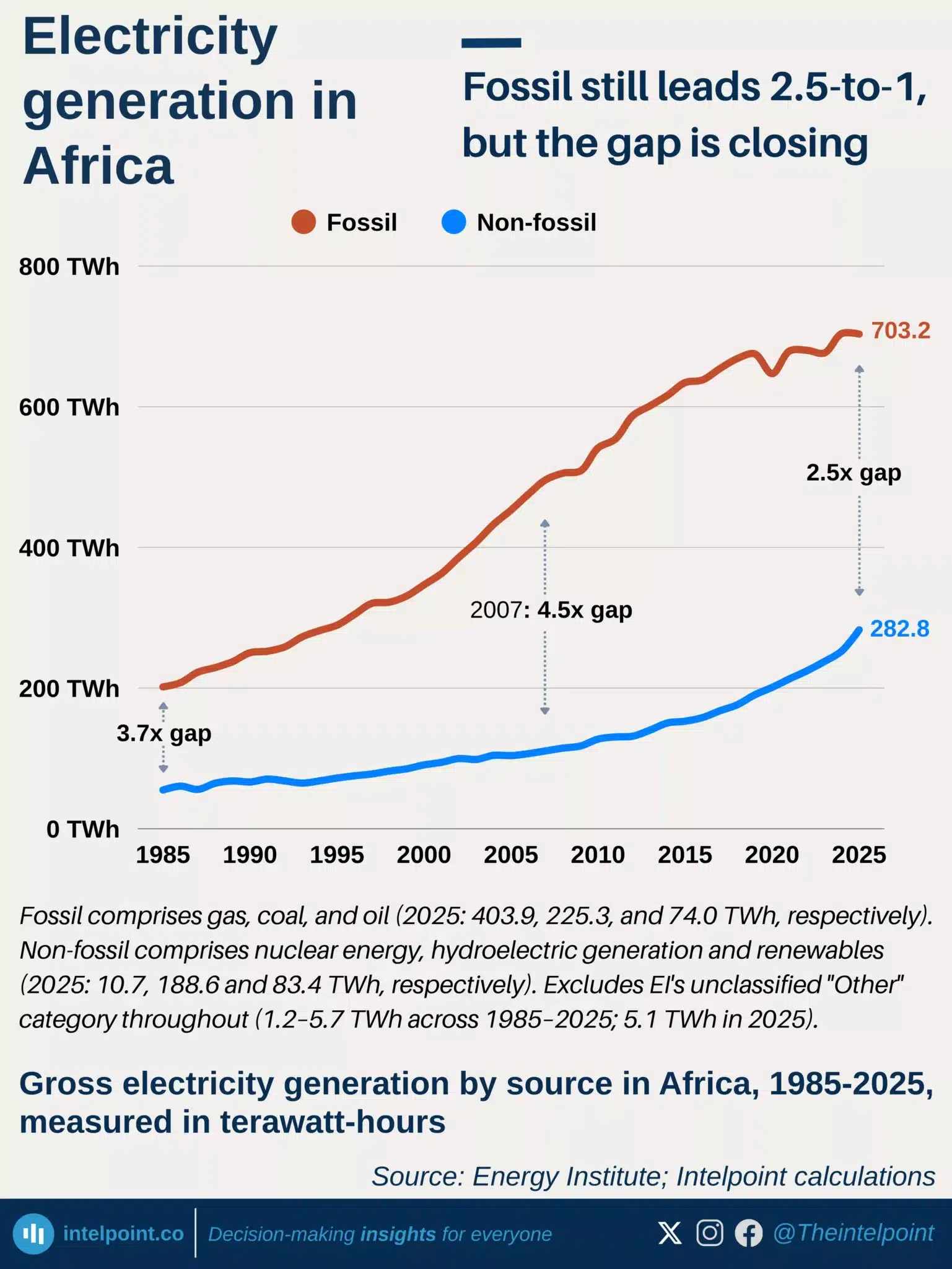
Zoom out from any single fuel, though, and fossil still dominates: gas, coal and oil combined generated 703.2 TWh in 2025 against non-fossil's 282.8 TWh — a gap 2.5 times as large. That gap isn't a fixed feature of the continent's power mix; it peaked at 4.5 times in 2007, up from 3.7 times in 1985, and has been narrowing ever since.