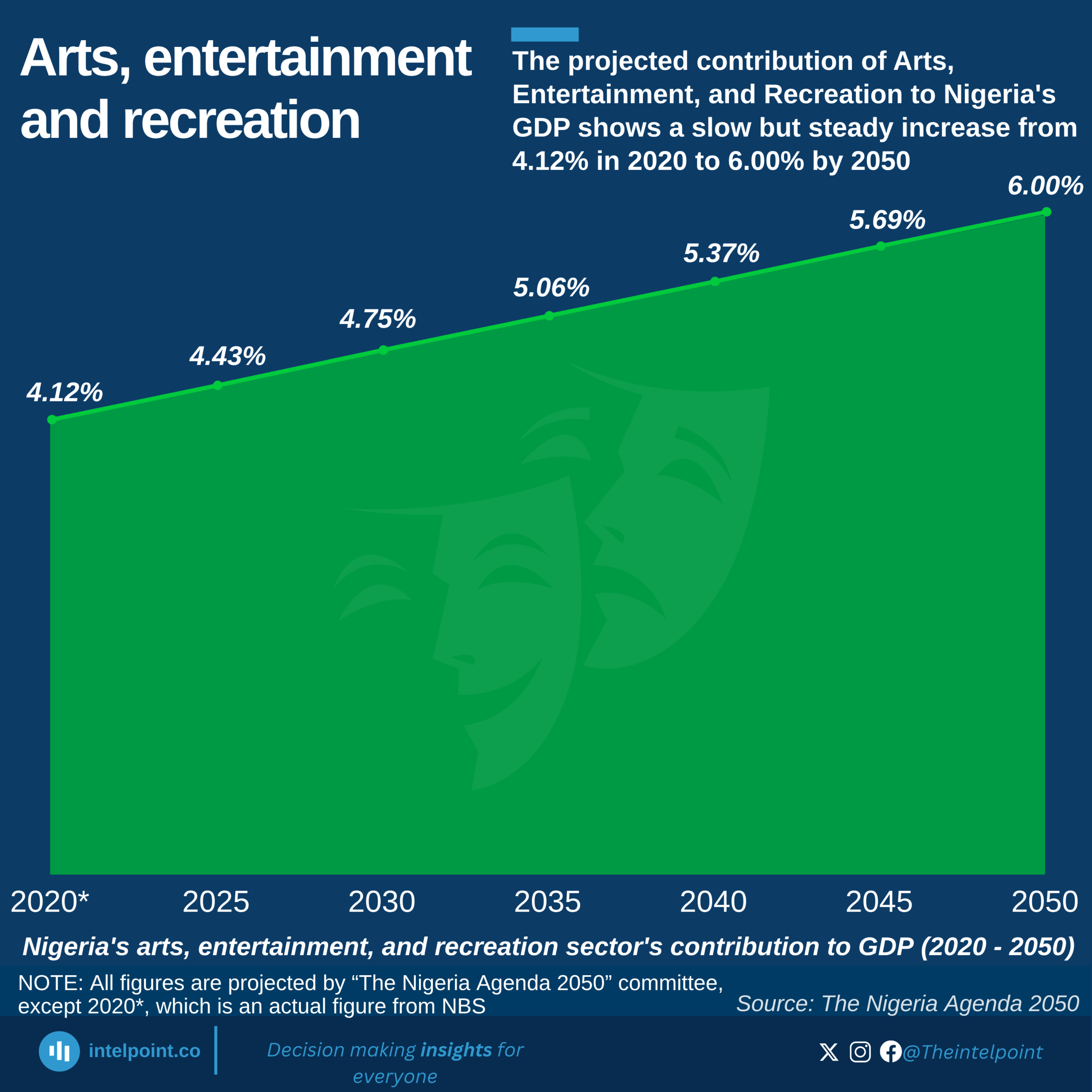
The projected contribution of Arts, Entertainment, and Recreation to Nigeria's GDP shows a slow but steady increase from 4.12% in 2020 to 6.00% by 2050

Key takeaways:

  • The arts, entertainment, and recreation sector contributed 4.12% to Nigeria’s GDP in 2020.
  • By 2025, this contribution is projected to rise modestly to 4.43%.
  • The growth rate maintains a steady pace, reaching 4.75% by 2030.
  • By 2050, the arts, entertainment, and recreation sector is projected to reach a 6.00% share of Nigeria’s GDP.
  • With only a 1.88 percentage point rise forecasted over 30 years, the pace of growth suggests the sector remains undervalued or under-leveraged relative to its potential.
  • The creative economy’s resilience, despite limited public infrastructure and policy support, demonstrates strong organic demand and global competitiveness.

Nigeria’s arts, entertainment, and recreation sector is expected to be increasingly important in the economy over the next three decades. Starting from a 4.12% contribution to GDP in 2020, projections show a consistent, albeit gradual, rise to 6.00% by 2050. This growth trajectory reflects the growing influence of creative industries in Nigeria’s broader economic agenda. It also underscores the potential of non-oil sectors to contribute meaningfully to economic diversification and job creation.
This upward trend is especially relevant in a country where a large percentage of the population is young, creative, and digitally connected. More platforms, sponsorships, and policy incentives can boost this growth beyond the projected 6.00% by 2050. As the global economy continues to evolve toward digital content and experiences, Nigeria’s creative economy could emerge as a major driver of future resilience and inclusion.
Source:

The Nigeria Agenda 2050

Period:

2020 - 2050
HTML code to embed chart
Want a bespoke report?
Reach out
Tags
Related Insights

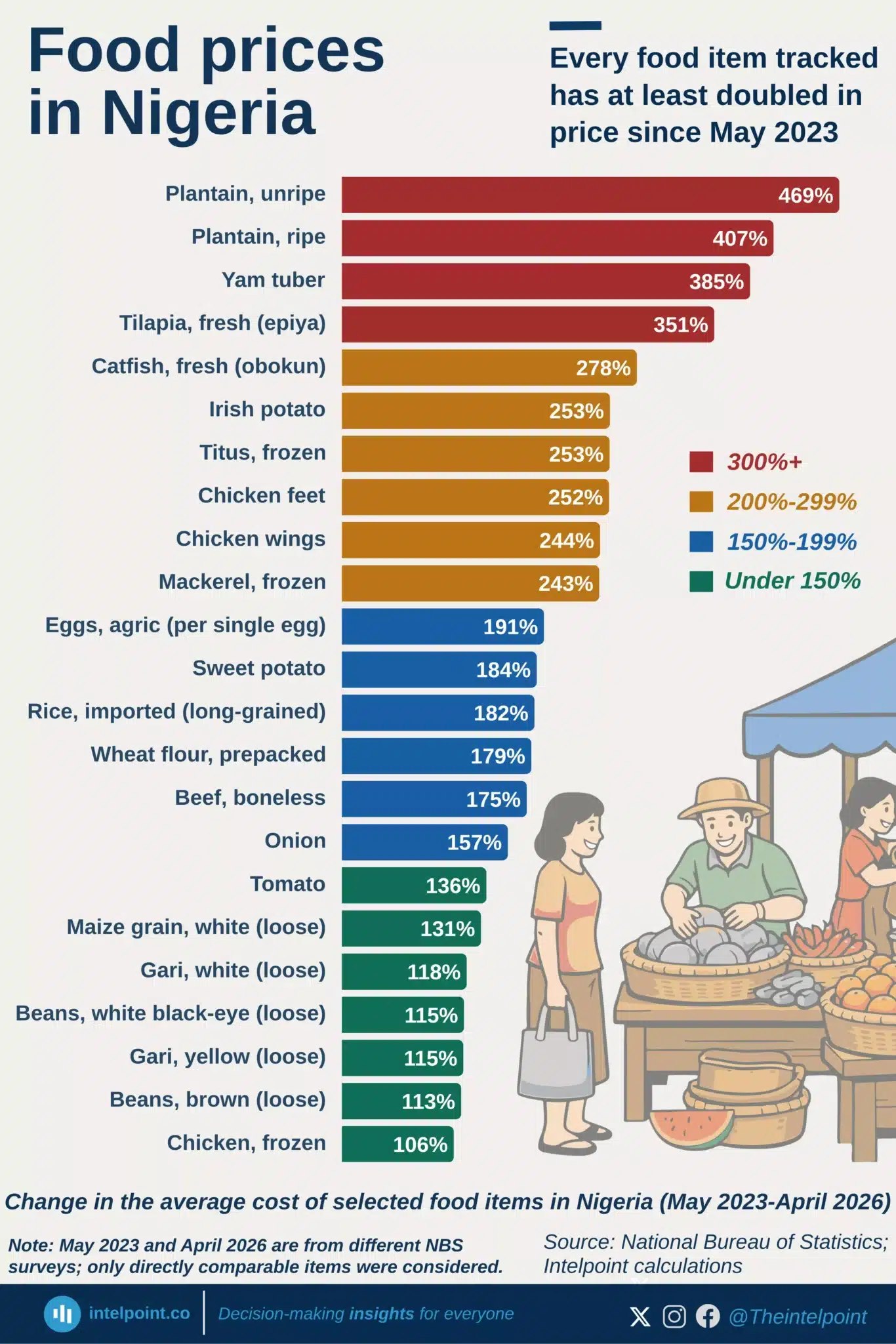
Every food item tracked has at least doubled in price since May 2023
  • Every comparable food item tracked is now at least twice as expensive as it was in May 2023.
  • Nearly half of the selected food items have more than tripled in price since the month before fuel subsidy removal.
  • Unripe plantain recorded the steepest increase, rising by 469% between May 2023 and April 2026.
  • Ripe plantain, yam tuber, and fresh tilapia also saw extreme increases of more than 300%.
  • Even the slowest-rising staples, including frozen chicken, beans, gari, and maize, still more than doubled in price.

Healthy diet costs rose fastest in Nigeria’s North-West over two years
  • Healthy diet costs rose 49% nationally in two years.
  • North-West states recorded the fastest increases.
  • All seven North-West states rose above the national average.
  • Katsina and Kogi recorded the steepest increases, at 98%.
  • Akwa Ibom had the lowest increase, at 5%.

One adult’s monthly healthy diet takes two-thirds of minimum wage
  • One adult’s healthy diet takes 66% of Nigeria’s minimum wage.
  • The national average monthly cost is about ₦46,230 per adult.
  • Ekiti has the highest burden, at 90% of minimum wage.
  • Six states require over 80% of minimum wage for one adult’s healthy diet.
  • Adamawa has the lowest burden, at 43%.

Israel Adesanya has not won a UFC fight since 2023, suffering four consecutive losses to leave his record at 13-6
  • Israel Adesanya has not won a bout since regaining middleweight gold at UFC 287 in April 2023, marking a nearly three-year drought from the winner's circle.
  • Adesanya has lost his past four consecutive appearances, a sharp contrast to his earlier career, where his elite striking defence made stoppage losses rare.
  • Adesanya has been tested at the highest level and has come up short each time, with all four defeats arriving between 2023 and 2026.
  • Six of his losses have come in the past five years of his career.

13 of all AFCON competitions have been won by the host nation
  • 13 out of 35 AFCON tournaments (37.1%) have been won by host nations
  • A larger share — 22 tournaments (62.9%) — were won by visiting teams.
  • The early AFCON years (1960s–1980s) saw more frequent home wins compared to recent decades.
  • Egypt has the most home-soil victories (3), followed by Ghana (2)
  • Despite high expectations, several hosts have failed to win.
  • Hosting provides crowd support and familiarity, but also brings heightened expectations and pressure.

EbonyLife’s ₦271.6mn revenue per screen places it at the top of the region’s highest-grossing cinemas
  • With revenue per screen of ₦ 271.6 million, EbonyLife Cinemas outperforms other top cinemas in West Africa.
  • Several Genesis and FilmHouse branches fall within the strong mid-tier cluster, with revenue per screen ranging from ₦100 million to ₦160 million.
  • Lower-tier cinemas still generate ₦40 million to ₦70 million per screen
  • Revenue per-screen metric reveals the operational efficiency of the cinemas

POPULAR TOPICS
SIGN UP TO OUR NEWSLETTER
Get periodic updates about the African startup space, access to our reports, among others.
Subscribe Here
Subscription Form

A product of Techpoint Africa. All rights reserved