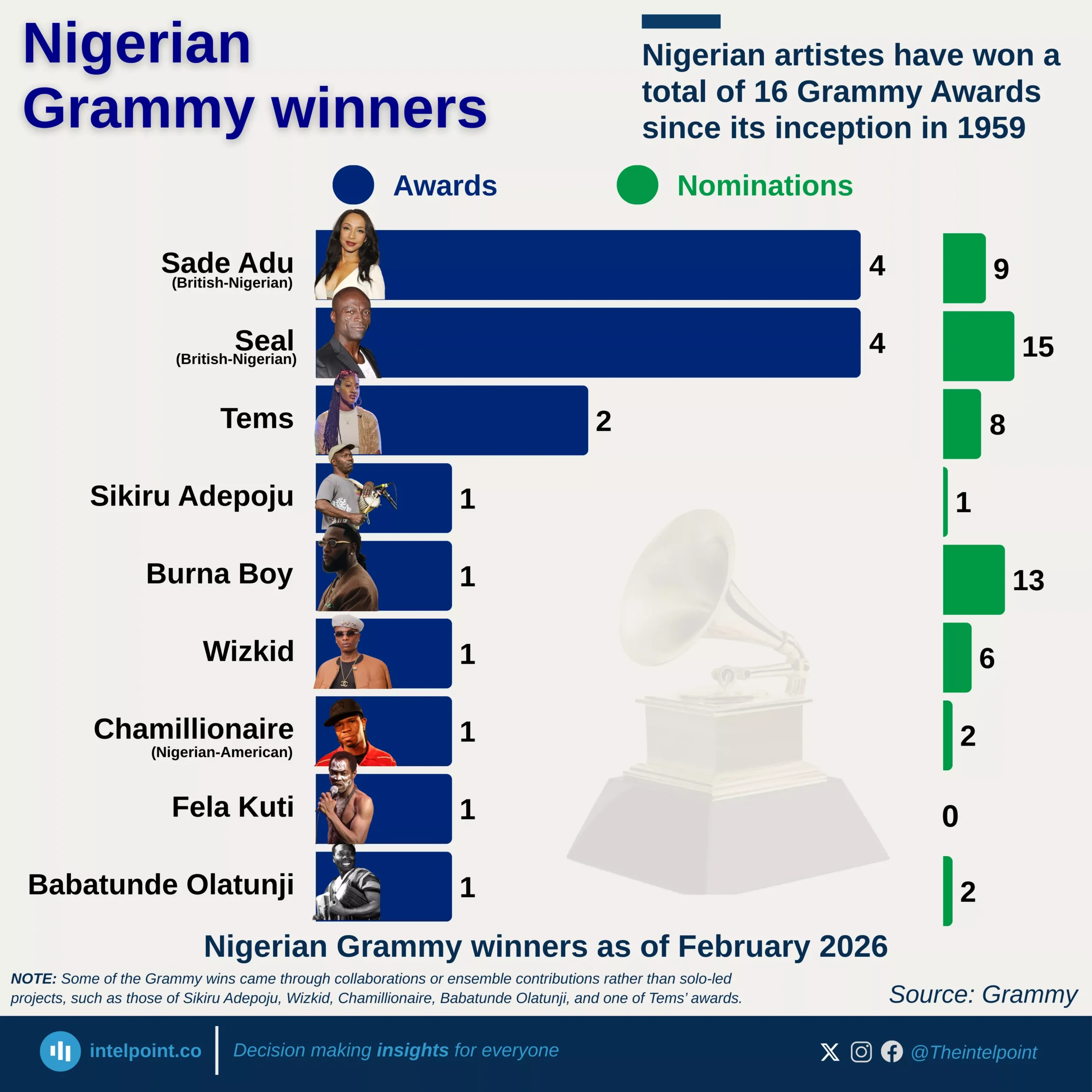
Nigerian artistes have won a total of 16 Grammy Awards since its inception in 1959

  • Nigerian artistes have won 16 Grammy Awards in total since the awards’ inception in 1959.
  • Sade Adu and Seal lead all Nigerian-linked artistes with four wins each.
  • Tems represents the new generation, combining multiple wins with a high number of nominations.
  • Burna Boy’s 13 nominations and one win highlight the gap between recognition and awards.
  • Wizkid and several others have entered Grammy history but have yet to convert nominations into multiple wins.
  • Earlier Grammy successes were mostly by Nigerian-born artistes based abroad.
  • Recent wins have come from artistes rooted in Africa’s contemporary music scene.
  • The 2026 Grammys, with Tyla’s win and Fela’s recognition, highlight Africa’s growing influence in global music.

Since the Grammy Awards began in 1959, Nigerian artistes have won 16 trophies, with Sade Adu and Seal (both British-Nigerians) leading the way with four awards each. Their success reflects the early influence of the Nigerian diaspora in shaping global music.

In recent years, a new wave has emerged, led by Tems, who has recorded two wins and eight nominations. Her rise shows how contemporary Nigerian sounds have become firmly rooted in mainstream pop culture.

At the same time, there is a clear gap between recognition and reward. Several artistes, including Burna Boy and Wizkid, have received multiple nominations but relatively few wins. This pattern suggests that while Nigerian music enjoys strong global visibility, translating nominations into trophies remains a major challenge.

Grammy success, however, rarely happens overnight. It is often the result of years of consistency, exposure, and artistic evolution. The 2026 Grammy Awards reinforced this reality. South Africa’s Tyla made history with her second win, while Fela Kuti’s legacy was honoured through posthumous recognition. In these moments, Nigeria’s long-standing influence remained part of the global conversation, showing that its impact continues to shape African and global music, even as new stars rise.
Source:

Grammy

Period:

2026
HTML code to embed chart
Want a bespoke report?
Reach out
Tags
Related Insights

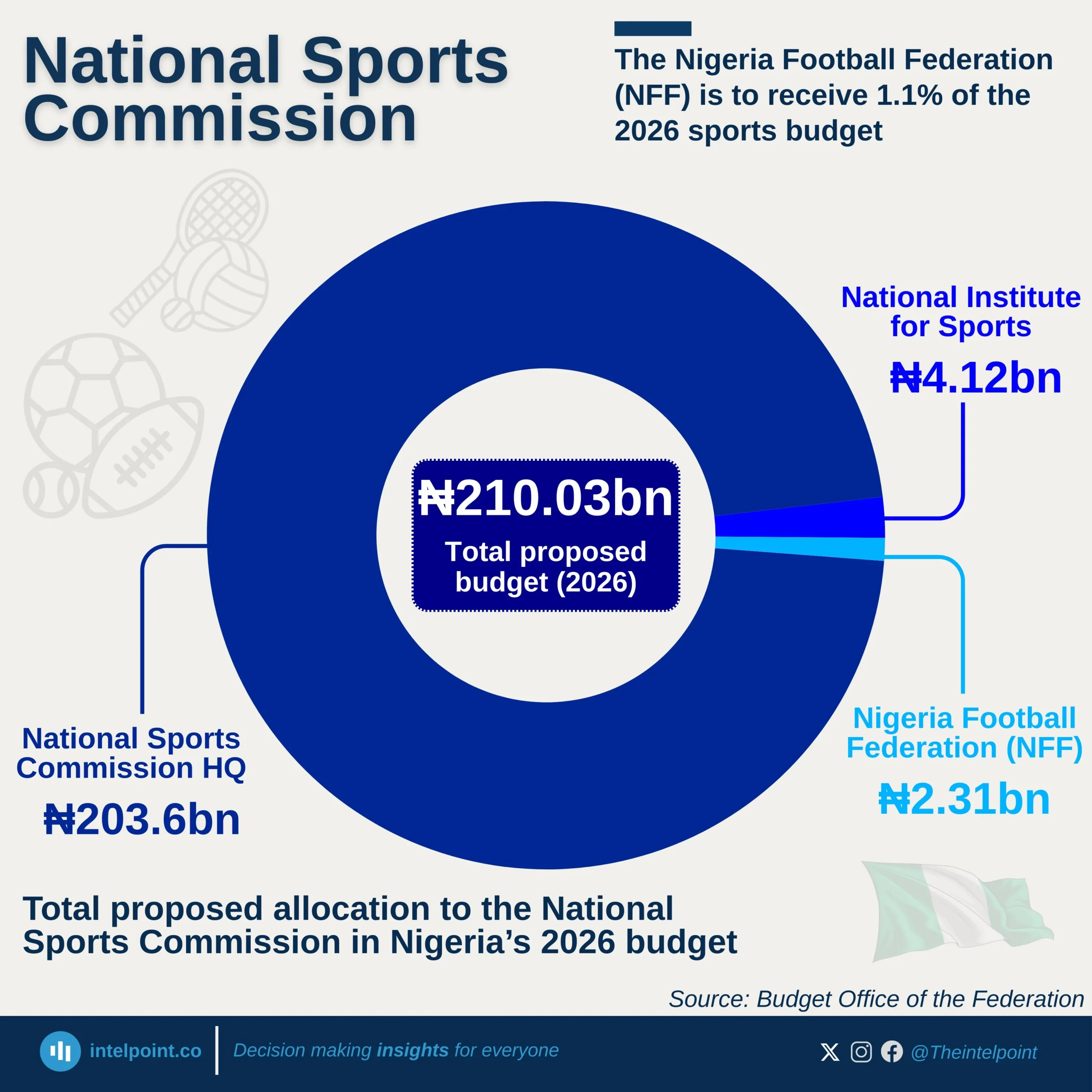
The Nigeria Football Federation (NFF) is to receive 1.1% of the 2026 sports budget
  • The NFF’s allocation of ₦2.31 billion is under 1.1% of the total sports budget.
  • The National Sports Commission HQ gets the most, with ₦203.6 billion, over 96% of the total.
  • The National Institute for Sports is to receive ₦4.12 billion, highlighting minimal federal investment in sports development.
  • Budget heavily favours administration over football development and grassroots programs.

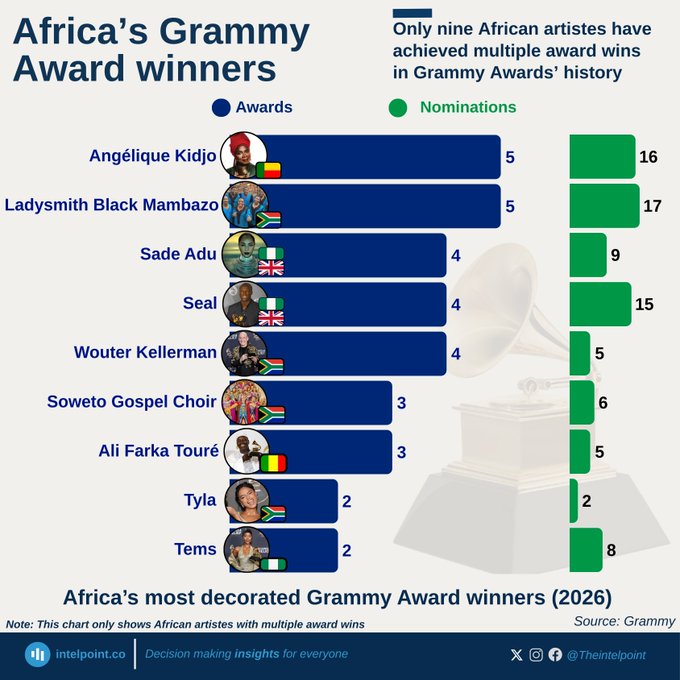
Only nine African artistes have achieved multiple award wins in Grammy Awards’ history
  • Only nine African artistes have won multiple Grammy Awards, highlighting how rare repeat wins remain at the global level.
  • Angélique Kidjo and Ladysmith Black Mambazo lead Africa with five wins each, but Ladysmith holds the record for the most nominations (17).
  • High nomination counts do not guarantee wins; Seal (15 nominations) and Tems (8 nominations) have fewer wins than peers with far fewer nominations.
  • Recent entrants are closing the gap quickly, with Tyla converting 100% of her two nominations into wins.

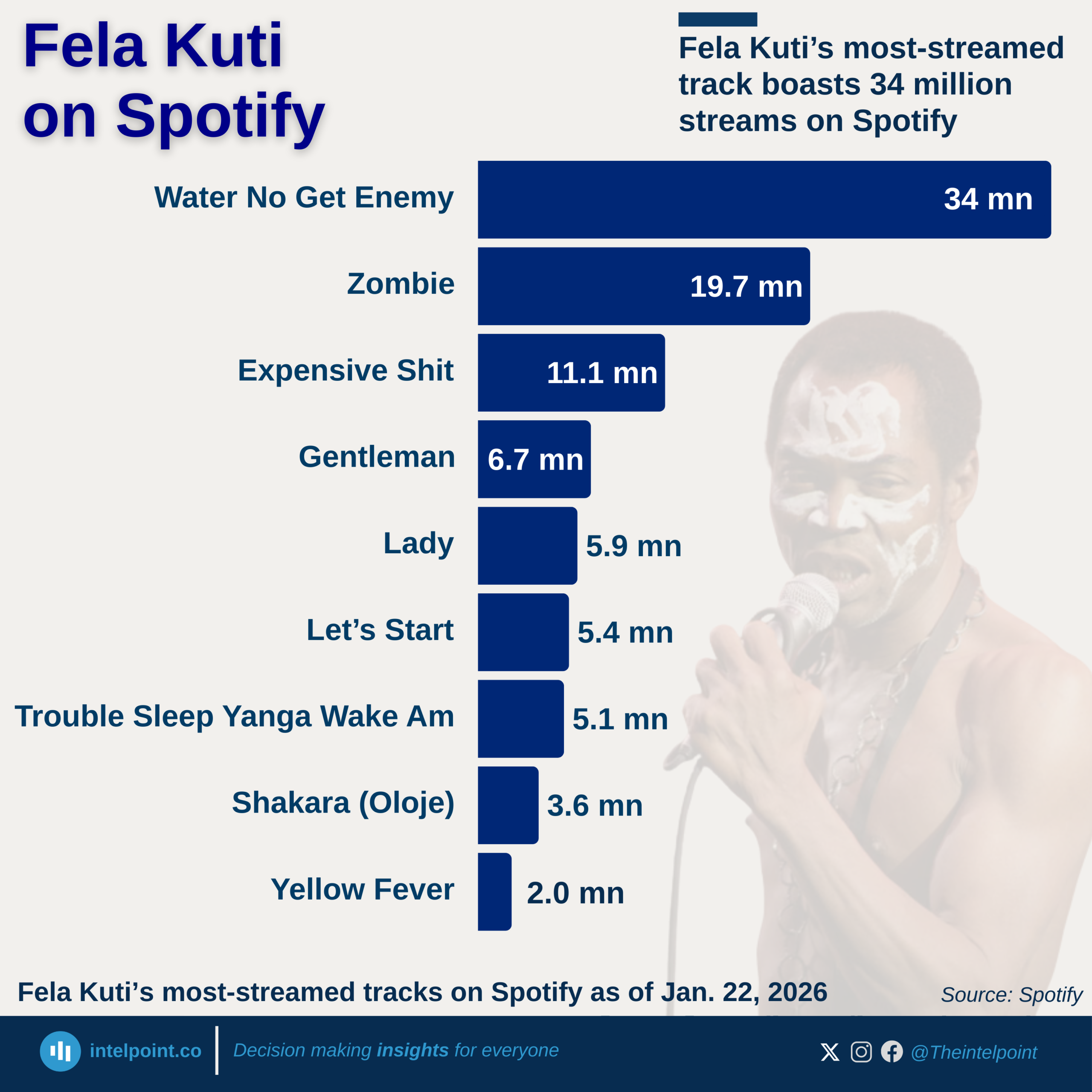
Fela Kuti’s most-streamed track boasts 34 million streams on Spotify
  • “Water No Get Enemy” dominates Fela’s Spotify catalogue with 34 million streams, nearly double the second-ranked track.
  • “Zombie” remains one of his most powerful digital performers, with 19.7 million streams.
  • The top two songs account for a large share of total streams, indicating strong concentration around a few classics.
  • Politically and socially themed tracks rank highest, suggesting listeners connect strongly with Fela’s activist legacy.
  • Only three songs have crossed the 10-million-stream mark, showing a steep drop after the top tier.

Following Senegal’s AFCON 25’ victory, West and North African countries now have the same number of titles (12)
  • West Africa now has 12 AFCON championships, equal to North Africa’s total after Senegal’s latest win.
  • Egypt is AFCON’s most successful nation with 7 titles.
  • Cameroon (5 titles) and Ghana (4) form the second tier of AFCON’s most successful teams.
  • 15 countries feature on the list of champions, reflecting sustained competitiveness.

Nigeria and Cameroon each rose 12 positions in the latest FIFA African soccer ranking
  • Morocco leads Africa and is ranked 8th globally.
  • Nigeria and Cameroon recorded the biggest jumps, each rising 12 positions.
  • Senegal is Africa’s second-best team at 12th in the world.
  • Algeria and Egypt continue to stay relevant at the top despite slower ranking movement.
  • DR Congo and Mali show strong upward momentum, reflecting growing competitiveness beyond the traditional giants.
  • Ghana’s position outside Africa’s top ten highlights the cost of inconsistent results.

Nigeria beats Egypt to win AFCON bronze medal, extending its record to nine third-place finishes
  • Nigeria extends its AFCON bronze medal wins to nine, the highest in men’s AFCON history, with another podium finish.
  • The win over Egypt highlights Nigeria’s resilience, turning late-stage setbacks into tangible success.
  • Bronze medals remain rare for most nations, with the majority appearing only once or twice in AFCON history.

POPULAR TOPICS
SIGN UP TO OUR NEWSLETTER
Get periodic updates about the African startup space, access to our reports, among others.
Subscribe Here
Subscription Form

A product of Techpoint Africa. All rights reserved