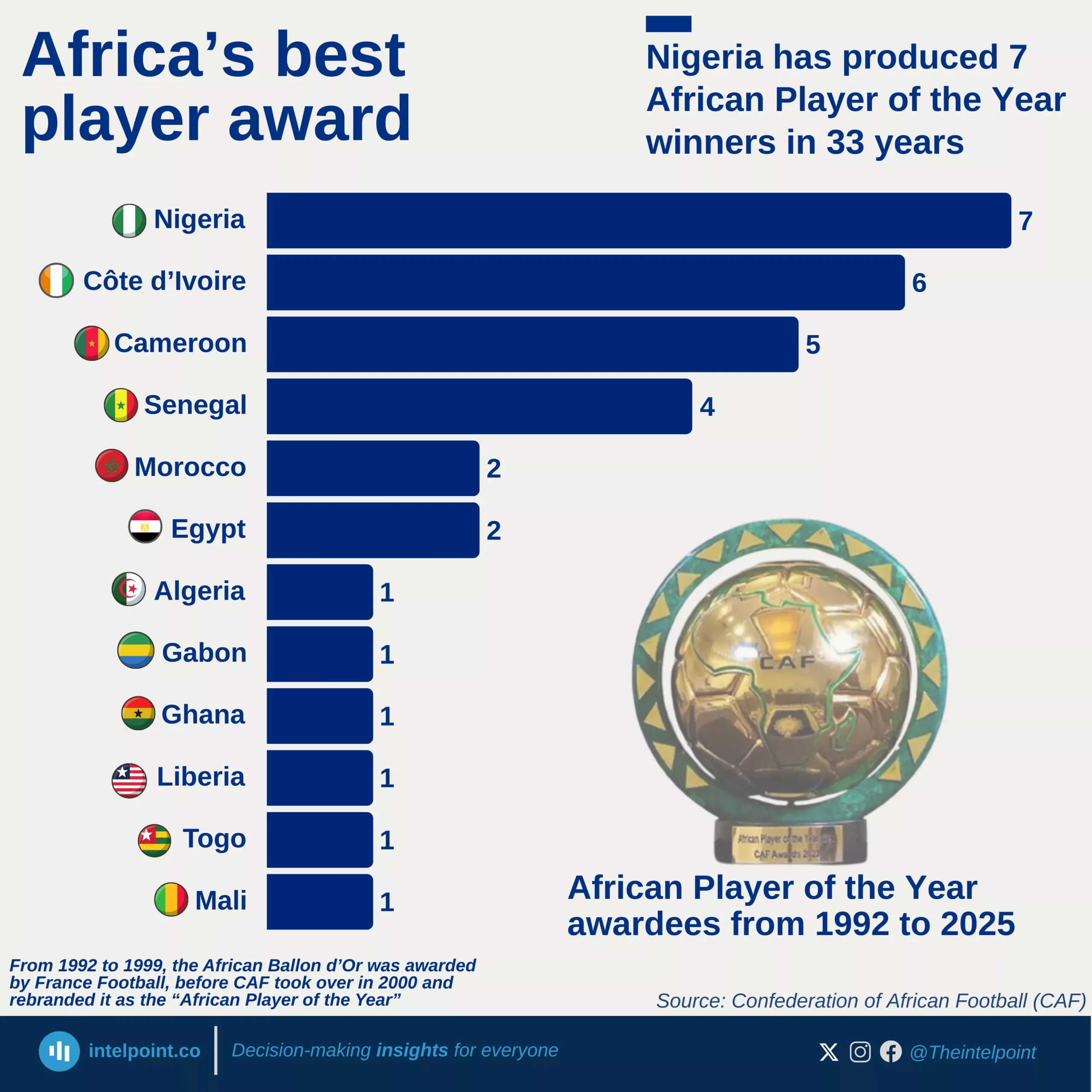
Nigeria has produced 7 African Player of the Year winners in 33 years

  • Nigerian players have won the award seven times from 1992 to 2025.
  • Ivorian players follow with six wins, driven by their strong presence in the 2000s and 2010s.
  • Only four countries have produced four or more individual winners: Nigeria, Côte d’Ivoire, Cameroon, and Senegal.
  • Just 12 African nations account for all winners across the 33 years, showing how concentrated elite talent production has been.

Over the past 33 years, the distribution of winners shows that a few footballing nations have consistently produced Africa’s top individual performers. Abedi Pelé (Ghana, winner of the first edition in 1992) kicked off the legacy.

Nigerian players lead the all-time chart with seven wins, a testament to the country’s enduring ability to develop high-level football talent. Close behind are Ivorian players with six wins, forming part of the continent’s most influential era of individual excellence. Cameroon (5) and Senegal (4) also stand out, shaped by legendary careers and generational standout performers who dominated their eras.

Beyond this core group, the pattern becomes more scattered: Morocco and Egypt each account for two wins through standout individuals, while Algeria, Gabon, Liberia, Togo, Mali, and Ghana each appear once.

Achraf Hakimi (Morocco), the 2025 awardee, shows that new chapters are being written in the story of Africa’s elite footballers.
Source:

Confederation of African Football (CAF)

Period:

1992-2025
HTML code to embed chart
Want a bespoke report?
Reach out
Tags
Related Insights

Nigeria has qualified for 6 World Cups since its first appearance in 1994
  • Nigeria has qualified for six World Cups since its first appearance in 1994.
  • Three second-round finishes in 1994, 1998, and 2014 represent the country's best performances at the tournament.
  • Nigeria ended three of its World Cup appearances at the group stage (2002, 2010, and 2018).
  • Nigeria failed to qualify for the 2006, 2022, and 2026 tournaments.
  • Nigeria did not qualify for any World Cup before 1994, making its debut year a significant milestone.
  • Qualification challenges are increasing, as shown by more failures in recent cycles.

The sports ministry's budget more than tripled in 2025, rising to ₦113B
  • Nigeria’s sports budget rose sharply to ₦113 billion in 2025, tripling from the 2024 figure.
  • The 2025 allocation represents a 243.8% increase compared to the previous year.
  • Youth and Sports budget allocations were relatively stable between 2021 and 2023, averaging about ₦186 billion.
  • The splitting of the Ministry of Youth and Sports budgets in 2024 likely contributed to the steep dip that year.
  • The rebound in the sports development budget in 2025 signals government re-prioritisation of sports development.

England tops the women's rugby ranking globally with 98 points, while South Africa and Kenya feature in the top 20 list
  • England tops the world women’s rugby ranking with 97.76 points, maintaining a clear lead over other nations.
  • Canada and New Zealand follow as the second and third-strongest women’s rugby teams globally.
  • South Africa ranks 12th and Kenya 20th, making them the only African nations in the global top 20.
  • Traditional rugby nations like France, Ireland, and Australia feature prominently in the top 10.
  • Asian teams such as Japan and Hong Kong highlight the growing spread of women’s rugby beyond traditional regions.

South Africa leads in the world rugby ranking for men with a commanding 92.78 points as of August 2025
  • South Africa leads the world rugby rankings with 92.78 points, ahead of New Zealand’s 92.06.
  • The gap between the first and second position is just 0.72 points, showing a close contest at the top.
  • Ireland remains the highest-ranked European team with 89.83 points.
  • France and England, with 87.82 and 87.64 points respectively, are in close competition for the fourth and fifth spots.

Global rugby participation grew by 11% to 8.46 million players in 2023
  • Global rugby participation grew by 11% in 2023, reaching 8.46 million players.
  • Female participation increased by 37%, showing the fastest growth in the sport.
  • Male participation also rose by 26%.
  • The substantial rise in female players signals rugby’s growing inclusivity.
  • The global rise suggests rugby is gaining ground beyond traditional rugby nations.

Nigeria tops Africa’s women’s football with 1,630.83 points and ranks 36th globally
  • Nigeria leads Africa with 1,630.83 points, ranked 36th globally, maintaining their long-standing supremacy in Africa's women’s football.
  • South Africa remains second, 165 points behind Nigeria, consolidating their position after consistent WAFCON performances.
  • North Africa's breakthrough is evident with Morocco at 3rd, driven by recent World Cup appearances and continental success.
  • There is tight competition in mid-table, with Zambia, Cameroon, and Ghana separated by less than 12 points.

POPULAR TOPICS
SIGN UP TO OUR NEWSLETTER
Get periodic updates about the African startup space, access to our reports, among others.
Subscribe Here
Subscription Form

A product of Techpoint Africa. All rights reserved