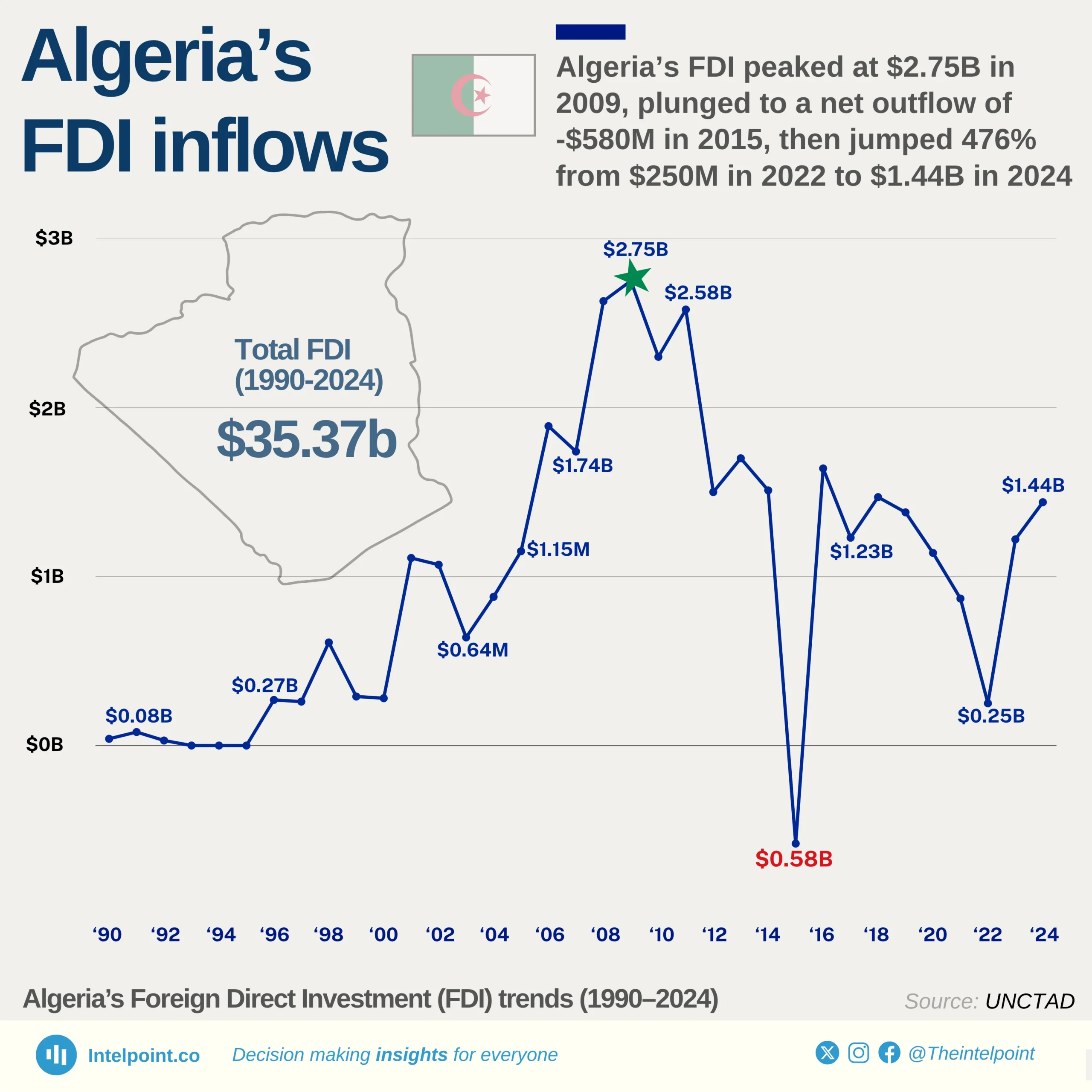
Algeria’s FDI peaked at $2.75B in 2009, plunged to a -$580M outflow in 2015, then jumped 476% from $250M in 2022 to $1.44B in 2024.

Key Takeaways

  • Peak FDI was in 2009 with $2.75 billion, the highest recorded in the 1990–2024 period.
  • The year 2015 saw a rare negative inflow of -$580 million, marking Algeria’s only net FDI loss in the last three decades.
  • FDI inflows rose significantly between 2005 and 2011, consistently staying above $1 billion each year.
  • After the 2015 drop, inflows recovered modestly, hovering between $1.1B and $1.6B from 2016 to 2020.
  • FDI weakened again post-2020, falling to just $250 million in 2022, before rebounding to $1.44 billion by 2024.

Algeria’s foreign direct investment was minimal through the 1990s, with inflows staying below $1 billion until 2001. The 2000s marked a shift, with FDI rising steadily to reach a high of $2.75 billion in 2009. This upward trend reflected a period of investor confidence and economic openness.


However, in 2015, Algeria recorded its only FDI outflow, a negative figure of -$580 million, signalling a year of capital withdrawal. Despite this drop, the country quickly regained momentum, bringing inflows back to over $1.6 billion in 2016 and maintaining stable values through 2020.

Post-2020, inflows weakened again, bottoming out at just $250 million in 2022. The country managed a partial recovery by 2024, ending the period with $1.44 billion in FDI. Overall, while growth has been uneven, Algeria’s FDI story reflects long-term improvement, from a near-zero base in the 1990s to substantial inflows in recent years.
Source:

UNCTAD

Period:

1990 - 2024
HTML code to embed chart
Want a bespoke report?
Reach out
Tags
Related Insights

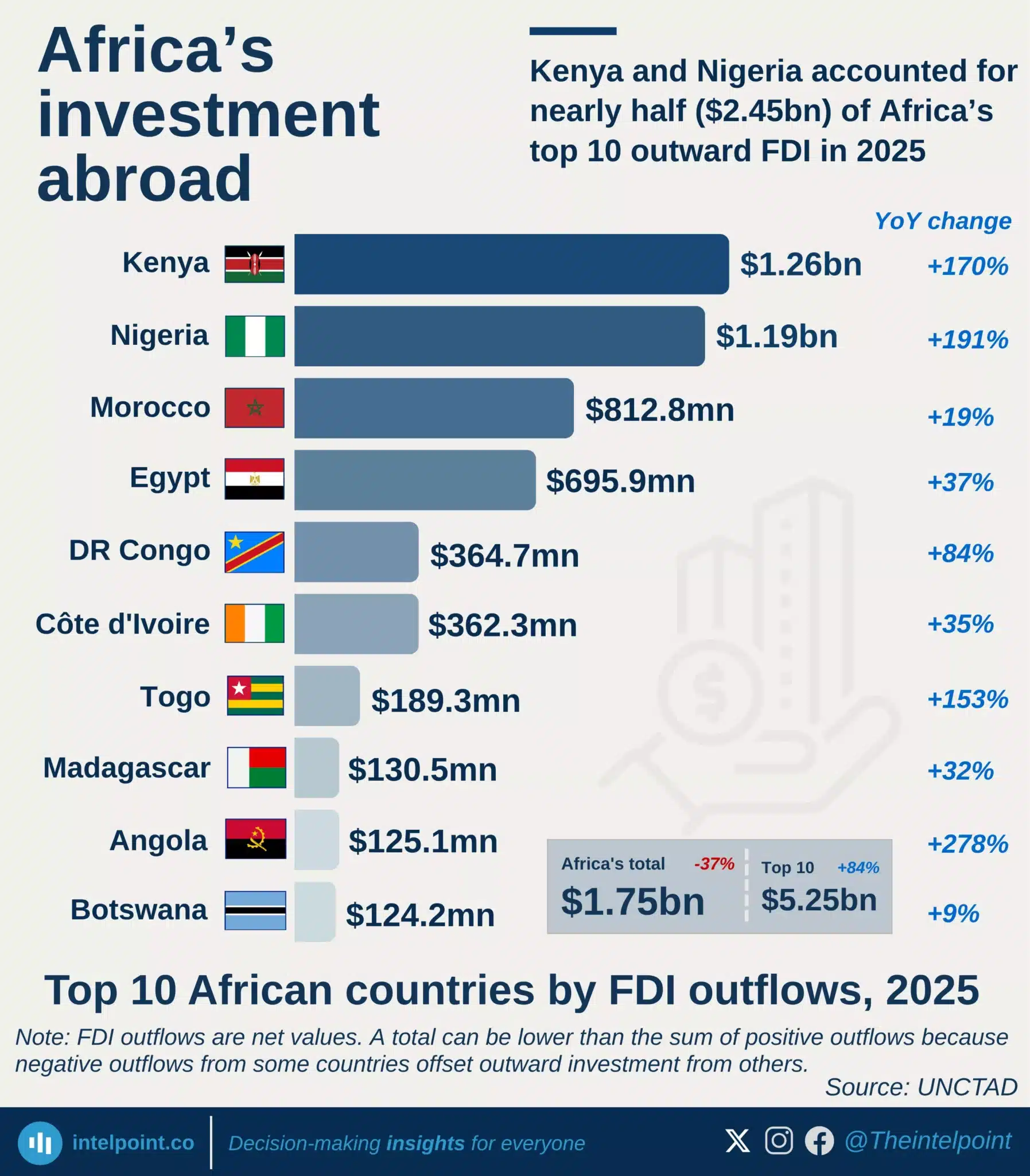
Kenya and Nigeria accounted for nearly half ($2.45bn) of Africa’s top 10 outward FDI in 2025
  • Kenya led Africa’s outward FDI in 2025, recording $1.26bn.
  • Nigeria followed closely with $1.19bn, after a 191% increase.
  • Together, Kenya and Nigeria accounted for $2.45bn of the top 10 total.
  • Morocco and Egypt completed the top four, with $812.8m and $695.9m.
  • Angola recorded the fastest growth among the top 10, rising 278%.
  • Africa’s total outflow was lower because negative outflows offset gains elsewhere.

Nigeria’s FDI inflow crossed $4bn for the first time since 2014
  • Nigeria’s FDI inflows rose to $4.01 billion in 2025, the highest level since 2014.
  • The 2025 figure represents a 148% increase from the revised $1.61 billion recorded in 2024.
  • Despite the rebound, Nigeria remains far below its 2011 peak of $8.91 billion.
  • Nigeria’s strongest FDI period was 2005 to 2014, when inflows stayed above $4 billion every year.

Nigeria’s FDI inflows rose to 4th in Africa after a 148% increase, while Egypt remained the continent’s top destination
Egypt remained Africa’s top FDI destination with $15.45bn. Nigeria ranked 4th after FDI inflows rose 148% to $4.01bn. Guinea had the biggest top-10 jump, rising 454% to $7.76bn. Africa’s top 10 accounted for 73% of total FDI inflows.

Europe, Asia, and the Americas have attracted a combined 94% of global foreign investment since 1990, leaving Africa and Oceania with just 6%
  • Europe ($12.58 trillion), Asia ($11.88 trillion), and the Americas ($11.49 trillion) are nearly tied after 35 years, each capturing roughly a third of global FDI
  • Asia grew from just $25 billion annually in 1990 to consistently attracting $600-700 billion per year, showing the most stable growth pattern
  • Major crises (2001, 2008-09, 2020, and 2022) caused dramatic swings, with Europe even recording negative flows in 2022
  • Africa and Oceania combined received just 6% of total FDI, remaining far behind despite Africa's recent acceleration to $97 billion in 2024

North Africa was the primary destination for FDI in 2024, attracting 52% of Africa's total FDI inflow
  • Africa attracted $97 billion in total FDI inflows in 2024.
  • North Africa dominated with $51 billion (52%), remaining the continent’s top foreign investment hub.
  • West Africa ranked second with $15 billion (15.3%).
  • East Africa secured $13 billion (13.3%).
  • Central Africa remained the least favoured, with only $8 billion (8.2%) in FDI inflows.

Nigeria’s share of Africa’s FDI collapsed from ~38% in 1994 to barely 1.1% in 2024
  • Nigeria’s FDI share plunged from 35% in 1990 to 1.1% in 2024.
  • Africa’s FDI surged over the same period, leaving Nigeria behind.
  • Q1 2025 inflow was only $126.3 million, showing persistent weakness.
  • Decline mirrors structural hurdles — unstable policies, forex issues, and weak infrastructure.

POPULAR TOPICS
SIGN UP TO OUR NEWSLETTER
Get periodic updates about the African startup space, access to our reports, among others.
Subscribe Here
Subscription Form

A product of Techpoint Africa. All rights reserved