The Nigerian workplace is changing fast, and if you're an HR professional, business leader, or job seeker, you need to understand what's happening.
That's exactly what The Nigerian Workplace Report reveals.
This comprehensive report by Intelpoint and AltSchool Africa surveys over 2,600 respondents across Nigeria, covering topics such as earnings, reasons for job quits, what HR professionals prioritize in hiring, and the biggest challenges freelancers face.
The findings are eye-opening, with some confirming what we suspected while others completely challenge conventional wisdom about work in Nigeria.
Whether you're trying to retain top talent, negotiate better pay, or understand the future of work in Nigeria, this report has the answers.
This report was produced by Intelpoint, the data and research arm of Techpoint Africa, in partnership with AltSchool Africa. The survey was conducted between December 2023 and March 2024 across all industries in Nigeria.
Key takeaways
- 69.58% of Nigerian workers have a bachelor's degree or higher, yet many feel their pay doesn't match their qualifications
- Only 1 in 3 workers believe their salary matches the value they provide, highlighting a major disconnect between compensation and contribution
- Companies pay 67.4% of employees' salaries only, with no commission, while non-monetary benefits remain limited
- The biggest reason people quit is for better offers elsewhere (not poor management as commonly assumed)
- Most workers spend 10-20% of their monthly income on transportation alone, eating significantly into take-home pay
- 58.68% of workers say their current job aligns with what they studied, showing career-field alignment is more common than expected
- Remote and hybrid workers face electricity and internet as their top challenges, not motivation or time management
- HR professionals prioritize experience and potential (80.91%) over education when hiring
- 74.6% of employees see a clear career path at their company, which correlates with longer tenure
- Freelancers' biggest challenge isn't finding work—it's getting paid on time, with 82.2% considering structured employment
Nigeria's workforce demographics in 2024
Nigeria has 87.2 million people aged 15 to 64, representing a massive, growing workforce that continues to expand each year.
The labour force participation rate reached 81.3% in 2022, meaning over 8 in 10 working-age Nigerians are economically active, while the employment-to-population ratio reached 78.2%.
| Workforce Indicator | Percentage/Figure |
| Labour force participation rate (2022) | 81.3% |
| Employment-to-population ratio (2022) | 78.2% |
| Population aged 15-64 | 87.2 million |
| Share of women in the labour force (2023) | 43.78% |
How educational qualifications have increased over time
Here's something that might surprise you: 78.1% of Nigeria's labour force has an advanced education as of 2022, meaning people with at least a bachelor's degree or equivalent.
Compare that with the 87.1% who completed secondary education, and the gap highlights how many Nigerians are pursuing higher qualifications beyond WAEC or NECO.
The report shows that 69.58% of survey respondents hold bachelor's degrees, with another 16.16% holding postgraduate degrees, meaning over 85% have university-level education or higher.
| Education Level | Share |
| Postgraduate Degree | 16.16% |
| Bachelor's Degree/HND | 69.58% |
| ND/NCE | 6.14% |
| SSCE/WAEC | 7.85% |
| Primary Education | 0.27% |
What Nigerians study and where they study it
Computer Science dominates as the most studied course among Nigerian workers, followed closely by Business Administration and Accounting, reflecting the country's growing tech economy and business sector needs.
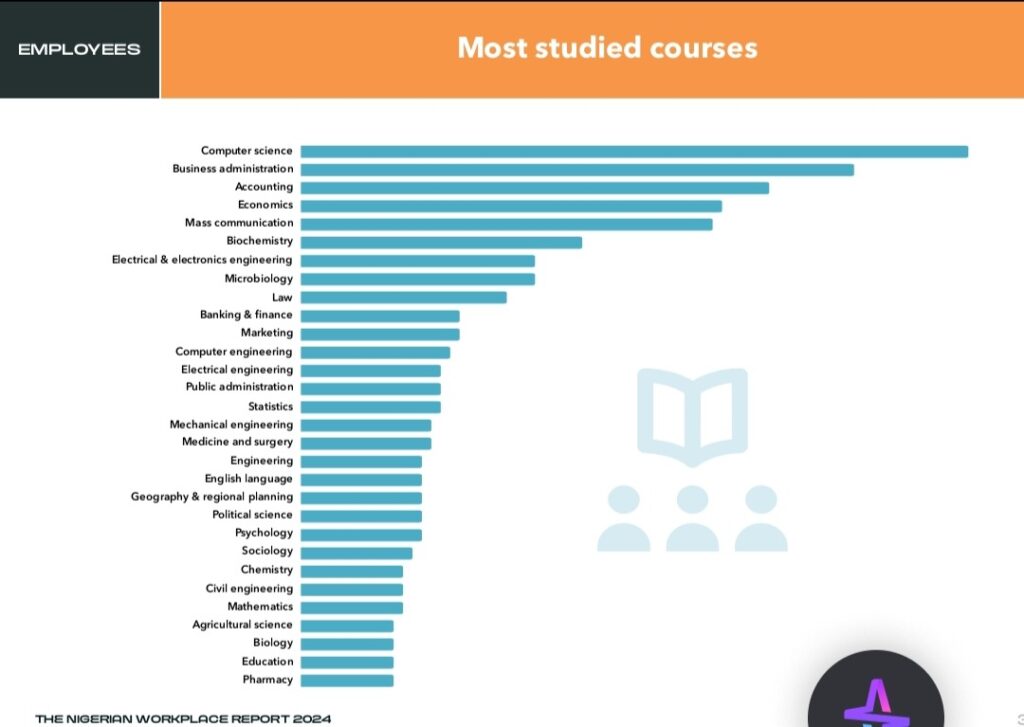
Economics, Mass Communication, Biochemistry, and Electrical & Electronics Engineering round out the top disciplines, with law, banking, and marketing also featuring prominently among popular choices.
Among survey respondents, the University of Lagos leads in alumni representation, followed by the University of Nigeria and Lagos State University, indicating a strong preference for established federal and state institutions.
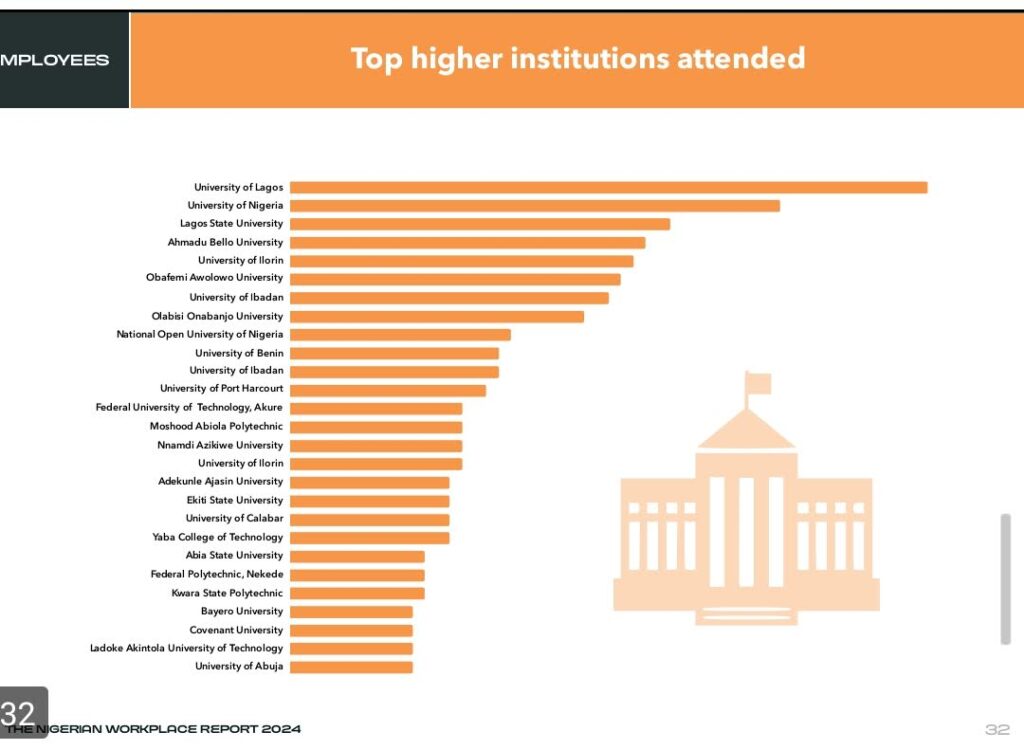
Ahmadu Bello University, University of Ilorin, Obafemi Awolowo University, and the University of Ibadan also feature heavily, while private institutions like Covenant University are gaining ground among younger graduates.
The National Open University of Nigeria's presence on the list demonstrates the growing acceptance of distance learning, especially among working professionals seeking to upgrade their qualifications while employed
Does your university degree actually matter for your career?
Here's a question that keeps many people up at night, especially after spending years and hundreds of thousands on education: Does your university degree actually determine your career path?
According to the report, 58.68% of workers say their current job aligns with what they studied, but 41.32% are working in fields completely different from their education.
Do Foreign Degree Holders Have an Advantage Over Nigerian Degrees: What Workers and HR Say
The question of whether foreign degrees carry more weight in Nigeria's job market reveals an interesting gap in perceptions between workers and HR professionals.
Only 4.1% of survey respondents hold foreign degrees, while 95.9% hold Nigerian degrees, yet the debate over bias remains heated across professional circles.
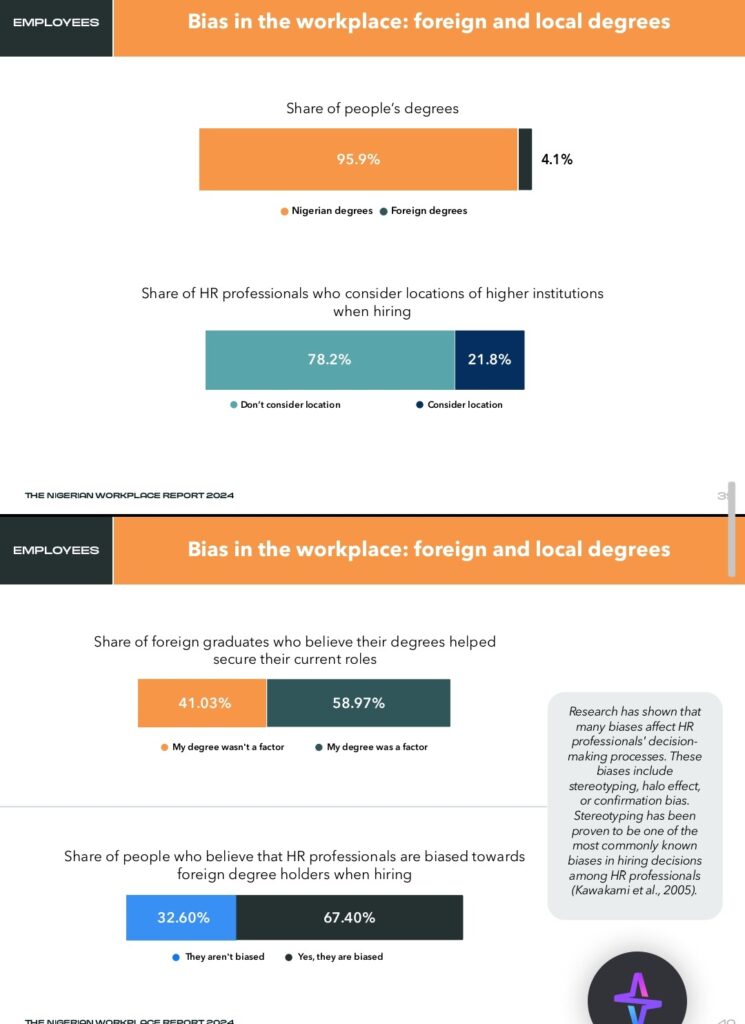
When it comes to hiring, 78.2% of HR professionals say they don't consider the location of higher education institutions, while only 21.8% admit university location influences their decisions.
However, workers tell a different story entirely. 67.40% of employees see HR professionals as biased towards foreign degree holders when hiring, while only 32.60% think recruitment is fair regardless of where you studied.
Interestingly, among those who hold foreign degrees, 58.97% believe their international education helped secure their current roles, while 41.03% say it wasn't a factor at all, suggesting the advantage may be smaller than commonly assumed.
What HR professionals prioritize during recruitment
Multinational and global recruiters are shifting away from prioritizing degrees in hiring, focusing instead on skills, experience, and potential, according to insights from HR professionals in the report.
The data supports this: 80.91% of HR professionals rate experience and potential as important or extremely important when hiring.
| Hiring Factor | Extremely Important |
| Skill set | 70.91% |
| Soft skills | 50% |
| Education | 22.73% |
Your degree opens doors and gets you past initial screening, but your skills and experience determine how far you actually go in your career.
Salary reality: What Nigerians actually earn monthly
Let's talk about money, because this is where things get uncomfortable for both employers and employees in Nigeria's workplace.
34.99% of employed Nigerians earn up to ₦100,000 monthly (about $65 at current exchange rates), while another 28.48% earn between ₦100,001 and ₦200,000.
Add those together, and you get 63.47% of workers earning ₦200,000 or less per month, with only 7.92% earning more than ₦700,000 per month.
| Salary Range | Share |
| Up to ₦100,000 | 34.99% |
| ₦100,001 - ₦200,000 | 28.48% |
| ₦200,001 - ₦300,000 | 13.67% |
| ₦300,001 - ₦400,000 | 7.15% |
| Above ₦700,000 | 7.92% |
The disconnect between pay and value contribution
Here's the painful part: both employers and employees need to acknowledge that only 44.99% of workers believe their salaries reflect the value they provide.
That means 55.01% feel underpaid for what they bring to the table, creating resentment, lower morale, and higher turnover as people continually seek better opportunities.
This disconnect exists across all salary ranges, with even those earning above ₦700,000 feeling they deserve more based on their contributions.
Where monthly salaries actually go
Transportation is eating into Nigerian workers' salaries more than you'd think, with three in 10 people spending between 10% and 20% of their income just on commuting.
Even more concerning, 14.46% spend 30% or more of their monthly income on commuting, which helps explain why remote and hybrid work arrangements are becoming increasingly attractive.
When asked about their largest monthly expense, 67.99% cited combined feeding and transportation, while housing accounted for just 2.43%, likely because many Nigerians own homes or live with family.
The real reasons Nigerians quit their jobs
Everyone assumes people quit because of bad bosses and toxic management, but the data tells a completely different story that challenges this conventional wisdom.
The number one reason Nigerians leave their jobs is simply getting a better offer elsewhere, not toxic culture, not bad leadership, just better opportunities with higher pay or better growth prospects.
| Reason for Leaving | Ranking |
| Better offer elsewhere | #1 |
| Lack of career advancement | #2 |
| Bad leadership | #3 |
| Poor company culture | #4 |
| Work-life balance issues | #5 |
Bad leadership and lack of career advancement come second and third, while poor company culture, work-life balance issues, and burnout round out the top reasons employees decide to move on.
Career growth: The secret to employee retention
Want to know the secret to keeping your best employees from jumping ship to competitors? Show them a clear career path with visible opportunities for progression.
The report shows that 74.6% of employees see a clear career progression at their current workplace, with only 16.7% saying no and 8.7% unsure about their growth prospects.
Here's the correlation that matters: people who see a clear path forward tend to stay significantly longer. 27.51% of workers have been with their current company for 0-3 years, while those who've stayed 4-6 years likely see that career path clearly.
| Years at Company | Share |
| 0-3 years | 27.51% |
| 4-6 years | 52.74% |
| 7-9 years | 9.70% |
| 10+ years | 10.05% |
The longer people stay, the older they tend to be: workers aged 49+ stay longer than those aged 30-49, suggesting that career investment pays off in loyalty over time.
Remote work in nigeria: infrastructure beats motivation
Let's be brutally honest about remote work in Nigeria: it's not the dream everyone makes it out to be; remote workers face several daily challenges.
The biggest challenge isn't motivation, time management, or loneliness like in developed countries, but rather electricity supply, with both HR professionals and workers agreeing on this critical infrastructure failure.
| Remote Work Challenge | Ranking |
| Electricity supply | #1 |
| Internet connection | #2 |
| Overcoming distractions | #3 |
| Blurred work-life boundaries | #4 |
Internet connectivity ranked second, while motivation, time management, and loneliness did not make the top issues, indicating that Nigerians working remotely are struggling not with discipline but with basic infrastructure.
Right now, 53.2% of Nigerian workers are fully on-site, 29.8% work hybrid, splitting time between office and home, while only 17% work fully remote. These numbers make sense given the infrastructure challenges.
The freelance economy: Income reality and payment struggles
Freelancing in Nigeria is growing rapidly, but it's far from the passive-income paradise that social media influencers make it seem, with real challenges that many don't openly discuss.
Five in 10 freelancers are ages 31-40, representing the prime working age and with enough experience to go independent. Most freelancers (37.18%) work five days a week, with another 21.79% working six days.
What Nigerian freelancers actually earn
The income reality is sobering: 27.40% of freelancers earn ₦50,000 or less per month, while 32.88% earn between ₦50,001 and ₦100,000.
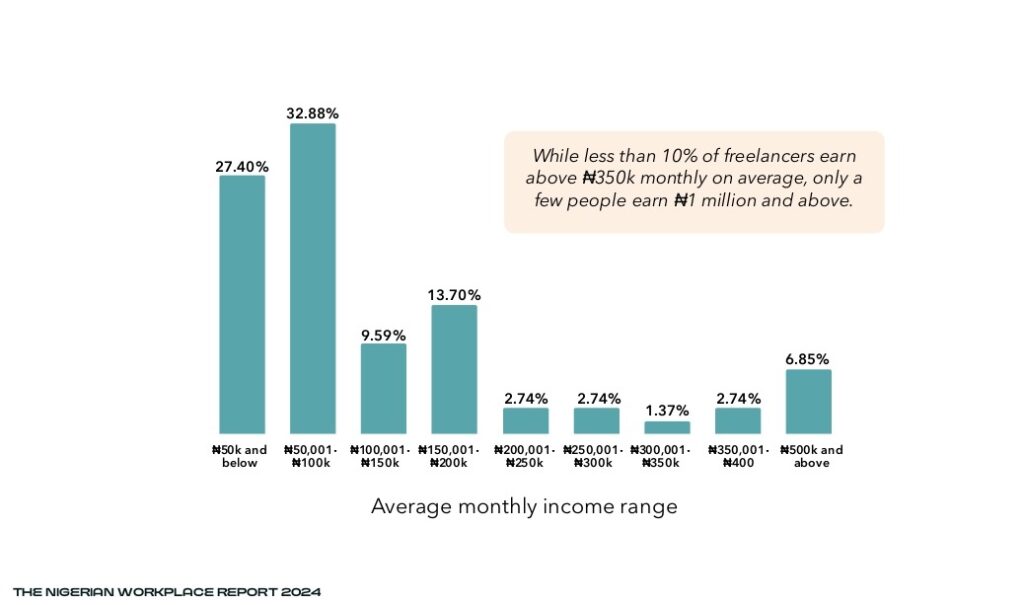
That's 60% of freelancers earning ₦100,000 or less per month, with only 6.85% earning ₦500,000 or more, dispelling the myth that freelancing automatically means big money.
| Top Freelancer Challenges |
| Lack of a steady income |
| Getting paid on time |
| Fake jobs and clients |
| Negotiating with clients |
| Building an online presence |
Here's the kicker that reveals everything about freelancing struggles in Nigeria: 82.2% of freelancers would consider taking a structured job if the right opportunity came along, which tells you everything about the stability of freelancing.
Unemployment trends: Duration and what job seekers want
Understanding unemployment patterns helps both job seekers and employers navigate the market more effectively, and data show encouraging trends despite the challenges.
44.5% of unemployed people say there aren't enough jobs available in their field, while 16.5% are re-entering the workforce after maternity, paternity, or study leave.
How long Nigerians stay unemployed
The good news is that 70.31% of unemployed Nigerians have been out of work for less than 1 year, 21.09% for 1-2 years, and only 3.13% for 5 years or more.
This demonstrates that most unemployment is relatively short-term rather than long-term, suggesting the job market has some mobility despite its challenges.
What unemployed people prioritize in job hunting
When looking for work, remuneration and benefits top the list unsurprisingly, followed by professional development opportunities that signal long-term growth potential.
Company culture and values matter more than many employers realize, with workplace flexibility increasingly important, especially post-COVID. Job title and location matter, but rank lower than pay and growth.
Work-Life balance: Employee perceptions and reality
Everyone talks about work-life balance as if it's a luxury, but the data shows how Nigerian workers actually rate their current situation, with some surprising positive findings.
46.62% rate their work-life balance as good, 29.37% as fair, 16.38% as excellent, and only 5.24% as poor.
That's more positive than expected, honestly, showing that despite long hours and economic pressure, many Nigerian workers still feel they can maintain some balance between their professional and personal lives.
The role of HR: Whose side are they really on?
This question reveals a fundamental tension in every workplace: who does HR actually work for, the employees or management?
| HR's Primary Role | Employees |
| Protect the workplace (balanced) | 51.43% |
| Protect employees | 38.84% |
| Biased toward management | 9.74% |
Interestingly, HR professionals see it differently: 76.36% say their role is to protect the workplace overall, while only 20% say they protect employees specifically.
This gap in perception might explain why many workers feel HR isn't on their side when conflicts arise, creating mistrust that damages workplace relationships and morale.
What does this all mean for Nigeria's workplace future
The Nigerian workplace stands at a critical crossroads, with education levels rising and young people more qualified than ever. Yet infrastructure challenges, pay-value disconnects, and limited career advancement hinder progress.
The good news is that companies that invest in their people, create clear career paths, and offer competitive compensation will win.
The challenge is that most organizations haven't adapted their practices to meet modern workforce expectations, and they still operate with outdated HR systems and compensation structures.
For HR professionals and business leaders, The Nigerian Workplace Report offers a roadmap for identifying gaps and, more importantly, for fixing them.
For employees and job seekers, it provides leverage by showing what's normal, what's acceptable, and when you're being undervalued relative to market standards.
Download The Nigerian Workplace Report today to access the full findings and detailed breakdowns by sector, region, and demographic.