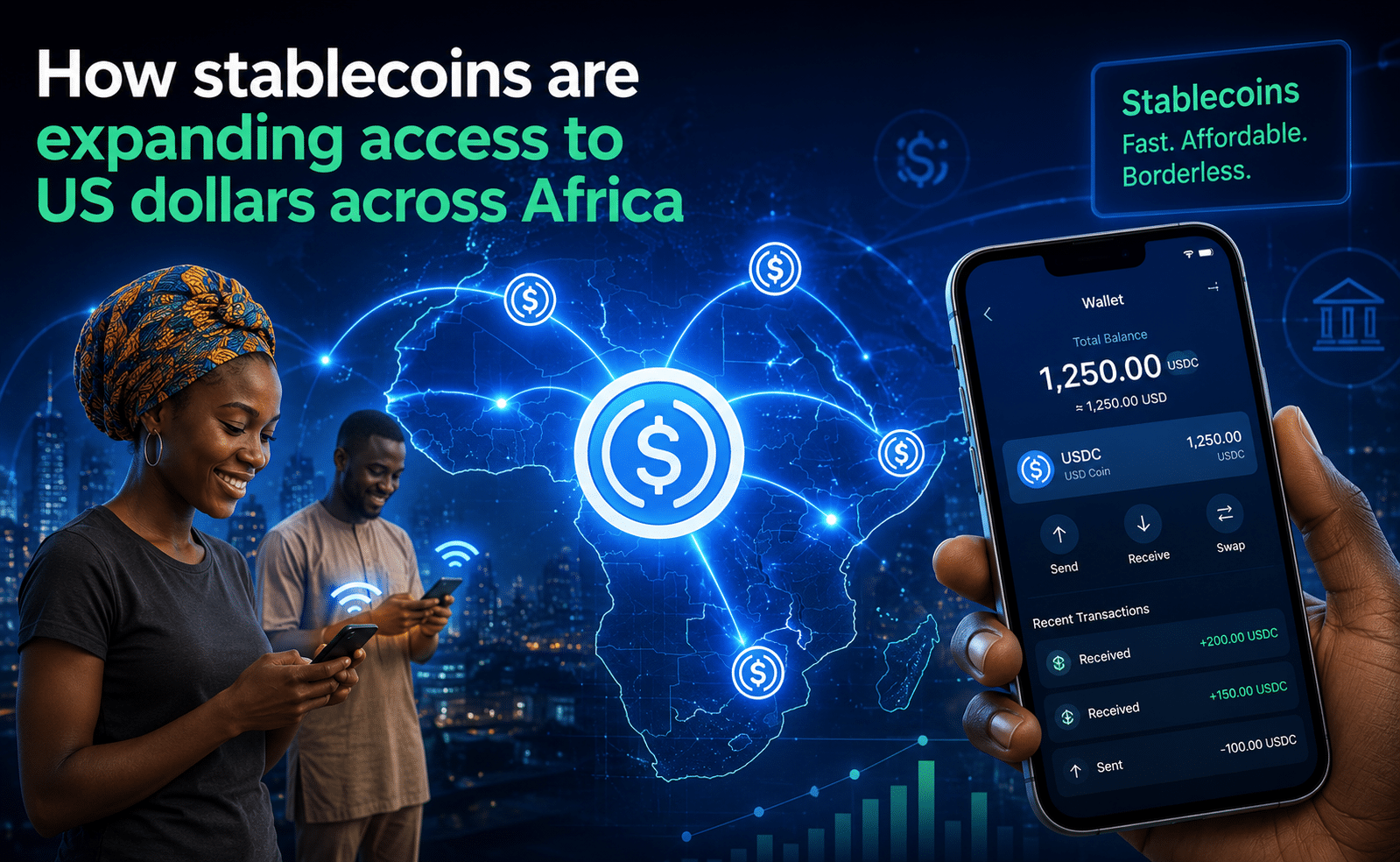
Say a business in Lagos places an order with a supplier in Accra, and the inventory moves in days. The payment for it is usually where things get complicated.
The money might route through a correspondent bank outside Africa, undergo two or three currency conversions along the way, and take days longer to land, all while exchange rates drift and fees quietly pile up on both ends.
It's a strange contradiction: goods move across African borders faster than the money that pays for them. As the African Continental Free Trade Area (AfCFTA) pushes to grow intra-African trade, that contradiction is getting harder to ignore, and it's raising a pointed question: how do businesses move money as efficiently as they move goods?
That question is exactly what's pulling stablecoins and crypto-powered payment infrastructure into the conversation.
Key takeaways:
- Intra-African trade accounts for between 14% and 16% of total trade, compared with around 60% in Europe and over 50% in Asia.
- A single cross-border payment between African businesses can still be routed through banks outside the continent, adding delays and extra fees.
- The Pan-African Payment and Settlement System (PAPSS), launched by Afreximbank in 2022, now covers 28 countries and over 250 financial institutions.
- Stablecoins like USDT and USDC are emerging as a parallel settlement layer.
Why paying across African borders is still harder than it should be
Africa uses 42 currencies, and historically, a significant portion of transactions or trade between African countries have had to be converted to dollars or euros first.
Send money from Nigeria to Ghana, Kenya to South Africa, or Egypt to Nigeria, and there's a good chance it routes through the US dollar or euro first. Over 80% of cross-border African payments are still routed through correspondent banks in the US or Europe, forcing currencies like the Kenyan shilling and Nigerian naira to undergo unnecessary dollar conversions. That detour adds 2–5% to every transaction.
The cost adds up fast. Sub-Saharan Africa remains the most expensive region in the world to send money, averaging 8.45% to move just $200, against a global average of 6.4% and a G20 target of 3%. In certain corridors, like Tanzania to Rwanda, costs can soar to 15–20%. FX liquidity shortages compound the problem further, reportedly costing the continent an estimated $5 billion a year.
AfCFTA is increasing the need for better payment infrastructure
AfCFTA exists to turn Africa's 54 economies into something closer to a single market, with goods and services flowing across borders the way they do within a country. But that vision runs into a wall fast if the money can't move as easily as the goods do.
That's exactly why PAPSS is instrumental here. Launched by Afreximbank in 2022 alongside the African Union and the AfCFTA Secretariat, PAPSS now connects 28 countries, 190 commercial banks, and 16 payment gateways, settling transactions directly in local currencies instead of routing everything through the dollar.
While that's real progress, plenty of markets and corridors still aren't connected, and adoption among businesses is uneven. AfCFTA's trade ambitions and Africa's payment infrastructure have to grow up together, or one will drag the other down.
Stablecoins are emerging as a new settlement layer
Stablecoins like USDT and USDC give businesses something correspondent banking struggles to offer:
- Faster settlement (in hours instead of days).
- Value pegged to the dollar instead of a local currency that might lose ground overnight.
- A way to move money without routing through a chain of intermediary banks.
For a business managing exposure to naira or cedi volatility, holding value in a stablecoin for the length of a transaction just makes the math safer.
I want to be clear about what this actually is, though. Stablecoins aren't trying to replace the naira, the cedi, or other African currencies. They're filling the gap when local currencies can't easily be traded against each other, functioning as a settlement bridge rather than a substitute for the currencies.
From receiving crypto to receiving local currency
Stablecoins solve the settlement problem, but most businesses don't actually want to hold crypto. They want it to become usable money, fast. That's the gap conversion platforms exist to close.
The flow tends to look roughly the same across providers:
- A business receives a payment.
- The transaction gets verified.
- The stablecoin is converted.
- Settlement happens.
- The funds land in a bank account or wallet the business can actually use.
What used to require a business to juggle a crypto wallet, a separate exchange, and a banking relationship now happens as one continuous process. This means a business doesn't need to become a crypto expert to benefit from stablecoin settlement. All they need is a platform that handles the conversion step reliably, quickly, and at a rate they can trust from the start.
Breet Business is one example of a platform built around this flow. It offers a crypto and stablecoin payment API alongside crypto invoicing and an OTC desk for larger transaction volumes. The company has reportedly settled over 3 million transactions for more than 100 verified businesses across Africa.
Settlements are available in NGN, GHS, USD, or stablecoins, and are paid out to bank accounts or mobile money with rates locked in on OTC conversions. Compliance runs underneath all of it: KYC and AML checks, PCI DSS standards, and data handling aligned with Nigeria's NDPA.
Which businesses stand to benefit?
The use cases here are pretty concrete:
- An importer paying a supplier in another African country avoids stacking conversion fees.
- A logistics company settling invoices across three markets can use a single process instead of three.
- SaaS companies and digital agencies billing international clients can receive stablecoins and convert to local currency without waiting on slow bank wires.
- Remote teams and African freelancers working with overseas clients get paid faster, without losing a chunk of it to intermediary fees.
- Merchant platforms and remittance businesses can offer their own customers faster settlement without rebuilding their entire payment stack.
Challenges remain
I won't pretend this is a solved problem. Regulatory clarity around stablecoins is still developing across most African markets, and oversight varies wildly from one country to the next. Liquidity isn't evenly distributed either. Some corridors are well served, others barely at all.
Plenty of business owners still don't fully understand how stablecoin settlement works, which, in turn, slows adoption. Tax treatment of crypto transactions remains murky in several jurisdictions. And traditional businesses accustomed to conventional banking relationships aren't rushing to change how they operate.
None of these erases the progress stablecoin infrastructure has made. It just means it's an emerging layer, not a finished replacement for the systems businesses already trust.
Could Africa build its next payment network without relying entirely on correspondent banks?
I think the honest answer is probably, but not through any single solution.
PAPSS is already reducing dependence on correspondent banks for the countries connected to it. Stablecoins are filling gaps where local currency pairs don't exist.
Central Bank Digital Currencies (CBDCs) are still in their early stages, but several central banks are actively exploring them. APIs and fintech infrastructure are stitching all of this together into something usable for actual businesses.
I don't see one of these winning outright. What I see instead is a hybrid future.
Traditional banking, regional systems like PAPSS, and crypto infrastructure working alongside each other, each covering what the others can't, until moving money across African borders finally starts to feel as easy as moving the goods themselves.