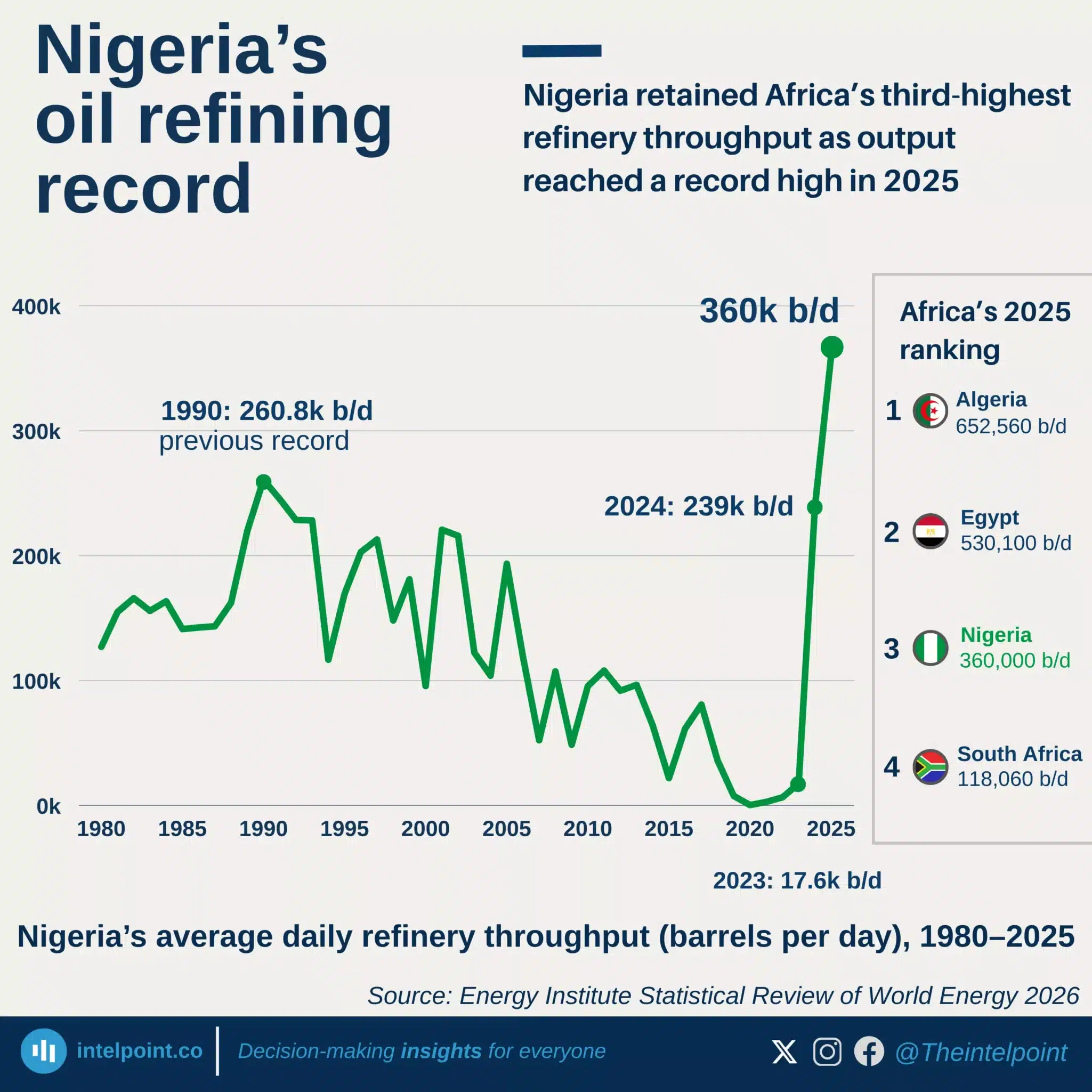
Nigeria retained Africa’s third-highest refinery throughput as output reached a record high in 2025

Key Takeaways

  • Nigeria recorded its highest refinery throughput since 1990 at 360,000 b/d.
  • Throughput increased by 50.6% from 239,000 b/d in 2024.
  • The 2025 level was more than 20 times the 17,600 b/d recorded in 2023.
  • Nigeria remained Africa’s third-highest, behind Algeria and Egypt.
  • Dangote’s contribution is not reported separately.

Nigeria’s refinery throughput reached a record average of 360,000 barrels daily in 2025, its highest level since the
Energy Institute's series began in 1980.

The increase coincided with the first full year of operations at the Dangote refinery, which began processing crude in January 2024 and producing petrol that September. As the 650,000-barrel-per-day facility ramped up, Nigeria’s national throughput increased from 17,600 barrels daily in 2023 to 239,000 in 2024 and 360,000 in 2025.

Nigeria retained Africa’s third-highest refinery throughput, behind Algeria and Egypt. However, the Energy Institute reports only Nigeria’s national total and does not separate Dangote’s contribution from that of the country’s other refineries.
Source:

Energy Institute Statistical Review of World Energy 2026

Period:

1980-2025
HTML code to embed chart
Want a bespoke report?
Reach out
Tags
Related Insights

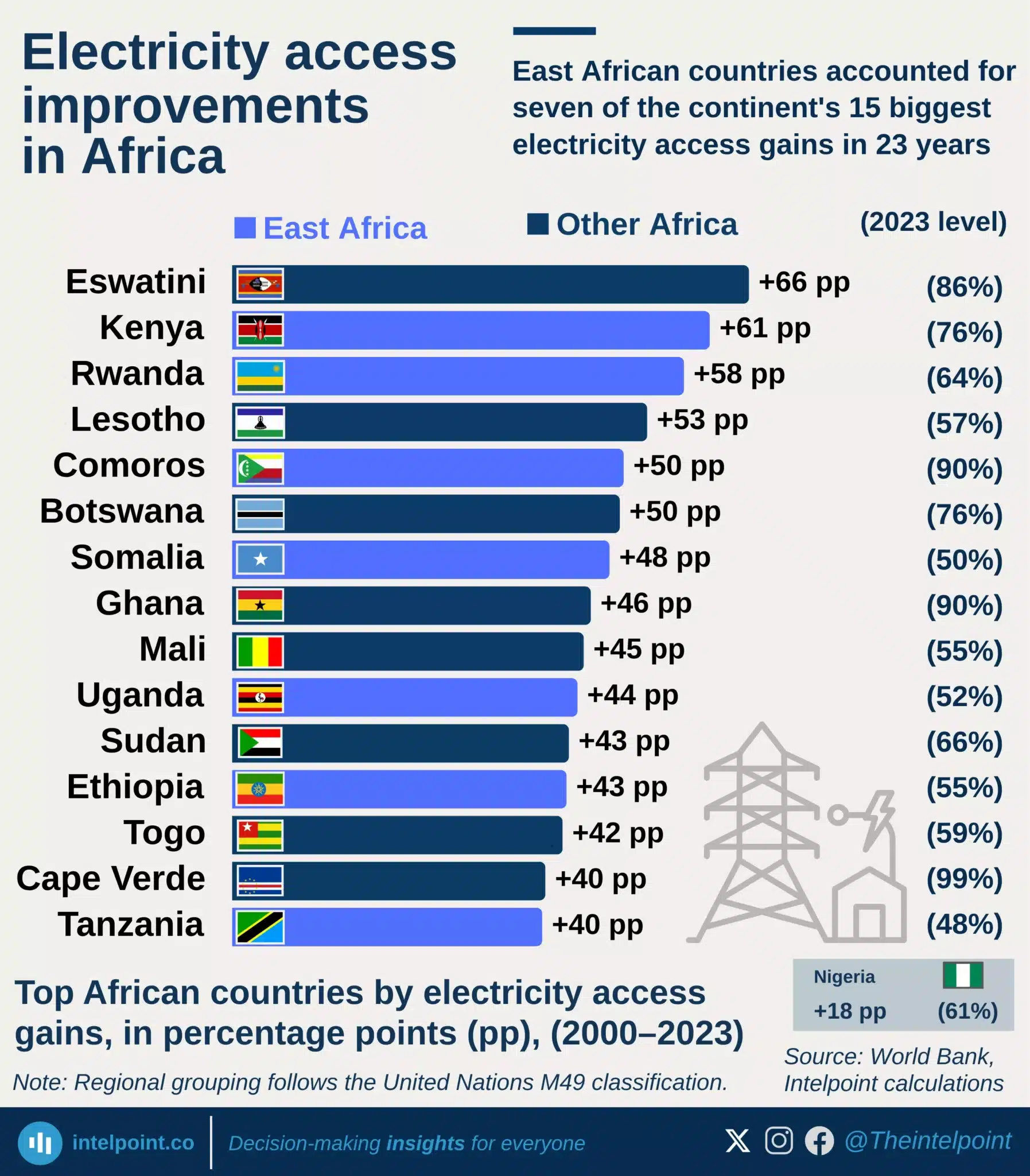
East African countries accounted for seven of the continent's 15 biggest electricity access gains in 23 years
  • Eswatini recorded Africa’s largest electricity access gain, rising by 66 percentage points from 2000 to 2023.
  • Kenya and Rwanda followed with gains of 61 pp and 58 pp, respectively.
  • East African countries accounted for 7 of Africa’s top 15 electricity access improvements.
  • Comoros, Ghana and Cape Verde reached very high access levels by 2023, at 90%, 90% and 99% respectively.
  • Nigeria’s electricity access improved by 18 percentage points, from 43% in 2000 to 61% in 2023.
  • Despite that improvement, Nigeria remained outside Africa’s top 15 gainers over the period.
  • Some countries were absent from the ranking because they had already reached high access levels by 2000.

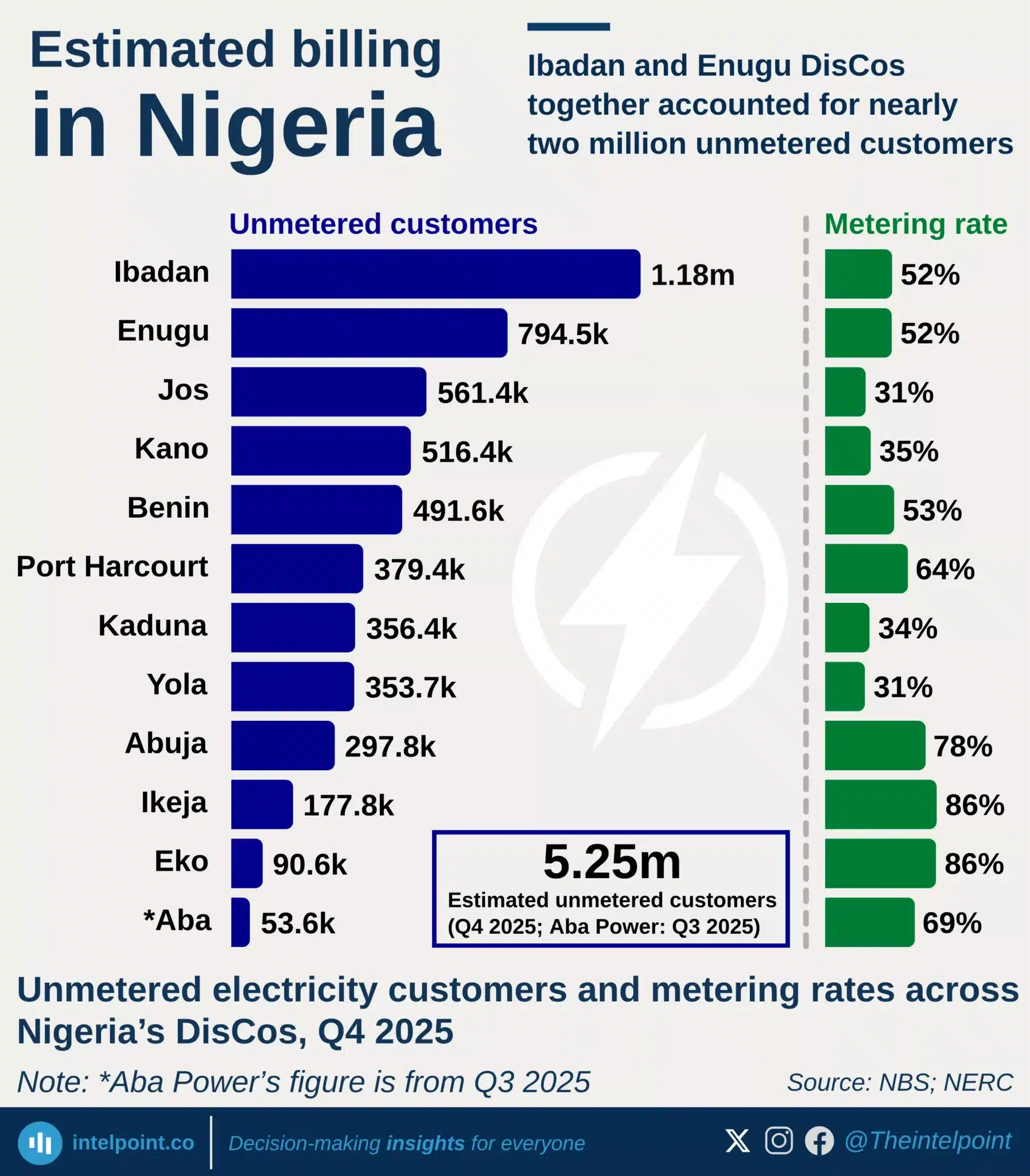
Ibadan and Enugu DisCos together accounted for nearly two million unmetered customers
  • Nigeria still had about 5.25 million unmetered electricity customers across DisCos.
  • The 11 DisCos reported in Q4 2025 had 5.20 million unmetered customers.
  • Nigeria’s reported metering rate stood at 57.3% as of Q4 2025.
  • Ibadan and Enugu had the largest gaps, with nearly two million unmetered customers combined.
  • Ibadan alone had 1.18 million unmetered customers, the highest of any DisCo.
  • Ikeja and Eko had the strongest metering performance, both at about 86%.
  • At the 2025 pace of meter additions, closing the current gap could take close to seven years.

A 12.5kg cooking gas refill now costs over 6x what it did in 2016
  • A 12.5kg refill is now over 6x costlier than in 2016.
  • The April 2026 price reached ₦22.4k, up from ₦3.7k in January 2016.
  • Prices stayed fairly stable until 2021, then surged sharply.
  • Fresh reports suggest gas prices kept rising after April 2026.

Africa’s share of global oil consumption has stayed below 5% for six decades
  • Global oil consumption rose from about 30.9 million barrels per day in 1965 to 101.4 million barrels per day in 2024, more than tripling over the period.
  • Asia Pacific saw the biggest structural shift in global oil demand, increasing its share from 10.7% in 1965 to 37.9% in 2024 to become the world’s largest oil-consuming region.
  • Africa accounted for just 1.9% of global oil consumption in 1965 and 4.5% in 2024, staying below 5% for nearly 60 years.
  • The global centre of oil demand has gradually shifted away from Western economies toward Asia, reflecting industrialisation, urbanisation, and population growth across the region.
  • Africa’s modest share of global oil demand highlights the continent’s relatively low industrial energy consumption despite rapid population growth.

Africa's only nuclear power plant is producing half its 2016 peak
  • South Africa’s Koeberg has been Africa’s only commercial nuclear power station since 1984.
  • Africa produced just 7.8 TWh of nuclear power in 2024, far below France’s 380 TWh and the US’ 823 TWh.
  • Egypt’s El Dabaa plant could change Africa’s nuclear map, adding 4,800 MW when completed.
  • Africa’s nuclear challenge is no longer just generation, but whether countries can finance, regulate, build, and sustain nuclear programmes.

Nigeria's domestic gas market is absorbing an increasing share of the country's gas output
  • Domestic share rose steadily from 34% in 2021 to 45% in 2025, gaining eleven percentage points in five years.
  • Export share fell from 66% to 55%, losing ground every year without a single recovery.
  • 2023 was the sharpest single-year shift; domestic share jumped seven points, from 36% to 43%.
  • The gap between export and domestic share has narrowed from 32 to just 10 points.

POPULAR TOPICS
SIGN UP TO OUR NEWSLETTER
Get periodic updates about the African startup space, access to our reports, among others.
Subscribe Here
Subscription Form

A product of Techpoint Africa. All rights reserved