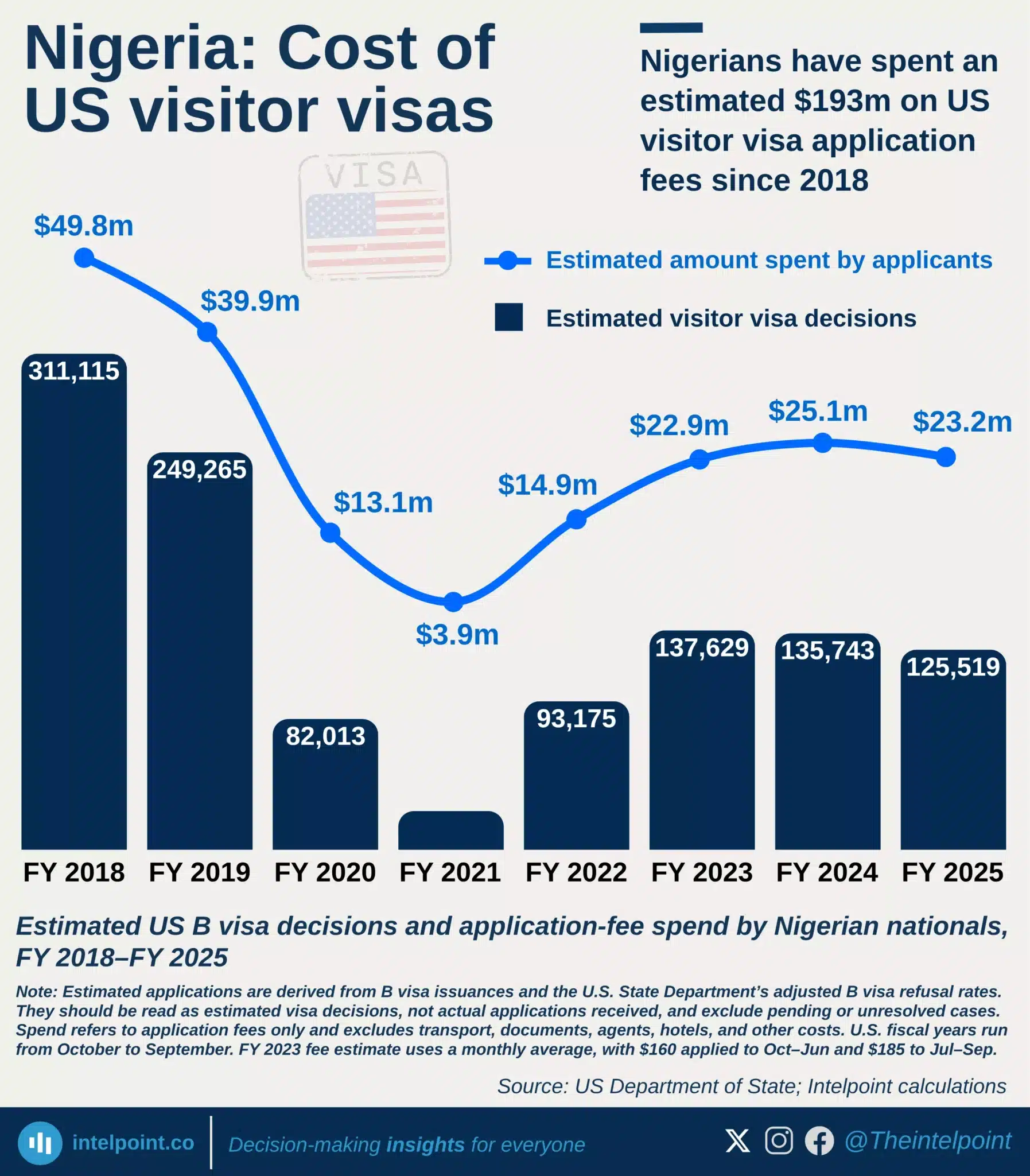
Nigerians have spent an estimated $193 million on U.S. visitor visa application fees since 2018

  • Estimated visitor visa fee spending reached $193 million between FY 2018 and FY 2025.
  • Applicants paid the fee whether their visas were approved or refused.
  • Estimated spending peaked at $49.8 million in FY 2018.
  • Spending recovered to $25.1 million in FY 2024 before falling to $23.2 million in FY 2025.
  • The estimates exclude transport, documents, agents, accommodation and other related costs.

Nigerians spent an estimated $193 million on US visitor visa application fees between FY 2018 and FY 2025.

For most of the period, each B visa application cost $160, before the fee increased to $185 in June 2023. Applicants paid this fee whether their visa was approved or refused.

The estimates cover B visa applications that received a decision, based on visa issuances and adjusted refusal rates. Estimated spending peaked at $49.8 million in FY 2018, fell sharply during the pandemic, and recovered to $25.1 million in FY 2024 before easing to $23.2 million in FY 2025.

The figures exclude pending or unresolved cases and do not include transport, documents, agents, accommodation, or other related costs.
Source:

US Department of State, Intelpoint calculations

Period:

FY 2018-FY 2025
HTML code to embed chart
Want a bespoke report?
Reach out
Tags
Related Insights

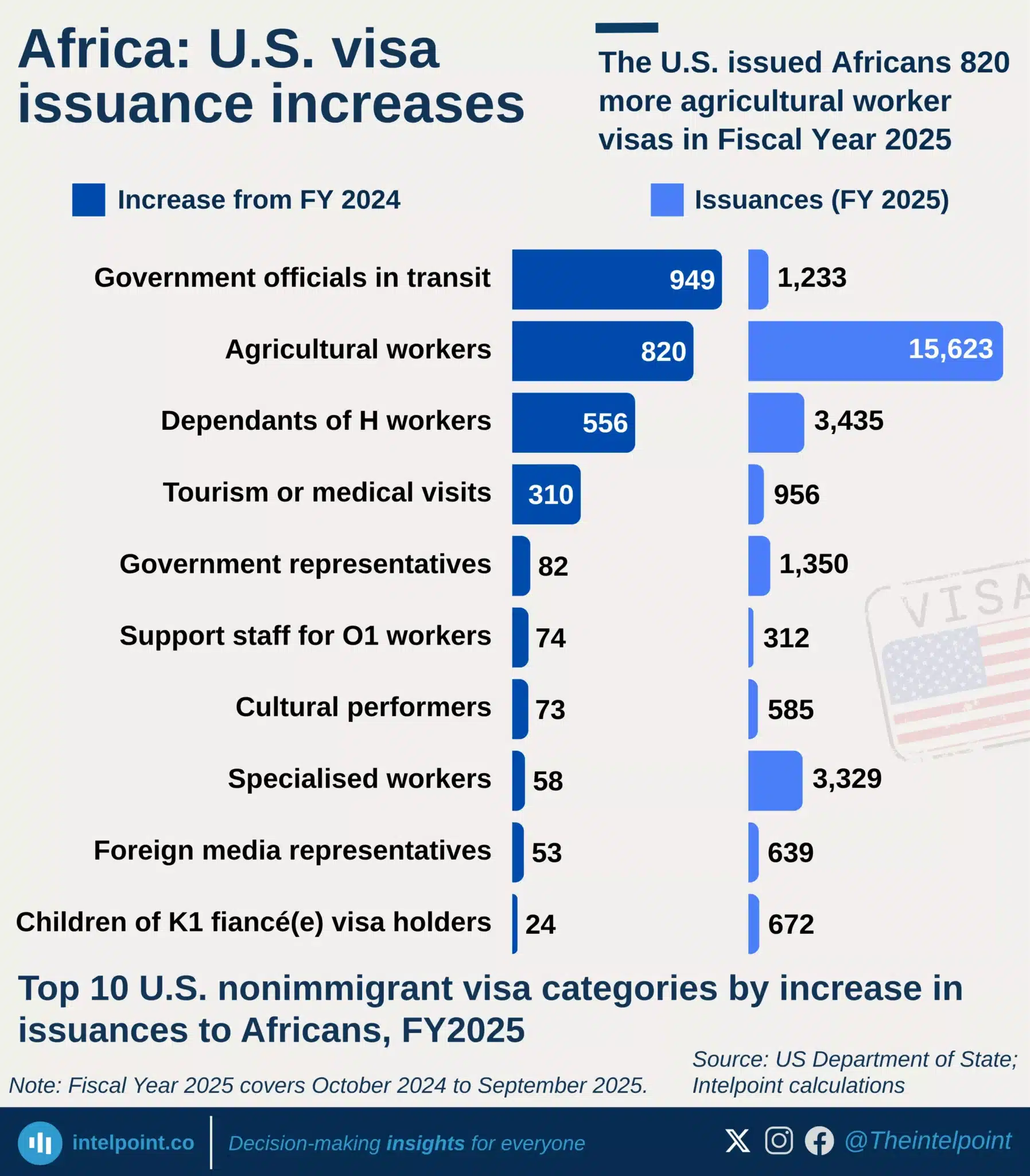
The U.S. issued Africans 820 more agricultural worker visas in Fiscal Year 2025
  • U.S. nonimmigrant visa issuances to Africans fell by 23.6% to 413,259.
  • Twenty-five visa categories still recorded increases despite the overall decline.
  • C3 visas posted the largest numerical increase, rising by 949.
  • H2A agricultural worker visas increased by 820 to 15,623.
  • B1/B2 visitor visas recorded the biggest decline, falling by 109,653.

14 African nations affected as the US expands temporary visa restrictions to include Nigeria
  • Africa is the hardest-hit region, with 14 countries under partial visa restrictions, including Nigeria, limiting travel for business, tourism, and study.
  • Temporary bans target B‑1/B‑2 visas for business and tourism, and may also affect F‑1 student, M‑1 vocational, and J exchange visitor visas, impacting students, trainees, and cultural exchange participants.
  • Other affected regions include the Caribbean, Asia, and South America, showing the temporary restrictions span multiple continents.
  • Exemptions exist for lawful permanent residents, diplomats, and travellers with valid pre-existing visas, so not all citizens from these countries are blocked from entering the US.
 

Nearly 2.8 million African-born immigrants live in the US as of 2023, led by Nigeria, Ethiopia, and Egypt
  • In 2023, the total number of African-born immigrants in the US was about 2.79 million.
  • Western Africa is the largest source region, contributing 1.08 million immigrants (39%), led by Nigeria (476k).
  • Eastern Africa is the second-largest source (28%), dominated by Ethiopia (278.2k).
  • Northern Africa accounts for 17%, mainly from Egypt (225.7k).
  • Central Africa contributes 8%, with Cameroon (90.7k) as the top country.
  • Southern Africa is smaller at 5%, almost entirely from South Africa (133.4k).
  • Five countries—Nigeria, Ethiopia, Egypt, Cameroon, and South Africa—together make up nearly half of all African-born immigrants in the US.

H-1B visa programme shows rising demand with 427k petitions filed in 2024
  • Petitions peaked in 2022, with 474,301 filed, but only 442,043 approved, marking the widest gap in the five-year period.
  • 2021 was unique, as approvals (407,071) actually exceeded the number of petitions filed (398,269), reflecting carryovers or adjustments from prior years.
  • 2023 saw the lowest filings and approvals, at just under 387,000 each, signalling reduced demand or stricter caps.
  • By 2024, filings rebounded to over 427,000, but approvals lagged at 399,402, continuing the trend of more petitions being filed than granted.

Nigerian nationals received 880 H-1B visas in FY 2024, with the highest number of approvals recorded in December 2023
  • Nigeria received a total of 880 H-1B visas in FY 2024, averaging about 73 per month.
  • December 2023 was the peak month, with 118 issuances, while June 2024 recorded the lowest at just 46.
  • Issuances fluctuated throughout the year, reflecting no clear upward trend but significant month-to-month volatility.
  • Despite peaks and dips, overall activity remained steady, with most months ranging between 60–90 approvals.

Africa secured just 1.5% of the US Skilled Worker (H-1B) Visas in 2024 — Nigeria tops the list
  • Nigeria ranked first in Africa, with 880 H-1B visas issued in FY 2024, far ahead of Ghana (499) and Egypt (364).
  • East and Southern Africa featured prominently, with Kenya (320), South Africa (208), and Zimbabwe (132) among the top 10.
  • North African representation was modest, with Morocco (78) and Egypt (364) being the only countries in the region on the list.
  • Despite these numbers, Africa’s collective total is marginal globally, especially compared to India’s ~150,000 issuances and China’s large volumes.
  • President Donald Trump’s $100,000 fee for new U.S. H-1B skilled worker visas will have limited impact on Africa, which has historically received only a small fraction of these visas.

POPULAR TOPICS
SIGN UP TO OUR NEWSLETTER
Get periodic updates about the African startup space, access to our reports, among others.
Subscribe Here
Subscription Form

A product of Techpoint Africa. All rights reserved