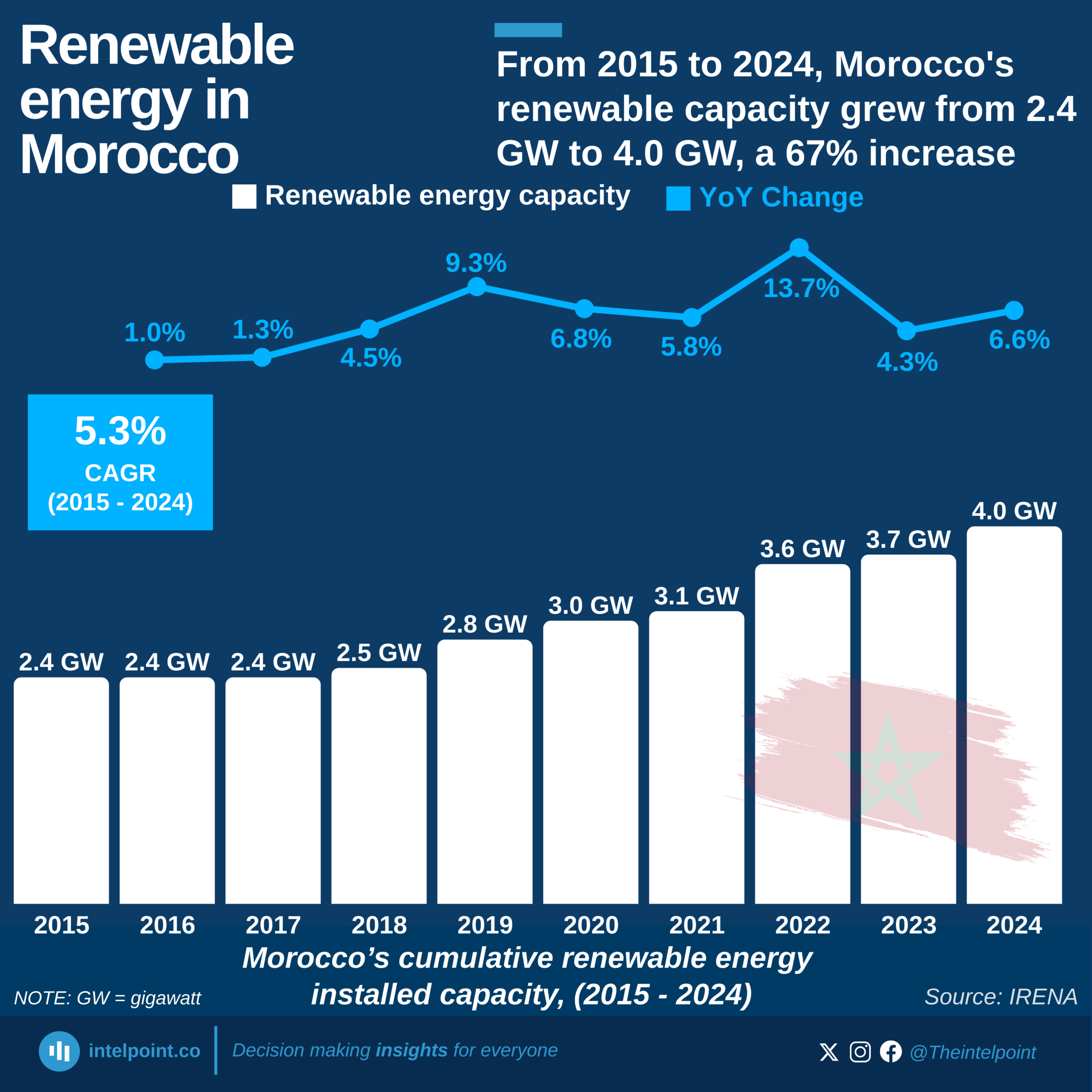
From 2015 to 2024, Morocco's renewable capacity grew from 2.4 GW to 4.0 GW, a 67% increase

  • Morocco’s renewable energy capacity grew from 2.4 GW in 2015 to 4.0 GW in 2024.
  • This represents a 67% increase over the decade.
  • The compound annual growth rate (CAGR) was 5.3% between 2015 and 2024.
  • Capacity was stagnant at 2.4 GW from 2015 to 2017 before growth resumed.
  • The biggest single-year increase happened in 2022, with a 13.7% jump.
  • Capacity additions slowed in 2023 (3.7 GW) and 2024 (4.0 GW).

Morocco has made consistent strides in expanding its renewable energy capacity over the last decade, increasing from 2.4 GW in 2015 to 4.0 GW in 2024. This represents a 67% increase, showing the country’s commitment to clean energy development. With a compound annual growth rate (CAGR) of 5.3% during this period, Morocco’s growth pattern reflects incremental progress rather than rapid expansion.

The country’s progress is a reminder that renewable energy transitions are not always dramatic leaps but often steady steps forward. Just as households gradually shift to solar panels or energy-efficient appliances, Morocco’s renewable growth shows that slow, consistent investments can still lead to meaningful change over time.

Notably, Morocco recorded its strongest annual growth in 2022, when capacity jumped from 3.1 GW to 3.6 GW — a 13.7% increase in just one year. However, the following years saw smaller gains, with capacity rising to 3.7 GW in 2023 and 4.0 GW in 2024.
Source:

IRENA

Period:

2015-2024
HTML code to embed chart
Want a bespoke report?
Reach out
Tags
Related Insights

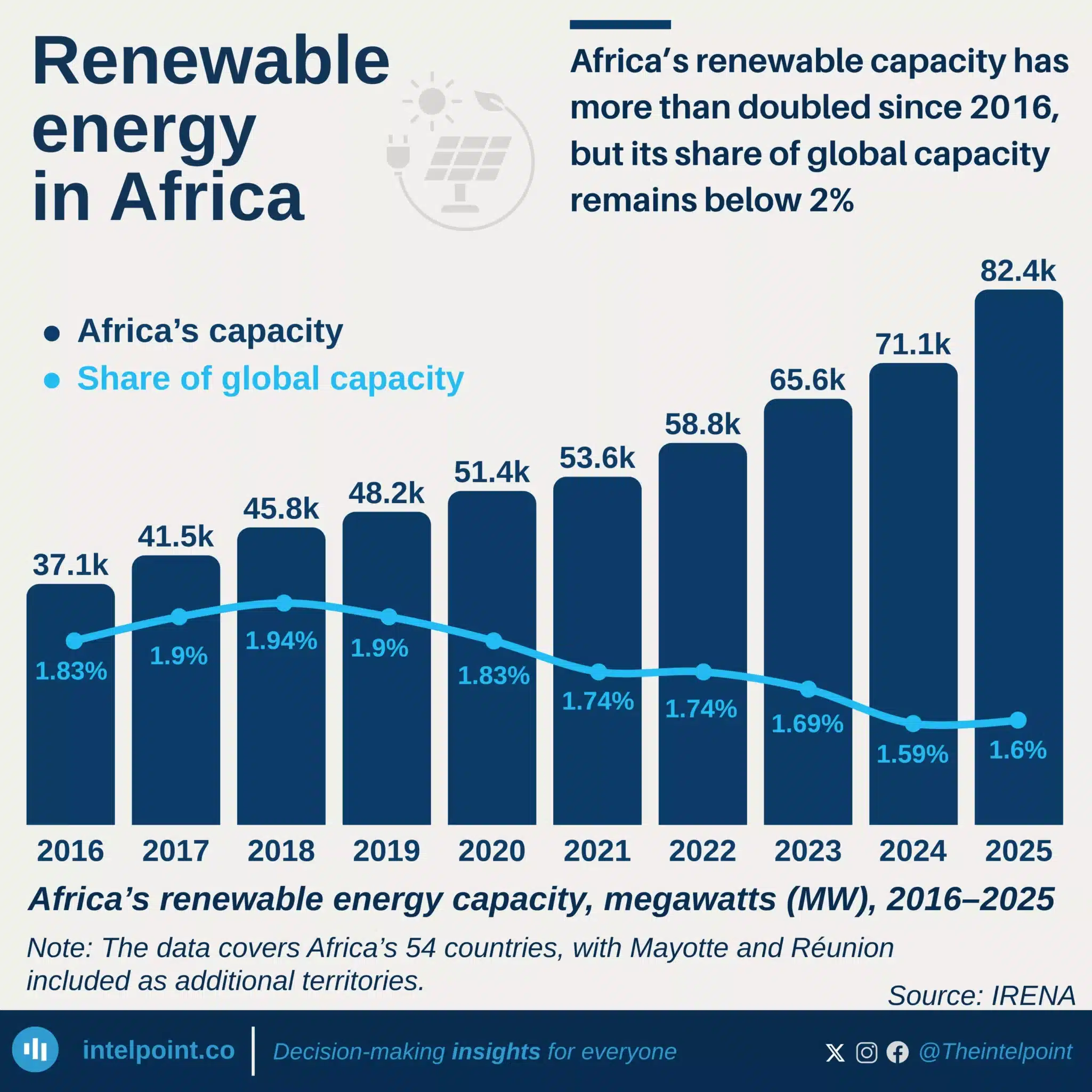
Africa’s renewable capacity has more than doubled since 2016, but its share of global capacity remains below 2%
  • About 600 million Africans still lack access to electricity.
  • Africa has 20% of the world's population but receives less than 3% of global energy investment.
  • South Africa added the most renewable capacity from 2016–2025, followed by Ethiopia, Egypt, Morocco and Tanzania.
  • Africa's renewable capacity is growing, but its share of global capacity remains small.

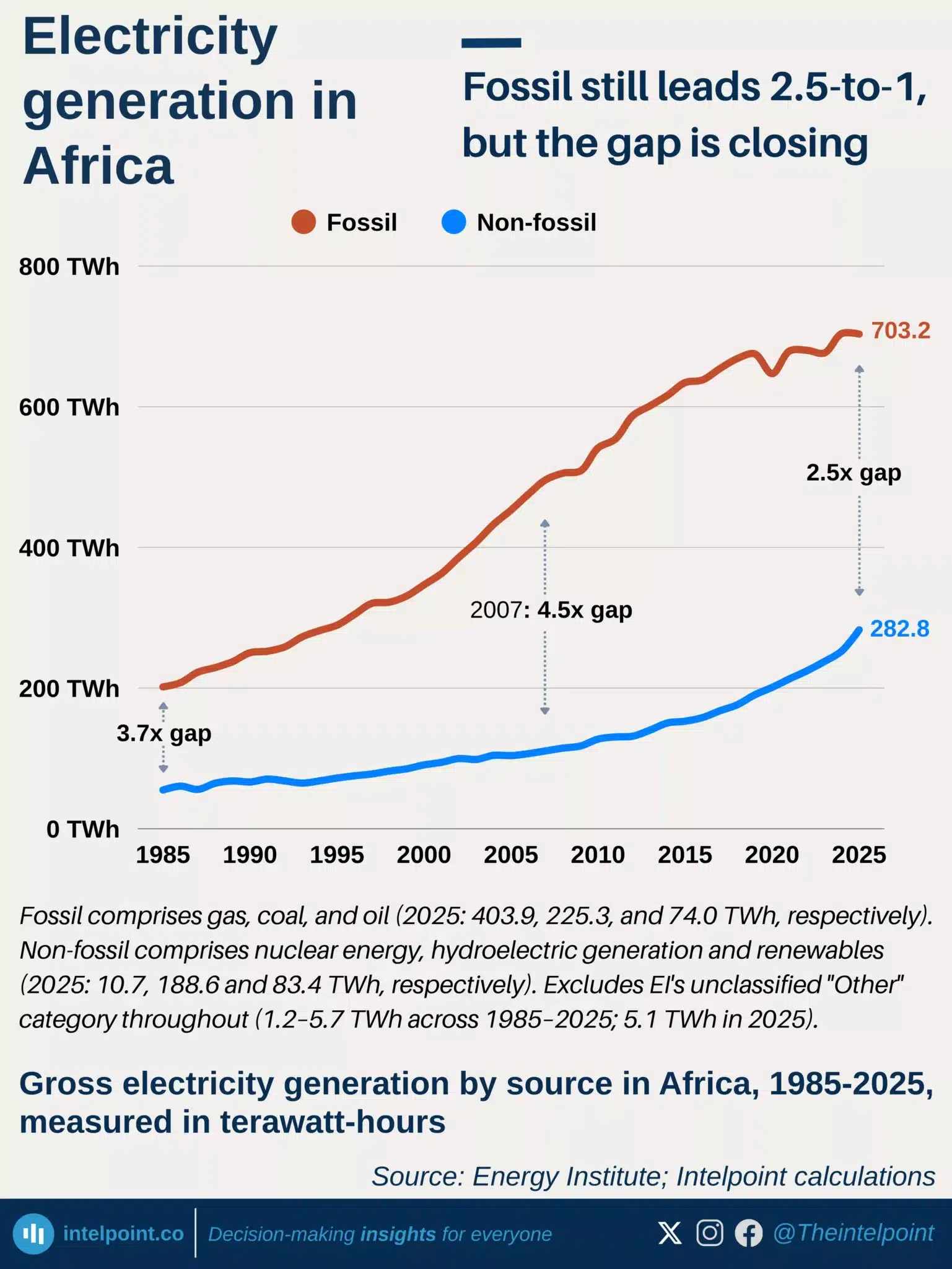
Electricity generation in Africa: fossil still leads 2.5-to-1, but the gap is closing
  • Fossil fuels still generate 2.5x more electricity than non-fossil sources, though the gap has narrowed from a 2007 peak of 4.5x.
  • South Africa and Egypt together account for all of Africa's nuclear power and 59% of its non-hydro renewables.
  • Hydropower, the largest non-fossil source at 188.6 TWh, tells a different geographic story, with 91% generated outside South Africa and Egypt, mainly in Eastern, Middle, and Western Africa.
  • Gas still leads at 403.9 TWh, but its growth slowed to 0.8% in 2025 versus 11.9% growth for non-fossil sources.

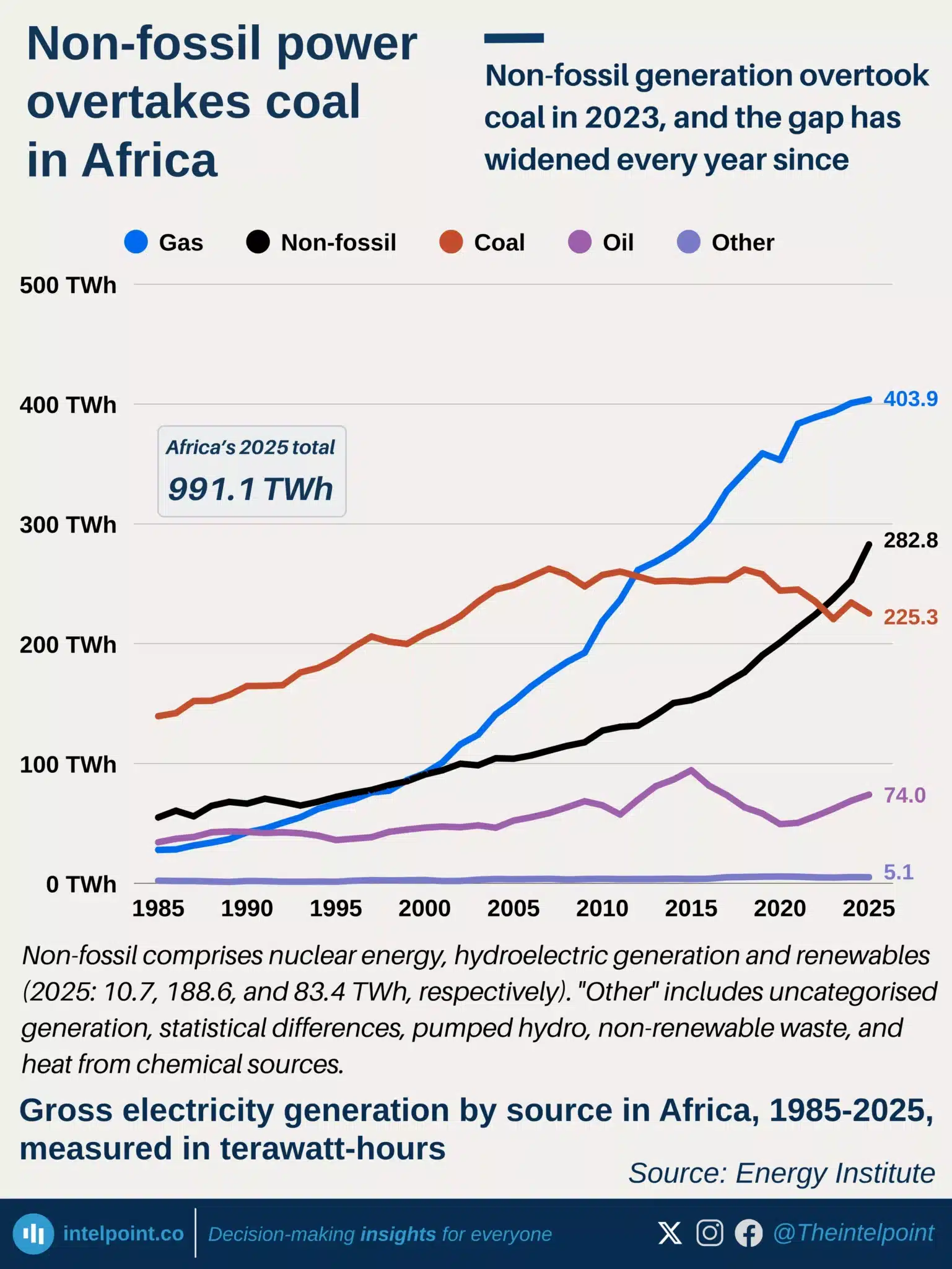
Non-fossil generation overtook coal in 2023, and the gap has widened every year since
  • Non-fossil generation overtook coal in 2023, with the gap reaching 57.5 TWh in 2025.
  • Coal generation fell to 225.3 TWh, below its 262.6 TWh peak in 2007.
  • Hydropower dominates non-fossil generation, producing 188.6 TWh in 2025.
  • Fossil fuels still dominate, generating 703.2 TWh versus 282.8 TWh from non-fossil sources.

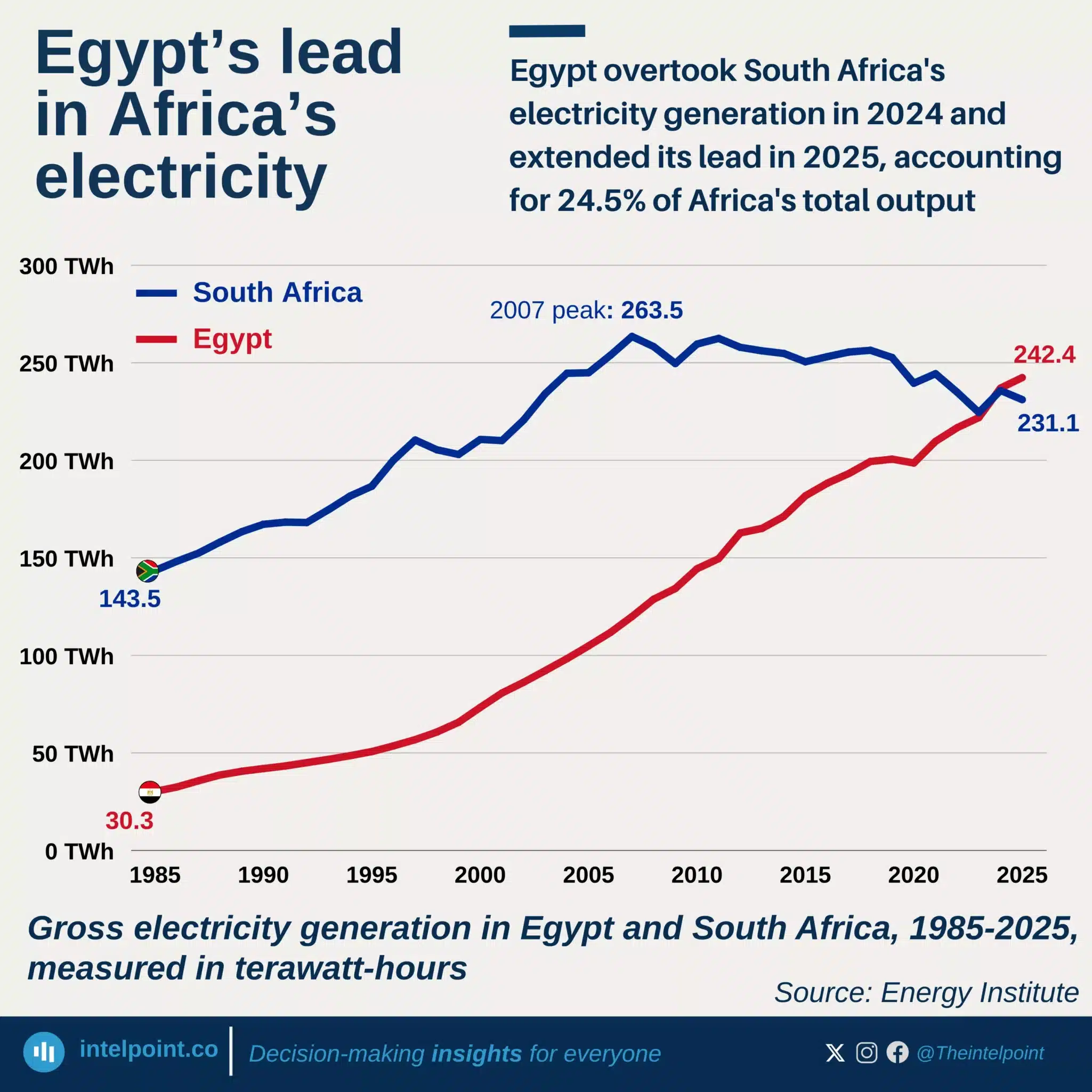
Egypt overtook South Africa's electricity generation in 2024 and extended its lead in 2025
  • Africa’s share of global electricity generation rose only from 2.6% in 1985 to 3.1% in 2025.
  • Africa’s electricity generation increased 283% over the past 40 years.
  • Egypt overtook South Africa as Africa’s largest electricity producer in 2024.
  • Egypt generated 242.4 TWh in 2025, up from 30.3 TWh in 1985.
  • South Africa generated 231.1 TWh in 2025, down from its 263.5 TWh peak in 2007.
  • Egypt and South Africa accounted for 24.5% of Africa’s electricity generation in 2025.

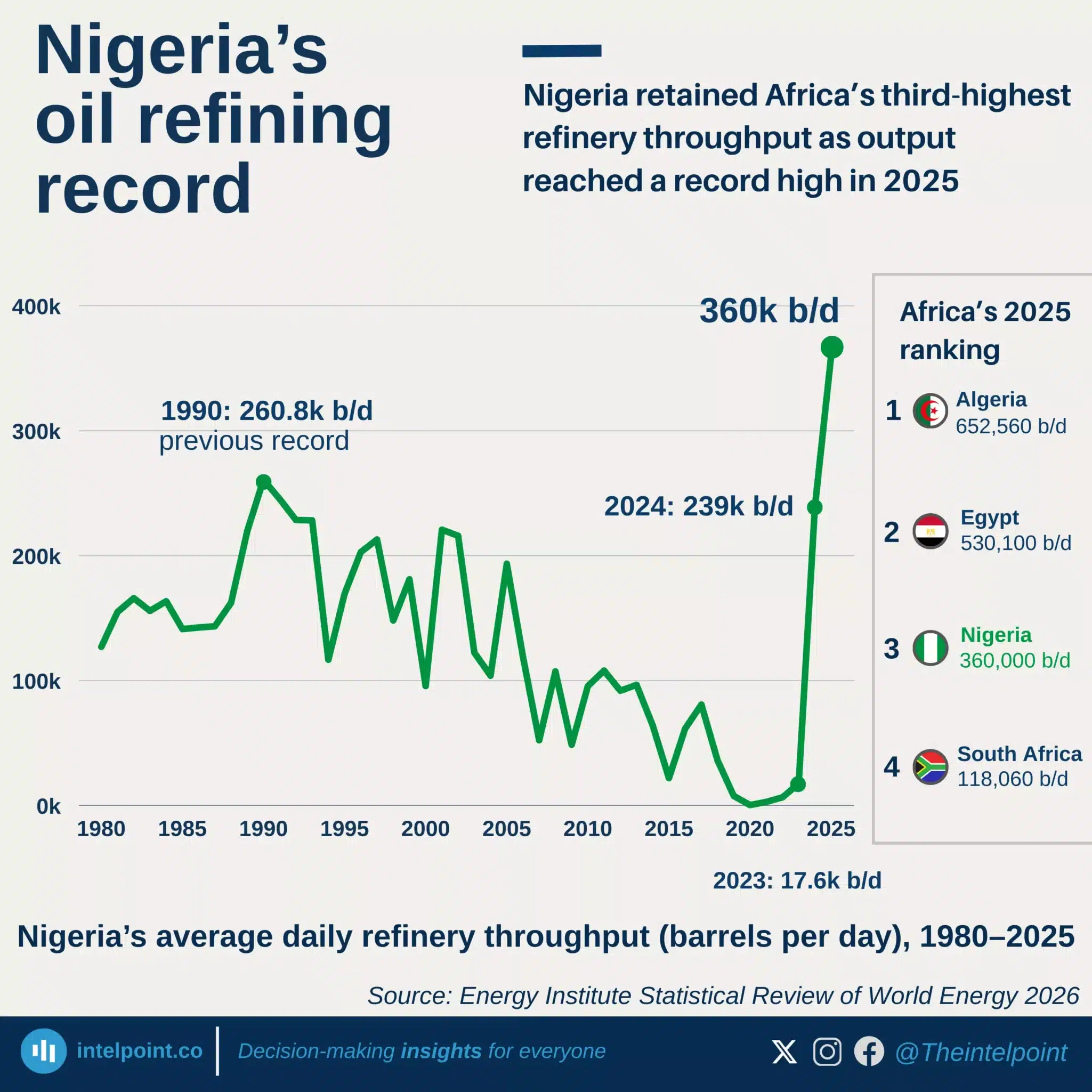
Nigeria retained Africa’s third-highest refinery throughput as output reached a record high in 2025
  • Nigeria recorded its highest refinery throughput since 1990 at 360,000 b/d.
  • Throughput increased by 50.6% from 239,000 b/d in 2024.
  • The 2025 level was more than 20 times the 17,600 b/d recorded in 2023.
  • Nigeria remained Africa’s third-highest, behind Algeria and Egypt.
  • Dangote’s contribution is not reported separately.

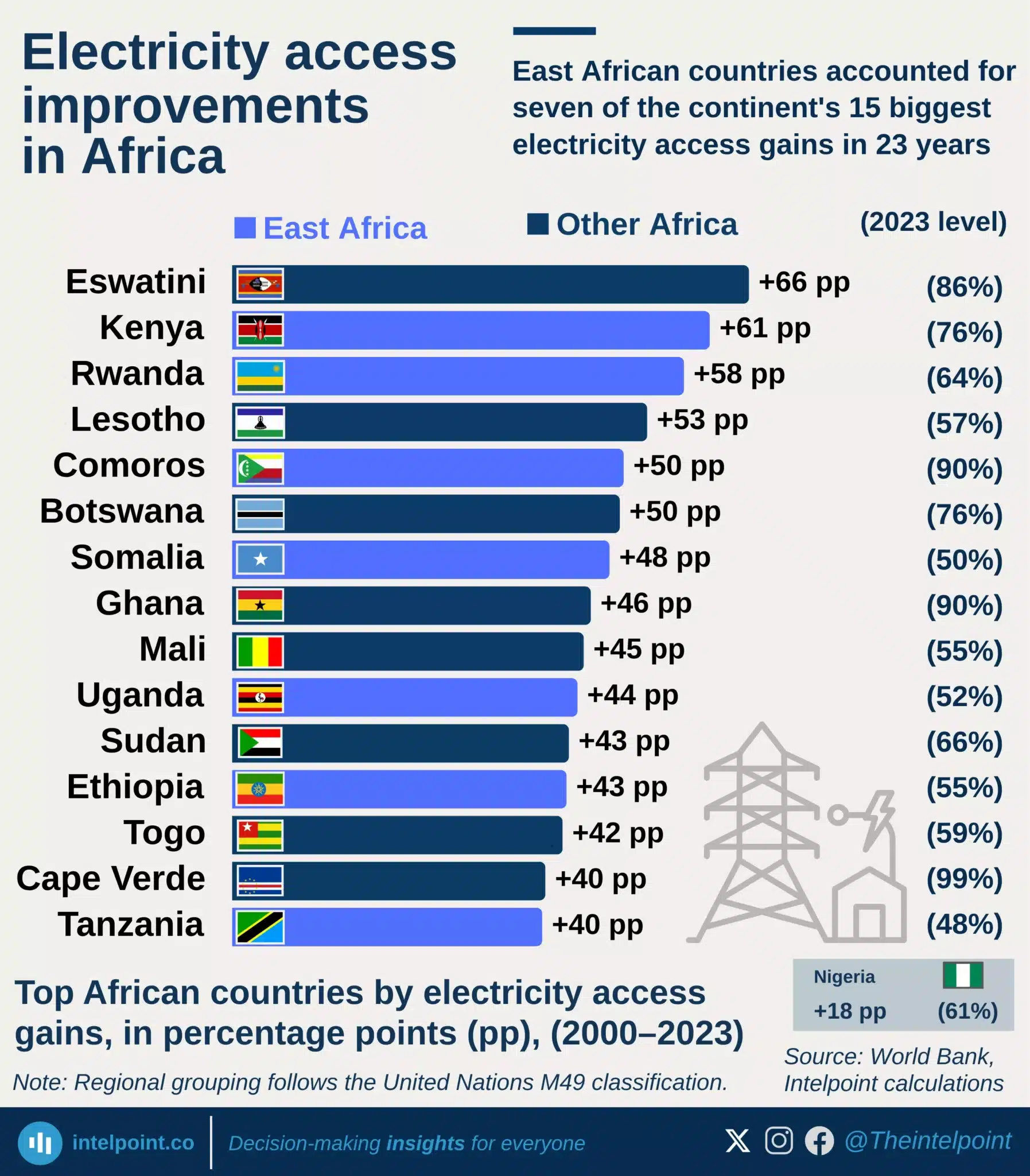
East African countries accounted for seven of the continent's 15 biggest electricity access gains in 23 years
  • Eswatini recorded Africa’s largest electricity access gain, rising by 66 percentage points from 2000 to 2023.
  • Kenya and Rwanda followed with gains of 61 pp and 58 pp, respectively.
  • East African countries accounted for 7 of Africa’s top 15 electricity access improvements.
  • Comoros, Ghana and Cape Verde reached very high access levels by 2023, at 90%, 90% and 99% respectively.
  • Nigeria’s electricity access improved by 18 percentage points, from 43% in 2000 to 61% in 2023.
  • Despite that improvement, Nigeria remained outside Africa’s top 15 gainers over the period.
  • Some countries were absent from the ranking because they had already reached high access levels by 2000.

POPULAR TOPICS
SIGN UP TO OUR NEWSLETTER
Get periodic updates about the African startup space, access to our reports, among others.
Subscribe Here
Subscription Form

A product of Techpoint Africa. All rights reserved