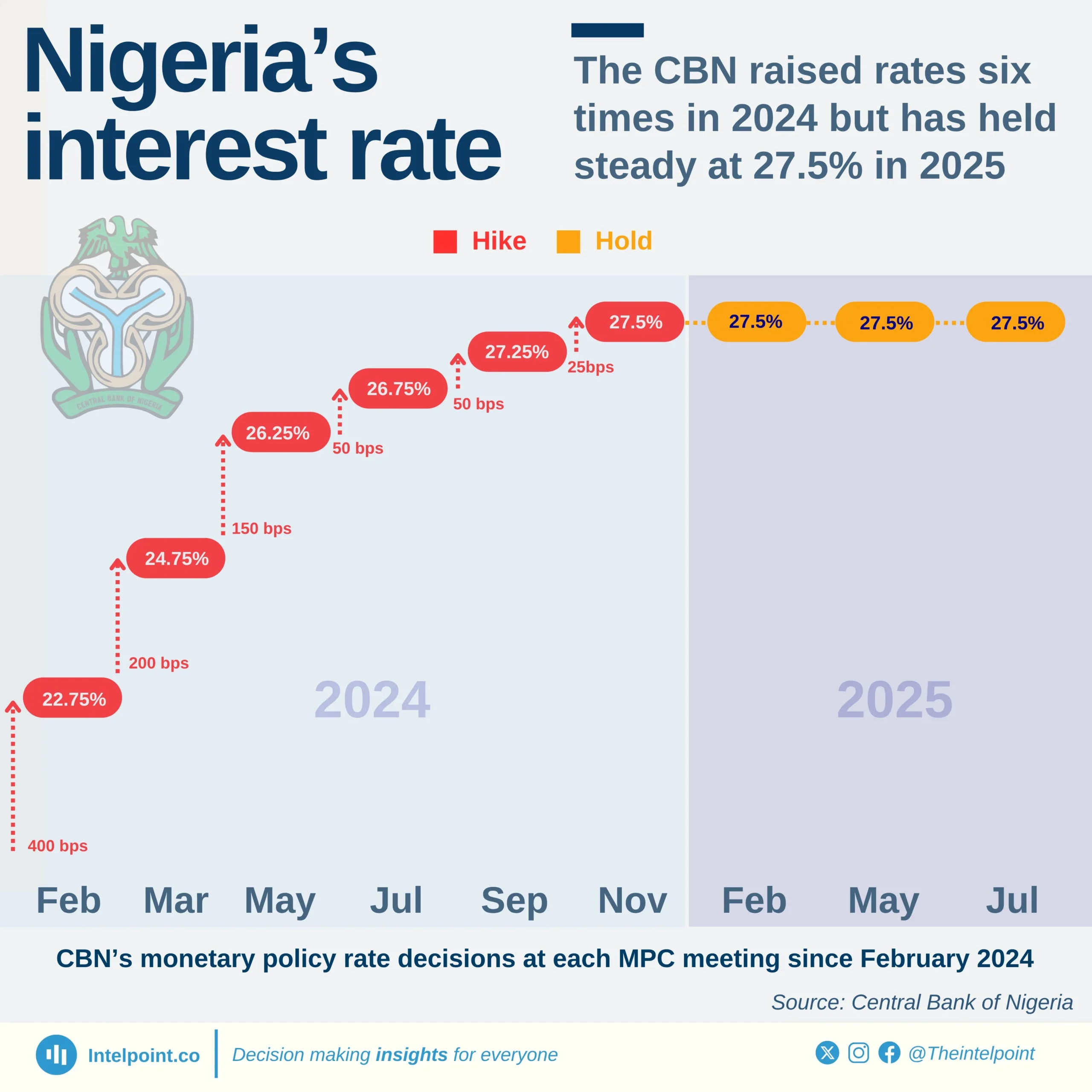
The CBN raised rates six times in 2024 but has held steady at 27.5% in 2025

Key Takeaways

  • Over six MPC meetings from February to November 2024, the MPR rose cumulatively by 875 basis points, ending the year at 27.5%.
  • The pace of increases slowed after March: from 200 bps (Feb–Mar) to just 25 bps (Sept–Nov), reflecting a tapering hike strategy.
  • Since November 2024, the CBN has maintained the rate at 27.5% across four consecutive MPC meetings into July 2025.
  • The 2024 cycle was dominated by aggressive rate hikes aimed at stabilising inflation and exchange rate volatility.
  • The CBN’s interest rate strategy appears more restrained in 2025, indicating a possible pause phase in the monetary policy cycle.

Since Olayemi Cardoso took office as CBN governor, the Monetary Policy Committee has raised the interest rate from 18.75% to 27.5% across six meetings in 2024, beginning with a sharp 400 basis points hike in February. The pace of tightening slowed progressively through the year, and since November 2024, the rate has been held steady at 27.5% across four MPC meetings in 2025, signalling a shift from aggressive inflation-fighting to a more cautious, stabilisation-focused approach.
Source:

Central Bank of Nigeria

Period:

February 2024 - Present
HTML code to embed chart
Want a bespoke report?
Reach out
Tags
Related Insights

Portfolio investment into Nigeria hit a 13-year quarterly high in Q1 2026
  • Portfolio investment into Nigeria reached $9.86 billion in Q1 2026, the highest quarterly level in 51 quarters.
  • The Q1 2026 portfolio inflow was higher than the previous peak of $7.11 billion recorded in Q1 2019.
  • Portfolio investment accounted for 95% of Nigeria’s total capital importation in Q1 2026.
  • Foreign Direct Investment remained low at $135 million, far below portfolio inflows.
  • Other Investment stood at $374 million, making it the second-largest inflow category in Q1 2026.

Three African countries are projected to have debt exceeding their GDP in 2026
  • Sudan is projected to have Africa’s highest debt-to-GDP ratio in 2026, at 169.1%.
  • Only three African countries are projected to owe more than the size of their economies in 2026.
  • Senegal and Mozambique join Sudan among countries with debt-to-GDP ratios above 100%.
  • Africa’s average government debt-to-GDP ratio is projected at 60.7% in 2026.
  • Nigeria’s projected debt-to-GDP ratio of 32.3% is far below the African average.

Every food item tracked has at least doubled in price since May 2023
  • Every comparable food item tracked is now at least twice as expensive as it was in May 2023.
  • Nearly half of the selected food items have more than tripled in price since the month before fuel subsidy removal.
  • Unripe plantain recorded the steepest increase, rising by 469% between May 2023 and April 2026.
  • Ripe plantain, yam tuber, and fresh tilapia also saw extreme increases of more than 300%.
  • Even the slowest-rising staples, including frozen chicken, beans, gari, and maize, still more than doubled in price.

Healthy diet costs rose fastest in Nigeria’s North-West over two years
  • Healthy diet costs rose 49% nationally in two years.
  • North-West states recorded the fastest increases.
  • All seven North-West states rose above the national average.
  • Katsina and Kogi recorded the steepest increases, at 98%.
  • Akwa Ibom had the lowest increase, at 5%.

One adult’s monthly healthy diet takes two-thirds of minimum wage
  • One adult’s healthy diet takes 66% of Nigeria’s minimum wage.
  • The national average monthly cost is about ₦46,230 per adult.
  • Ekiti has the highest burden, at 90% of minimum wage.
  • Six states require over 80% of minimum wage for one adult’s healthy diet.
  • Adamawa has the lowest burden, at 43%.

GTCO turned ₦40 of every ₦100 earned into profit
  • GTCO had the strongest profit conversion in 2025.
  • GTCO turned about ₦40 of every ₦100 earned into profit.
  • Stanbic IBTC followed with about ₦34 profit per ₦100 earned.
  • Zenith made the highest profit, but not the strongest conversion.
  • First HoldCo had the weakest profit conversion among the banks reviewed.
 

POPULAR TOPICS
SIGN UP TO OUR NEWSLETTER
Get periodic updates about the African startup space, access to our reports, among others.
Subscribe Here
Subscription Form

A product of Techpoint Africa. All rights reserved