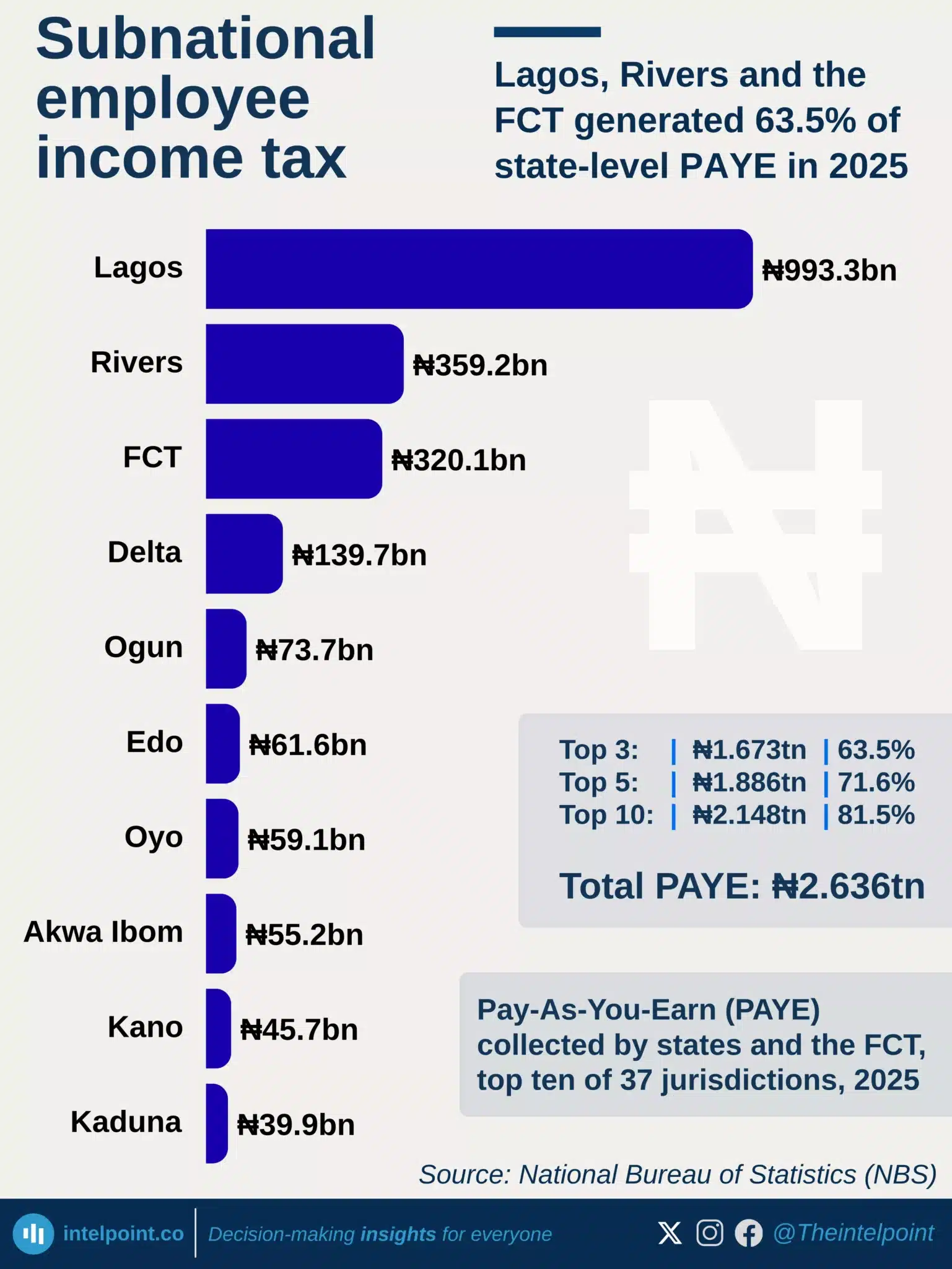
Lagos, Rivers and the FCT generated 63.5% of state-level PAYE in 2025

Key Takeaways

  • Lagos, Rivers and the FCT collected 63.5% of state-level PAYE in 2025.
  • Lagos collected ₦993.3 billion in PAYE, more than the next five jurisdictions combined.
  • The top 10 jurisdictions accounted for 81.5% of ₦2.636 trillion in total PAYE.
  • The bottom five jurisdictions collected ₦47.0 billion combined, less than 2% of the total.
  • Delta collected ₦139.7 billion, less than half of the FCT’s ₦320.1 billion.

Lagos, Rivers and the FCT generated 63.5% of state-level PAYE, the income tax deducted from workers' salaries, in 2025. Together they collected ₦1.673 trillion of the ₦2.636 trillion total, and Lagos alone collected ₦993.3 billion, more than the next five jurisdictions combined and 2.8 times Rivers, the second highest.

Delta, in fourth place, collected ₦139.7 billion, less than half of the FCT's ₦320.1 billion. The top 10 accounted for 81.5%, while the bottom five collected ₦47.0 billion between them, under 2% of the total.
Source:

National Bureau of Statistics

Period:

2025
HTML code to embed chart
Want a bespoke report?
Reach out
Tags
Related Insights

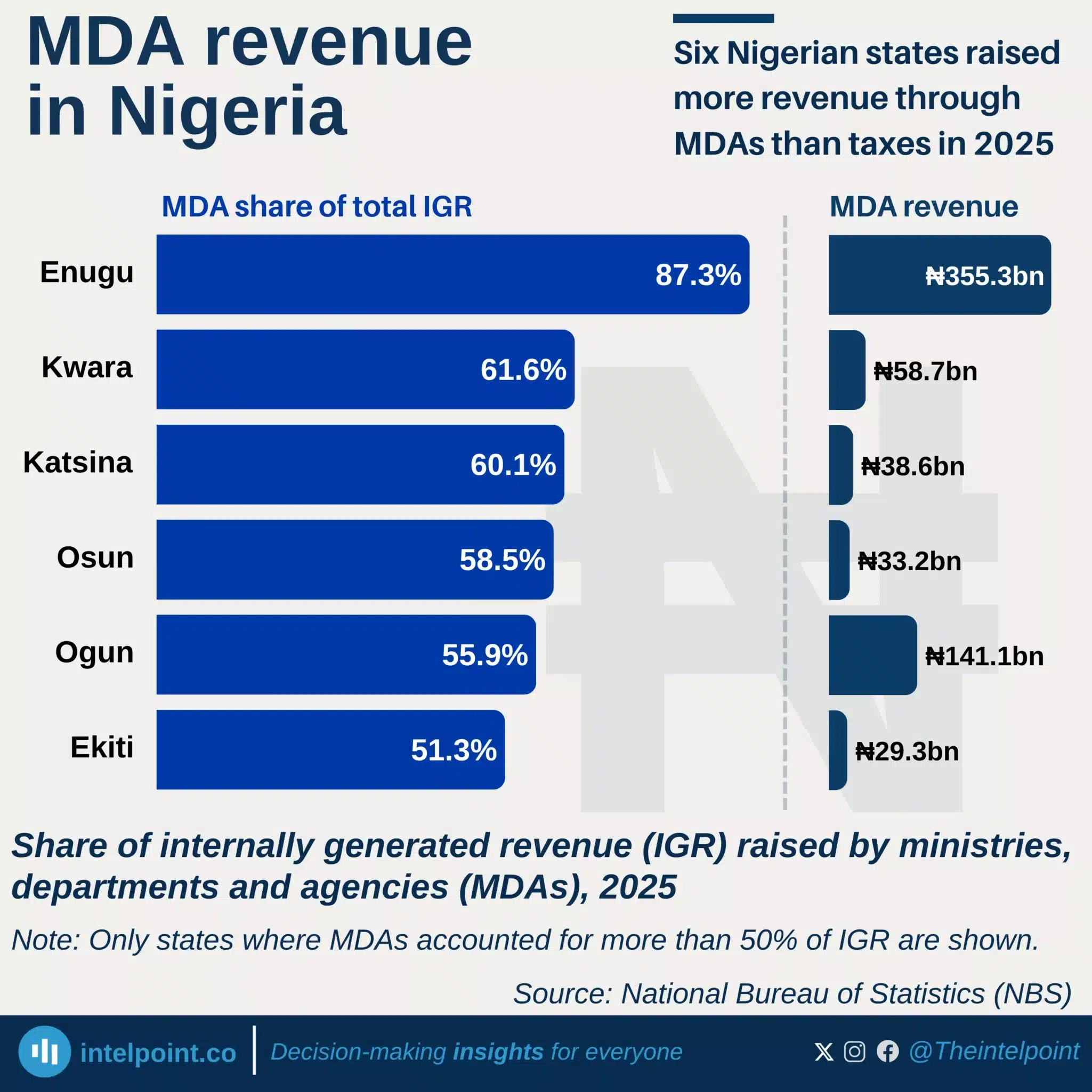
Six Nigerian states raised more revenue through MDAs than taxes in 2025
  • Six states generated about ₦656 billion through MDAs in 2025, nearly half of all MDA revenue.
  • The number of states where MDAs accounted for over half of IGR fell from seven in 2024 to six in 2025.
  • Enugu’s MDA share rose from 82.9% in 2024 to 87.3% in 2025, widening its lead.
  • Kwara, Katsina and Osun recorded MDA shares of 61.6%, 60.1% and 58.5%, respectively.

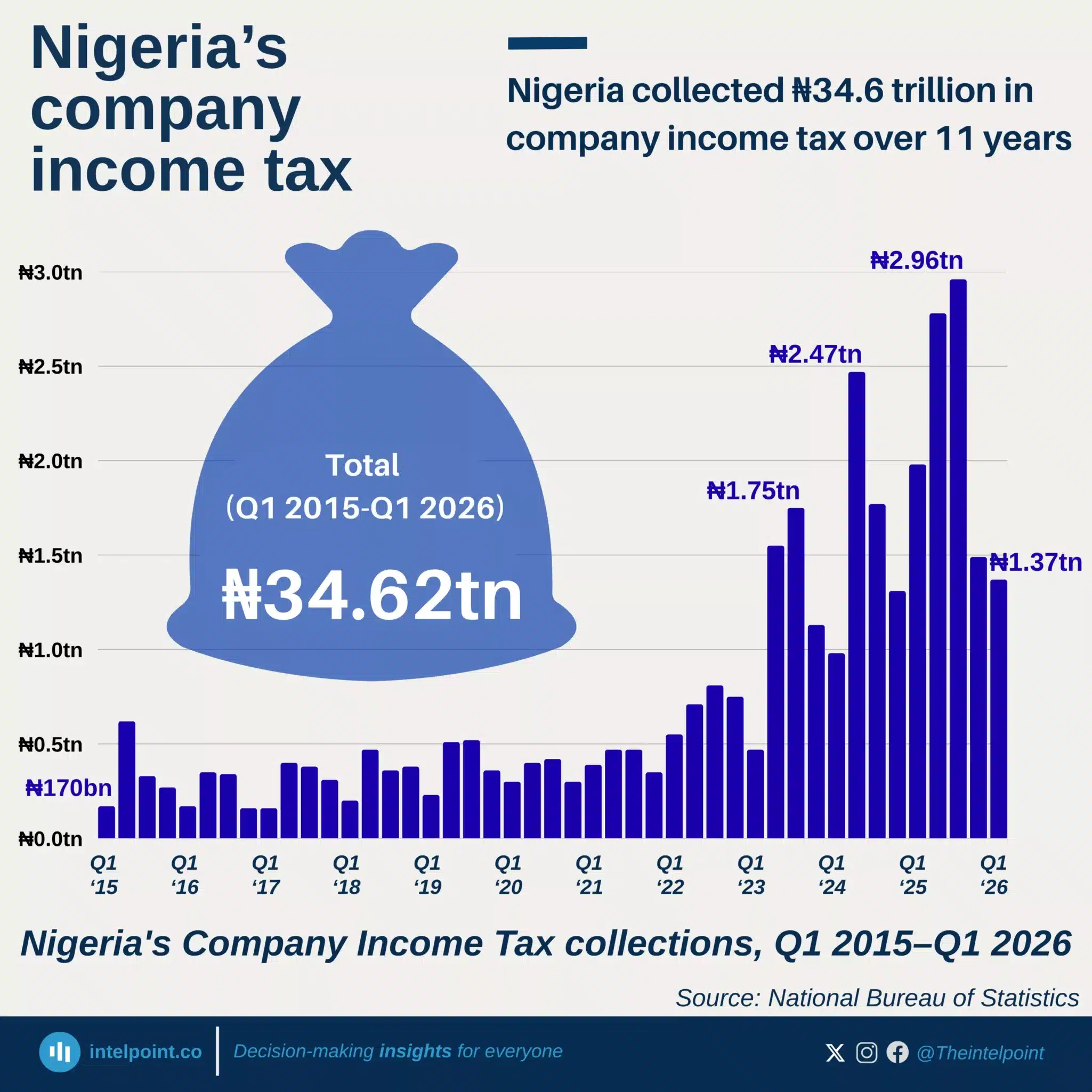
Nigeria collected ₦34.6 trillion in company income tax over 11 years
  • Nigeria collected ₦34.62 trillion in company income tax across 45 quarters from Q1 2015 to Q1 2026.
  • Average quarterly collection stood at about ₦769 billion over the period.
  • CIT collections stayed below ₦1 trillion in every quarter until Q2 2023.
  • Since Q2 2024, collections have remained above ₦1 trillion for eight straight quarters.
  • The highest quarterly collection was ₦2.96 trillion in Q3 2025.
  • Annual CIT collections rose sharply from ₦2.82 trillion in 2022 to ₦9.21 trillion in 2025.
  • The recent surge is nominal and likely reflects stronger collections, inflation, naira depreciation, and higher naira-value foreign CIT receipts.

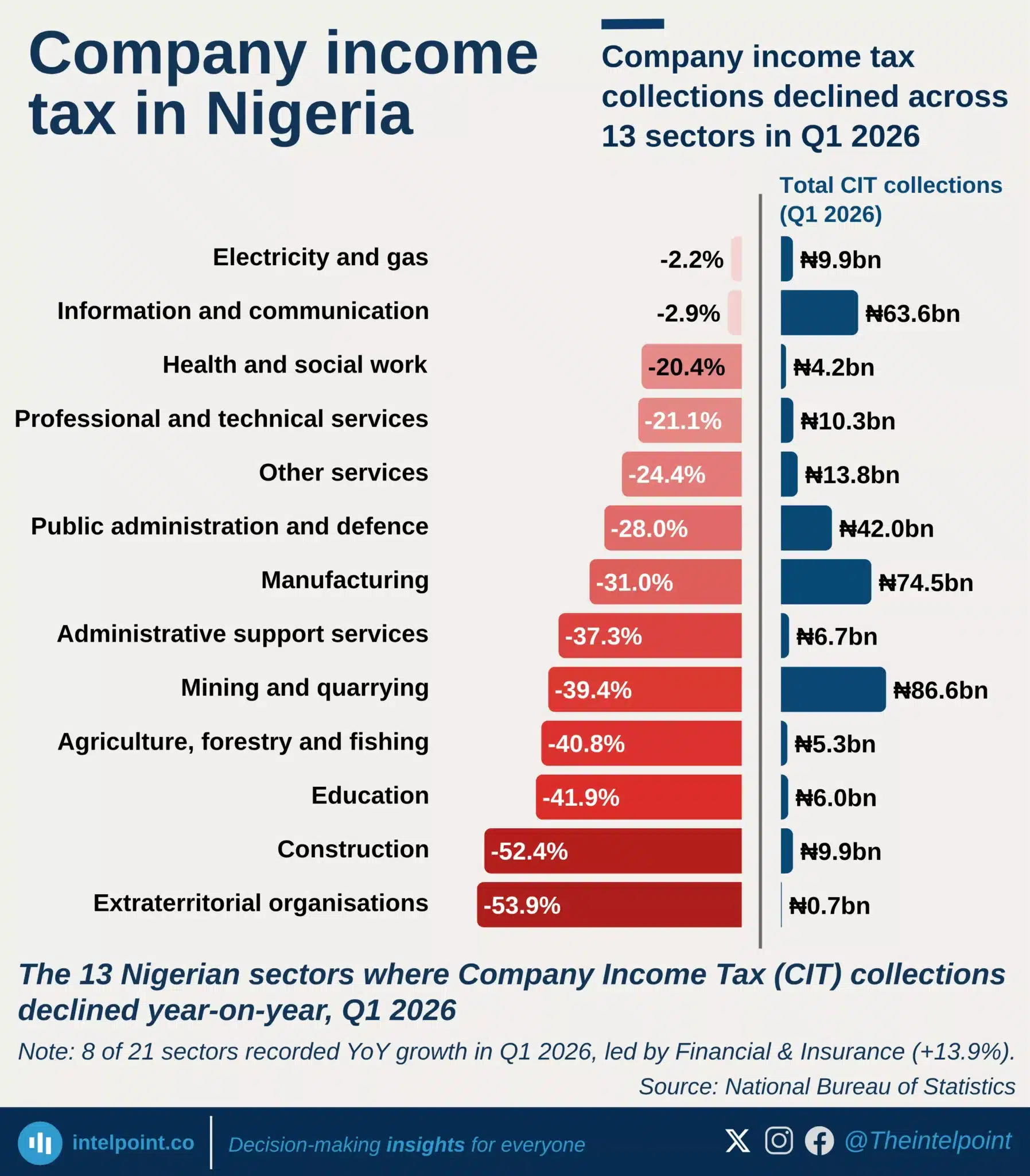
Company income tax collections declined across 13 sectors in Q1 2026
  • Thirteen of Nigeria’s 21 sectors recorded year-on-year declines in CIT collections.
  • Extraterritorial organisations recorded the steepest fall at 53.9%.
  • Construction collections fell by 52.4%, the second-largest decline.
  • Mining and agriculture declined by 39.4% and 40.8%, respectively.
  • Manufacturing still generated ₦74.5 billion despite a 31.0% decline.

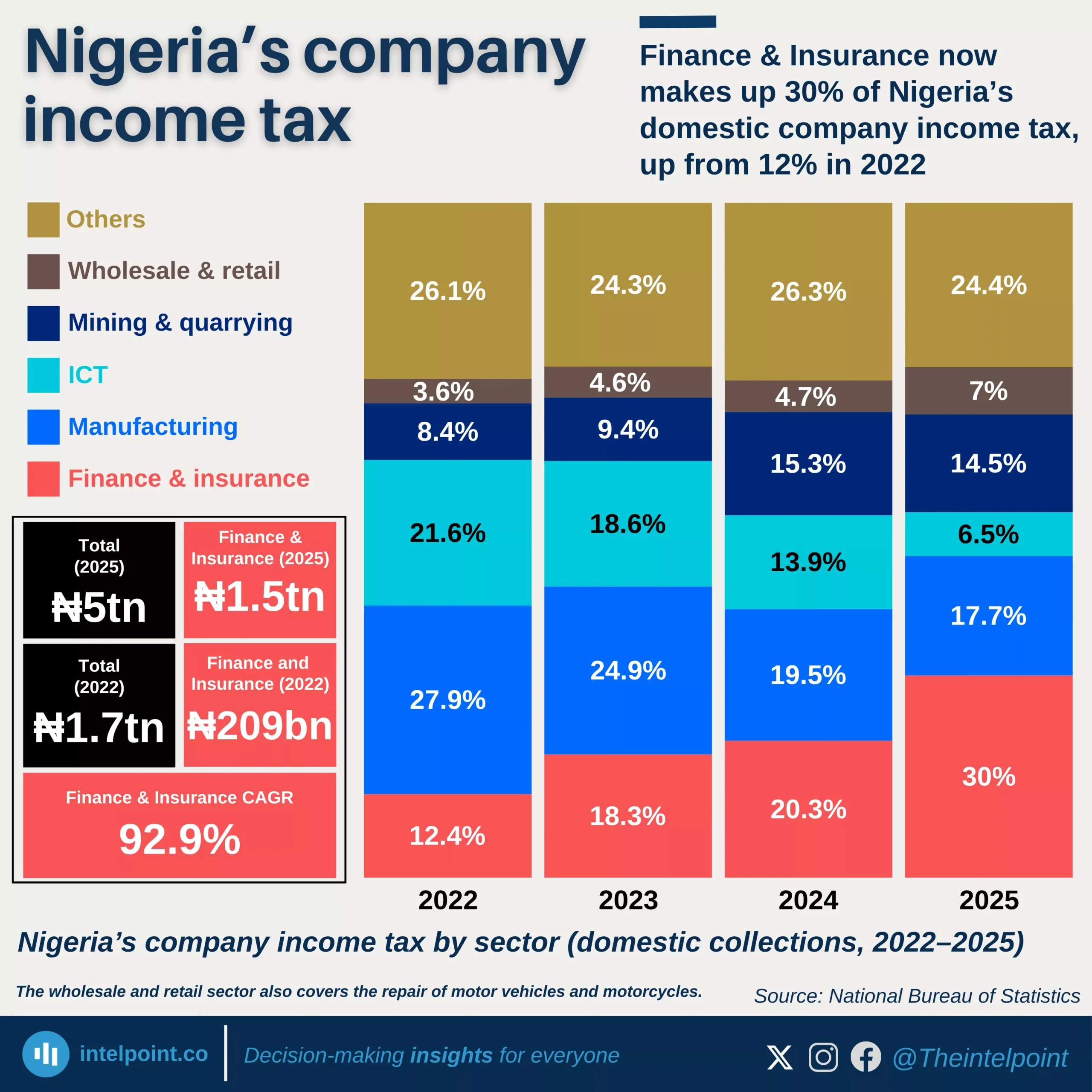
Finance & Insurance now makes up 30% of Nigeria’s domestic company income tax, up from 12% in 2022
  • Company income tax collections rose from ₦1.7tn in 2022 to ₦5.0tn in 2025.
  • Finance & Insurance more than doubled its share, from 12.4% to 30.0%.
  • Finance became the largest single sector in the tax mix by 2025.
  • Manufacturing remained important, but its share fell from 27.9% to 17.7%.
  • ICT saw one of the sharpest declines, from 21.6% to 6.5%.
  • Mining & quarrying gained weight, rising from 8.4% to 14.5%.
  • Wholesale & retail also increased, from 3.6% to 7.0%.
  • The tax base became less evenly distributed across sectors.

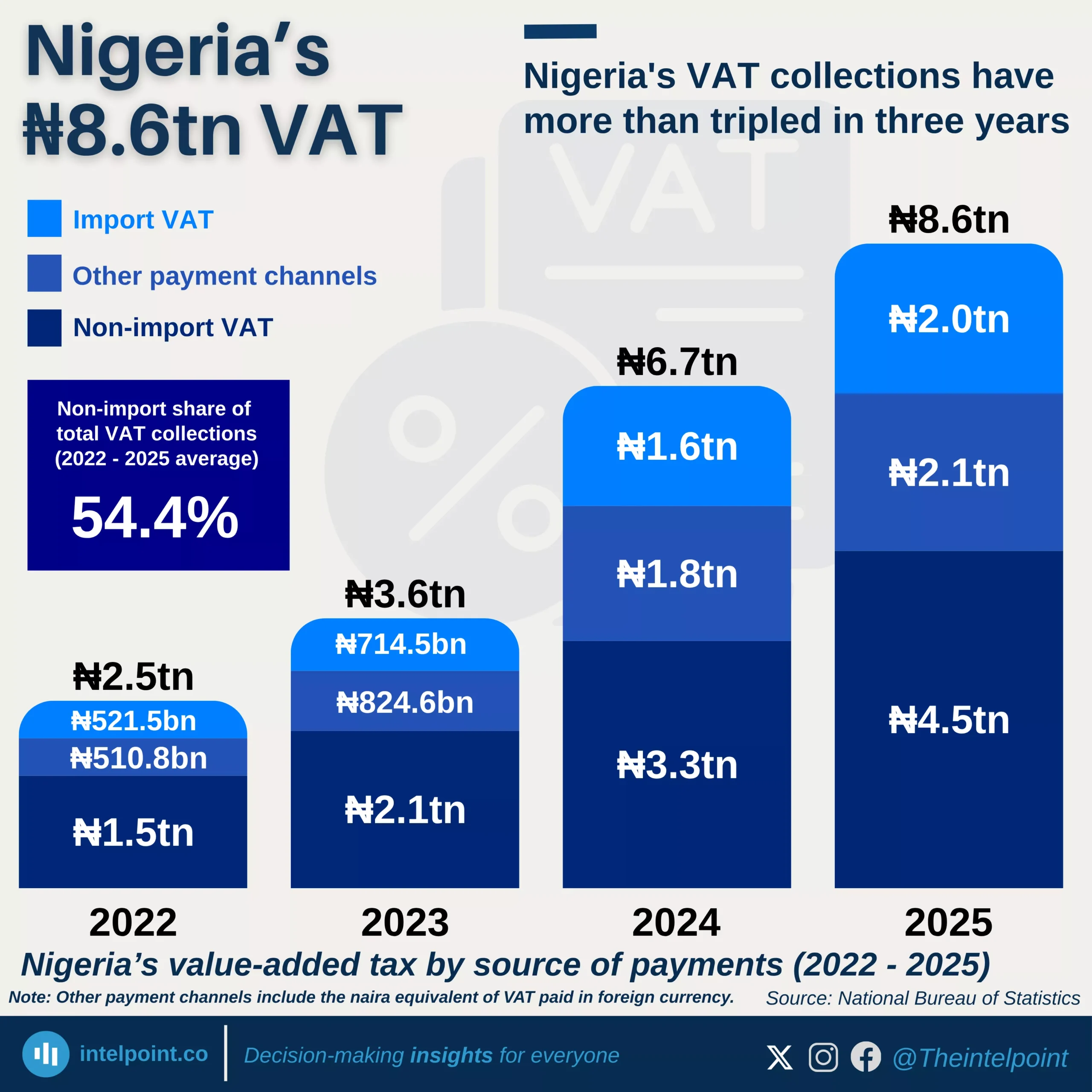
Nigeria's VAT collections have more than tripled in three years
  • Nigeria’s total VAT rose from ₦2.5tn in 2022 to ₦8.6tn in 2025.
  • VAT collections more than tripled in four years.
  • Local VAT remained the largest source of VAT throughout the period.
  • Local VAT increased from ₦1.5tn to ₦4.5tn.
  • Local VAT averaged 54.4% of total VAT between 2022 and 2025.
  • Import VAT also grew strongly, from ₦521.5bn to ₦2.0tn.
  • Other payment channels rose from ₦510.8bn to ₦2.1tn.
  • VAT growth is increasingly being driven by non-import activity.

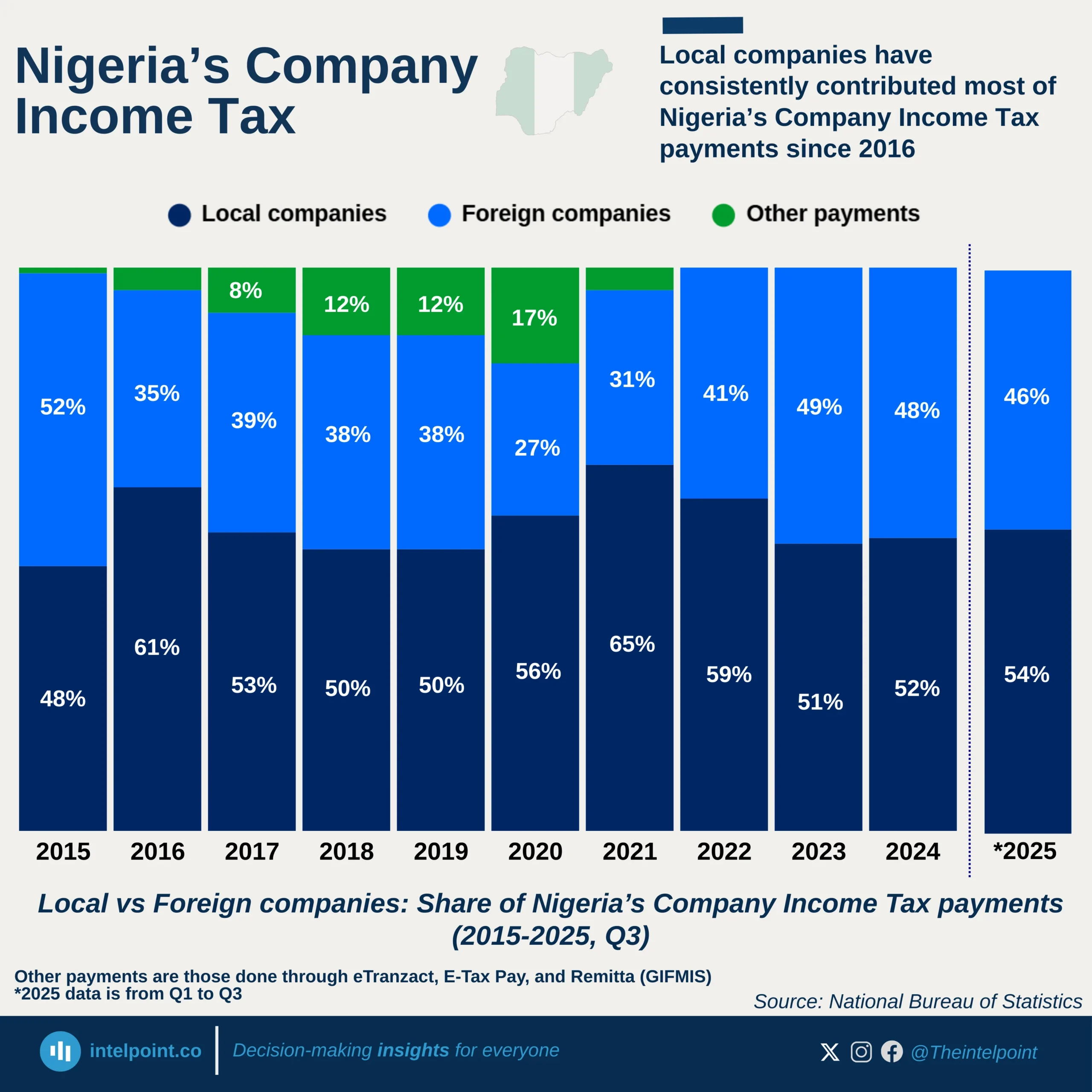
Local companies have consistently contributed most of Nigeria’s Company Income Tax payments since 2016
  • Local companies dominated CIT contributions in most years, accounting for over 50% of payments in 9 of 11 periods between 2015 and 2025 (Q1–Q3).
  • Foreign companies briefly closed the gap in 2023, contributing 49%, the closest they have come to matching local firms.
  • Local companies recorded their strongest share in 2021 at 65%, marking the widest gap between local and foreign contributors.
  • “Other payments” peaked during the pandemic, rising to 17% in 2020 before dropping to 0% from 2022 onward.

POPULAR TOPICS
SIGN UP TO OUR NEWSLETTER
Get periodic updates about the African startup space, access to our reports, among others.
Subscribe Here
Subscription Form

A product of Techpoint Africa. All rights reserved