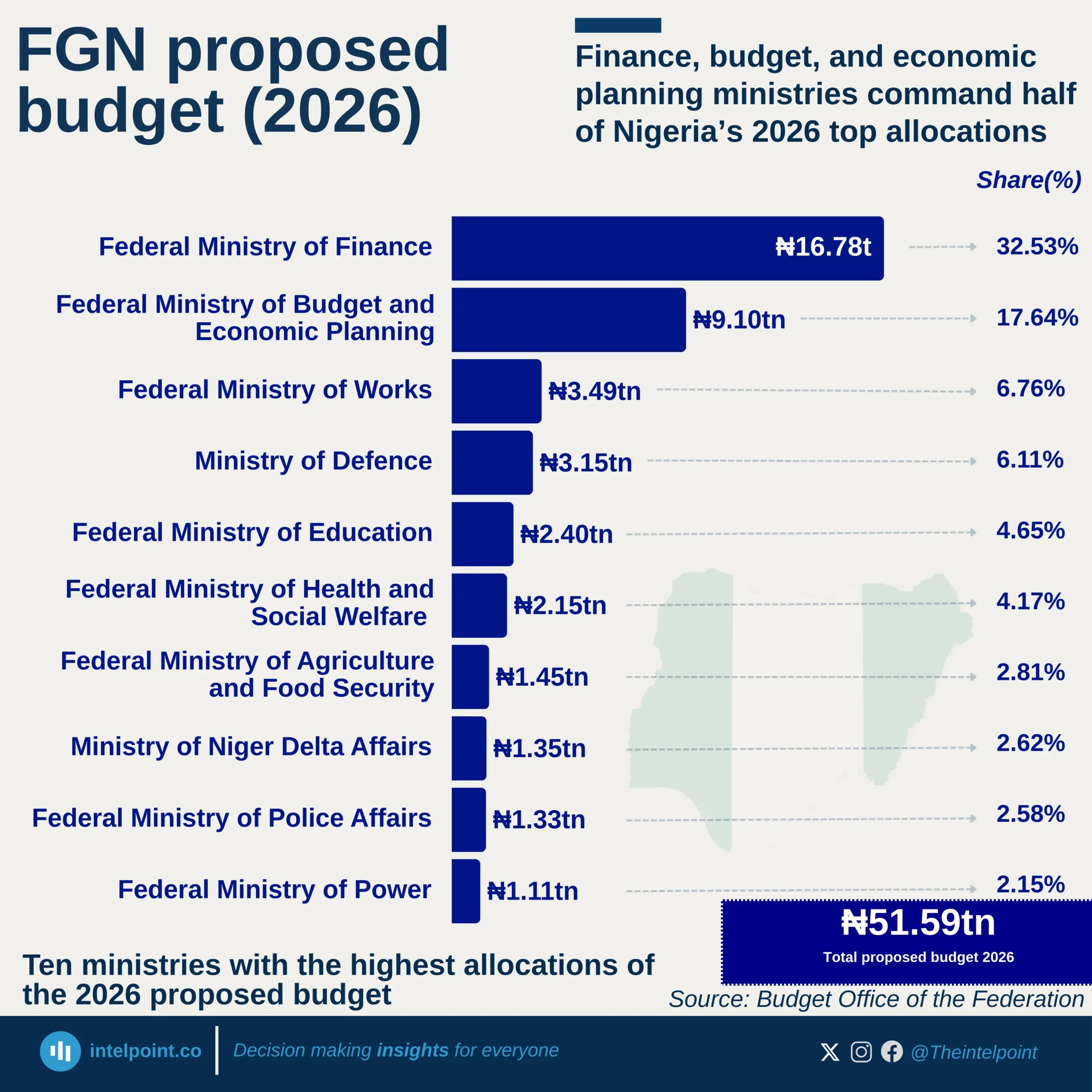
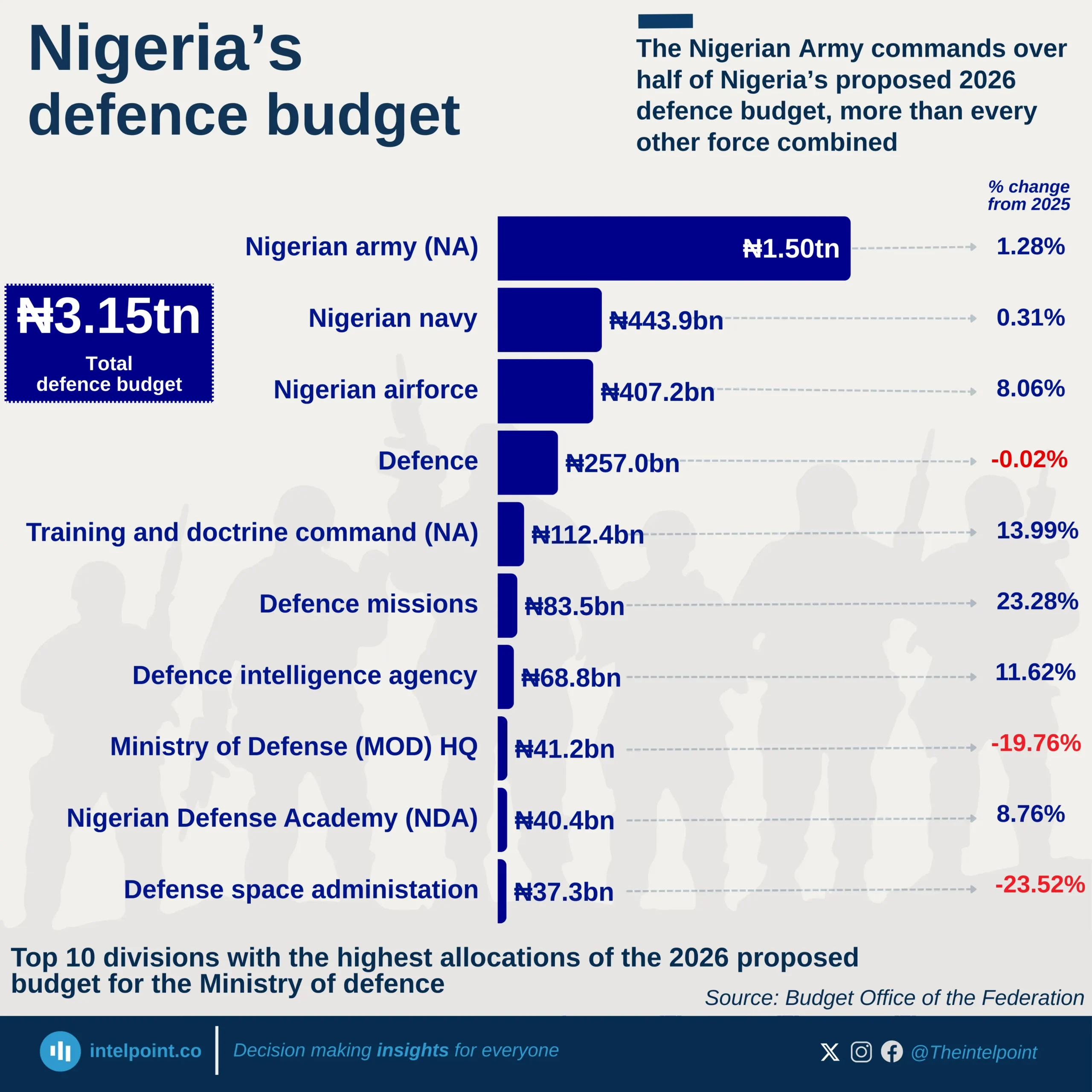
The structure of Nigeria’s 2026 defence budget reveals a military built for ground dominance first and everything else second: the Nigerian Army’s ₦1.5 trillion allocation towers over every other arm, reflecting a country whose security threats — insurgency, banditry, and internal stability — are still being addressed mainly on land. The Navy (₦443.9 billion) and Air Force (₦407.2 billion) provide crucial reach across the sea and sky, but their combined firepower still remains in the Army’s shadow, reinforcing Nigeria’s prioritisation of territorial control over projection.
Meanwhile, training, doctrine, and intelligence, through bodies like TRADOC (₦112.4 billion) and the Defence Intelligence Agency (₦68.8b), quietly shape the thinking behind the guns, ensuring the force can adapt to evolving threats. At the edge of the future sits the Defense Space Administration, a small but symbolic investment that signals Nigeria knows tomorrow’s wars will also be fought with satellites, data, and surveillance. Taken together, the numbers paint a military focused on winning today’s wars on the ground while cautiously preparing for tomorrow’s battles in the air, at sea, and in space.